
Lead generation tactics for local service businesses Toronto should connect three things: high-intent visibility, clear service-area trust, and a simple path from search to call, form, or booked consultation. For contractors, clinics, repair companies, home service providers, and professional firms across Toronto, Ontario, the strongest lead systems usually combine local SEO, Google Ads, landing pages, conversion tracking, and steady follow-up rather than relying on one channel alone.
The real challenge is not only getting more traffic. A local service business needs qualified enquiries from people who are in the right area, have the right service need, and can be contacted quickly. That is why a campaign should be judged by calls, form submissions, booked jobs, close rate, and cost per qualified lead—not by impressions or clicks without business context.
Zigma Internet Marketing works with Toronto-area businesses from its Markham office, supporting lead generation across SEO, PPC, web design, content, and analytics. If your current marketing reports show activity but not enough sales conversations, the issue may be tracking, targeting, landing page clarity, or weak local trust signals.
Quick Facts: lead generation tactics for local service businesses Toronto
The short version for business owners comparing channels.
- What: A practical lead system built around local search visibility, paid search demand, conversion-focused pages, and accurate tracking.
- Who: Local service businesses that rely on calls, quote requests, appointments, consultations, or booked site visits.
- Where: Toronto, Ontario service areas such as Downtown Toronto, North York, Scarborough, Etobicoke, Midtown, and nearby GTA communities.
- How: SEO, Google Business Profile work, Google Ads, landing pages, call tracking, GA4 events, and follow-up reporting are aligned around qualified leads.
- Why: Better channel clarity helps owners reduce wasted spend, identify profitable service areas, and prioritise enquiries that are more likely to become revenue.
How local service lead generation works in Toronto, Ontario
A good lead generation plan starts with intent. Someone searching for an emergency repair, a nearby consultant, or a specialty service in Toronto is often much closer to taking action than someone casually browsing social media. Search behaviour, service-area relevance, page quality, and response time all affect whether that person becomes a real enquiry.
For many local service businesses, the lead path looks simple from the outside: a person searches, clicks, reads, and contacts the company. Under the surface, several systems must work together. The page must match the search. The call button must work on mobile. The form must be short enough to finish. The ad or organic result must set the right expectation. The tracking must show which channel created the lead.
This is where Digital Marketing Services become more useful than disconnected tasks. SEO, PPC, content, design, and reporting need shared goals. If Google Ads brings traffic to a slow or vague page, cost per lead rises. If SEO rankings improve but the offer is unclear, organic visitors leave without contacting the business.
Useful lead generation is therefore a system, not a single tactic. The core question is direct: where are qualified buyers losing confidence before they contact you?
Lead generation tactics for local service businesses Toronto: the practical mix
The strongest mix depends on demand, competition, service urgency, and sales capacity. A business that handles urgent calls may need paid search coverage first, while a professional service firm may benefit from stronger organic pages and credibility-building content. The channel sequence should reflect how customers actually choose a provider.
Search engine optimization creates long-term visibility across service, location, and informational searches. For example, SEO Services can support service pages, technical SEO, local landing pages, and content that answers buyer questions before they call. Paid search can then fill high-intent gaps while SEO gains traction.
For immediate demand capture, Google Ads Management can target searches where people are already comparing providers. The campaign still needs careful query control, negative keywords, conversion tracking, and landing pages designed for the service being advertised.
A balanced Toronto lead generation plan often includes:
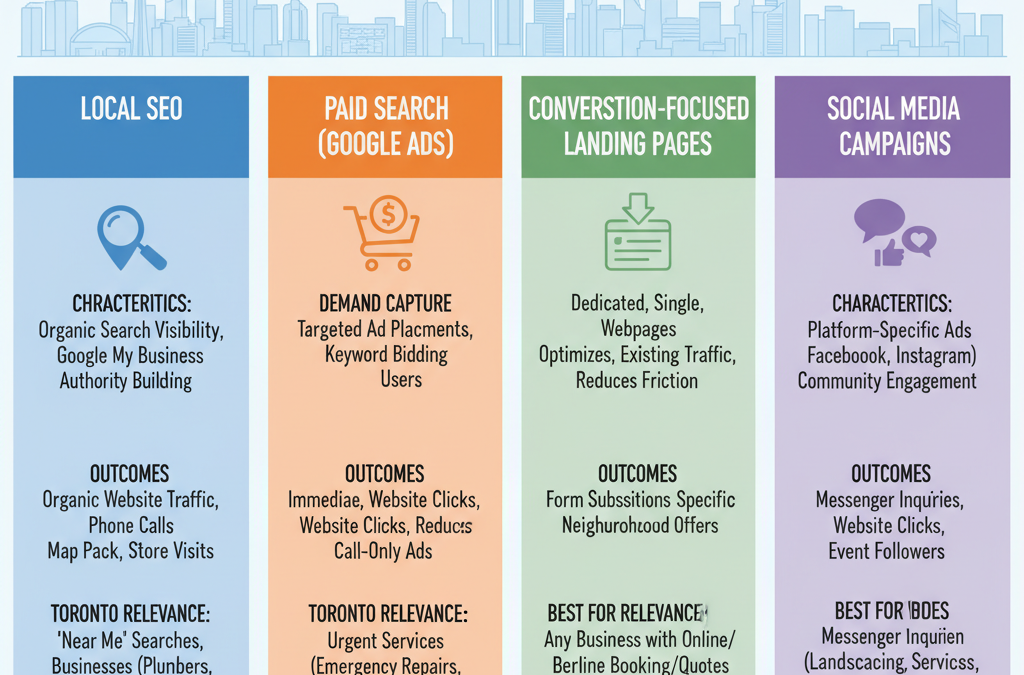
- Local SEO: Service pages, location signals, reviews, internal links, and Google Business Profile optimization help search engines understand where the business serves and what it offers.
- Paid search: Google Ads campaigns capture urgent or high-value searches while budgets are monitored against qualified lead quality.
- Landing pages: Service-specific pages reduce friction by matching the visitor’s search intent, location, concern, and next step.
- Conversion tracking: GA4, Google Tag Manager, form events, and call tracking connect marketing activity to enquiries.
- Follow-up discipline: Fast response, CRM notes, and lead quality feedback help advertising and SEO decisions improve over time.
Toronto service areas create different lead generation pressures
Toronto, Ontario is not a uniform market. A business serving condo-heavy Downtown Toronto may need different landing page details than a company serving detached homes in North York or Scarborough. A professional firm in the Financial District may need stronger trust content, while a contractor working across Etobicoke and East York may need clearer service-area coverage and faster mobile contact paths.
Neighbourhood intent also affects keyword strategy. Searches from Liberty Village, The Beaches, Yorkville, or Leslieville may reflect different service expectations, budgets, and urgency. A company that treats every visitor the same can miss signals that affect conversion: building type, response window, parking constraints, project size, or whether the buyer is a homeowner, tenant, office manager, or property manager.
Local SEO GTA work should therefore account for nearby communities as well as Toronto proper. Markham, Vaughan, Richmond Hill, Mississauga, Brampton, Pickering, and Ajax can all influence how service-area pages are planned when a business operates across the GTA. The goal is not to create thin pages for every suburb; the goal is to build useful pages that reflect real service capacity and buyer intent.
Comparing SEO, PPC, landing pages, and social campaigns
Comparison is useful because each channel creates a different type of lead. Some channels capture existing demand, while others build familiarity before a buyer is ready to search. The right mix should reflect cash flow, sales cycle, urgency, and how quickly the business can respond to enquiries.
SEO versus PPC for local service demand
A) SEO: SEO supports long-term visibility for service and location searches. It can reduce reliance on paid traffic over time when pages are technically sound and useful.
- How it works: SEO improves crawlability, content relevance, internal links, local signals, and page experience so service pages can earn organic visibility.
- Best fit: SEO fits businesses that want steady search visibility and have time to build topical authority across core services.
- Example: A clinic may use seo services toronto to build pages for treatments, neighbourhood access, and patient questions.
B) PPC: PPC creates paid visibility for specific searches and can be adjusted quickly. It is useful when the business needs lead flow while organic rankings are developing.
- How it works: Campaigns bid on search queries, send visitors to relevant landing pages, and track calls or forms as conversions.
- Best fit: PPC fits urgent services, competitive categories, seasonal pushes, and businesses that can respond quickly to leads.
- Example: A repair company may use google ads management toronto for emergency searches and measure which calls become booked work.
C) Combined SEO and PPC: A combined plan can use paid data to reveal converting queries while SEO builds durable pages for those themes. The two channels should share data rather than operate separately.
- How it works: Paid search tests query intent, while organic pages are refined around the services and locations that bring qualified enquiries.
- Best fit: The combined route fits businesses that want near-term lead volume and stronger organic visibility over time.
- Example: A home services firm may hire a ppc agency toronto while also improving service-area SEO pages.
Service pages versus landing pages
A) Website service pages: Core service pages help visitors understand the company’s offering, process, proof points, and service areas. These pages often serve both SEO and buyer education.
- How it works: A service page answers common buyer questions, supports internal linking, and gives search engines a stable URL to index.
- Best fit: Service pages fit businesses that need evergreen visibility for core services and want to build authority over time.
- Example: A company researching website design toronto may need redesigned service pages before increasing ad spend.
B) Paid landing pages: Landing pages are focused pages built around a specific campaign, service, or audience. They usually remove distractions and emphasise conversion clarity.
- How it works: A landing page aligns headline, proof, offer, form, and call button with one paid campaign theme.
- Best fit: Landing pages fit campaigns where every click has a cost and the business needs cleaner conversion data.
- Example: A legal or healthcare campaign may use conversion rate optimization toronto support to reduce form abandonment.
C) Technical fixes first: Sometimes the page type is less urgent than fixing speed, indexing, tracking, or mobile usability. Technical barriers can quietly block both SEO and PPC performance.
- How it works: Technical seo services address crawl issues, page speed, structured data, internal links, and tracking gaps.
- Best fit: Technical fixes fit sites that get visits but show weak conversion or inconsistent reporting.
- Example: A WordPress site with slow mobile pages may need performance work before scaling paid traffic.
Search campaigns versus social campaigns
A) Search campaigns: Search captures people who are already expressing demand. The strongest campaigns match keywords to service urgency and landing page detail.
- How it works: Search ads appear for chosen queries and send visitors to pages built around the exact service need.
- Best fit: Search fits high-intent services where buyers often compare providers before calling.
- Example: A lead generation agency toronto search may indicate a business owner actively comparing firms.
B) Social campaigns: Social campaigns often build awareness, retarget previous visitors, and support demand creation. They work best when creative, audience, and offer are specific.
- How it works: Paid social uses audience targeting, creative testing, and remarketing to bring prospects back into the funnel.
- Best fit: Social fits visual services, trust-heavy categories, recruiting support, and remarketing to previous website visitors.
- Example: A design or renovation firm may use before-and-after creative to support online marketing toronto campaigns.
C) Reporting-led channel mix: Reporting should decide which channel receives more attention. Channel preference without lead quality data can waste budget.
- How it works: Dashboards compare channel, source, campaign, form type, call quality, and booked outcome where available.
- Best fit: Reporting-led planning fits businesses that already receive leads but cannot see which sources create sales conversations.
- Example: A marketing agency gta review may reveal that branded search converts well while broad social traffic needs retargeting support.
How to choose the right digital partner
Choosing a digital marketing agency toronto provider should begin with questions about measurement, process, and fit. A polished proposal is less useful than a clear explanation of how leads will be tracked, how campaign changes will be made, and how quality feedback will be handled after enquiries arrive.
A credible partner should ask about service areas, margins, close rates, seasonal pressure, internal capacity, and sales follow-up. Those questions shape the campaign. A company with limited dispatch capacity should not chase broad lead volume that the team cannot service. A professional firm with a longer sales cycle may need nurturing content and retargeting rather than only direct-response ads.
If a business is comparing a seo company toronto, a PPC specialist, or a full-service team, the decision should be based on execution needs. Fragmented vendors can work, but only if strategy, tracking, and reporting are aligned. Full-service support may be more practical when the website, ads, SEO, and analytics all need improvement at the same time.
Questions worth asking before signing
- How will qualified leads be defined? The answer should separate raw form fills from enquiries that match your services, area, and sales criteria.
- Which conversions will be tracked? Calls, forms, booking clicks, chat events, and CRM outcomes may need different tracking rules.
- How will search terms be reviewed? For paid search, irrelevant queries must be excluded regularly so spend is not drained by poor-fit clicks.
- How will landing pages be improved? A strong agency should discuss page speed, message match, proof, mobile layout, and form friction.
- How will reporting connect to revenue conversations? The report should help owners decide what to keep, pause, test, or refine.
What affects ROI in modern lead campaigns
Return from lead generation is shaped by more than ad spend or rankings. Lead quality, response time, sales process, service margin, booking rate, and customer lifetime value all affect whether a campaign is profitable. A channel can look weak if the team responds slowly, and a channel can look strong if low-quality leads are counted the same as booked work.
For local service businesses, the most useful marketing dashboard usually includes both marketing and sales indicators. Cost per form fill is only the first layer. Cost per qualified lead, cost per booked job, close rate by source, missed-call rate, and average response time show whether the system is improving.
Modern campaigns also need clean attribution. A customer may first find a business through organic search, return through a retargeting ad, and then call after seeing the Google Business Profile. Attribution will not be perfect, but better tracking helps teams avoid cutting a channel that assists conversions earlier in the buyer path.
ROI drivers to review every month
- Search intent: Queries with clear service intent usually deserve more attention than broad research terms.
- Landing page relevance: A visitor searching for a specific service should land on a page that speaks to that service directly.
- Lead handling: Missed calls, slow replies, and unclear intake questions can lower conversion even when marketing is working.
- Budget allocation: Spend should move toward services, locations, and channels that produce qualified conversations.
- Content quality: content marketing toronto efforts should answer real buyer concerns instead of publishing generic posts that do not support sales decisions.
SEO and PPC each have a clear role
SEO and PPC should not be treated as rivals. SEO builds durable visibility, while PPC gives more control over timing, keywords, and testing. The right balance depends on how quickly the business needs leads and how competitive the category is in Toronto search results.
SEO is useful for building service-area authority, answering buyer questions, improving technical health, and earning visibility without paying for every click. PPC is useful for urgent demand capture, campaign testing, seasonal pushes, and categories where organic rankings will take time. Used together, PPC query data can guide SEO content, while SEO landing pages can improve the quality of paid traffic paths.
A practical sequence often starts with tracking and landing page fixes, then uses PPC to test high-intent demand while SEO pages are improved. Once organic pages gain traction, paid budgets can be refined toward the highest-value gaps rather than broad coverage.
Use SEO when the business needs
- Stable visibility: Service pages and location pages can keep attracting qualified visitors after the initial build and refinement period.
- Trust content: Educational pages help buyers compare services, understand process, and feel safer before contacting the business.
- Technical strength: Better site structure, speed, and indexing support every channel that sends traffic to the website.
Use PPC when the business needs
- Faster demand capture: Paid search can put a business in front of buyers searching for immediate service help.
- Controlled testing: Ads can test service messaging, search terms, and landing page variations faster than organic SEO alone.
- Seasonal coverage: Campaigns can be adjusted around busy periods, staffing levels, and service availability.
How Toronto local businesses can compete online
Toronto local businesses can compete online by being clearer, faster, and more specific than larger competitors. Large brands may have bigger budgets, but smaller service businesses can often win by showing neighbourhood relevance, proof of service quality, detailed pages, strong reviews, and a better contact experience.
For example, a service business in Scarborough can create a page that speaks directly to the service problem, building type, response process, and surrounding service area. A Downtown Toronto firm can highlight transit access, appointment formats, and industry focus. A North York company can show project examples, service boundaries, and clear intake steps. Specificity builds confidence.
The biggest mistake is copying broad competitor language. Local buyers want to know whether the business understands their situation, can serve their area, and can respond in a reasonable timeframe. A page that answers those questions plainly can outperform a page with bigger claims but weaker detail.
Practical moves that improve local competitiveness
- Build service pages around buyer intent: Each page should answer who the service is for, where it is available, and what happens after a person contacts the company.
- Strengthen Google Business Profile signals: Categories, services, photos, reviews, posts, and accurate hours help support local visibility and trust.
- Show real service-area coverage: Pages should reflect actual routes, staff capacity, and neighbourhood patterns rather than generic city lists.
- Improve mobile conversion: Many local searches happen on phones, so call buttons, forms, speed, and page layout directly affect lead volume.
- Connect reporting to business decisions: Analytics should show which locations, services, and campaigns produce useful enquiries.
What experienced marketers check before scaling spend
Before increasing budget, experienced marketers check whether the funnel can handle more traffic. Scaling a weak funnel usually makes the weakness more expensive. If the landing page is vague, tracking is incomplete, or the phone process is inconsistent, more spend can increase confusion rather than qualified leads.
Several practical checks can prevent wasted budget:
- Search term quality: Paid campaigns should be reviewed for irrelevant queries that attract people outside the service fit.
- Conversion path clarity: A visitor should understand the service, service area, proof, and next step without hunting through the page.
- Tracking accuracy: Calls, forms, and key clicks should be recorded correctly before campaign changes are judged.
- Lead feedback loop: Sales teams should tell marketers which leads were qualified, booked, poor-fit, or unreachable.
- Page speed and mobile layout: Slow mobile pages can reduce conversion before a buyer ever reads the offer.
Small fixes can change campaign economics. A clearer headline, a shorter form, a stronger service-area statement, or better negative keyword work may reduce waste before any major redesign is needed.
Common mistakes that quietly reduce lead quality
Lead generation problems often come from small gaps that are easy to miss. A campaign may look active while the business receives calls from the wrong area, forms from low-fit prospects, or clicks from searches that do not match the service. The report may still show conversions, but the sales team feels the mismatch immediately.
Watch for these common issues:
- Counting every enquiry as equal: A wrong-area call and a booked consultation should not carry the same weight in reporting.
- Sending all traffic to the homepage: Homepages often serve too many audiences, which can reduce message match for paid traffic.
- Ignoring missed calls: Local service buyers often call multiple providers, so missed calls can become lost revenue conversations.
- Using broad-match campaigns without close review: Search terms can drift away from profitable service intent if campaigns are not monitored.
- Publishing thin location pages: Pages with swapped city names and little substance rarely build trust or durable visibility.
The fix is not more activity. The fix is cleaner intent, clearer pages, better tracking, and tighter feedback between marketing and sales.
Trust signals that support local service conversions
Trust signals help buyers decide whether a business is credible enough to contact. For local service businesses, trust is built through proof that is specific, visible, and relevant to the service being requested. Reviews, certifications, project examples, team credentials, service processes, and clear contact details all reduce uncertainty.
Zigma Internet Marketing brings Google Partner-certified expertise, full-service delivery across SEO, PPC, web, content, and social, and performance reporting focused on business outcomes. That matters most when a business needs practical implementation, not only strategy documents. Tracking, dashboards, CRO, landing pages, and technical fixes often need to be shipped together.
For readers comparing agencies, a useful question is: will this team show exactly how marketing activity connects to calls, forms, and sales conversations? If the answer is unclear, reporting may become a list of vanity metrics instead of a decision tool.
Build a lead system you can measure and improve
A strong Toronto lead generation system is built in cycles: clarify the offer, attract the right search demand, improve the page, track the enquiry, review lead quality, and refine the next campaign change. Each cycle should make the business more informed about which services, areas, and messages create qualified conversations.
Zigma Internet Marketing supports local service businesses with SEO, Google Ads, web design and development, landing pages, content, social campaigns, analytics setup, dashboards, and ongoing performance optimisation. The work is practical: measure what counts, ship improvements, and keep strategy tied to business constraints.
Ready to review your lead flow?
If your Toronto service business needs clearer tracking, stronger landing pages, or a better SEO and PPC mix, Zigma can assess the current funnel and identify the highest-impact fixes. Call (647) 556-6071 or email info@zigma.ca.
FAQs About lead generation tactics for local service businesses toronto
Lead quality can improve once tracking, search targeting, and landing page clarity are fixed. Paid search changes may show directional signals sooner, while SEO gains usually take longer because pages need to be crawled, trusted, and ranked. Toronto, Ontario competition also affects timing.
Start with tracking and the website conversion path before increasing traffic. If calls and forms are not recorded properly, it is hard to judge SEO, PPC, or social campaigns. After that, choose the channel based on urgency, service margin, and available sales capacity.
Google Ads can work when campaigns target high-intent searches, use careful negative keywords, and send visitors to relevant landing pages. Small service companies in Toronto, Ontario should watch qualified leads rather than clicks, because raw traffic does not prove campaign value.
Google Business Profile can strongly influence calls, direction requests, and local visibility because buyers often compare providers directly in search results. Categories, services, photos, reviews, hours, and accurate contact details all support trust before a visitor reaches the website.
SEO and PPC reports can show source, campaign, form submissions, calls, and tracked conversion events. To connect leads to customers, the business usually needs CRM notes or sales feedback so marketing data can be matched with qualified enquiries and booked work.
Related Topics:
