
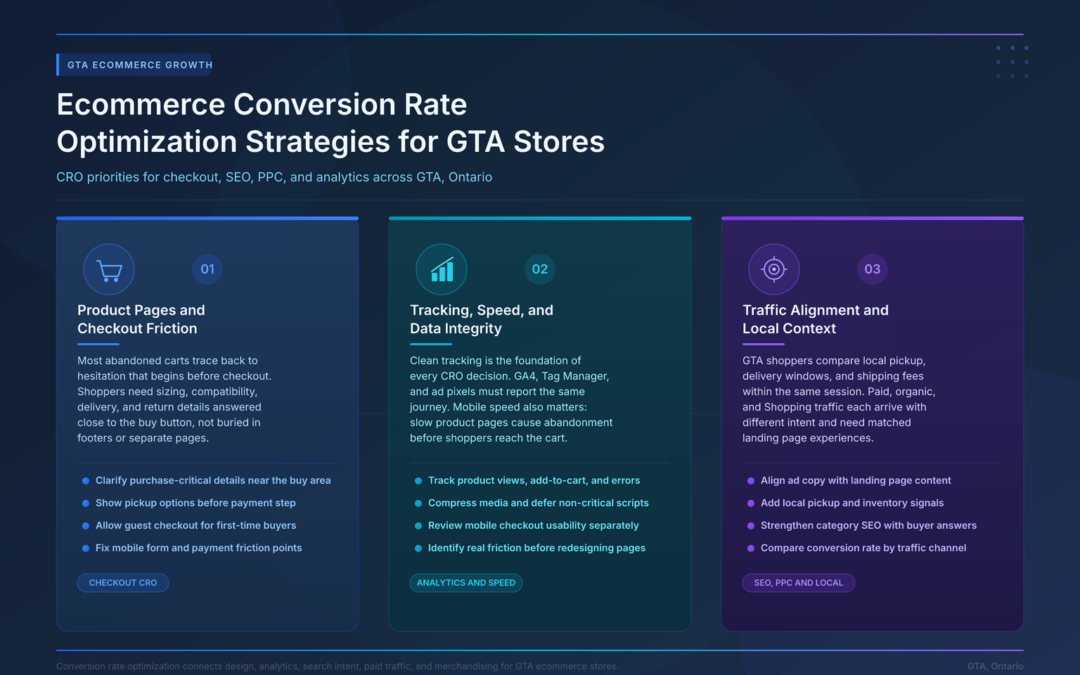
ecommerce conversion rate optimization strategies for GTA stores are the practical changes that help more shoppers complete purchases without forcing more ad spend into the funnel. For retailers across GTA, Ontario, CRO usually means improving product pages, search and filters, checkout flow, speed, trust signals, and tracking so each visit has a clearer path to revenue.
For a Shopify, WooCommerce, or custom e-commerce store, the question is rarely “How do we get more traffic?” on its own. A better question is: “Where are qualified shoppers hesitating, abandoning, or choosing a competitor?” That shift is where conversion rate optimization becomes a commercial growth tool rather than a design exercise.

How ecommerce conversion rate optimization strategies for GTA stores differ from generic CRO
Generic CRO often starts with broad advice: shorten forms, improve buttons, or add reviews. Those changes can help, but GTA stores usually need sharper segmentation because shoppers may compare local pickup, delivery windows, shipping fees, product availability, and return rules before buying.
A Markham-based beauty retailer, a Toronto apparel brand, and a Mississauga parts supplier may all run e-commerce sites, but their buyer behaviour can be very different. One store may lose sales because mobile product pages load slowly. Another may lose sales because shoppers cannot confirm compatibility, sizing, or local pickup before checkout.
Strong CRO connects design, analytics, search intent, paid traffic, and merchandising. That is why Zigma Internet Marketing often reviews store performance alongside SEO Services, product feed quality, paid campaigns, and landing page behaviour rather than treating CRO as a single page redesign.
Why CRO feels different in GTA, Ontario
GTA, Ontario shoppers often have several competing choices within the same search session. A customer in Vaughan may compare shipping against same-day pickup, while a shopper in downtown Toronto may care more about delivery timing, payment flexibility, and clear return handling.
Retailers near Markham, Richmond Hill, Mississauga, Brampton, and Scarborough also need to think about multilingual audiences, mobile-heavy browsing, and seasonal buying patterns. A winter product category may require delivery reassurance, while a fashion or gift category may need sharper urgency around availability without using pressure-based messaging.
Local context also affects traffic quality. Campaigns from Google Ads Management, organic rankings, Google Shopping listings, and social ads often send visitors with different expectations. CRO helps match each traffic source to a page experience that feels consistent, credible, and easy to act on.
Conversion problems that usually hide in plain sight
Most e-commerce teams notice abandoned carts, but fewer teams can trace where hesitation begins. The issue may start before checkout: unclear product information, weak filters, unexpected shipping details, unavailable sizes, hidden delivery limits, or a product page that answers the wrong question.
A conversion review should separate symptoms from causes. Low checkout completion may point to checkout friction, but it may also reveal poor product-page qualification. If shoppers add items to cart only to abandon later, they may have been missing key details earlier in the journey.
Signals worth reviewing before changing the design
- Product page engagement: Review scroll depth, image interaction, variant selection, size guide use, and add-to-cart behaviour to see whether shoppers understand the product before committing.
- Search and filtering behaviour: Watch how shoppers use site search, filters, and category sorting because poor product discovery can reduce sales even when traffic volume looks healthy.
- Checkout friction: Track checkout start, payment selection, shipping step exits, promo-code interaction, and error messages so fixes target the actual point of drop-off.
- Traffic-source quality: Compare conversion behaviour from organic search, paid search, Google Shopping, email, and social traffic because each source may need a different landing page path.
Which CRO changes deserve priority first?
Not every change deserves immediate development time. A store should prioritize fixes based on revenue exposure, traffic volume, implementation effort, and the likelihood that the change will reduce hesitation for qualified shoppers.
Product page changes
A) Clarify purchase-critical details: Product pages should answer sizing, compatibility, materials, delivery, returns, warranty, and stock questions before the shopper reaches checkout.
- How it works: The store adds product details close to the buy area so shoppers do not leave the page to search for basic information.
- Best fit: This choice fits stores with strong traffic but weak add-to-cart behaviour on high-intent product pages.
- Example: A GTA apparel store may place fit notes, model details, exchange rules, and size guidance beside variant selectors.
B) Improve product imagery: Shoppers often need visual confirmation before buying, especially for apparel, home goods, beauty products, and accessories.
- How it works: The store adds clearer product angles, close-ups, scale references, or short product clips where visual uncertainty affects decisions.
- Best fit: This choice fits stores where visitors view products but rarely interact with variants or add items to cart.
- Example: A furniture retailer serving Toronto condos may show scale references in smaller living spaces.
C) Add trust proof near the decision point: Reviews, policies, guarantees, and support details work better when placed close to the purchase decision.
- How it works: The page places relevant trust signals near the add-to-cart button, not only in the footer.
- Best fit: This choice fits stores selling higher-consideration products or products where returns and delivery confidence affect purchases.
- Example: A specialty retailer may show verified reviews, return timing, and customer support availability beside the buy area.
Cart and checkout changes
A) Reduce surprise costs: Unexpected shipping, taxes, handling fees, or delivery constraints can interrupt purchase momentum late in the process.
- How it works: The store communicates shipping thresholds, delivery regions, pickup availability, and return rules before checkout begins.
- Best fit: This choice fits stores with healthy add-to-cart behaviour but weak checkout completion.
- Example: A GTA store may show pickup availability in Markham, Toronto, or Mississauga before the shopper enters payment details.
B) Simplify account creation: Mandatory accounts can block first-time shoppers who want a fast purchase path.
- How it works: The store allows guest checkout, then offers account creation after purchase confirmation.
- Best fit: This choice fits stores with many first-time buyers from Google Ads, Shopping, or organic search.
- Example: A beauty brand may keep checkout short and request loyalty sign-up after the order is complete.
C) Fix payment and form friction: Small checkout errors can create large losses if shoppers encounter them at the final step.
- How it works: The store reviews field errors, mobile form behaviour, wallet payments, address validation, and payment failures.
- Best fit: This choice fits stores with mobile traffic, cross-device sessions, or payment abandonment patterns.
- Example: A mobile-first Shopify store may add accelerated payment choices and reduce unnecessary form fields.
Traffic and landing page alignment
A) Match paid traffic to buyer intent: Paid visitors arrive with expectations shaped by the ad, search query, and landing page headline.
- How it works: The store aligns ad copy, product feed titles, landing pages, and product availability so the click feels consistent.
- Best fit: This choice fits stores working with a ppc agency toronto or investing in google ads management toronto.
- Example: A retailer bidding on a specific product category should send shoppers to a filtered category or product page, not a broad homepage.
B) Strengthen organic landing pages: SEO traffic often includes research-driven shoppers who need content, filters, and product proof before buying.
- How it works: The store improves category content, internal links, product schema, speed, and technical SEO services tied to crawlability.
- Best fit: This choice fits retailers comparing seo services toronto or speaking with a seo company toronto about e-commerce growth.
- Example: A category page for winter boots can answer sizing, waterproofing, delivery, and return questions while still presenting products clearly.
C) Use local visibility for hybrid retail: Stores with physical pickup, showrooms, or service areas can support e-commerce purchases through local trust signals.
- How it works: The store connects product pages with store pickup, local inventory messaging, google business profile optimization, and local seo gta signals.
- Best fit: This choice fits hybrid retailers that sell online while serving walk-in or pickup customers.
- Example: A Markham retailer may show pickup details and location trust cues for shoppers comparing nearby sellers.
Practical CRO priorities for GTA e-commerce stores
Priority 1: Clean up tracking before testing
GA4, Google Tag Manager, ad platform pixels, and e-commerce events need to report the same customer journey. Without clean tracking, a store may make design choices based on incomplete data. This step helps identify real friction so the team can decide with better evidence.
Key metric: Track product views, add-to-cart actions, checkout starts, purchase events, revenue, and traffic source quality.
Common gap: Stores often track purchases but miss checkout errors, product filter use, or promo-code behaviour.
Example: A Shopify store may see strong add-to-cart behaviour from paid search but weak checkout completion on mobile devices, pointing to a checkout usability review.
Priority 2: Improve speed on mobile product pages
Mobile shoppers often decide quickly, and slow image loading can make a strong product feel unreliable. Product media, theme scripts, apps, and third-party tags should be reviewed before new features are added. This step helps reduce abandonment so shoppers can browse without interruption.
Key metric: Compare mobile conversion behaviour across product pages with different media weight and script load.
Common gap: Stores add apps for reviews, upsells, popups, and shipping messages without checking how those scripts affect the mobile experience.
Example: A fashion retailer may compress product imagery, defer non-critical scripts, and simplify mobile variant selectors before redesigning the full store.
Priority 3: Make product pages answer buying questions
A product page should reduce uncertainty before the shopper reaches cart. Strong pages answer size, fit, compatibility, shipping, returns, materials, stock, and support questions close to the purchase controls. This step helps shoppers feel ready so they can act without opening more tabs.
Key metric: Review add-to-cart rate, scroll depth, variant interactions, and product-page exits.
Common gap: Product descriptions often sound polished but miss the details that shoppers use to compare similar products.
Example: A retailer selling home products may add dimensions, room examples, care instructions, delivery notes, and return conditions directly above the review section.
Priority 4: Align PPC, SEO, and landing pages
Traffic quality changes by source. A shopper from Google Shopping may be ready to compare price and availability, while an organic visitor may need category guidance first. This step helps connect online marketing toronto activity with page experiences that match buyer intent.
Key metric: Compare conversion rate, revenue per visitor, bounce behaviour, and assisted purchases by channel.
Common gap: Paid campaigns and organic landing pages often send different shoppers to the same generic destination.
Example: A marketing agency gta review may find that paid search traffic needs tighter landing pages while organic traffic needs richer category content and better internal links.
Priority 5: Strengthen checkout confidence
Checkout should confirm the decision, not introduce fresh doubts. Delivery timing, return rules, payment choices, tax visibility, customer support, and cart editing should be clear before payment. This step helps reduce late-stage drop-off so qualified shoppers complete the purchase.
Key metric: Review checkout starts, shipping step exits, payment failures, wallet payment use, and cart recovery behaviour.
Common gap: Stores sometimes add trust badges while leaving shipping rules unclear, which fails to address the real concern.
Example: A GTA store offering pickup can show location, pickup timing, and support details before payment rather than placing those details only in policy pages.
How to choose the right digital partner for CRO
The right digital partner should understand how CRO connects with traffic acquisition, analytics, merchandising, and development. A design-only review may produce nicer pages, but CRO needs evidence from visitor behaviour, search intent, paid traffic, and checkout data.
A search for digital marketing toronto or digital marketing agency toronto will show many firms with different strengths. For e-commerce, ask how the agency diagnoses conversion friction, how it prioritizes tests, and how it connects CRO changes to revenue, not just visual preference.
Zigma Internet Marketing supports e-commerce brands through analytics setup, SEO, PPC, landing pages, website development, and reporting. That mix helps keep CRO grounded in the full buying journey rather than isolated page edits.
Questions to ask before hiring
- Tracking readiness: Ask whether the agency reviews GA4, Google Tag Manager, ad pixels, and e-commerce events before recommending design changes.
- Development support: Ask whether the agency can implement improvements on Shopify, WordPress, or WooCommerce rather than handing off vague recommendations.
- Channel awareness: Ask how CRO recommendations change for SEO traffic, paid search traffic, email traffic, and social media traffic.
- Reporting clarity: Ask whether reports connect conversion metrics with business outcomes such as orders, revenue, lead quality, and acquisition efficiency.
What affects ROI in modern e-commerce campaigns
ROI is shaped by more than ad spend. Product margins, average order value, repeat purchase rate, return rate, fulfilment capacity, landing page relevance, and checkout completion all affect whether a campaign can scale responsibly.
A lead generation agency toronto may focus on form fills and calls, while an e-commerce CRO plan must account for product economics. A low-priced product with high shipping complexity needs a different campaign structure than a higher-consideration product with strong repeat purchase behaviour.
For retailers investing in content marketing toronto, social ads, SEO, or paid search, CRO gives campaign teams better pages to send traffic to. Without that foundation, more traffic may simply amplify the same friction.
ROI drivers worth reviewing
- Traffic intent: A shopper searching a specific product name is closer to purchase than a shopper reading a broad category article.
- Landing page relevance: The page should match the ad, query, or email promise closely enough that shoppers do not need to re-orient themselves.
- Average order value: Bundles, cross-sells, and free-shipping thresholds can support revenue when they are helpful rather than intrusive.
- Repeat purchase behaviour: Email flows, loyalty prompts, replenishment reminders, and post-purchase care can improve lifetime value after the first order.
SEO vs PPC for e-commerce CRO decisions
SEO and PPC can both support e-commerce growth, but they reveal different conversion signals. PPC gives faster feedback on query intent, ad messaging, product-feed quality, and landing page fit. SEO shows how category pages, product pages, content, and technical structure perform over time.
Retailers comparing website design toronto, Shopify web design Toronto, WordPress web design Toronto, or conversion rate optimization toronto support should avoid treating SEO and PPC as separate silos. A paid search landing page that converts well may reveal messaging that should be added to an organic category page. A strong organic page may also become a better paid destination than a generic campaign page.
For a store in GTA, Ontario, the practical choice is not SEO versus PPC. The stronger question is which channel reveals the next conversion constraint fastest, and which channel can scale once the store experience is improved.
Where each channel can guide CRO
- SEO: Use SEO data to improve category structure, internal linking, product schema, informational content, and technical crawlability.
- PPC: Use PPC data to test messaging, query intent, offer clarity, landing page fit, and product feed accuracy.
- Email: Use email behaviour to identify repeat purchase triggers, cart recovery issues, and post-purchase education gaps.
- Social: Use social campaign feedback to test creative angles, product objections, and audience-specific product framing.
How GTA retailers can compete online without wasting traffic
Local retailers across the GTA do not need to win every search or outspend national brands to compete. They need pages that answer buyer questions faster, show availability clearly, and make the buying path feel low-friction.
A retailer near Markham may compete through pickup convenience, local trust, and product expertise. A Toronto store may compete through fast delivery, strong product imagery, and mobile checkout. A Mississauga or Brampton store may benefit from clearer service-area messaging and stronger local inventory cues.
Digital marketing services work better when the store experience can handle the traffic. That is where Digital Marketing Services, CRO, analytics, and web development need to work together.
Competitive moves that are visible to shoppers
- Clear delivery and pickup information: Shoppers should know whether an item can be shipped, picked up, or delivered before they reach checkout.
- Useful product content: Product and category pages should answer the questions that influence buying decisions, not only describe the item.
- Fast mobile journeys: Mobile pages should load quickly, present variants clearly, and keep checkout steps simple.
- Credible local signals: Store location, support access, reviews, and pickup details can reduce uncertainty for GTA shoppers comparing retailers.
Where Zigma Internet Marketing fits into CRO planning
Zigma Internet Marketing is a Markham-based digital marketing agency serving Toronto, the GTA, and nearby Ontario markets. The team supports e-commerce brands with SEO, PPC, Shopify and WordPress development, landing pages, technical SEO, analytics setup, dashboards, product feed work, and conversion-focused content.
For e-commerce CRO, Zigma’s value is the ability to connect the store experience with the channels feeding it. A CRO recommendation may involve a checkout fix, a product-page rewrite, a Google Shopping feed adjustment, a category SEO update, or a landing page test tied to paid search.
Trust signals matter in a decision like this. Zigma brings Google Partner-certified expertise, full-service execution across SEO and paid media, and clear reporting focused on calls, forms, sales, and acquisition efficiency rather than vanity metrics.
Want a clearer CRO plan for your store?
Speak with Zigma Internet Marketing about tracking, landing pages, SEO, PPC, and checkout improvements that fit your e-commerce goals. You can also reach the team at (647) 556-6071 or info@zigma.ca.
FAQs About ecommerce conversion rate optimization strategies for GTA stores
A store should review CRO once it has enough traffic and transaction data to spot patterns. For GTA, Ontario retailers, early review is useful when paid campaigns, local pickup, or seasonal product demand are already sending qualified shoppers to the site.
An audit should usually review category pages, top product pages, cart, checkout, search, filters, and the highest-spend landing pages. The priority should be based on traffic, revenue exposure, and where shoppers show measurable hesitation.
CRO can reveal whether poor performance comes from the store experience or from weak traffic fit. If visitors arrive from mismatched ads, broad keywords, or unclear product feeds, fixing campaigns may be needed before page changes can show meaningful gains.
Many Shopify stores benefit from CRO work because themes and apps do not automatically solve product clarity, checkout confidence, mobile speed, or local pickup messaging. GTA, Ontario stores often need CRO tied to delivery, inventory, and buyer expectations.
SEO brings qualified organic visitors to category, product, and content pages. CRO improves the path those visitors take after landing. Together, they help a store turn visibility into purchases by aligning search intent with a clearer buying experience.
Related Topics:
