
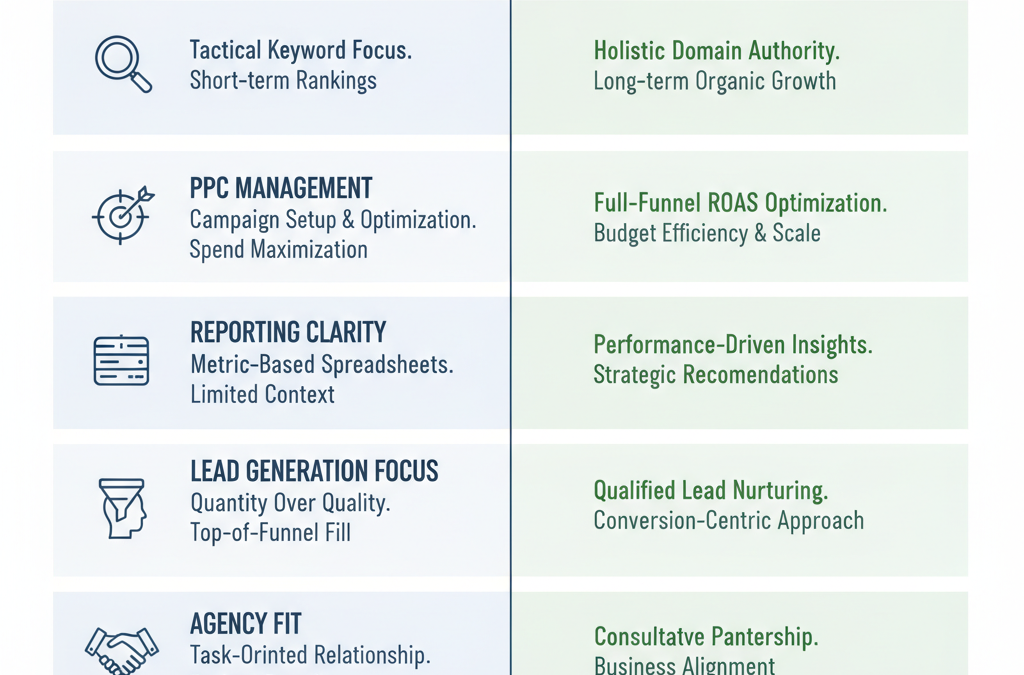
Searching for marketing firms near me usually means you want practical help, not vague promises. In most cases, the right firm should help you attract qualified traffic, turn that traffic into leads or sales, and show clearly what is working across channels such as SEO, paid search, web design, content, and tracking. The challenge is that many agencies sound similar until you look at process, reporting, and fit.
A good starting point is to separate visibility from business results. Some firms are strong at getting impressions or clicks. Others are better at building the full path from search to landing page to phone call or form submission. If your goal is steady lead generation, that distinction changes everything.
That is also why comparing service scope early helps. If you need stronger search visibility, SEO Services may be central. If you need leads faster, paid search or conversion work may deserve more attention. From there, the smarter questions become easier to ask.
What people usually mean when they search for marketing firms near me
Most searchers are not just trying to find the nearest office on a map. They are trying to find a team that understands their market, responds clearly, and can work closely enough to support real business growth. In practice, that could mean a local SEO provider, a broader digital marketing agency, or a specialist in one channel such as paid search.
A marketing firm typically combines strategy and execution. That can include search engine optimization, pay per click advertising, content planning, landing page improvement, website work, and analytics and tracking setup. The strongest firms do not treat these as separate tasks. They connect them so traffic quality, conversion rates, and reporting all point in the same direction.
Misunderstandings are common. Some business owners assume more traffic automatically means more revenue. Others assume a firm handling ads will also fix weak pages, missing conversion tracking, or poor local visibility. That is rarely true unless the engagement includes those pieces. For businesses comparing broader support, a page like Digital Marketing Services is often a useful way to see the full picture.
How to judge whether a nearby firm is actually a good fit
Nearness can help, but proximity alone is a weak buying signal. A better question is whether the firm understands your sales process, your search landscape, and the handoff between marketing activity and business outcomes. A local service company, an e-commerce store, and a B2B firm can all need very different campaign structures even when they operate in the same city.
Start with scope. Do you need a digital marketing agency toronto-style partner that handles strategy across channels, or a focused ppc agency toronto or seo company toronto relationship? If your site gets traffic but few enquiries, the problem may be positioning, offer clarity, or conversion optimization rather than reach. If your site is invisible in search, then technical seo services, content, and google business profile optimization may have more impact.
Then look at how the team works. Do they explain what they will measure? Do they distinguish between vanity metrics and business metrics? Can they show how lead generation agency toronto work differs from general awareness campaigns? A useful comparison is this: some firms act like channel vendors, while others act more like growth operators. The second group usually asks harder questions up front.
What strong marketing firms do behind the scenes
Step 1: Build clean tracking before scaling spend
Reliable marketing starts with trustworthy data. A firm should confirm that forms, calls, purchases, and key page actions are being captured correctly in tools such as GA4 and tag management platforms. This step helps reduce wasted decisions so you can judge channel performance with more confidence.
Watch for: Missing call tracking, duplicate conversions, or campaign reports that only mention clicks and impressions.
Why it changes results: Once tracking is clean, budget shifts become evidence-based rather than guesswork.
Example: A business may think google ads management toronto is underperforming, but the real issue can be untracked phone enquiries from mobile visitors.
Step 2: Match search intent to the right page
Good firms do not send every visitor to the homepage. They align keywords, ad groups, and organic pages with what the searcher is actually trying to do. This step helps improve conversion quality so you can generate stronger leads from the same traffic level.
Watch for: Broad campaigns pointing to generic pages with no clear offer, proof, or next step.
Why it changes results: Intent alignment usually lowers friction and increases response rates.
Example: Someone searching website design toronto should land on a page about design and development, not a broad service overview.
Step 3: Strengthen local visibility where it affects buying
For service businesses, nearby search behaviour often includes map results, location pages, reviews, and service-area relevance. A capable firm improves those signals instead of focusing only on general rankings. This step helps support qualified local enquiries so you can appear in the places buyers actually compare providers.
Watch for: No plan for local landing pages, weak business profile categories, or inconsistent business information.
Why it changes results: Local intent often converts faster than broad informational traffic.
Example: Businesses targeting local seo gta often need stronger location relevance before they need more blog traffic.
Step 4: Improve the offer, page structure, and calls to action
Traffic quality and page quality work together. Even strong campaigns underperform when the landing page is slow, unclear, or not built around one action. This step helps lift response rates so you can get more value from existing traffic sources.
Watch for: Slow pages, weak headlines, too many buttons, or forms that ask for unnecessary information.
Why it changes results: Small page changes can have an outsized effect on lead flow.
Example: A company investing in content marketing toronto may still struggle if visitors reach pages that do not explain the service clearly.
Step 5: Run a steady improvement cycle instead of random changes
Useful agencies test, review, and adjust on a predictable rhythm. That may include search query reviews, negative keyword updates, content refreshes, technical fixes, and monthly reporting tied to leads or sales. This step helps create compounding gains so you can improve efficiency over time rather than resetting every quarter.
Watch for: Reports with no recommendations, no prioritization, or no explanation of what changed and why.
Why it changes results: Marketing performance usually improves through accumulated refinements, not one large fix.
Example: A business running online marketing toronto campaigns across SEO and ads benefits more from coordinated review cycles than isolated channel updates.
How to choose the right marketing firm without overcomplicating it
The easiest way to narrow the field is to compare firms on four areas: capability, clarity, accountability, and fit. Capability means they can handle the work you actually need, whether that is seo services toronto, landing pages, ad management, or technical fixes. Clarity means they can explain their plan in plain language. Accountability means reporting ties activity to outcomes such as calls, form submissions, or revenue. Fit means their communication style and process work for your team.
A useful comparison is specialist depth versus full-funnel coordination. A narrow specialist may outperform on one channel. A broader marketing agency gta may create better overall results if your business needs SEO, paid media, web support, and conversion improvement working together. Neither is automatically better. The best choice depends on where your bottleneck sits right now.
Two guiding questions help here: Where are leads breaking down today? And which firm seems most disciplined about measurement, not just activity? Those answers usually tell you more than a polished sales deck.
Screening points worth using in conversations
- Ask how success is measured: A serious firm should name the business metrics first, then the channel metrics that support them.
- Ask what they would review in the first 30 days: Strong answers often include tracking, search intent, page quality, account structure, and competitor positioning.
- Ask what they would not do yet: Restraint is often a sign of experience. Not every business needs every channel immediately.
- Ask who is doing the work: Strategy, implementation, and reporting quality can vary sharply depending on who is actually in the account.
What shapes return from modern digital campaigns
Return is usually driven by a handful of practical factors, not one magic lever. Audience intent, offer strength, landing-page clarity, tracking quality, site speed, competitive pressure, and follow-up speed all play a role. A firm can improve traffic acquisition, but weak sales handling or unclear service pages can still limit results.
Think of campaign return like a pipeline with several valves. Better rankings help. Better ad targeting helps. Better pages, stronger calls to action, and cleaner analytics often help just as much. For many businesses, conversion rate optimization toronto work produces gains faster than publishing more content or expanding ad budgets.
That is why good firms usually avoid channel tunnel vision. If SEO drives traffic but the enquiry rate stays flat, the answer may be page messaging or trust cues. If ads generate leads but quality is poor, the answer may be keyword intent, negatives, or tighter landing-page segmentation. The numbers only become useful when they are connected to what the buyer experienced.
Common ROI drivers that deserve attention
- Search intent quality: High-intent queries usually outperform broad research traffic for lead generation.
- Page relevance: Better message match between keyword, ad, and landing page often lifts response rates.
- Technical health: Slow pages, broken tracking, or poor mobile usability can suppress performance quietly.
- Follow-up process: A slow response to enquiries can erase campaign gains that looked strong in reports.
SEO and PPC solve different timing problems
SEO and PPC are often framed as substitutes, but they usually work better as complements. SEO builds unpaid visibility over time through content, technical improvements, internal structure, and relevance. PPC creates faster access to high-intent search traffic through paid placements and tighter control over targeting.
If your business needs near-term lead flow, Google Ads Management may create useful momentum while SEO compounds in the background. If your paid acquisition costs are climbing, SEO can reduce dependence on ad spend over time. The trade-off is speed versus durability: PPC can move faster; SEO tends to build longer-lasting visibility.
A blended approach is often the most rational. Use paid search to validate offers, surface high-converting queries, and support urgent campaigns. Use SEO to strengthen category pages, service pages, google business profile optimization, and content depth. That mix is especially helpful for businesses trying to balance lead volume with efficiency.
Which path tends to fit which situation
- SEO fits: Businesses willing to invest in sustained visibility, stronger organic lead flow, and content or technical improvements.
- PPC fits: Businesses needing faster testing, faster lead generation, or more control over query targeting.
- Both fit: Businesses with growth targets that need immediate demand capture and long-term visibility at the same time.
How nearby businesses can compete online without acting like big brands
Smaller businesses often assume they must outspend larger competitors. Usually, they do not. They need tighter positioning, cleaner local visibility, faster follow-up, and better pages for the services that produce the most value. Precision often beats volume, especially in crowded local search environments.
For example, a business may gain more by improving two service pages, tightening ad targeting, and cleaning up technical SEO than by launching ten new campaigns at once. The same goes for web work. A focused Website Design & Development update that improves speed, messaging, and conversion flow can outperform a flashy redesign that ignores search intent.
Firms that work well with local and regional businesses usually understand this constraint. They prioritise what is measurable, implement in stages, and keep reporting close to outcomes. That approach tends to suit owner-led companies that want fewer assumptions and more operational clarity.
Where smaller firms can gain ground
- Service-page depth: Detailed, relevant pages often beat broad pages that try to cover everything.
- Local search signals: Reviews, business profile quality, and service-area relevance can move the needle quickly.
- Conversion focus: Better forms, stronger proof, and clearer next steps can improve lead flow without adding traffic.
- Reporting discipline: Monthly visibility is useful, but lead quality and sales outcomes usually tell the real story.
Questions worth asking before you hire anyone
Before choosing among marketing firms near you, ask for clarity on process rather than promises. Who owns strategy? What gets reviewed first? How are leads tracked? How often are campaigns adjusted? Which channels are likely to help now, and which can wait? Straight answers are a better sign than polished language.
It also helps to ask how the team handles implementation. Some agencies provide recommendations but leave execution to your staff. Others manage the full stack, including SEO, ads, web updates, landing pages, and dashboards. If your internal capacity is limited, that difference can affect speed and consistency more than the channel plan itself.
For businesses that want a partner focused on lead generation, reporting clarity, and execution across SEO, PPC, web, content, and tracking, Zigma Internet Marketing brings a practical, measurement-first approach. As a Google Partner-certified team based in Markham and serving Toronto and the GTA, Zigma supports businesses that need clearer visibility into what is driving calls, forms, and sales. If tailored advice would help, 📩 Ask an SEO/PPC question.
FAQs About marketing firms near me
Physical distance is less important than communication, responsiveness, and channel fit. A nearby firm can be useful if you want more direct collaboration, but the larger issue is whether the team understands your business model, reporting needs, and conversion path.
A useful first conversation should cover goals, current lead sources, tracking quality, website condition, and which channels are most likely to help first. If the discussion jumps straight to selling a package, you may not be getting enough diagnosis.
That depends on your bottleneck. If you already know the problem is isolated to one channel, a specialist can make sense. If SEO, paid media, website performance, and reporting all need coordination, one full-service team often creates fewer handoff issues.
Useful reports connect activity to outcomes. They should show what changed, why it changed, and how that affected leads, sales, or acquisition efficiency. Reports built mainly around impressions, clicks, and rankings can be incomplete if they ignore conversion quality.
The answer usually depends on timing and constraints. Ads can help test and capture demand quickly, SEO supports longer-term visibility, and website improvements often raise the value of both. If conversion rates are weak, fixing the site can be the most sensible early move.
A clearer way to compare marketing firms near me
The best choice is rarely the firm with the loudest pitch. It is usually the team that can explain the work plainly, measure the right things, and improve the parts of your funnel that are holding results back. For some businesses that starts with SEO. For others it starts with paid search, page improvements, or better tracking. Clear diagnosis first. Then steady execution.