
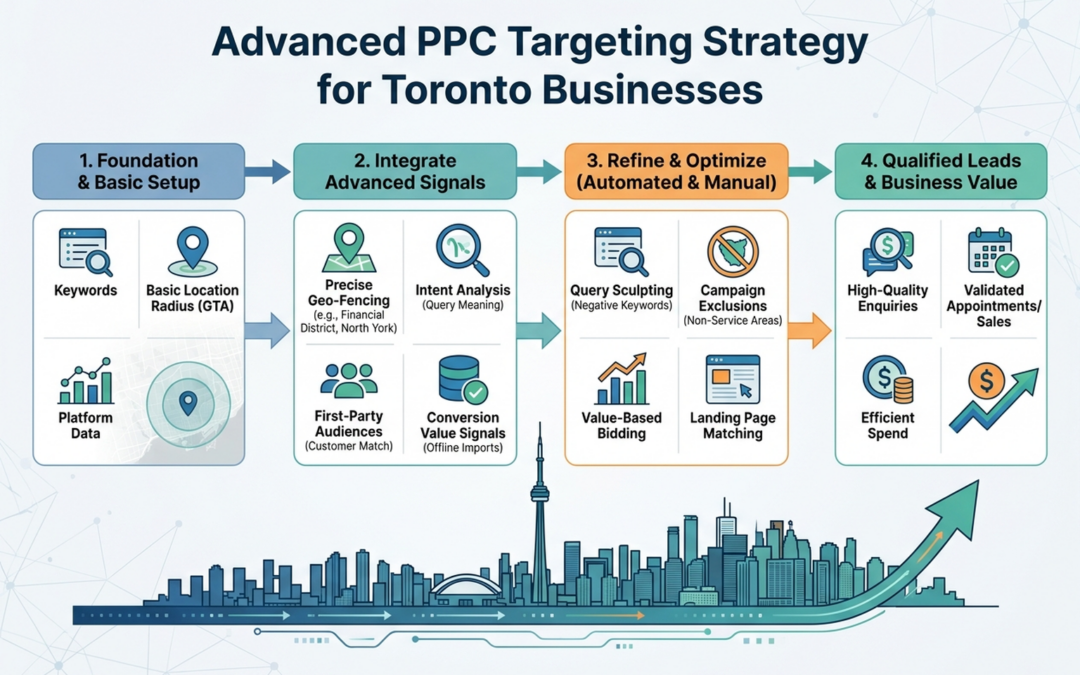
Advanced PPC targeting techniques for businesses in Toronto combine geographic controls, search intent, first-party audience data, conversion quality signals, and campaign exclusions. The aim is not simply to generate more clicks. It is to direct advertising spend toward Toronto prospects who are more likely to become qualified leads or customers—and to give bidding systems reliable data about which conversions create business value.
These techniques are most useful for established campaigns with dependable conversion tracking and enough search activity to support informed decisions. A new advertiser may need a simpler structure first. Businesses with multiple services, sales territories, customer values, or locations usually have more to gain from advanced targeting.

How advanced PPC targeting techniques work in Toronto
Basic targeting tells an advertising platform where an ad can appear and which searches may trigger it. Advanced targeting adds several layers: the user’s location, query meaning, prior interaction with the business, customer characteristics, device, time, and expected conversion value. Each signal changes how a campaign bids, qualifies traffic, or excludes weak prospects.
The strongest account structure separates audience selection from measurement. A Toronto business can target a precise service area, yet still waste spend if calls, forms, booked appointments, and sales are recorded as equal conversions. Reliable conversion tracking connects ad interactions to meaningful outcomes, while offline conversion imports can identify which enquiries became qualified opportunities.
Campaign maturity also affects the right level of automation. Automated bidding can process more signals than a person can evaluate manually, but automation needs accurate data and clear constraints. Google Ads Management should therefore include query reviews, negative keywords, landing-page evaluation, and lead-quality feedback—not bidding changes alone.
Toronto geography requires more than a radius
Toronto campaigns often cover areas with very different travel times, population density, commercial activity, and customer intent. A broad radius around downtown may include parts of Mississauga, Vaughan, or Pickering while missing how service capacity changes across the city. Location settings should reflect actual delivery areas, appointment logistics, and sales priorities.
Google Ads location settings also distinguish between people physically present in a region and people who merely show interest in it. A company serving Toronto customers will often favour presence-based targeting, then review location reports for traffic outside the intended territory. Exclusions should cover areas the business cannot serve profitably or consistently.
Use geographic segments tied to operating reality
- Downtown and the Financial District: B2B campaigns may prioritize weekday demand, mobile calls, and high-intent searches tied to immediate commercial needs.
- North York and Scarborough: Local service campaigns can separate these areas when travel capacity, service mix, or lead quality differs from the downtown core.
- Liberty Village and surrounding employment hubs: SaaS, professional services, and e-commerce advertisers may test business-hour bidding against evening research behaviour.
- GTA expansion areas: Separate campaigns for Markham, Vaughan, Mississauga, or Brampton provide cleaner budgets and reporting than one oversized Toronto radius.
Postal-code targeting can add precision, although small geographic segments may produce limited data or encounter platform restrictions. The practical test is whether the business can act differently on the segment. If pricing, availability, sales follow-up, or customer value remains identical, extra segmentation may add complexity without improving decisions.
Audience signals that sharpen search intent
Search keywords reveal immediate intent, while audience signals provide context about the person behind the query. Using both can separate a first-time researcher from a previous visitor, current customer, or prospect resembling a valuable customer group.
First-party audience lists
Customer Match can use consented customer data to support retention, upselling, exclusions, or acquisition. A business might exclude existing customers from a new-customer promotion while showing a separate message to previous buyers. Data collection and activation should follow platform rules, consent requirements, and applicable Canadian privacy obligations.
Remarketing lists for search campaigns
Remarketing lists can adjust how search campaigns treat previous website visitors. Someone who viewed a service page but did not submit a form may receive a different landing page or bid treatment when returning through a high-intent search. Frequency and audience duration should match the sales cycle rather than remain at default settings.
Observation before restriction
Adding audiences in observation mode allows an advertiser to assess performance without limiting reach. Targeting mode restricts ads to selected groups and can reduce volume sharply. Observation is usually the safer starting point for search campaigns because it reveals differences in conversion quality before eligibility changes.
A buyer comparing a ppc agency toronto provider with an internal hire should ask how audience data is collected, segmented, and protected. Which signal will change a real campaign decision? If an audience segment does not affect bids, creative, exclusions, or landing pages, it may only make reporting more crowded.
Value-based bidding needs qualified conversion data
Lead volume alone can push automated bidding in the wrong direction. A campaign may generate inexpensive forms from job seekers, vendors, or prospects outside the service area. If every form receives the same conversion value, the platform receives no signal that some enquiries are commercially weak.
Value-based bidding assigns different values to outcomes such as a qualified call, booked consultation, accepted sales opportunity, or completed purchase. For lead generation, those values can be imported from a customer relationship management system after the sales team reviews each enquiry. For e-commerce, transaction revenue and margin-aware product data can guide bidding more directly.
A practical conversion hierarchy
- Primary conversions: Count completed purchases, qualified forms, booked appointments, or calls that meet a useful duration and quality threshold.
- Secondary conversions: Observe actions such as page engagement, brochure downloads, or chat starts without allowing them to drive core bidding.
- Offline outcomes: Return qualified-lead, opportunity, or sale data to the advertising platform when consent and technical requirements are met.
- Enhanced conversion signals: Use privacy-conscious matching features to improve attribution where the platform and consent framework permit.
A lead generation agency toronto engagement should define these stages before expanding budgets. Zigma Internet Marketing supports GA4 setup, Google Tag Manager, call and form tracking, and marketing dashboards that connect advertising activity with business outcomes.
Query sculpting can prevent expensive traffic drift
Modern match types interpret meaning rather than relying solely on exact wording. That flexibility can uncover valuable searches, but it can also send campaigns toward adjacent intent. Search-term reviews remain essential even when automated bidding performs well.
Negative keywords should address more than obvious irrelevant terms. They can separate research intent from purchase intent, protect branded campaigns, prevent overlap between service categories, and exclude locations the business does not serve. Shared negative lists are useful for account-wide exclusions, while campaign-level negatives preserve intentional differences between services.
Build negatives from identifiable intent patterns
- Employment intent: Exclude searches containing careers, jobs, salaries, or training unless recruitment is a campaign goal.
- DIY and academic intent: Remove searches seeking templates, courses, definitions, or free resources when they do not support the commercial objective.
- Mismatched services: Exclude related services the company does not provide, rather than assuming the ad platform will distinguish them.
- Poor-fit geography: Add recurring city or country names from search-term reports when those areas fall outside service coverage.
For example, a firm bidding on google ads management toronto may not want traffic from people seeking a Google Ads certification course. The shared words are relevant, but the commercial intent is different.
Campaign segmentation versus consolidated automation
Highly segmented campaigns provide control, while consolidated campaigns give automated bidding more data. The right balance depends on whether each segment needs a distinct budget, goal, landing page, location boundary, or economic target.
| Structure | Strong fit | Primary trade-off |
|---|---|---|
| Tightly segmented search campaigns | Different services, territories, margins, or lead values | Greater control, but fragmented data can slow automated bidding |
| Consolidated search campaigns | Related services sharing one objective and similar economics | More data per campaign, but less direct budget control |
| Performance Max alongside search | E-commerce or advertisers with strong creative assets and conversion data | Broader inventory, but reporting and query control differ from standard search |
Segmentation should follow business constraints rather than account aesthetics. A Toronto home-services company may separate emergency calls from planned projects because urgency, staffing, landing pages, and conversion values differ. Splitting the same service into numerous neighbourhood campaigns without enough volume may weaken bidding signals.
Landing pages complete the targeting system
Precise targeting cannot compensate for a page that fails to confirm relevance. The landing page should match the query, location, service promise, and next action presented in the ad. A user searching for a specific Toronto service should not have to navigate from a generic homepage to verify coverage.
Strong conversion rate optimization toronto work examines form length, call visibility, proof placement, mobile speed, and message continuity. A landing-page test should change a defined variable and evaluate qualified conversions—not only button clicks. Website Design & Development can also address technical limitations that prevent clean tracking or fast mobile experiences.
Ad relevance and organic visibility often share the same foundation. Clear service architecture supports technical seo services, paid landing pages, and analytics implementation. Businesses comparing website design toronto providers should confirm that campaign tracking, page speed, and conversion paths are part of the build requirements.
How to choose the right digital marketing agency
A capable digital marketing agency toronto partner should explain how targeting decisions connect to revenue, capacity, and customer quality. Screenshots of click growth are not enough. Ask to see how the agency distinguishes platform conversions from qualified business outcomes.
Reporting should show spend, search demand, conversion volume, qualified leads, lead-to-sale progression, and acquisition efficiency. The agency should also document major changes so performance shifts can be traced to budget, targeting, creative, market demand, or website revisions.
Businesses comparing a marketing agency gta provider with a specialist PPC firm should consider how much implementation support is required. Some campaigns need only account management; others need analytics repairs, landing pages, product-feed work, or sales-system integration.
Questions worth asking before signing
- Measurement ownership: Confirm who controls the Google Ads, GA4, Google Tag Manager, and reporting accounts.
- Lead-quality process: Ask how sales feedback returns to campaign bidding and targeting decisions.
- Change transparency: Request a clear record of budget, bidding, keyword, audience, and creative changes.
- Cross-channel capability: Determine whether the agency can address SEO, CRO, web development, and feed issues that constrain PPC performance.
What affects returns from modern digital campaigns?
Advertising returns are shaped by more than cost per click. Search demand, competitive pressure, website conversion rate, lead qualification, sales response time, average customer value, and repeat-purchase behaviour all affect the final result. A campaign can look efficient inside Google Ads while producing weak revenue if sales follow-up is slow or conversion tracking counts low-value actions.
A search for digital marketing toronto or online marketing toronto may lead to agencies offering similar channel lists. The more useful comparison is how each provider defines success and diagnoses constraints. Campaign reporting should connect spend to calls, forms, sales, and efficiency rather than stopping at impressions and clicks.
A practical PPC scorecard
- Search quality: Review whether actual queries reflect the products, services, and locations the business can serve.
- Conversion integrity: Verify that forms, calls, purchases, and duplicate events are recorded accurately.
- Qualification rate: Measure how many advertising enquiries meet the sales team’s acceptance criteria.
- Commercial outcome: Compare spend with accepted opportunities, sales, revenue, or margin where reliable data exists.
- Operational fit: Check whether campaign volume aligns with inventory, staffing, appointment capacity, and geographic coverage.
SEO versus PPC for Toronto demand capture
PPC can create visibility quickly for specific searches, locations, and audiences, while SEO builds unpaid visibility through site structure, content, authority, and technical performance. Paid campaigns provide direct budget control and faster testing. Organic growth usually takes longer but can support durable demand capture across a broader set of searches.
A business choosing between seo services toronto and paid search should consider urgency, existing rankings, tracking readiness, and sales capacity. PPC is useful for testing new services or filling an immediate pipeline. SEO is well suited to recurring searches where strong pages can earn traffic over time.
The channels often work better as coordinated systems. Search-term data can inform content priorities, while organic landing-page insights can improve ad messaging. A prospective client comparing an seo company toronto provider with a paid-search specialist should ask how channel findings are shared rather than reported in isolation.
SEO Services can support service-page visibility, while Google Ads (PPC) provides controlled access to high-intent searches. The allocation between them should reflect timing, demand, and measurable business goals.
How Toronto businesses can compete against larger advertisers
Smaller Toronto businesses rarely benefit from matching a national advertiser’s coverage. A tighter focus on profitable services, serviceable neighbourhoods, useful business hours, and qualified customer groups can produce more relevant traffic without requiring broad exposure.
Local visibility also extends beyond paid search. google business profile optimization supports map visibility and customer confidence, while local seo gta work strengthens location and service relevance. For businesses with educational sales cycles, content marketing toronto initiatives can answer pre-sale questions before a prospect reaches an ad or form.
A coordinated campaign might target urgent paid searches in downtown Toronto, build organic service pages for North York and Scarborough, and use remarketing for prospects who compared services without enquiring. The advantage comes from precision and continuity rather than trying to appear for every related query.
Four competitive controls
- Service focus: Direct budgets toward services with suitable margins, capacity, and sales acceptance rates.
- Geographic discipline: Separate Toronto and surrounding GTA areas when operating economics differ.
- Message continuity: Align keywords, ads, landing pages, and follow-up language around the same customer need.
- Quality feedback: Return accepted-lead and sales data to campaign reporting so weak traffic can be reduced.
Key decisions before increasing PPC spend
Advanced targeting produces stronger decisions only when the campaign has dependable inputs. Before increasing spend, confirm that location settings reflect real service boundaries, primary conversions represent commercial outcomes, and sales feedback reaches the advertising account.
- Use presence-based geographic controls where the business serves people physically located in Toronto.
- Apply audience observation before restricting search reach to a narrow segment.
- Separate primary conversions from softer engagement events.
- Review search terms and negative keywords throughout the campaign lifecycle.
- Consolidate campaigns unless a distinct budget, goal, territory, or customer value justifies separation.
- Evaluate qualified leads and sales—not click volume alone.
Can your reporting show which Toronto campaigns generated accepted opportunities, rather than only forms? That question often reveals whether an account is ready for value-based bidding and broader automation.
FAQs About advanced PPC targeting techniques for businesses in Toronto
Targeting should match the areas your business can serve consistently and profitably. Separate Toronto neighbourhoods or GTA cities only when budgets, travel requirements, landing pages, customer values, or staffing differ. Excessive geographic segmentation can reduce the data available to automated bidding.
Audience signals add context, but search queries still reveal immediate intent. A strong search campaign combines keyword themes, query reviews, audience observation, geographic controls, and conversion-quality data. Restricting a campaign to a small audience too early may remove valuable demand before performance differences are established.
Value-based bidding becomes useful when conversion tracking is reliable and different outcomes have meaningfully different business values. Toronto lead-generation campaigns may import qualified leads or accepted opportunities from a CRM, while e-commerce campaigns can use transaction revenue and product-level economic data.
Review frequency should reflect spend, query volume, campaign maturity, and recent changes. A new or rapidly expanding campaign usually needs closer review than a stable account. Search-term analysis should continue after automation is introduced because match behaviour and customer demand can shift over time.
Combine Google Ads data with call tracking, form details, CRM stages, accepted-lead rates, sales outcomes, and geographic reports. Toronto businesses should also compare performance by service area, device, time, query, and landing page. Platform conversions alone cannot confirm whether enquiries became suitable customers.
Related digital marketing topics
These service areas support the tracking, landing-page, and organic visibility requirements behind effective paid campaigns.
Build a PPC plan around qualified business outcomes
Zigma Internet Marketing combines Google Partner-certified expertise with campaign tracking, search-query management, landing pages, CRO, and transparent KPI reporting. The team serves Toronto and the GTA from Markham, with a process centred on calls, forms, sales, and acquisition efficiency.
For a conversation about targeting structure, conversion quality, and campaign priorities, phone (647) 556-6071 or email info@zigma.ca.
Request a PPC strategy and pricing review
Discuss your Toronto service areas, lead-quality signals, tracking gaps, and landing-page requirements with Zigma Internet Marketing.