
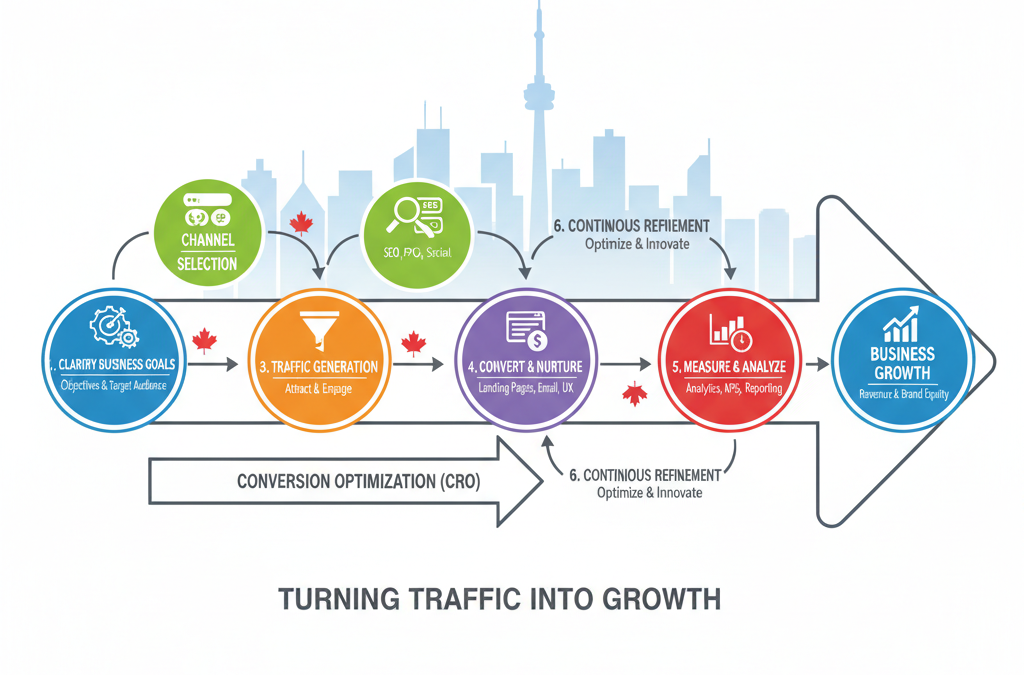
Digital marketing strategy that turns traffic into growth
Why a digital marketing strategy needs more than channel-by-channel tactics
A strong digital marketing strategy connects traffic, messaging, conversion paths, and reporting into one system. Without that structure, businesses often spend on disconnected activities—SEO in one corner, paid ads in another, social media somewhere else—and still struggle to see steady lead flow or reliable revenue. A strategy gives each channel a job, shows how they support one another, and makes it easier to measure what is actually producing calls, form fills, and sales.
That is especially true for teams trying to grow through search, paid media, and better website performance at the same time. Ranking well helps, but visibility without conversion creates waste. Running ads helps too, but ad spend without tight landing pages and tracking can burn budget quickly. For businesses that need practical execution, Digital Marketing Services work best when they are built around business goals rather than isolated tasks.
The useful question is simple: are your channels pulling in the same direction, or are they competing for budget without clear accountability? That distinction usually separates campaigns that create momentum from campaigns that only create activity.
What a digital marketing strategy actually includes in practice
In practical terms, a digital marketing strategy is the plan that decides who you want to reach, what offer or message they should see, which channels should carry that message, and how success will be measured. For one business, that might mean pairing technical SEO services with content marketing and conversion tracking. For another, it might mean using Google Ads for immediate demand capture while building organic visibility in parallel.
The mechanics usually come down to five moving parts: audience targeting, channel selection, landing page quality, measurement, and ongoing refinement. If one piece is weak, performance suffers. A campaign can attract qualified visitors and still underperform because the landing page is slow, the form is too long, or key conversions were never tracked properly. That is why many companies combine strategy with execution across SEO Services, content, development, and paid search instead of treating each as a separate project.
A common misconception is that strategy is just a slide deck made before launch. In reality, strategy is the decision framework behind ongoing choices: which keywords deserve priority, where budget should shift, which pages need CRO work, and which reports are tied to outcomes rather than vanity metrics.
How a digital marketing strategy should be shaped for Toronto, Ontario
In Toronto, Ontario, competition is rarely light. Businesses are often bidding against aggressive advertisers, competing for organic visibility in crowded search results, and trying to stand out in markets where buyers compare several providers before taking action. That raises the importance of sharper positioning, tighter keyword targeting, and cleaner measurement. A generic plan tends to get buried.
For example, a company targeting high-intent searches in downtown Toronto may need a different mix than a business serving broader GTA demand. Search behaviour, service-area targeting, landing page structure, and Google Business Profile optimization can all affect how visible and credible a brand appears. Zigma Internet Marketing approaches that problem by tying channel strategy to lead generation and measurable growth rather than treating traffic as the end goal.
Where local competition changes the playbook
Search demand around Toronto often intersects with nearby commercial hubs such as North York, Scarborough, and Markham, along with dense business corridors that create overlapping service areas. That means a campaign for digital marketing toronto cannot rely on broad language alone. It needs clear service intent, location alignment, and pages that match how people actually search for providers.
Local service companies and professional firms also face a different kind of pressure than e-commerce brands. They may need stronger local seo gta targeting, better review visibility, and faster response paths on mobile. A B2B company, by comparison, may depend more on longer lead cycles, more detailed service pages, and stronger attribution through analytics.
What businesses in Toronto, Ontario should weigh before committing budget
Three factors usually shape the right plan: sales cycle length, average lead value, and how much existing brand demand already exists. A business with urgent, high-intent searches may benefit from google ads management toronto earlier in the mix. A firm with a longer consideration cycle may need deeper content, remarketing, and stronger nurture paths. If the website is underperforming, conversion rate optimization toronto can improve output without increasing traffic at all.
That is where realistic planning helps. Faster channels can create immediate demand capture, while slower channels often build lower-cost visibility over time. Used together, they tend to behave less like substitutes and more like complementary growth levers.
How to compare the building blocks of a digital marketing strategy
Comparisons are useful because most businesses are not choosing a single tactic. They are deciding how to balance speed, cost control, lead quality, and long-term visibility. In Toronto, Ontario, that balance often determines whether a campaign scales efficiently or stalls after an initial push.
SEO, PPC, or a blended acquisition plan
A) SEO: SEO builds visibility in organic search through technical fixes, content, page structure, and authority signals.
- How it works: It improves rankings for relevant searches over time by strengthening site quality, keyword alignment, and topical depth.
- Best fit: It suits businesses that want durable visibility and can invest in compounding growth rather than instant volume.
- Example: A firm targeting seo company toronto and seo services toronto may publish stronger service pages, improve internal links, and fix technical barriers to indexing.
B) PPC: PPC captures demand immediately by placing ads in front of people already searching for a service.
- How it works: It uses bidding, ad relevance, keyword targeting, negatives, and landing pages to attract high-intent traffic fast.
- Best fit: It suits businesses that need speed, controlled testing, or lead volume in competitive markets.
- Example: A campaign built around ppc agency toronto or lead generation agency toronto can start producing qualified traffic while SEO work ramps up.
C) Blended plan: A blended plan uses paid search for immediate coverage and SEO for durable growth.
- How it works: Paid campaigns test messaging and keyword quality quickly, while organic strategy builds stronger long-term acquisition efficiency.
- Best fit: It suits businesses that want both near-term pipeline support and stronger long-range economics.
- Example: A company may run branded and non-branded search ads while improving organic pages for online marketing toronto and content marketing toronto.
Traffic growth versus conversion improvement
A) More traffic: Traffic growth focuses on increasing the number of relevant visitors reaching the site.
- How it works: It expands keyword reach, ad coverage, content production, or audience targeting.
- Best fit: It fits businesses with strong close rates and landing pages that already convert well.
- Example: An established brand may push harder on content seo, paid search, and local visibility because its website already turns visitors into enquiries efficiently.
B) Better conversion rate: Conversion work focuses on helping existing visitors take action more often.
- How it works: It improves page speed, calls to action, form design, trust elements, and message clarity.
- Best fit: It fits campaigns where traffic exists but lead volume remains inconsistent.
- Example: A business investing in landing pages & conversion rate optimization may generate more leads from the same paid budget.
C) Combined approach: The strongest plans often increase quality traffic while removing friction on key pages.
- How it works: It treats acquisition and conversion as one system rather than separate teams or goals.
- Best fit: It fits companies trying to reduce waste while scaling steadily.
- Example: A campaign for website design toronto paired with CRO and tracking often improves both click quality and enquiry rates.
Broad awareness versus high-intent lead generation
A) Awareness-led campaigns: Awareness campaigns focus on reach, recall, and visibility at the top of the funnel.
- How it works: It uses broader targeting, social promotion, video, or wider content themes to build familiarity.
- Best fit: It fits brands with longer buying cycles or launches that need audience education first.
- Example: A newer business may support organic social and social media marketing toronto while building more direct-response assets in the background.
B) High-intent campaigns: High-intent campaigns focus on users ready to call, book, or request information.
- How it works: It targets bottom-funnel keywords, sharp offers, and focused landing pages with clean tracking.
- Best fit: It fits businesses that need measurable lead flow tied closely to spend.
- Example: Search campaigns built around google business profile optimization, technical seo services, or lead generation agency toronto tend to draw more decision-ready traffic.
C) Balanced funnel planning: Balanced planning keeps enough top-of-funnel activity to support growth while prioritizing high-intent actions.
- How it works: It allocates effort by buyer stage instead of pushing every channel to serve every purpose.
- Best fit: It fits brands that want stable demand generation without losing short-term accountability.
- Example: A marketing agency gta may publish educational content while using paid search to capture immediate service demand.
What kind of strategy fits your business goals and operating reality?
A strategy has to fit the business behind it, not just the search term. A small local service company may need simple reporting, stronger local visibility, and faster lead response. A multi-service B2B business may need clearer segmentation, more specialised landing pages, and attribution that distinguishes branded demand from net-new demand. The plan should reflect real staffing capacity, sales follow-up speed, and average deal quality—not just traffic ambitions.
There is also a practical difference between growth that looks busy and growth that is manageable. More enquiries are not automatically better if they are low quality, poorly tracked, or arriving faster than the team can respond. By contrast, a well-built digital marketing strategy usually improves fit first: better search queries, cleaner targeting, stronger landing pages, and reporting that ties campaigns to calls, forms, and sales.
A useful comparison is this: some businesses need a bigger funnel, while others need a narrower funnel with less leakage. Knowing which problem you actually have saves a great deal of wasted effort.
How one campaign became more efficient after the strategy changed
In our work, we’ve observed that many campaigns underperform not because the channel is wrong, but because the structure behind it is incomplete. One Toronto-area service business came in with active paid search, basic SEO activity, and a steady stream of website visits, yet lead quality was inconsistent and reporting left too much guesswork.
The first issue was intent mismatch. Several campaigns were targeting broad phrases that generated clicks but not enough qualified enquiries. The second issue was conversion friction: key landing pages buried trust signals, forms asked for too much information, and analytics did not clearly separate phone calls from form submissions. The approach shifted toward tighter keyword groups, stronger negative keyword control, revised landing pages, and cleaner GA4 plus Google Tag Manager setup.
Over the next few months, the campaign became more efficient. Lead quality improved, waste from irrelevant searches dropped, and decision-making got faster because reporting finally connected spend to outcomes. Clients often tell us the most valuable part is not a sudden spike in traffic; it is being able to see which inputs are actually producing useful business results.
Client note: “We had activity before, but not enough clarity. Once tracking and targeting were cleaned up, the conversations coming in started to feel far more relevant.”
What experienced marketers usually spot before performance problems show up
- Tracking gaps tend to hide bigger problems: If calls, forms, and qualified leads are not separated properly, strong-looking reports can mask weak business performance. Good dashboards should show more than clicks and impressions.
- Search intent is often the real budget issue: A campaign can look expensive when the deeper problem is poor keyword targeting. Better negative keywords, tighter ad groups, and stronger landing-page alignment often fix efficiency faster than simply lowering spend.
- Website quality changes media performance: Slow pages, weak mobile layouts, and unclear trust elements can drag down both SEO and PPC. That is why website development gta work often affects marketing output more than teams expect.
What impacts ROI in modern digital campaigns
Return is usually shaped by a small set of controllable variables: traffic quality, offer-market fit, landing page clarity, follow-up speed, and measurement accuracy. If any of those break down, the campaign may still look active while producing disappointing revenue outcomes. A useful strategy treats those variables as connected rather than separate departments.
For example, a Google Ads campaign may bring in the right searchers, but slow follow-up can weaken close rates. Strong SEO may increase inbound leads, but unclear service pages can reduce enquiry quality. In other words, ROI often improves through a series of operational fixes, not only through bigger reach.
Most businesses also benefit from watching blended performance rather than judging each channel in isolation. Paid search may create immediate leads, while content marketing toronto and technical SEO support lower-cost acquisition over time. Judging one without the other can create short-term decisions that hurt long-term efficiency.
Key ROI drivers to watch
- Intent quality: High-intent keywords and tighter audience targeting usually outperform broad traffic campaigns for lead generation.
- Conversion path friction: Shorter forms, stronger trust cues, and clearer calls to action often raise output from the same traffic base.
- Tracking discipline: Reliable conversion tracking, call attribution, and dashboards prevent teams from optimising toward the wrong signals.
- Sales response speed: Fast follow-up often improves lead value, especially in competitive local service markets.
SEO vs PPC inside a digital marketing strategy
SEO and PPC solve different timing problems. SEO helps a business build long-term visibility, credibility, and compounding search presence. PPC helps a business appear immediately for commercial searches and test demand quickly. Neither channel is automatically superior; the better question is which business problem you need to solve first.
If the website has little organic visibility and the business needs pipeline soon, Google Ads Management may create faster traction. If the company already knows which services convert well and wants to reduce dependence on paid clicks over time, SEO usually deserves heavier investment. A blended strategy often works well because paid search reveals message and keyword data quickly, while organic search builds stronger long-term acquisition resilience.
For many businesses, the smartest sequence is not SEO or PPC. It is SEO and PPC, weighted differently by stage. Early on, paid search may carry more of the lead volume. Over time, organic growth, local SEO, and content depth can reduce pressure on paid acquisition and create a more balanced channel mix.
A simple way to decide
- Choose SEO first if you have patience, usable content assets, and a need for durable non-paid visibility.
- Choose PPC first if speed, testing, and immediate commercial intent are the priority.
- Choose both if you need short-term lead flow and a stronger long-term search position.
How local businesses in Toronto can compete online without wasting spend
Toronto businesses usually do not need to outspend every competitor. They need to be more precise. That starts with tighter service positioning, pages built around search intent, and local visibility assets that reinforce trust. For many companies, the gains come from narrower targeting and sharper execution rather than more budget.
A local business competing in Toronto, Ontario should usually focus on three layers at once: search visibility, conversion readiness, and proof. Search visibility includes local seo gta work, service pages, and Google Business Profile optimization. Conversion readiness includes speed, mobile usability, and landing pages that answer the buyer’s first few questions quickly. Proof includes reviews, clearer portfolio examples, and reporting that shows what is working.
Neighbourhood-level competition also changes how campaigns are structured. A business serving downtown Toronto may face different search patterns than one targeting North York, Etobicoke, or the eastern GTA. The strategy should reflect service coverage, travel realities, and where margins are strongest—not just where impressions are highest.
Practical ways to compete more effectively
- Build for intent, not volume: High-volume keywords are not always the ones that create qualified leads.
- Treat local SEO as an operational asset: Consistent listings, location relevance, and GBP quality can influence both visibility and trust.
- Strengthen the website before scaling spend: Better pages often improve paid and organic performance at the same time.
- Measure lead quality, not just lead count: A smaller stream of better-fit enquiries often outperforms broader, noisier traffic.
How to choose the right digital marketing agency
A good agency should be able to explain its thinking plainly, connect tactics to business outcomes, and show how tracking works before large campaign changes begin. If the conversation stays at the level of impressions, reach, and generic visibility, the strategy may be too shallow. The better agencies usually talk early about search intent, landing pages, attribution, and what counts as a qualified lead.
It also helps to ask how execution is handled across channels. SEO, PPC, web development, CRO, and analytics often affect one another. If those teams operate in silos, opportunities get missed. If they work together, the business usually gets cleaner data and more consistent improvement cycles.
A practical screening standard is whether the agency can answer three questions clearly: What is the acquisition plan? How will success be measured? What will be improved first if performance stalls?
What to ask before you commit
- Measurement: Ask how conversions, qualified leads, and revenue signals will be tracked from the start.
- Execution depth: Ask whether the team handles SEO, PPC, landing pages, and technical implementation directly or through handoffs.
- Reporting clarity: Ask for examples of dashboards that tie spend and traffic to calls, forms, or sales activity.
- Optimisation process: Ask what happens in the first 30, 60, and 90 days if performance is below expectations.
Five steps that make a digital marketing strategy more effective
Step 1: Clarify the business goal before choosing channels
Start with the business outcome, not the platform. A company trying to increase qualified demo requests needs a different campaign structure than a business trying to raise e-commerce revenue or improve local phone enquiries. This step helps align targeting, page structure, and measurement so you can judge performance against real commercial outcomes.
Focus: Tie every channel to a specific business action such as calls, forms, booked consultations, or purchases.
Why it helps: Clear goals reduce wasted effort and stop campaigns from drifting into vanity reporting.
Example: A lead-generation company may prioritise search, landing pages, and call tracking before investing heavily in awareness channels.
Step 2: Match keyword strategy to buyer intent
Not every search deserves the same investment. Informational searches support awareness and education, while commercial searches usually deserve more focused conversion paths. Separating those intents improves ad relevance, content planning, and page design.
Focus: Build separate paths for research-stage and decision-stage visitors.
Why it helps: Intent matching often improves both lead quality and campaign efficiency.
Example: A page targeting digital marketing agency toronto should not behave the same way as a blog aimed at broader educational searches.
Step 3: Fix conversion friction before scaling traffic
If a page is hard to use, extra traffic usually amplifies waste rather than results. Slow load times, cluttered layouts, weak trust cues, and confusing forms can quietly hold back both SEO and paid campaigns. Improving the page first often lifts performance without increasing media spend.
Focus: Review mobile usability, page speed, messaging hierarchy, and form experience.
Why it helps: Better conversion paths improve output from the traffic you already have.
Example: A service page supported by technical seo services and CRO may outperform a higher-traffic page with a weaker user path.
Step 4: Build reporting around decisions, not dashboards alone
Reports should make it easier to act. If the data cannot show which campaigns are producing qualified leads, where drop-off happens, or which pages deserve improvement next, the reporting layer is incomplete. Strong analytics setup makes optimisation faster and more confident.
Focus: Track meaningful conversions and connect spend to outcomes wherever possible.
Why it helps: Better measurement reduces guesswork and speeds up optimisation cycles.
Example: Clean GA4 setup, Google Tag Manager, and marketing dashboards make it easier to compare SEO and PPC contributions fairly.
Step 5: Optimise in cycles, not one-off bursts
Digital performance tends to improve through iteration. Search query analysis, new negative keywords, revised page copy, content updates, and technical fixes often produce better outcomes over time than large, infrequent overhauls. Small improvements compound when the system is measured properly.
Focus: Use recurring test-measure-improve cycles tied to the most important KPIs.
Why it helps: Continuous refinement usually creates steadier gains than sporadic campaign resets.
Example: A business investing in online marketing toronto can improve efficiency quarter by quarter by refining search terms, landing pages, and local visibility assets together.
FAQs About digital marketing strategy
It depends on the channels involved. PPC and paid social can generate early data quickly, while SEO, content, and technical improvements usually take longer to compound. Most businesses see the clearest progress once tracking, landing pages, and channel priorities are aligned.
No. Some businesses in Toronto, Ontario benefit from a blended plan, while others should start with one primary acquisition channel. The right mix depends on urgency, competition, budget flexibility, and whether the website is ready to convert incoming traffic.
The most common causes are weak intent targeting, unclear landing pages, poor conversion tracking, and slow follow-up on leads. In some cases, the traffic source is fine but the website or reporting setup prevents the campaign from producing useful business outcomes.
A local business usually needs a mix of local SEO, stronger service pages, Google Business Profile optimization, and clear trust signals on the website. In Toronto, Ontario, precise positioning often works better than broad targeting because competition is high across many service categories.
Ask how they define a qualified lead, how tracking will be set up, which channels they would prioritise first, and how reporting connects activity to outcomes. A useful answer should be specific, practical, and tied to your business goals rather than generic platform talk.
Clear strategy usually beats more activity
A digital marketing strategy works best when it simplifies decisions: which channels deserve focus, what the website needs to convert better, and how performance will be measured without guesswork. For businesses trying to improve lead generation, that clarity often creates more progress than adding another platform or producing more campaign activity. Zigma Internet Marketing brings together SEO, PPC, web, content, and analytics with a conversion-focused approach and transparent reporting. If you want a tailored view of what fits your situation, 📩 Ask an SEO/PPC question.
