
Digital marketing near me starts with clear goals
Digital marketing near me is usually a search for practical help: a team that can improve visibility, attract qualified leads, track what is working, and explain decisions in plain language. The phrase often signals that a business owner wants accountability, communication, and measurable progress rather than a vague marketing package.
A useful digital marketing partner should be able to connect strategy to business outcomes. That means understanding how search engine optimization, paid search, landing pages, content, analytics, and conversion improvements work together. If those pieces are handled separately with no shared reporting, campaigns can look busy while sales teams still ask where the leads are coming from.
Zigma Internet Marketing supports businesses with Digital Marketing Services across SEO, PPC, web design, content, social media, analytics, and conversion rate improvement. The practical question is not simply “who ranks near me?” It is: which team can diagnose the real growth constraint and show the evidence behind each recommendation?
How digital marketing turns attention into leads
Digital marketing is the planned use of online channels to attract the right audience, guide visitors toward action, and measure which channels create real business value. A campaign may include organic search, paid search, social media, content, email, landing pages, tracking setup, and website improvements.
Each channel plays a different role. SEO Services build visibility for people searching without an ad click. Paid search captures demand from people already typing commercial terms into Google. Website design and conversion work help turn visits into calls, forms, purchases, or qualified enquiries.
The weak point is often measurement. A business may see traffic growing but have no clear view of which pages, ads, or keywords influence leads. Proper analytics setup, Google Tag Manager configuration, form tracking, call tracking, and dashboard reporting make marketing decisions easier to evaluate.
What a serious digital marketing plan should include
A strong plan does not start with every channel at once. It starts with the current business model, lead quality, sales process, website condition, and capacity to follow up. A clinic, contractor, ecommerce store, consultant, and B2B company can all use digital marketing, but the channel mix should reflect how customers actually decide.
- Search visibility: SEO should address technical crawl issues, keyword intent, on-page structure, content depth, internal links, and authority signals.
- Paid acquisition: PPC should include query review, negative keywords, conversion tracking, ad testing, landing page alignment, and budget pacing.
- Conversion paths: Landing pages should make the next step clear, reduce friction, and match the promise made in the ad or search result.
- Content strategy: Content should answer real buyer questions, support service pages, and build topical authority over time.
- Reporting: Dashboards should connect spend, traffic, leads, sales conversations, and efficiency signals rather than showing vanity metrics alone.
The goal is not to run more campaigns. The goal is to build a system where each channel has a job, each job has a measurable outcome, and each report supports a better decision.
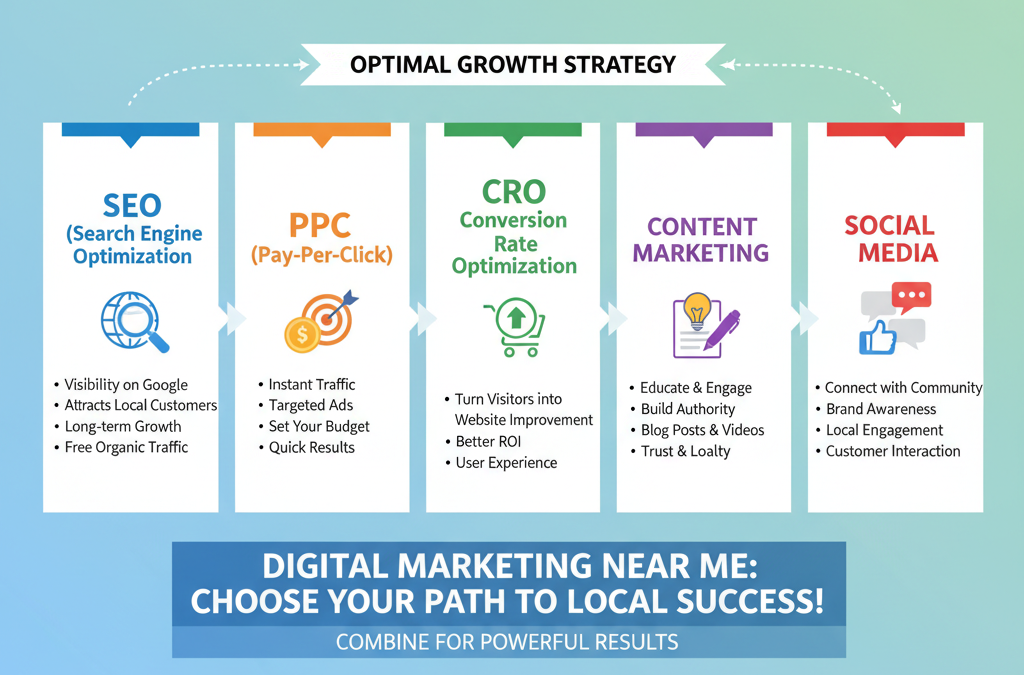
Comparing SEO, PPC, CRO, content, and social media
Digital marketing choices become clearer when each channel is judged by speed, control, durability, and measurement. The table below shows how common services fit different business situations.
| Channel | Primary role | Strong fit | Common risk |
|---|---|---|---|
| SEO | Build organic visibility for search demand. | Businesses that need durable rankings and steady lead flow. | Publishing content without technical cleanup or intent mapping. |
| PPC | Capture high-intent searches through paid ads. | Businesses that need controlled testing and faster demand capture. | Spending before tracking, landing pages, and query filtering are ready. |
| CRO | Improve the percentage of visitors who take action. | Websites with traffic but weak form fills, calls, carts, or demo requests. | Changing page design without checking user behaviour or lead quality. |
| Content | Answer buyer questions and support search visibility. | Brands with complex services, long consideration cycles, or multiple buyer concerns. | Writing generic posts that do not support service pages or sales conversations. |
| Social media | Build awareness, retarget visitors, and support audience engagement. | Businesses with visual proof, repeat engagement, or audience education needs. | Posting consistently without a conversion path or tracking plan. |
For many businesses, the strongest mix is not one channel replacing another. It is SEO creating durable visibility, PPC testing demand quickly, CRO improving lead capture, and analytics showing where the next improvement should happen.
How to choose a digital marketing agency
Choosing an agency should feel less like buying a service bundle and more like selecting an operating partner for growth. A good agency asks about margins, close rates, follow-up speed, capacity, and sales quality because marketing performance depends on what happens after the click.
Ask specific questions before committing. Which conversions will be tracked? How will the agency separate qualified leads from weak enquiries? How often will search terms, landing pages, and campaign structure be reviewed? Clear answers reveal whether the team is thinking beyond traffic.
Useful evaluation signals include:
- Audit quality: The agency should identify technical, content, tracking, and conversion issues before recommending major work.
- Reporting clarity: Reports should explain what changed, what the data suggests, and what action comes next.
- Channel fit: The recommended mix should match the sales cycle, competition level, and available internal resources.
- Implementation depth: Strategy has limited value if no one can fix tracking, improve pages, write content, or adjust campaigns.
- Communication rhythm: Regular review cycles help prevent wasted spend and keep priorities tied to business conditions.
What affects ROI in modern digital campaigns
Return on investment is shaped by more than ad spend or rankings. Lead quality, conversion rate, website speed, search intent, sales follow-up, offer clarity, and tracking accuracy all influence whether marketing activity becomes revenue.
For example, a PPC campaign can generate form submissions but still underperform if the landing page attracts the wrong audience or the sales team receives incomplete lead details. An SEO campaign can increase organic traffic but fail commercially if rankings come from informational queries with little buyer intent.
Meaningful reporting should connect marketing activity to observable business signals:
- Lead source: Which channel, campaign, page, or keyword influenced the enquiry?
- Lead quality: Did the enquiry match the service, budget, timing, and decision stage?
- Conversion rate: Which pages turn visitors into forms, calls, purchases, or booked conversations?
- Acquisition efficiency: Which campaigns produce stronger outcomes relative to spend and effort?
- Pipeline impact: Which marketing sources contribute to real sales conversations, not just website activity?
SEO vs PPC and when each strategy fits
SEO and PPC solve different timing problems. SEO is better suited to long-term visibility, content depth, technical site health, and sustained organic lead flow. PPC is better suited to controlled testing, demand capture, and campaigns where speed and targeting precision are useful.
Google Ads Management can reveal which search terms, messages, and landing pages attract qualified leads. Those insights can also support SEO content planning. In the other direction, strong SEO pages can improve the user experience for paid traffic by answering questions and reducing friction.
A practical comparison is simple: PPC is like renting visibility while you test demand; SEO is like building owned visibility that compounds through better content, technical improvements, and authority. Neither channel fixes a weak offer or poor website on its own.
How service businesses can compete online
Service businesses often compete against larger brands, directories, marketplaces, and companies with bigger ad budgets. A smaller team can still compete by being more specific, more useful, and more disciplined with tracking.
Strong competition usually requires sharper positioning. Pages should speak to exact services, use cases, customer concerns, and proof points. Ads should avoid broad targeting that burns budget on weak queries. Content should support the questions a buyer asks before reaching out.
Practical ways to compete include:
- Build focused service pages: Each page should match one clear search intent and guide the reader toward a specific action.
- Improve technical foundations: Slow pages, crawl errors, thin content, and poor mobile layouts can limit both SEO and paid campaign performance.
- Use proof carefully: Case details, process explanations, reviews, and before-and-after context are stronger than vague claims.
- Track the full path: Marketing reports should show which channels create qualified conversations and where drop-offs occur.
A practical checklist before hiring
Before hiring a digital marketing agency, prepare a short internal snapshot. This helps the agency diagnose the situation accurately and helps you compare recommendations fairly.
Step 1: Define the business outcome
Write down the main outcome you want marketing to support, such as more qualified calls, ecommerce sales, demo requests, repeat purchases, or lower wasted ad spend. A clear outcome helps every channel serve a defined role.
Check: Can the agency explain how each recommended activity connects to that outcome?
Example: A company with traffic but weak enquiries may need landing page and tracking work before expanding ad campaigns.
Step 2: Review current tracking
Check whether forms, calls, purchases, newsletter signups, and key page events are tracked properly. Without accurate tracking, budget decisions can be based on incomplete evidence.
Check: Ask whether GA4, Google Tag Manager, conversion events, and reporting dashboards will be reviewed before major campaign changes.
Example: A form submission event may fire on page load instead of successful submission, which can inflate reported performance.
Step 3: Separate traffic problems from conversion problems
A website with low traffic needs visibility work. A website with steady traffic but few leads needs conversion and messaging work. Treating both problems the same can waste effort.
Check: Ask whether the agency has reviewed search visibility, landing page behaviour, form friction, and mobile usability.
Example: More ad spend will not fix a page that hides the form, loads slowly, or does not explain the service clearly.
Step 4: Ask for the first diagnostic priorities
A credible agency should be able to name the first set of checks before promising a campaign roadmap. The first priorities often include tracking, website quality, keyword intent, content gaps, and ad account structure.
Check: Listen for clear reasoning rather than a preset package.
Example: A paid campaign may need negative keyword cleanup before new ads are written.
Step 5: Agree on reporting that supports decisions
Reports should make the next decision clearer. Rankings, clicks, impressions, and spend are useful only when connected to lead quality, revenue signals, or conversion behaviour.
Check: Ask what will change if a campaign underperforms for reasons the dashboard reveals.
Example: If paid search produces high click volume but weak leads, the next action may be query refinement, landing page changes, or offer clarification.
Trust signals to check before choosing digital marketing near me
A final decision should include both marketing skill and operational fit. Zigma Internet Marketing brings Google Partner-certified expertise, full-service execution across SEO, PPC, web, content, social, and analytics, plus clear KPI reporting focused on calls, forms, sales signals, and acquisition efficiency.
If you want a second opinion on your current SEO, PPC, tracking, or website conversion setup, you can reach Zigma Internet Marketing at (647) 556-6071 or info@zigma.ca. For a structured conversation, use Ask an SEO or PPC question.
FAQs About digital marketing near me
Compare agencies by how clearly they diagnose your current situation. Ask about tracking, conversion paths, lead quality, reporting, technical SEO, PPC structure, and website issues. A useful agency should explain the first priorities before recommending a full campaign plan.
Start with the areas that affect lead flow most directly: tracking accuracy, website conversion, SEO visibility, and paid search efficiency. If the website already gets traffic, conversion rate improvement may come before more advertising. If traffic is weak, SEO and PPC may need attention first.
Useful data can appear as soon as tracking is correctly installed and campaigns or pages receive enough activity to show patterns. Early signals can guide adjustments, but stronger decisions come from repeated evidence across search terms, landing pages, lead quality, and sales feedback.
SEO fits long-term organic visibility, while PPC fits controlled demand capture and faster testing. Many businesses use both because paid campaigns can reveal keyword and message insights, while SEO builds content depth and durable search presence over time.
A useful dashboard should show more than clicks and impressions. It should connect traffic sources, conversions, campaign spend, search terms, landing pages, call or form activity, and lead quality signals so marketing decisions are based on business outcomes.
Related Topics:
