
A clear role before you spend more
A digital marketing consultant helps a business diagnose marketing gaps, set priorities, and connect channels such as SEO, paid search, web design, content, analytics, and conversion work to business outcomes. The role is not just to suggest more activity. A good consultant separates activity from traction, then shows which work is likely to improve qualified leads, sales enquiries, or revenue efficiency.
That distinction matters most when marketing feels busy but unclear. A company may be publishing content, running ads, posting on social media, and redesigning landing pages, yet still struggle to answer basic questions: Which channel creates sales conversations? Which campaign wastes spend? Which pages turn visitors into leads? Those questions are where consulting becomes useful.
For businesses comparing internal hires, freelancers, agencies, and consultants, the decision usually comes down to diagnosis and execution capacity. If you need channel-by-channel implementation, a full service partner may fit better. If you need an experienced second set of eyes before committing budget, consulting can reduce guesswork and help your team act with clearer priorities. Zigma Internet Marketing supports both strategy and execution through Digital Marketing Services built around tracking, reporting, and continual improvement.
How a digital marketing consultant turns activity into accountable work
A digital marketing consultant starts by checking whether marketing activity is tied to the right signals. Traffic alone is not enough. A campaign that increases visits but produces few qualified calls, demo requests, cart checkouts, or form submissions may need sharper targeting, better page content, stronger tracking, or a different channel mix.
The work usually begins with an audit. That may include reviewing your website structure, search visibility, paid search account, landing pages, analytics setup, content quality, conversion tracking, and sales handoff. The audit should identify which problems are technical, which are strategic, and which are caused by unclear measurement.
Key terms should be defined early in the process. SEO, or search engine optimization, is the work of improving organic visibility through technical fixes, content, relevance, and authority signals. PPC, or pay per click advertising, places paid ads in search or social platforms and charges when someone clicks. CRO, or conversion rate optimization, improves the percentage of visitors who take a desired action. GA4 refers to Google Analytics 4, a tool used to measure user behaviour and campaign performance.
Those channels affect one another. Weak tracking can make a strong ad campaign look poor. A slow website can reduce the value of both SEO and PPC. A landing page with unclear calls to action can waste traffic from every channel. A consultant’s job is to show those relationships so decisions are based on evidence rather than preference.
Signs your marketing needs outside diagnostic thinking
Outside guidance is useful when your team has activity but lacks confidence in what to change first. The warning signs are usually visible in day-to-day conversations: reports show numbers but not meaning, ad spend rises without clearer lead quality, or content is published without a plan for ranking, conversion, or sales support.
Common signals include:
- Leads are increasing but sales conversations are weak: The issue may be audience targeting, keyword intent, landing page messaging, or form qualification rather than lead volume alone.
- SEO traffic is flat despite publishing: Content may not match search intent, technical issues may block performance, or the site may lack internal linking that helps search engines understand priority pages.
- Paid ads spend is difficult to explain: Search queries, negative keywords, match types, bidding, and landing page fit may need review before more budget is added.
- Reports do not connect to business decisions: Dashboards should show metrics such as cost per lead, conversion rate, lead-to-sale rate, return on ad spend, and customer acquisition cost where the data is available.
- Your website looks acceptable but does not convert: Page speed, layout, offer clarity, trust signals, mobile usability, and form friction can all affect whether visitors take action.
The most useful question is not “Which channel should we use?” A stronger question is: “Which constraint is stopping qualified prospects from becoming customers?” That question moves the conversation from channel preference to business diagnosis.
Consultant vs agency vs freelancer: how the roles differ
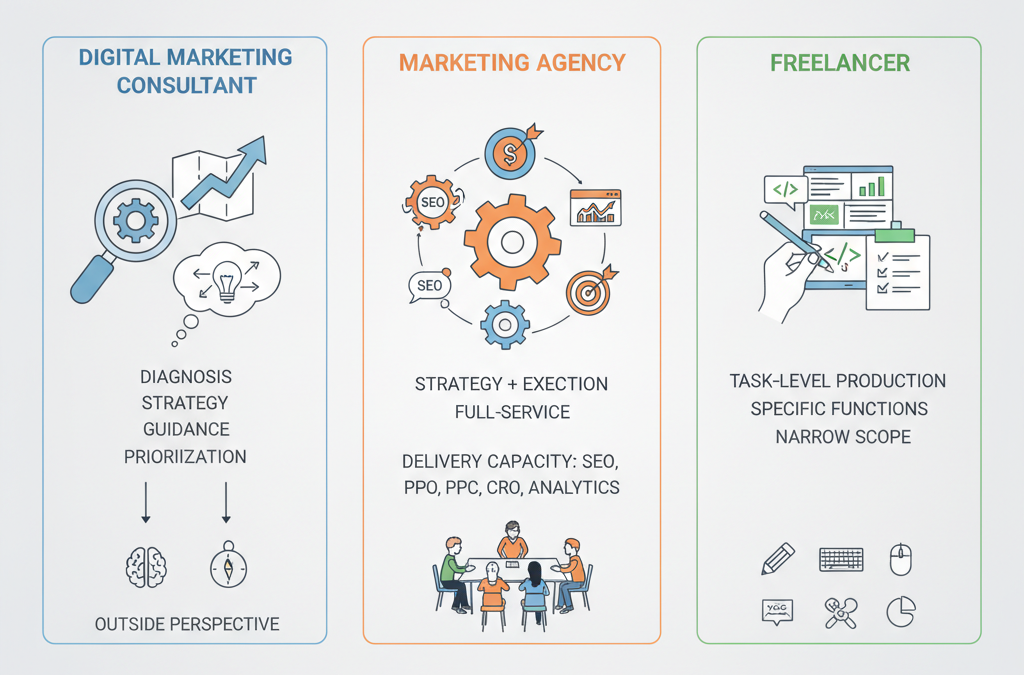
Different marketing partners solve different problems. A consultant is often strongest at diagnosis, planning, prioritization, and performance review. An agency usually combines strategy with hands-on execution across several channels. A freelancer may be a strong fit for a specific task such as copywriting, design, development, or paid ads management.
Choosing the right support structure
A) Consultant: A consultant reviews your current marketing system and recommends what to fix, pause, or scale. The consultant may also guide your internal team or coordinate specialist work.
- How it works: The consultant audits performance, clarifies gaps, builds a priority plan, and helps decision makers understand trade-offs.
- Fit: This role fits a business that has staff or vendors but needs sharper direction and better measurement.
- Example: A company running ads and publishing content may hire a consultant to identify why conversions remain low despite steady traffic.
B) Agency: An agency handles strategy and execution across several areas. This can include SEO, PPC, landing pages, development, analytics, content, and social media work.
- How it works: The agency creates a plan, implements channel work, reports on performance, and adjusts campaigns based on data.
- Fit: This structure fits a business that needs delivery capacity along with strategic guidance.
- Example: A company may work with Zigma Internet Marketing for SEO Services, paid search, landing pages, and analytics under one coordinated plan.
C) Freelancer: A freelancer usually supports a defined function. That narrower scope can be efficient when the strategy is already clear.
- How it works: The freelancer completes assigned work such as writing pages, building ad creatives, editing a website, or configuring tracking.
- Fit: This role fits a business with strong internal direction and a clear brief.
- Example: A marketing manager may hire a freelance designer after a consultant has already mapped the landing page requirements.
The trade-off is simple. Consulting gives clarity. Agency work gives delivery. Freelance support gives task-level production. Some businesses need one of these roles; others need a combination, especially when strategy and implementation must move together.
A practical checklist before hiring marketing guidance
Before speaking with a consultant, gather the information that will make the conversation useful. A strong advisor can work with imperfect data, but scattered access and unclear goals slow down diagnosis. Preparation also helps you judge whether the advice is grounded or vague.
Step 1: Define the business outcome
Write down the outcome you want marketing to support. That may be more qualified enquiries, lower wasted ad spend, better e-commerce conversion, improved organic visibility, or clearer reporting for leadership.
Useful metric: Choose one primary metric such as qualified leads, sales-qualified enquiries, purchases, or booked demos.
Common mistake: Asking for more traffic without defining what the right visitor should do.
Example: A service business may decide that the target outcome is more qualified form submissions from high-intent service pages rather than more total website visits.
Step 2: Check whether tracking is trustworthy
Review whether calls, forms, purchases, chat leads, and key events are measured correctly. Poor tracking can lead to the wrong conclusion about which campaigns deserve budget.
Useful metric: Compare platform conversions with CRM records or actual sales conversations when possible.
Common mistake: Treating every form fill as equal when some submissions are spam, vendor outreach, or poor-fit requests.
Example: A PPC campaign may appear profitable until duplicated conversions or low-quality submissions are removed from reporting.
Step 3: Separate channel problems from website problems
A campaign may bring the right visitors to the wrong page. Before blaming SEO or ads, review page speed, message clarity, mobile layout, trust cues, forms, and calls to action.
Useful metric: Look at conversion rate by landing page, not just by channel.
Common mistake: Increasing ad spend before fixing a landing page that does not answer buyer questions.
Example: If visitors click an ad for a specific service but land on a generic homepage, conversion rates may suffer even when targeting is accurate.
Step 4: Review how decisions are made
Marketing improves faster when decisions follow a consistent cycle: test, measure, review, adjust. Random changes make performance difficult to interpret.
Useful metric: Track changes against dates, campaigns, page updates, and budget shifts.
Common mistake: Changing ads, pages, offers, and tracking all at once, then being unable to identify what caused the result.
Example: A landing page test should compare a clear variation against a current page while keeping the traffic source stable enough for interpretation.
Step 5: Ask how recommendations will be prioritized
A useful plan ranks work by likely effect, effort, urgency, and dependency. Technical fixes, content updates, paid search improvements, and CRO tasks should not be treated as equal.
Useful metric: Assign each task an expected business impact and implementation effort rating.
Common mistake: Starting with visible design changes while tracking, search intent, or page structure problems remain unresolved.
Example: Fixing broken conversion tracking may come before rewriting ads because accurate measurement is needed to judge the next round of changes.
How to judge SEO, PPC, CRO, and reporting quality
Marketing advice should become more specific as the consultant reviews your data. Broad statements may be acceptable in an early conversation, but a real assessment should eventually name the page, query, campaign, audience, event, or reporting gap being discussed.
SEO quality signals
Strong SEO guidance connects search intent, technical health, content structure, internal linking, and authority signals. If a consultant recommends new content, they should explain which query theme it addresses, which page it supports, and how success will be evaluated. For complex site issues, technical SEO services may include crawl checks, indexation review, speed analysis, structured data, and content architecture.
PPC quality signals
Paid search advice should address search terms, negative keywords, match types, bidding, budget allocation, conversion tracking, and landing page relevance. A healthy Google Ads (PPC) account is not judged by clicks alone; it is judged by the quality and cost efficiency of the actions those clicks produce.
CRO quality signals
Conversion work should focus on user behaviour, page clarity, trust cues, friction, and message match. A consultant may recommend clearer headlines, stronger proof points, fewer form fields, better mobile layouts, or improved offer framing. The goal is to make the next step easier for qualified visitors, not to pressure every visitor into submitting a form.
Reporting quality signals
Reporting should help a decision maker act. Useful dashboards connect spend, traffic, conversions, lead quality, and sales feedback where data access allows. If reports show only impressions, clicks, sessions, and rankings, they may be missing the business context needed for budget decisions.
What a healthy consulting engagement should produce
A useful engagement should leave you with clearer decisions, not just a longer task list. The final output may be an audit, roadmap, channel plan, measurement plan, dashboard review, landing page brief, or campaign improvement plan. The format can vary, but the substance should reduce uncertainty.
Look for these concrete deliverables:
- A prioritized roadmap: The plan should rank work by impact, effort, and dependencies so your team knows what to address first.
- A measurement framework: The consultant should define which events, conversions, and business metrics will be used to judge performance.
- Channel-specific recommendations: SEO, PPC, content, social, web, and analytics advice should be tied to the role each channel plays in the customer journey.
- Implementation guidance: Recommendations should be clear enough for a developer, marketer, designer, or ad specialist to act on.
- A review cadence: Marketing decisions should be revisited after enough data has been collected to make a fair comparison.
A consultant does not remove uncertainty from marketing. No serious advisor can promise that. The real value is sharper thinking, cleaner measurement, and fewer decisions made from incomplete signals.
A careful next step if you want outside perspective
If your marketing reports are difficult to interpret, or if SEO, PPC, landing pages, and analytics feel disconnected, a structured review can help you decide what deserves attention first. Zigma Internet Marketing brings Google Partner-certified expertise, full-service execution across SEO, paid search, web, content, and social, and clear reporting focused on calls, forms, sales, and acquisition efficiency.
For a grounded review of your current marketing setup, you can ask Zigma for a practical marketing review. Bring your goals, access to available reports, and the questions your team has been debating. A useful conversation should make the next decision clearer, even before any campaign work begins.
FAQs About digital marketing consultant
Choose a consultant when you need diagnosis, planning, or an outside review of existing marketing. Choose an agency when you also need hands-on execution across SEO, PPC, web, content, analytics, or social channels. Some businesses use both: consulting for direction and an agency for implementation.
Prepare your main business goal, current website, analytics access, ad account access if available, recent reports, customer types, and sales feedback. The most useful inputs are not polished presentations; they are real performance signals that show where prospects come from and where they drop off.
Timing depends on the issue being fixed. Tracking corrections and landing page changes may clarify performance quickly, while SEO content and technical improvements usually require longer review cycles. A consultant should explain which recommendations can be assessed soon and which need more data.
Yes. A consultant can audit search terms, conversion tracking, landing pages, bidding structure, campaign settings, and lead quality without taking over management. The review should identify wasted spend patterns, measurement gaps, and practical changes your internal team or agency can apply.
Useful reporting connects marketing activity to decisions. A strong report shows which channels create qualified actions, which pages convert, which campaigns waste budget, and which changes were made during the reporting period. Detail helps only when it explains what should happen next.