
Clear marketing starts with clear measurement
A digital marketing business helps companies attract, convert, and measure demand through channels such as search engines, paid ads, websites, content, social media, and analytics. The real value is not just publishing more campaigns; it is connecting marketing activity to observable outcomes such as qualified leads, sales conversations, form submissions, phone calls, and repeat purchases.
For a business owner or marketing manager, the hard part is often deciding where effort should go first. A faster website may raise conversion rates, but only if the traffic is relevant. Paid search may bring leads quickly, but weak tracking can hide wasted spend. Search engine optimization may build durable visibility, but it requires patience, technical discipline, and content that answers buyer questions clearly.
Zigma Internet Marketing works across SEO, PPC, web design, content, social media, and reporting, so the team often sees the same pattern: campaigns perform better when strategy, landing pages, and tracking are treated as one connected system. For a deeper view of service areas, see Digital Marketing Services.
Quick facts for planning
Use this short snapshot before comparing channels or vendors.
- Core purpose: Digital marketing turns search demand, paid traffic, content, and websites into measurable business conversations.
- Main channels: SEO, Google Ads, landing pages, content, email, social media, and analytics often work better as a coordinated system.
- Key metrics: Useful reporting focuses on qualified leads, conversion rate, cost per lead, sales value, and channel efficiency.
- Common risk: A campaign can look successful on clicks and impressions while failing to produce leads that sales teams can use.
- Practical sequence: Fix tracking first, improve landing pages next, then scale the channels that produce qualified demand.
How a digital marketing business creates accountable growth
A digital marketing business creates accountable growth by aligning audience research, channel strategy, campaign execution, conversion tracking, and reporting. Each part affects the next. If keyword research is weak, SEO content may attract the wrong visitors. If ad targeting is broad, paid campaigns may spend budget on people who are not ready to act. If the landing page is unclear, even strong traffic can underperform.
Accountable marketing starts with a defined conversion. A conversion may be a contact form, phone call, demo request, purchase, newsletter signup, or booked consultation. Once that action is defined, marketers can ask better questions: Which channel created the lead? Which landing page converted? Which keyword or ad group produced a real sales conversation?
That measurement discipline changes the tone of decision-making. Instead of debating opinions about design, copy, or ad spend, the team can compare behaviour in analytics and customer relationship management data. The goal is not to chase every available channel. The goal is to identify the few activities that produce useful demand and then improve them over time.
Search engine optimization is often the foundation for long-term visibility. Technical fixes, content planning, and authority signals help pages become easier for search engines and buyers to understand. If SEO is a priority, SEO Services can clarify how audits, content, and technical improvements fit together.
The core channels and where each one fits
Digital marketing channels are not interchangeable. Each channel has a different job, timeline, and risk profile. The right mix depends on the buying journey, the sales cycle, the website’s current condition, and the quality of internal follow-up after a lead arrives.
SEO builds visibility for demand that already exists
SEO helps a website appear for search queries connected to products, services, problems, and comparisons. Technical SEO improves crawlability and site performance, while content SEO gives searchers clear answers. SEO usually works best when the business can commit to improving pages, publishing useful content, and cleaning up technical issues over time.
PPC reaches high-intent searchers faster
Pay-per-click advertising can place a business in front of people actively searching for a product or service. The trade-off is direct spend. A weak campaign structure, poor negative keyword management, or vague landing page can raise acquisition costs quickly. Strong PPC work combines query control, ad testing, landing page alignment, and conversion tracking. For search campaigns, Google Ads Management gives structure to bidding, testing, and reporting.
Web design and development affect every channel
A website is often the place where trust is confirmed or lost. Speed, mobile layout, page structure, calls to action, and technical health influence both search visibility and paid campaign efficiency. A redesign should not be treated as a visual project alone; it should protect SEO value, improve conversion paths, and make tracking easier to manage. For that reason, Website Design & Development should include technical and conversion planning early.
Content and social media support buyer confidence
Content marketing gives prospects enough context to trust the next step. Service pages, articles, case studies, product content, and social posts can reduce repeated sales questions and support remarketing campaigns. Social media can assist awareness and credibility, but it should be judged by its role in the buying path rather than by engagement alone.
Why tracking is the first system to fix
Marketing without reliable tracking creates noisy decisions. A campaign may appear healthy because clicks are rising, while lead quality is falling. Another campaign may look quiet in platform data but generate phone calls that are not being recorded properly. Tracking turns campaign activity into evidence that business owners can act on.
Useful tracking usually includes analytics setup, event tracking, form tracking, phone call tracking where appropriate, dashboard reporting, and a clean naming structure for campaigns. The reporting should separate raw activity from business value. Sessions, impressions, and clicks are useful diagnostic signals, but they should not be treated as success by themselves.
A practical reporting dashboard answers questions such as:
- Which channels create qualified enquiries? Lead source reporting helps identify where budget and effort deserve more attention.
- Which pages help visitors take action? Landing page data shows whether messaging, layout, and form placement support conversion.
- Which campaigns waste spend? Search term reviews, audience data, and conversion records expose mismatches between traffic and buyer intent.
- Which fixes should happen next? A dashboard should guide decisions, not only display charts.
Tracking does not need to be overly complex at the start. A clean foundation is better than a complicated dashboard that nobody trusts.
SEO and PPC are stronger when they share data
SEO and PPC are often discussed as separate disciplines, yet they can inform each other. Paid search can reveal which queries convert before a business invests months building organic visibility. SEO data can show which topics attract steady demand and reduce dependence on paid clicks over time.
The comparison becomes clearer when each channel is judged by timing, control, and durability:
SEO versus PPC by business situation
A) SEO for compounding visibility: SEO works well when the business wants to build search presence across service pages, informational content, and technical site health.
- How it works: SEO improves page relevance, crawlability, internal linking, content depth, and authority signals so search engines can understand the site more clearly.
- Best fit: SEO fits businesses with patience, stable services, and a need for durable visibility across recurring search demand.
- Example: A service company may build pages for core services, then publish answer-focused content that supports those pages.
B) PPC for controlled testing: PPC works well when a business needs fast feedback on messaging, keywords, and landing page performance.
- How it works: Paid campaigns target search queries or audiences, then use conversion data to refine bids, ads, exclusions, and landing pages.
- Best fit: PPC fits launches, seasonal pushes, competitive categories, and campaigns where lead volume needs closer control.
- Example: A campaign can test several service messages before the winning message is added to SEO pages.
C) Combined SEO and PPC for shared insight: A blended plan uses PPC for faster testing and SEO for long-term search coverage.
- How it works: Paid query data informs content planning, while organic performance reduces reliance on paid traffic for recurring searches.
- Best fit: A combined plan fits businesses that need near-term lead flow while building a more stable search footprint.
- Example: A high-converting paid keyword can become the basis for a dedicated landing page and supporting SEO content.
How to choose an agency without relying on surface claims
Choosing a marketing partner is easier when the evaluation focuses on process rather than promises. A polished sales pitch may sound convincing, but a stronger signal is how the agency diagnoses problems, explains trade-offs, and connects recommendations to business outcomes.
Ask questions that reveal how the work will be managed after launch:
- How will conversions be defined? The agency should clarify which actions count as qualified outcomes and how those actions will be tracked.
- How will reporting separate activity from value? A good report explains what changed, why it changed, and which decision follows from the data.
- How will SEO and paid media influence each other? Shared keyword, landing page, and conversion insights can reduce waste across channels.
- How will technical issues be handled? Marketing plans often stall when website speed, tracking, crawlability, or development capacity is ignored.
- How will testing be prioritized? A clear testing sequence prevents teams from changing too many variables at the same time.
Zigma Internet Marketing’s full-service structure covers SEO, PPC, web development, content, social media, landing pages, conversion rate optimization, and analytics. That breadth is useful when a campaign problem sits between disciplines rather than inside one channel.
What affects return from modern campaigns
Campaign return is shaped by more than ad budget or publishing frequency. Return is influenced by the match between the audience, the message, the landing page, the offer, the follow-up process, and the quality of measurement. A campaign with modest traffic can outperform a larger campaign if the traffic is more qualified and the page answers buying questions clearly.
Several factors have a direct effect on campaign efficiency:
- Intent match: Searchers using urgent, comparison, or purchase-focused queries behave differently from visitors reading early research content.
- Landing page clarity: A page should state who the service fits, what problem it solves, what action to take, and what happens after the enquiry.
- Tracking quality: Inaccurate tracking can send budget toward clicks that do not create real sales opportunities.
- Follow-up speed and consistency: A strong campaign can still lose value if enquiries sit unanswered or sales teams lack context.
- Technical performance: Slow pages, broken forms, weak mobile layouts, and unclear navigation can reduce conversion from both SEO and paid traffic.
Return improves when teams treat campaigns as operating systems. The work is not finished when ads launch or content goes live. Testing, measurement, and refinement are where the gains often appear.
How smaller businesses can compete online
Smaller businesses do not need to copy larger competitors. A smaller company can compete by being sharper: clearer service pages, better-defined audiences, stronger proof points, faster follow-up, and tighter tracking. Precision can offset limited budget when every campaign decision is connected to observable behaviour.
A focused plan might start with a technical website review, then prioritize the service pages most likely to create qualified demand. Paid search can test which messages convert, while SEO content addresses questions that prospects ask before speaking with sales. Conversion rate optimization can then improve forms, calls to action, page layouts, and trust signals.
The practical advantage for a smaller business is speed. Fewer decision layers can mean faster page updates, faster ad testing, and faster reporting changes. The constraint is capacity; marketing work still needs ownership, review time, and consistent follow-through.
Signals that a smaller business is ready to scale
- Clear service focus: The business knows which offers produce worthwhile sales conversations and which ones distract the team.
- Working website foundation: The site loads reliably, presents services clearly, and gives visitors a simple path to enquire.
- Sales feedback loop: The team can identify which leads are qualified and why certain enquiries fail to convert.
- Consistent reporting cadence: Marketing decisions are reviewed on a regular schedule using the same source of truth.
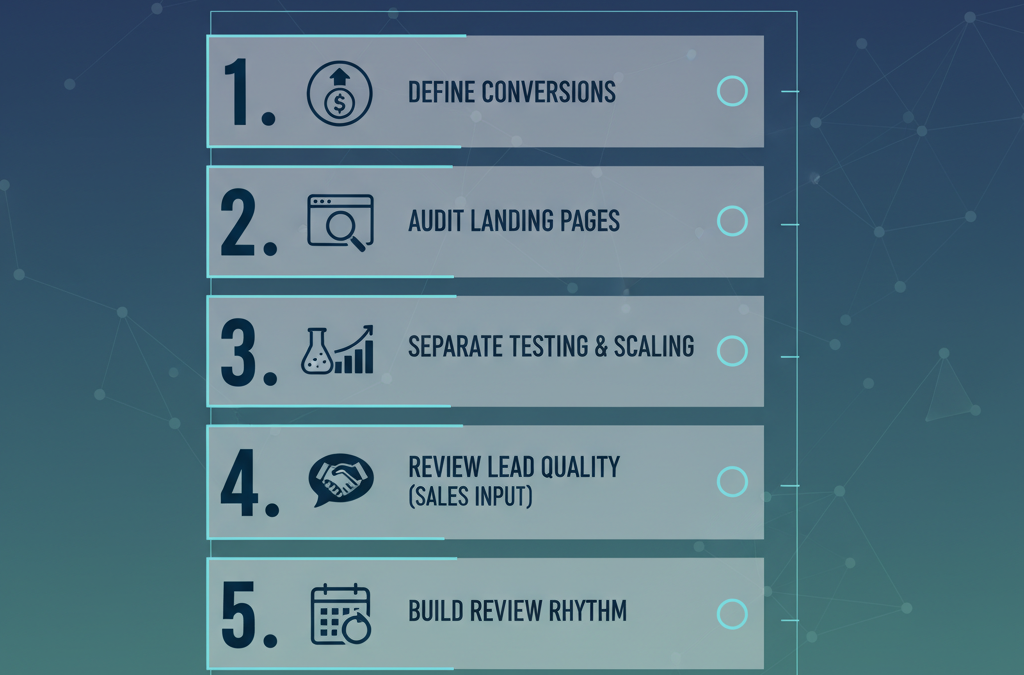
A practical checklist before increasing spend
Before a business raises ad budgets or expands content production, the foundation should be checked. More traffic can amplify existing weaknesses. A confusing offer, weak tracking, or slow landing page may become more expensive once campaigns scale.
Step 1: Define the conversion clearly
Decide which action counts as a meaningful outcome before judging performance. This step helps teams avoid vanity metrics so budget can be tied to enquiries, purchases, or sales-ready conversations.
Watch for: Reports that celebrate clicks without showing lead quality.
Useful check: Confirm that forms, calls, and purchase actions are tracked in the same reporting view.
Example: A campaign should distinguish between a newsletter signup and a request from a buyer ready to speak with sales.
Step 2: Audit the landing page
Review the page that receives traffic before changing the campaign. This step helps improve conversion paths so visitors understand the offer, trust the business, and know the next action.
Watch for: Pages with vague headlines, hidden forms, weak mobile layouts, or unclear proof points.
Useful check: Compare page behaviour by device, source, and conversion action.
Example: A paid search campaign may improve after the landing page answers pricing process, timing, and service fit questions more clearly, without listing unsupported cost claims.
Step 3: Separate testing from scaling
Run controlled tests before expanding spend across channels. This step helps identify which message, audience, or page change caused the shift in performance.
Watch for: Teams changing ads, landing pages, audiences, and budgets at the same time.
Useful check: Keep a simple log of campaign changes and review performance after enough data has collected.
Example: A headline test can be judged more cleanly if the campaign structure and landing page remain stable during the test period.
Step 4: Review lead quality with sales input
Marketing data should be checked against sales feedback. This step helps prevent campaigns from optimizing toward leads that look good in analytics but fail during follow-up.
Watch for: Campaigns with many form submissions but low-fit enquiries.
Useful check: Tag leads by source, service interest, qualification status, and sales outcome.
Example: If one keyword creates frequent low-fit enquiries, negative keywords or revised page copy may improve efficiency.
Step 5: Build a review rhythm
Set a recurring review cycle for performance, technical issues, content, and conversion tests. This step helps turn marketing into continuous improvement rather than occasional campaign launches.
Watch for: Reports that show data but do not identify the next decision.
Useful check: End each review with a short action list, an owner, and a follow-up date.
Example: A monthly review may prioritize one technical SEO fix, one landing page change, and one campaign adjustment instead of scattering effort.
Honest signals that your marketing needs a reset
A reset is not a failure. It is often a sign that the business has outgrown older tracking, messaging, or website structure. The warning signs usually appear in operations before they appear in dashboards.
Common signs include rising spend without better lead quality, traffic growth without more sales conversations, inconsistent reporting between platforms, and landing pages that no longer match current services. Another signal is internal confusion: sales, leadership, and marketing teams disagree about which campaigns are working because each team sees a different slice of the data.
Short-term fixes versus system fixes
A short-term fix may pause a weak ad group or rewrite a headline.
A system fix may rebuild tracking, revise landing pages, and connect lead quality back to source data.
Short-term fixes can help, but system fixes usually explain why performance changed.
The stronger path is usually to simplify first. Clean up tracking, define qualified outcomes, repair the highest-impact website issues, and then decide which channels deserve renewed investment.
Get clear advice before your next campaign
If your marketing reports feel busy but not useful, a structured review can show where the gaps are. Zigma Internet Marketing brings Google Partner-certified expertise across SEO, PPC, web development, content, conversion rate optimization, and analytics, with reporting focused on business outcomes rather than isolated platform metrics.
For a practical review of your current channel mix, tracking setup, and growth priorities, 📩 Book a Free Strategy Call.
FAQs About digital marketing business
Campaigns are being measured properly when form submissions, phone calls, purchases, and other meaningful actions can be traced back to the correct channel and campaign. Reports should also separate traffic activity from qualified business outcomes.
Useful data can appear once campaigns have enough traffic and conversions to show patterns. Paid campaigns often provide faster feedback than SEO, while SEO signals usually need more time because rankings, content performance, and technical changes develop gradually.
The better first step depends on the business problem. Paid ads can test demand and messaging quickly, while SEO builds longer-term search visibility. Many businesses benefit from using paid search data to guide future SEO content and landing pages.
A website affects performance through page speed, mobile usability, message clarity, form placement, trust signals, and technical SEO. Strong traffic can still underperform if visitors cannot understand the offer or complete the conversion action easily.
Compare agencies by how clearly they define conversions, explain reporting, connect channels, and handle technical website issues. A strong agency should make trade-offs visible and show how recommendations connect to leads, sales conversations, or revenue quality.
Related Topics:
