
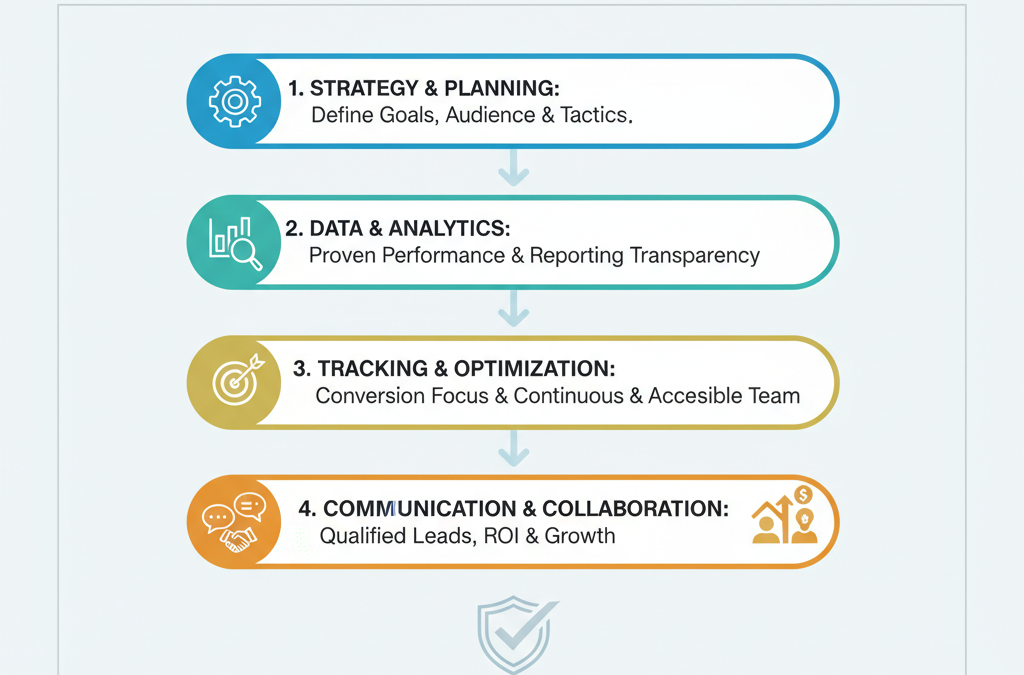
A search for digital marketing agency near me usually means the business owner wants practical help, not vague marketing talk. A qualified agency should be able to explain which channels fit your sales cycle, how leads will be tracked, what your website needs before traffic increases, and how performance will be reviewed over time.
The useful question is not only “Who appears closest in search?” It is also “Who can connect SEO, paid ads, landing pages, content, tracking, and reporting into one workable growth system?” That distinction can prevent wasted ad spend, unclear reporting, and campaigns that generate traffic without enough qualified enquiries.

What people usually mean by digital marketing agency near me
Most people using this search are not asking for a single service. They are trying to find a team that can diagnose why their current marketing is not producing enough calls, form submissions, sales, or repeatable pipeline. The phrase often points to a need for accountability, clearer communication, and practical execution.
A digital marketing agency may manage search engine optimization, paid search, website improvements, analytics, content, and social media. The stronger agencies do not treat those services as separate silos. They look at how each channel affects the next step: search visibility affects traffic, landing page quality affects conversion rate, and tracking quality affects decision-making.
For example, a company may believe it has an advertising problem because Google Ads is not generating enough leads. After reviewing the account, the actual issue may be that conversion tracking is missing, landing pages load slowly, or ads are sending visitors to broad service pages instead of focused pages with a clear next action.
How a digital marketing agency near me should think about growth
A capable agency should begin with the business model, not the channel. A service business with high-ticket enquiries needs a different plan than an e-commerce store with hundreds of products. A B2B company with a long sales cycle needs different reporting than a business that can measure same-day purchases.
The early conversation should clarify several things: which services or products have the highest value, which audiences are most likely to convert, what a qualified lead looks like, and how sales teams currently handle enquiries. Without that context, marketing reports can look busy while still failing to answer the central question: did the work create useful business activity?
Strong digital strategy often connects several execution areas:
- SEO: Improving organic visibility through technical fixes, useful content, internal linking, and stronger service pages.
- PPC: Using paid search to capture high-intent demand, test messaging, and create lead flow while organic rankings build.
- CRO: Improving landing pages, forms, calls-to-action, page speed, and trust signals so existing traffic converts more often.
- Analytics: Setting up GA4, Google Tag Manager, dashboards, and conversion tracking so decisions are based on real behaviour.
- Content: Creating pages and articles that answer buyer questions before a salesperson enters the conversation.
If SEO support is the next priority, Zigma Internet Marketing outlines its approach through its SEO Services. If paid search is the issue, the Google Ads Management page gives a clearer view of how campaigns can be structured and measured.
Which digital channels fit different business goals?
Digital marketing decisions become easier when channels are compared by timing, risk, and measurement. SEO, PPC, and CRO can all support growth, but they solve different problems. A healthy plan often uses more than one channel, with each channel assigned a specific job.
| Channel | Useful for | Typical measurement | Common risk |
|---|---|---|---|
| SEO | Building long-term search visibility for services, products, and educational queries. | Organic rankings, qualified traffic, calls, form submissions, assisted conversions. | Publishing content without fixing technical issues or weak service pages. |
| PPC | Reaching people who are already searching for a solution and need a timely response. | Cost per lead, conversion rate, search terms, impression share, return on ad spend. | Paying for broad clicks without negative keywords, landing page testing, or tracking. |
| CRO | Turning more existing visitors into enquiries, purchases, or booked appointments. | Form completion rate, call clicks, checkout progress, lead quality, page engagement. | Changing page design without understanding user intent or sales objections. |
| Content | Answering customer questions, supporting sales teams, and improving topical depth. | Engaged sessions, ranking growth, assisted leads, internal link performance. | Writing broad articles that do not connect to real services or buyer concerns. |
The main comparison is timing. PPC can create faster testing data because ads begin collecting search term and conversion data once campaigns run. SEO usually takes longer, but a well-built SEO asset can keep earning visibility after the initial work is complete. CRO sits between them because even small improvements to page clarity can affect both paid and organic traffic.
How to judge an agency before you sign anything
A good agency evaluation should feel more like a diagnostic conversation than a sales presentation. The agency should ask about margins, sales capacity, seasonality, customer lifetime value, and past marketing results. If the conversation jumps straight to deliverables, the plan may miss the business constraints that shape performance.
Use these questions to separate practical skill from polished language:
- How will leads be tracked? Ask whether calls, forms, purchases, and key website actions will be measured through GA4, Google Tag Manager, ad platforms, or CRM data.
- Which pages need improvement first? A serious review should identify whether your service pages, product pages, or landing pages can convert traffic before spend increases.
- How will reporting connect to business outcomes? Reports should explain lead volume, lead quality, conversion rate, acquisition cost, and channel contribution rather than only traffic and impressions.
- What will be tested in the first 60 to 90 days? Early testing may include ad copy, landing page structure, keyword targeting, search terms, content gaps, and tracking accuracy.
- Who is responsible for implementation? Strategy has limited value if technical SEO fixes, tracking setup, website edits, and campaign changes are not completed.
For website-related gaps, the service page for Website Design & Development explains how design, development, and technical SEO can work together. For broader planning, Zigma’s Digital Marketing Services page shows how SEO, PPC, web, content, and analytics fit into one operating plan.
What impacts ROI in modern digital campaigns
Marketing ROI is shaped by more than ad spend or rankings. The biggest drivers are often the less visible pieces: tracking accuracy, page relevance, sales follow-up speed, lead qualification, and how quickly the campaign is adjusted after data arrives.
Several metrics deserve attention because they connect marketing activity to business performance:
- Conversion rate: The percentage of visitors who complete a meaningful action, such as calling, submitting a form, or buying.
- Cost per qualified lead: The spend required to generate a lead that matches your target customer profile, not just any enquiry.
- Lead-to-sale rate: The percentage of leads that become customers after sales follow-up.
- Revenue per channel: The revenue linked to SEO, PPC, email, social, referral, or direct traffic where tracking allows it.
- Landing page engagement: Behaviour signals such as scroll depth, form interaction, click activity, and drop-off points.
A campaign with a lower cost per click can still underperform if the clicks are weak. A campaign with a higher cost per click can be profitable if the search terms are specific, the landing page is persuasive, and the sales team responds quickly. The full path has to be measured.
SEO vs PPC and when each route makes sense
SEO and PPC are often compared as if one should replace the other. A more useful view is to assign each channel a different job. SEO builds visibility and authority over time, while PPC creates faster testing data and captures demand that may not yet be covered by organic rankings.
SEO is usually a strong fit when your business needs durable visibility for service pages, product categories, resource content, and branded credibility. Technical SEO, content SEO, and internal linking help search engines understand what your website offers and which pages deserve visibility.
PPC is usually a strong fit when speed, testing, or controlled targeting is needed. Google Ads can test which search terms convert, which messages produce enquiries, and which landing pages need revision. That data can also improve SEO planning because paid search reveals how real people phrase high-intent searches.
The combined route is often the most practical: use PPC for immediate demand capture and message testing, while SEO builds stronger organic visibility. Add CRO to improve both channels because better landing pages can reduce waste in paid campaigns and increase the value of organic traffic.
Common warning signs during agency selection
Some warning signs appear before work begins. A proposal that promises rankings without reviewing your website, competitors, content, and technical condition is not grounded in enough evidence. A paid ads plan that ignores landing pages and conversion tracking is also incomplete.
Watch for these issues during early conversations:
- No tracking plan: If an agency cannot explain how calls, forms, purchases, or qualified leads will be measured, reporting may become unreliable.
- Channel-first thinking: A recommendation for SEO, PPC, or social media should be tied to your sales cycle and customer behaviour.
- Thin reporting: Reports that focus only on impressions, clicks, and rankings may not show whether marketing is helping revenue conversations.
- Weak implementation support: Campaign ideas can stall if the agency cannot help with landing pages, tracking, technical fixes, or content production.
- Overconfident timelines: Search behaviour, competition, website condition, and sales process quality all affect how quickly results appear.
A reliable agency should be comfortable explaining limitations. Some websites need technical cleanup before aggressive content production. Some ad accounts need tracking repaired before spend increases. Some landing pages need clearer proof, stronger forms, or simpler navigation before more traffic is useful.
A practical checklist for choosing with confidence
Before choosing a digital marketing partner, document what success actually looks like. “More traffic” is not specific enough. Better goals include more qualified consultation requests, higher e-commerce conversion rate, lower wasted ad spend, stronger visibility for priority services, or clearer attribution across channels.
Step 1: Define the business outcome
State the outcome in plain language before reviewing channels. The goal may be more sales calls, better product revenue, stronger pipeline quality, or improved visibility for a priority service.
Useful metric: Qualified leads, purchases, booked consultations, or revenue attributed to marketing channels.
Risk if skipped: Campaigns can look active while failing to support sales priorities.
Example: A business may decide that lead quality is more valuable than raw lead volume because the sales team is spending too much time on poor-fit enquiries.
Step 2: Audit the website before increasing traffic
Review page speed, mobile usability, service page clarity, form behaviour, and tracking. More traffic will not fix a website that confuses visitors or hides the next step.
Useful metric: Conversion rate by landing page, mobile engagement, form completion rate, and call click activity.
Risk if skipped: Paid and organic campaigns may send visitors to pages that are not ready to convert.
Example: A service page with strong rankings may still underperform if the page lacks proof, clear service details, and a simple enquiry path.
Step 3: Ask for channel reasoning
Each recommended channel should have a clear role. SEO may build durable visibility, PPC may test demand quickly, and CRO may improve the value of both.
Useful metric: Channel contribution to qualified enquiries, assisted conversions, and lead-to-sale rate.
Risk if skipped: Budget can be spread across too many activities without enough depth in any single area.
Example: A company with urgent lead needs may use PPC first while technical SEO and service page improvements are being completed.
Step 4: Review reporting samples
Reporting should explain what changed, why it changed, and what will happen next. A dashboard is useful only if the agency can interpret the data and turn it into action.
Useful metric: Search terms, conversion paths, campaign spend, landing page conversion rate, and lead quality notes.
Risk if skipped: You may receive data without clear decisions attached to it.
Example: A PPC report should show which queries created waste, which negative keywords were added, and which landing page changes are planned.
Step 5: Confirm implementation ownership
Clarify who will write content, build landing pages, update the website, configure tracking, and adjust campaigns. Clear ownership prevents delays.
Useful metric: Completed tasks, testing cadence, technical fixes shipped, and campaign changes documented.
Risk if skipped: Strategy can sit unused because nobody is responsible for execution.
Example: If a landing page test is recommended, the next step should identify who writes the copy, who builds the page, and how the result will be measured.
How Zigma Internet Marketing approaches the conversation
Zigma Internet Marketing focuses on lead generation and measurable growth across SEO, PPC, web design and development, content, social media marketing, analytics, and conversion improvement. The work is built around clear reporting, practical implementation, and steady optimisation cycles.
Trust signals should be specific. Zigma brings Google Partner-certified expertise, full-service execution across major digital channels, and reporting that connects campaign activity to calls, forms, sales, and acquisition efficiency. That combination is especially useful when a business needs both strategy and the technical work required to put the strategy into practice.
If you want a second set of eyes on your search visibility, paid campaigns, tracking, or landing pages, you can 📩 Book a Free Strategy Call with Zigma Internet Marketing.
FAQs About digital marketing agency near me
An agency understands your business when it asks about margins, lead quality, sales follow-up, customer lifetime value, and capacity before recommending channels. Strong recommendations should connect marketing activity to specific outcomes such as qualified enquiries, purchases, booked consultations, or reduced wasted spend.
Start with the area creating the biggest constraint. If the website does not convert, improve landing pages and tracking first. If fast testing is needed, PPC can provide data quickly. If long-term search visibility is weak, SEO should become a structured priority.
A useful audit should review technical SEO, content gaps, paid search structure, landing page clarity, conversion tracking, analytics setup, and reporting quality. The audit should also identify which fixes are urgent, which can wait, and which actions are likely to affect leads or sales.
Paid campaigns can produce early data once tracking is working, but performance still needs testing and refinement. SEO usually needs a longer review window because technical fixes, content improvements, indexing, and ranking movement take time. Judge progress through milestones, not only final outcomes.
Monthly reporting should show traffic quality, rankings where relevant, paid search spend, conversions, cost per lead, landing page performance, completed work, and next actions. The report should explain what the data suggests rather than only listing numbers from different platforms.
Related Topics:
