
The phrase best GPT ads agency (advertising on OpenAi chatgpt) usually means you are trying to find a team that can help you prepare for paid visibility in AI-driven environments without wasting budget on vague AI branding. Right now, most businesses do not need hype. They need a partner that can connect audience research, ad strategy, landing pages, tracking, creative testing, and conversion data into a plan that is practical today and adaptable as GPT ads mature.
A strong agency in this space should already be good at the fundamentals: paid media planning, audience segmentation, message testing, analytics, and conversion rate optimization. That matters because advertising in AI-led products will likely reward the same discipline that makes Digital Marketing Services perform well elsewhere—clear intent matching, clean data, strong offers, and landing experiences that answer the user’s question fast. If you are evaluating agencies now, the real question is not who says “AI” the most. It is who can help you spend carefully, measure honestly, and adapt quickly as the channel evolves.
What a GPT ads agency actually does
A GPT ads agency should do more than place ads beside AI conversations. The real job is to build a paid acquisition system that fits how people behave when they use conversational tools. A search user often types a short query. A ChatGPT user may describe a need in full sentences, ask follow-up questions, compare vendors, and narrow intent across several turns. That changes messaging, offer structure, and the way a landing page needs to carry the conversation forward.
In practice, that means the agency should be able to translate audience language into campaigns, build conversion-focused pages, set up clean attribution, and compare performance against channels such as paid search and paid social. If they already manage Google Ads Management, they should be able to explain what would stay the same and what would change in a conversational ad environment. The overlap is substantial: keyword intent becomes prompt intent, ad relevance still matters, and measurement is still the line between useful testing and expensive guessing.
It also helps if the agency understands owned media. Businesses that invest in SEO Services, technical content, and first-party data are usually in a stronger position for AI visibility overall. Paid exposure may open the door, but the website, offer, and tracking setup still decide whether the campaign produces leads or just traffic.
How to judge the best GPT ads agency before you sign
If you are buying agency support for a new ad environment, the safest starting point is operational discipline. Ask how the agency validates demand, how it structures tests, what it considers a meaningful sample, and how it decides whether to scale or stop. A capable team will talk about message clarity, conversion tracking, audience quality, assisted conversions, and landing-page friction—not just impressions and novelty.
There is also a useful comparison to make here. Some agencies are strong at media buying but weak on the website side. Others are creative-heavy but light on attribution. For lead generation ads, that gap becomes expensive fast. If the ad gets attention but the page is slow, confusing, or untracked, the campaign can look worse than it really is—or better than it really is. The best agency is usually the one that can connect media, CRO, analytics, and content without forcing you to manage the gaps yourself.
Ask a few direct questions: Who owns the tracking plan? Who builds the landing page? Who reviews search intent, prompt intent, and audience signals together? How are reports tied to calls, forms, qualified leads, or sales? Those questions often reveal more than a pitch deck.
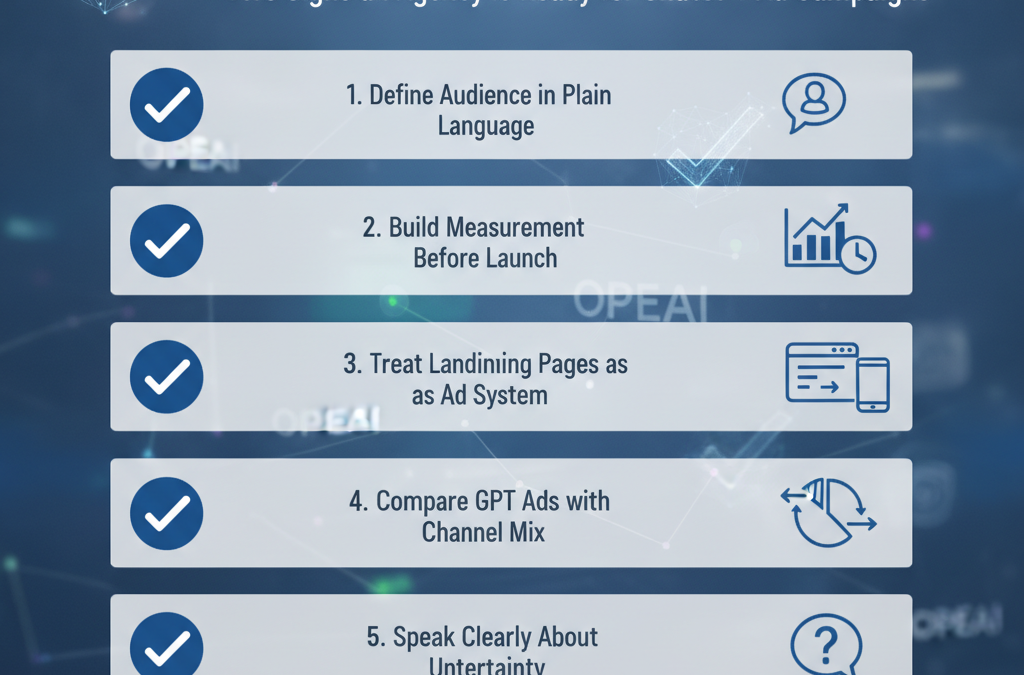
Five signs an agency is ready for GPT ad campaigns
Step 1: They define the audience in plain language
A capable team should explain who the campaign is for, what problem the audience is trying to solve, and what level of buying intent the message targets. That description should sound like a real buyer conversation, not a bundle of demographics. This step helps sharpen targeting so you can reduce wasted clicks and make creative choices that fit the user’s actual question.
What to look for: They can separate early-stage research users from ready-to-buy users.
Why it counts: Conversational platforms often reveal intent depth more clearly than short search queries.
Example: A B2B software firm may need one message for users comparing vendors and another for users trying to solve an internal workflow issue.
Step 2: They build measurement before launch
The agency should map conversions before any campaign goes live. That includes forms, calls, booked meetings, e-commerce events, CRM handoff, and any offline conversion import that affects decision quality. This step helps protect reporting integrity so you can judge channel quality instead of reacting to surface-level traffic numbers.
What to look for: A clear plan for conversion tracking, analytics, and source attribution.
Why it counts: New channels create reporting confusion when foundational tracking is weak.
Example: If a campaign generates demo requests but none are tagged correctly in the CRM, budget decisions become guesswork.
Step 3: They treat landing pages as part of the ad system
A serious GPT ads agency will not act as if media buying alone carries the result. The post-click experience has to match the promise, answer the next question, and reduce friction. This step helps improve lead quality so you can turn paid interest into calls, forms, or sales instead of bounces.
What to look for: Experience with landing pages & conversion rate optimization (CRO).
Why it counts: AI-driven discovery often produces better-informed visitors who expect sharper answers.
Example: A landing page that repeats generic claims may underperform against one that shows use cases, proof points, and a simple next step.
Step 4: They compare GPT ads with the rest of your channel mix
The best agency should explain whether this channel belongs beside paid search, retargeting, social, or content amplification. New inventory should be assessed in context, not isolation. This step helps allocate budget sensibly so you can protect efficiency while still testing emerging opportunities.
What to look for: Cross-channel planning across search engine marketing SEM, paid social, and content.
Why it counts: A good result is not just “traffic from AI.” It is profitable traffic compared with alternatives.
Example: A local service brand may get faster lead volume from paid search first, while GPT-oriented testing supports brand consideration and mid-funnel education.
Step 5: They speak clearly about uncertainty
Any agency working near a new ad format should be upfront about what is proven, what is still being tested, and which inputs may change. That includes inventory availability, targeting controls, creative constraints, reporting depth, and scale potential. This step helps set expectations so you can make decisions based on evidence instead of momentum.
What to look for: Calm language, testing discipline, and reporting that connects spend to outcomes.
Why it counts: Overconfidence is often a warning sign in emerging channels.
Example: If an agency guarantees volume before it has real data, it is probably selling certainty it cannot measure.
How to choose the right digital marketing agency for GPT ads
The right agency for GPT ads usually looks a lot like the right agency for any serious acquisition effort: strategic, technically competent, and willing to be measured on business outcomes. The difference is that AI-led advertising adds more ambiguity at the channel level, so the agency’s planning process becomes even more important. A team that is weak on structure can burn time quickly.
Start by checking whether the agency has real depth in ppc agency toronto-style campaign management, landing page execution, and reporting. Even if your target market is not tied to a city, that phrase often signals a commercial skill set: paid media efficiency, search intent analysis, and lead quality management. The agency should also be able to support adjacent needs such as website development & technical SEO, content testing, and analytics setup. GPT ads will not exist in a vacuum. They will sit inside a larger digital system.
A few useful filters:
- Ask for process, not slogans: A real team can show how campaigns move from research to launch to optimisation.
- Check implementation depth: If they cannot touch the page, the tracking, or the offer, performance may stall even with decent ad traffic.
- Review reporting logic: Clear dashboards and CRM feedback loops matter more than broad traffic summaries.
- Look for channel honesty: A strong agency will tell you when another platform may deserve budget first.
What impacts ROI in modern digital campaigns
Return from paid media is usually shaped less by the platform name and more by the system behind it. Audience fit, message clarity, speed-to-page, conversion friction, offer quality, and sales follow-up all influence whether media spend turns into revenue. That is true for online marketing toronto, for traditional search, and for any future conversational ad channel.
Three performance patterns show up repeatedly. First, campaigns tend to improve when the offer is specific. “Book a demo in 15 minutes” is easier to act on than broad brand language. Second, campaigns tend to improve when the page answers the next question immediately. Third, campaigns tend to improve when reporting closes the loop between click and outcome. If a team is serious about marketing dashboards, ga4 setup, and google tag manager, that is usually a good sign. It suggests the agency understands that spend without clean data is not strategy.
One practical comparison helps here: a mediocre campaign with strong tracking can often be fixed, while a decent campaign with weak tracking can remain misleading for months. That is why the best GPT ads agency should care as much about attribution as ad placement.
SEO vs PPC: where GPT advertising fits
Search engine optimization and paid media play different roles, and GPT advertising will likely sit closer to PPC than SEO in execution while still being influenced by both. SEO builds visibility over time through technical health, content quality, topical coverage, and site authority. PPC buys attention faster, but it depends on message testing, bidding discipline, and conversion efficiency.
For many businesses, the smarter question is not SEO versus PPC. It is timing and sequencing. If you need near-term demand capture, paid campaigns may do more heavy lifting. If you need durable visibility, content and technical work become more important. If you are preparing for AI discovery, both sides help: structured content improves understanding, while paid testing helps you refine offers and user language. Businesses that invest in content marketing toronto, technical seo services, and clean paid acquisition often have a better base for future AI placements.
That balance is one reason full-service support can be useful. If your agency also understands Website Design & Development, it can improve the page experience instead of blaming performance on the channel alone.
How local businesses can compete online without wasting budget
Many small and mid-sized firms do not need a huge experimental budget to compete. They need cleaner positioning, stronger service pages, tighter targeting, and better follow-up. For local brands, the basics often still carry the most weight: local seo gta, google business profile optimization, tightly managed paid search, and landing pages built for a single action.
A local service business, for example, may benefit more from improving google ads management toronto-style campaign structure, call tracking, and geographic exclusions than from chasing every new ad format at once. An e-commerce brand may get better early signals from feed quality, retargeting, and product-specific landing pages. GPT ads may become a meaningful part of the mix, but they should enter a system that already works reasonably well.
The businesses that usually compete best are not the ones doing everything. They are the ones measuring a few important actions consistently—calls, forms, booked consultations, qualified leads, repeat purchases—and refining from there.
Why trust matters when hiring a GPT ads agency
If you are evaluating the best GPT ads agency for advertising on OpenAI ChatGPT, trust should come from process visibility and practical execution, not big claims. Zigma Internet Marketing brings Google Partner-certified expertise, cross-channel delivery across SEO, PPC, web, content, and social, and a reporting style built around measurable outcomes such as calls, forms, sales, and acquisition efficiency. That combination is useful when a newer channel requires careful testing and clean data.
Businesses that work with Zigma also gain implementation support across landing pages, analytics, dashboards, and performance improvement cycles. For conversations about fit, planning, and next steps, you can reach the team at (647) 556-6071 or info@zigma.ca.
Ready to assess GPT ads with a measurable plan?
Zigma Internet Marketing helps businesses evaluate new paid channels with disciplined tracking, landing page support, and KPI-focused optimisation. That means clearer decisions before budget scales.
FAQs About best GPT ads agency (advertising on OpenAi chatgpt)
Testing makes sense once your core tracking, landing pages, and offer positioning are already in decent shape. If those basics are weak, a newer ad channel can create noise rather than useful signal.
The first layer should be qualified traffic, conversion actions, lead quality, and assisted conversion behaviour. Impressions alone rarely tell you whether the channel is producing commercial value.
Yes, if the agency is strong in audience intent, creative testing, landing pages, and attribution. The platform may be different, but the underlying discipline is still campaign structure plus measurement.
No. It is more realistic to treat it as an additional channel or format that may support awareness, consideration, or lead generation depending on how inventory and targeting develop.
The biggest mistake is choosing based on AI buzzwords alone. A better choice is an agency that can explain targeting, testing, tracking, landing page alignment, and what success would look like before launch.
Related Topics:
- search engine optimization
- pay per click advertising
- local search marketing
- conversion optimization
- analytics and tracking setup