
How digital marketing companies near me searches really work
Searching for digital marketing companies near me usually means you want more than a list of agencies. You want to know which company can explain the work clearly, connect marketing activity to leads or sales, and show whether your budget is being used wisely. The phrase “near me” can help you find agencies that are easier to communicate with, but proximity alone does not prove capability.
A strong digital marketing company should be able to explain how SEO, paid ads, website performance, content, tracking, and conversion paths work together. If the conversation starts and ends with rankings, impressions, or vague traffic growth, the strategy may be incomplete. A better conversation connects marketing activity to business outcomes such as calls, form submissions, qualified enquiries, booked appointments, or e-commerce transactions.
Zigma Internet Marketing supports businesses with Digital Marketing Services that combine planning, execution, reporting, and continuous improvement. The main lesson for any business owner is simple: choose a marketing partner based on evidence, clarity, and fit — not just search visibility.
Quick Facts: Digital Marketing Companies Near Me
Use this snapshot before comparing agencies.
- What: A digital marketing company plans and manages online growth channels such as SEO, PPC, website improvements, content, analytics, and social campaigns.
- Who: The right fit is usually a team that can explain strategy, implement changes, and report on business outcomes rather than isolated marketing activity.
- Where: “Near me” helps narrow your search, but service quality depends on process, communication, technical skill, and accountability.
- How: Strong agencies use tracking, keyword research, landing pages, campaign testing, reporting dashboards, and conversion analysis to guide decisions.
- Why: Better selection reduces wasted spend, unclear reporting, slow execution, and campaigns that attract traffic without producing qualified leads.
How a digital marketing company actually creates growth
A digital marketing company creates growth by improving how people find, evaluate, and contact your business online. That usually involves several connected services rather than a single tactic. Search engine optimization helps your website become more visible for relevant queries. Paid search can bring faster traffic while organic visibility develops. Website design and conversion rate optimization help visitors take the next step once they land on a page.
The mechanism is cause and effect. Better targeting brings better traffic. Better landing pages reduce confusion. Better tracking shows which campaigns produce calls, forms, purchases, or qualified conversations. Without that chain, marketing becomes difficult to judge because activity increases while business impact stays unclear.
For example, SEO Services should not only focus on keywords. Effective SEO also addresses technical health, content quality, page structure, internal links, search intent, and conversion paths. The goal is not just to appear in search; the goal is to attract the right audience and give that audience a clear reason to act.
Signals that separate capable agencies from weak ones
The strongest agency signals are usually visible before a contract is signed. A capable digital marketing company asks about margins, lead quality, sales process, service capacity, seasonality, and current tracking. A weaker agency may jump straight into channel recommendations before understanding how your business earns revenue.
Look for evidence in the way the agency explains decisions. If an agency recommends Google Ads, can the team explain keyword intent, negative keywords, conversion tracking, landing page alignment, and budget pacing? If an agency recommends SEO, can the team explain technical issues, content gaps, search intent, internal linking, and how progress will be measured?
- Clear measurement plan: The agency should define which actions count as meaningful conversions, such as calls, forms, purchases, demo requests, or booked consultations.
- Channel-specific reasoning: Recommendations should explain why SEO, PPC, social media, content, or web development fits the current business stage.
- Implementation ability: Strategy has limited value if no one can update landing pages, install tracking, fix technical SEO issues, or test ad copy.
- Reporting clarity: Reports should connect spend, traffic, enquiries, lead quality, and next actions rather than listing disconnected metrics.
Comparing SEO, PPC, web design, and analytics support
Different digital marketing services solve different problems. A business that needs immediate demand may require paid search, while a business with weak organic visibility may need SEO and content. A business with traffic but few enquiries may need landing page improvements and analytics work before increasing ad spend.
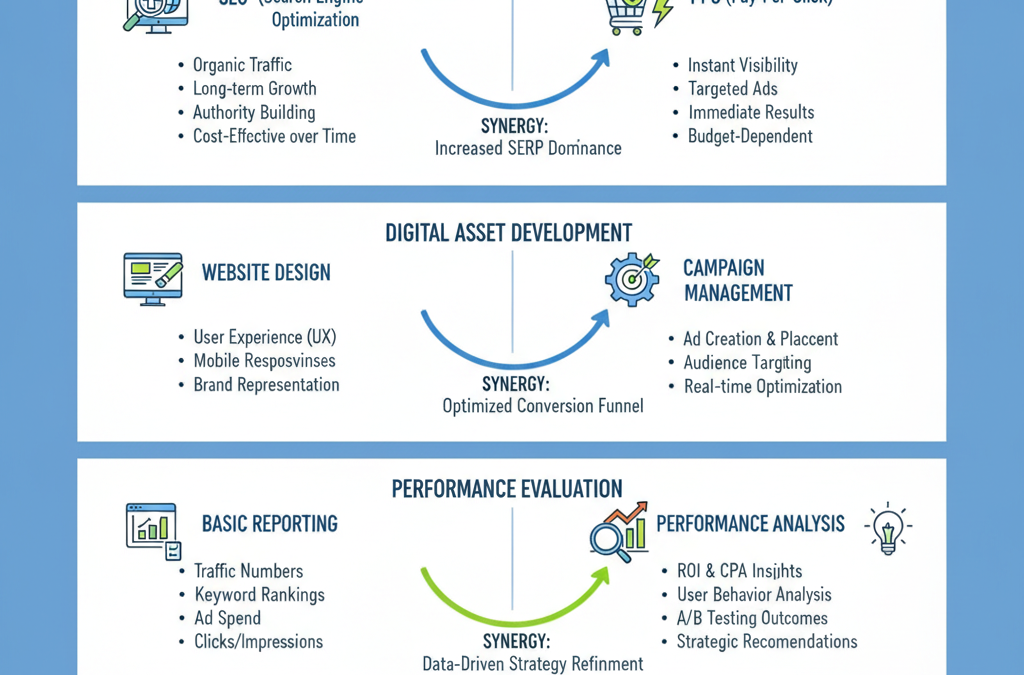
SEO compared with paid search
A) SEO: SEO improves organic visibility by strengthening website structure, content, authority signals, and technical performance.
- How it works: SEO aligns pages with search intent, improves crawlability, and builds content that answers buyer questions.
- Best fit: SEO fits businesses that want durable search visibility and can invest in steady improvements over time.
- Example: A service page with weak content may need clearer headings, stronger FAQs, internal links, and technical cleanup before rankings improve.
B) PPC: PPC places ads in front of searchers quickly and gives the business faster feedback on keywords, offers, and landing pages.
- How it works: Campaigns target specific queries, control bids, filter poor matches, and measure conversions from paid traffic.
- Best fit: PPC fits businesses that need faster lead flow, have clear margins, and can handle active campaign testing.
- Example: A campaign may reveal which search terms produce qualified enquiries before the business invests in longer-term SEO content.
C) Combined SEO and PPC: Using both channels can create faster insight and stronger long-term visibility when tracking is set up correctly.
- How it works: PPC data can inform SEO priorities, while SEO pages can improve landing page relevance for paid campaigns.
- Best fit: A combined plan fits businesses that want short-term traffic feedback and longer-term organic growth.
- Example: Paid search data may show that one service category converts better, which can guide future SEO page development.
Website work compared with campaign work
A) Website design: Website design shapes how visitors understand your offer, trust your business, and move toward contact or purchase.
- How it works: Design improves page layout, message clarity, mobile usability, navigation, calls to action, and visual hierarchy.
- Best fit: Website design fits businesses with outdated pages, unclear service information, or low enquiry rates despite traffic.
- Example: A landing page may need clearer proof, shorter forms, stronger service explanations, and faster mobile loading.
B) Campaign management: Campaign management focuses on attracting qualified traffic through paid search, paid social, organic content, or email campaigns.
- How it works: Campaign work tests audiences, keywords, creative, budgets, and landing pages to improve acquisition quality.
- Best fit: Campaign management fits businesses that already have a credible website and need more qualified traffic.
- Example: A Google Ads campaign may need tighter query controls and better landing page alignment to reduce wasted clicks.
C) Website and campaign alignment: The strongest results often come when traffic generation and conversion improvements are managed together.
- How it works: Campaign data identifies visitor behaviour, while website updates remove friction from the enquiry or purchase path.
- Best fit: Alignment fits businesses that are spending on ads but seeing too few qualified leads from that traffic.
- Example: A campaign may produce clicks, but a slow page or unclear offer can stop visitors from converting.
Reporting compared with real analysis
A) Basic reporting: Basic reporting lists numbers such as sessions, impressions, clicks, rankings, or follower activity.
- How it works: Reports pull data from platforms and present campaign activity in a recurring format.
- Best fit: Basic reporting may be enough for simple visibility tracking, but it rarely explains what should change next.
- Example: A report may show more traffic without explaining whether the traffic produced useful enquiries.
B) Performance analysis: Performance analysis connects metrics to business questions and identifies the next improvement.
- How it works: Analysis reviews conversion paths, lead quality, search terms, landing page behaviour, and campaign efficiency.
- Best fit: Performance analysis fits businesses that need to decide where to invest time and budget next.
- Example: Analysis may show that mobile users abandon a form, leading to a shorter form and clearer page copy.
C) Dashboard plus action plan: A dashboard becomes more useful when it is paired with clear actions, owners, and timelines.
- How it works: Dashboards monitor KPIs while the agency translates patterns into changes across ads, SEO, content, or landing pages.
- Best fit: This structure fits businesses that want accountability and a consistent improvement rhythm.
- Example: A dashboard may show rising cost per lead, while the action plan addresses query waste and landing page friction.
Questions to ask before hiring an agency
A good agency conversation should feel structured, specific, and easy to follow. You do not need to know every technical term, but you should understand why the agency recommends a channel and how success will be evaluated. Ask questions that reveal how the company thinks, not just what services it sells.
Question 1: Which business outcome are we improving first?
This question separates activity from strategy. A clear answer might focus on more qualified calls, stronger e-commerce sales, improved lead quality, reduced wasted ad spend, or better conversion tracking.
Watch for: Answers that jump straight to rankings, impressions, or clicks without explaining how those metrics connect to revenue or lead quality.
Example: If your website already receives traffic but enquiries are weak, conversion rate optimization may deserve attention before a larger ad budget.
Question 2: How will tracking be set up and checked?
Tracking is the measurement foundation. A serious agency should discuss GA4, Google Tag Manager, call tracking where appropriate, form tracking, e-commerce events, and dashboard reporting.
Watch for: Reports that show traffic but cannot identify which channel, page, or campaign produced meaningful actions.
Example: A business may think ads are underperforming until tracking reveals that phone calls were not being counted.
Question 3: What needs to change on the website?
Traffic alone rarely fixes a weak conversion path. The agency should review page speed, page structure, mobile usability, service clarity, forms, trust signals, and calls to action.
Watch for: Campaign recommendations that ignore the landing page experience.
Example: Paid traffic sent to a generic homepage may convert poorly compared with traffic sent to a focused landing page.
Question 4: How often will strategy be adjusted?
Digital campaigns need review cycles. Search terms change, competitors adjust, landing pages age, and user behaviour shifts across devices.
Watch for: Plans that describe setup but say little about testing, measurement, and refinement.
Example: A PPC account may need negative keyword updates, budget reallocation, ad copy tests, and landing page changes after early data comes in.
Question 5: Who is doing the work?
Strategy, implementation, and reporting require different skills. Ask who handles technical SEO, ad management, content, development, analytics, and account communication.
Watch for: A vague team structure where no one is clearly responsible for execution quality.
Example: A content recommendation may require a developer, SEO strategist, copywriter, and analytics specialist to complete properly.
What impacts ROI in modern digital campaigns
Return on investment in digital marketing is shaped by more than traffic volume. Campaign efficiency depends on targeting quality, landing page clarity, sales follow-up, offer strength, conversion tracking, and how quickly insights become action. A campaign can look busy in a report while still producing poor commercial value.
Several factors carry extra weight. Search intent affects whether visitors are researching or ready to contact a provider. Landing page speed affects how many people stay long enough to read. Forms affect completion rates. Sales response time affects whether an enquiry turns into revenue. Tracking affects whether the business can see which channel deserves more attention.
Useful ROI conversations often begin with two questions: which leads are actually valuable, and which marketing actions influence those leads? Without those answers, budget decisions become guesswork.
Campaign factors that change performance
- Intent quality: High-intent search terms usually produce stronger enquiries than broad informational traffic with no clear buying signal.
- Landing page fit: A page should match the ad or search query closely enough that visitors immediately understand the offer.
- Tracking accuracy: Decisions improve when calls, forms, purchases, and lead sources are measured consistently.
- Sales process alignment: Marketing performance can be limited if enquiries are slow to receive a response or are not qualified properly.
- Testing rhythm: Campaigns improve faster when ad copy, search terms, page content, and conversion paths are reviewed regularly.
SEO vs PPC: where each strategy fits
SEO and PPC are often compared as if one must replace the other. A more useful comparison is timing and control. SEO builds organic visibility through content, technical health, and authority signals. PPC gives faster placement and more control over which queries trigger visibility, but paid traffic stops when campaigns pause.
SEO can be a stronger fit when your website needs long-term visibility across service pages, educational content, and recurring search demand. PPC can be a stronger fit when you need faster testing, controlled traffic, or support for a specific offer. Many businesses use both: PPC supplies faster feedback, while SEO builds a more durable acquisition channel.
Zigma Internet Marketing manages Google Ads Management alongside SEO, web development, content, and analytics. That combined view is useful because poor campaign performance is not always an ad problem. Sometimes the real issue is tracking, page speed, offer clarity, or a mismatch between search intent and landing page content.
Website and conversion work should not be an afterthought
Many marketing problems are website problems in disguise. If your site loads slowly, hides key service details, lacks proof, or makes contact forms difficult, more traffic can simply send more people into the same friction. That is why website work and conversion rate optimization should be part of the agency discussion.
A conversion-focused website does not need to be complicated. It needs clear service pages, persuasive but honest copy, strong mobile usability, visible contact paths, and analytics that confirm whether visitors take meaningful actions. For e-commerce, the same principle applies to product pages, product feeds, checkout flow, and campaign tracking.
If your current website is limiting performance, Website Design & Development can support SEO, paid campaigns, and conversion improvements at the same time. The key is to treat the website as a revenue asset, not just a digital brochure.
A trust check before choosing digital marketing companies near me
Before choosing from digital marketing companies near me, look for trust signals that connect directly to execution quality. Zigma Internet Marketing brings Google Partner-certified expertise, full-service delivery across SEO, PPC, web, content, social, and analytics, and reporting that focuses on KPIs tied to business outcomes. That mix helps reduce the gap between strategy and implementation.
If you want a second set of eyes on your current marketing setup, you can reach Zigma Internet Marketing at (647) 556-6071 or info@zigma.ca. You can also request a practical strategy conversation here: Book a Free Strategy Call.
FAQs About digital marketing companies near me
Compare agencies by how clearly they explain strategy, tracking, implementation, and reporting. A strong agency should connect SEO, PPC, website work, content, and analytics to business outcomes such as qualified enquiries, sales, or booked appointments.
Paid campaigns can produce early traffic and conversion data quickly, while SEO usually requires a longer improvement cycle. Useful signals often include search term quality, landing page behaviour, conversion tracking accuracy, and whether enquiries match the business’s ideal customer profile.
Hiring one agency for SEO and PPC can work well if the team shares data between channels. PPC can reveal converting queries, while SEO can strengthen pages that support long-term visibility. The main requirement is clear reporting across both channels.
Reports feel unclear when they focus on activity instead of decisions. Impressions, clicks, and rankings can be useful, but they need context. Better reporting explains what changed, what the data suggests, and what action should happen next.
Prepare your current website, main services or products, target customer profile, sales process, past campaign data, and tracking access if available. Clear business context helps the agency recommend the right mix of SEO, PPC, website, content, and analytics work.
