
Why marketing B2b needs a different playbook
Marketing b2b is the process of attracting, educating, and converting business buyers through channels and messages built for longer sales cycles, multiple decision-makers, and higher-stakes purchases. Unlike consumer campaigns, B2B growth usually depends on trust, clarity, and proof over time. A prospect may visit your site several times, compare vendors, bring colleagues into the process, and only then request a conversation. That is why strong Digital Marketing Services tend to focus on both lead quality and buying readiness, not just traffic volume.
For many teams, the real challenge is not getting seen. It is getting seen by the right companies, at the right stage, with the right message. A campaign can generate clicks and still fail if the offer is vague, tracking is incomplete, or the landing page does not answer the questions buyers actually have. Once that is clear, the rest of the strategy becomes easier to structure.
How marketing b2b works in practice
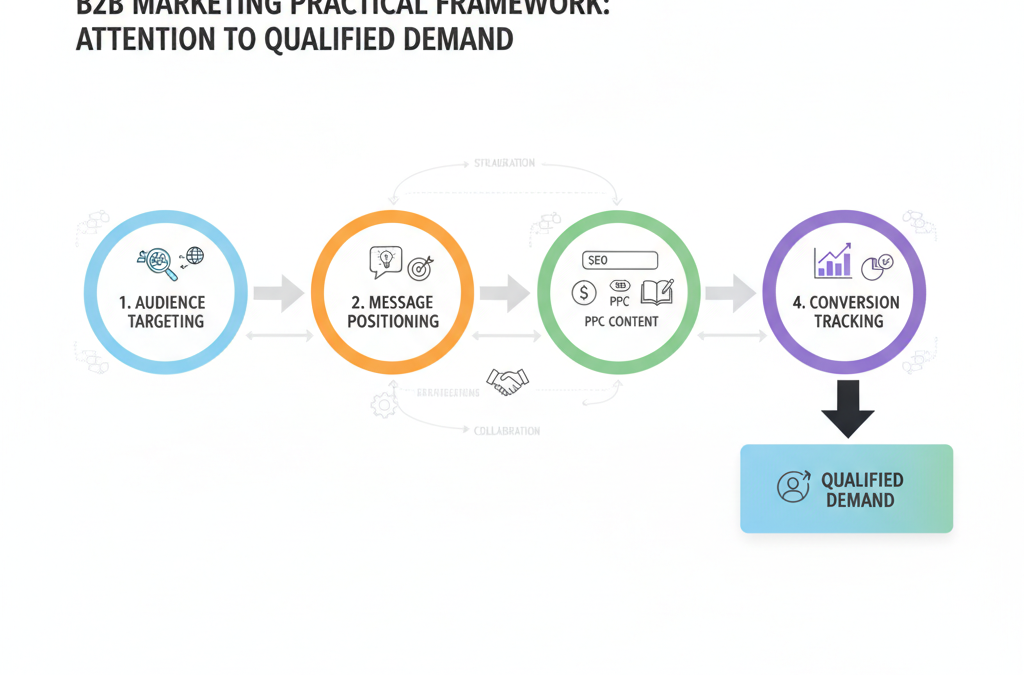
At a practical level, marketing b2b connects four pieces: audience targeting, message positioning, demand capture, and conversion tracking. Audience targeting defines who you want to reach by industry, company size, pain point, or buying intent. Message positioning explains why your solution deserves attention. Demand capture brings those prospects in through channels such as search, paid media, content, and email. Conversion tracking tells you which efforts are producing qualified conversations rather than empty form fills.
This is also where many firms mix up activity with progress. Publishing content is not a strategy by itself. Running ads is not a strategy by itself. Even a polished website is only part of the system. Sustainable B2B growth usually happens when SEO Services, paid acquisition, landing pages, and measurement work together. The goal is simple: create enough confidence for the buyer to take the next step with fewer unanswered questions.
A common misconception is that B2B buyers want deeply technical information immediately. Some do, especially late in the buying cycle. Earlier on, most buyers need a cleaner explanation: what problem you solve, who you solve it for, what implementation looks like, and what proof supports your claims. If those basics are missing, even highly relevant traffic can stall.
The B2B channels that usually carry the most weight
Most effective B2B programs are not built around one channel. They are built around how buyers behave. A prospect may first find you through search engine optimization, return later through a branded search, click a retargeting ad, and finally convert after reviewing a case study or service page. That sequence is normal. It also explains why disconnected reporting often hides what is actually driving pipeline.
Channel mix depends on sales cycle length, deal size, and market maturity, but a few patterns show up often. High-intent search tends to be useful when buyers already know the category. Pay per click advertising helps capture demand faster and test messaging quickly. Content marketing toronto-style thinking, applied to B2B more broadly, supports education and trust-building across longer cycles. Local search marketing and google business profile optimization can matter too for service firms that sell to businesses within defined regions.
What should a leadership team ask first? Usually this: are we trying to generate demand, capture existing demand, or improve conversion from the demand we already have? The answer changes where budget should go.
A practical framework for building a stronger marketing b2b system
Step 1: Define the buying committee clearly
Many B2B campaigns underperform because they speak to a company as if it were one person. In reality, there may be an owner, a marketing manager, an operations lead, and a finance approver involved. This step helps tighten relevance so you can write offers, ads, and pages that reflect real objections and real priorities.
What to document: Job roles, business pains, urgency triggers, and what each person needs to feel comfortable moving forward.
Real consequence: Better-fit leads and fewer sales calls spent educating people who were never a match.
Example: A lead generation agency toronto firm targeting manufacturers would likely need different messaging for owners than for internal marketers evaluating vendors.
Step 2: Match the offer to search intent
Not every visitor wants the same thing. Someone searching broad educational terms often wants clarity first, while someone searching branded services may be closer to a buying decision. This step helps align pages and campaigns with buyer intent so you can reduce friction and improve qualified conversion rates.
What to build: Educational blog content for early research, service pages for evaluation, and landing pages for campaign-specific conversion paths.
Real consequence: Lower bounce rates and stronger conversion paths because the page answers the question the visitor actually had.
Example: A search for technical seo services should not land on a generic agency homepage with no explanation of audits, implementation, or reporting.
Step 3: Build measurement before scaling spend
Traffic numbers can look healthy while pipeline stays flat. That usually points to missing attribution, broken forms, poor CRM visibility, or weak lead qualification rules. This step helps connect channels to outcomes so you can improve based on evidence rather than assumption.
What to track: Form submissions, phone calls, booked meetings, sales-qualified leads, and closed revenue where possible.
Real consequence: Cleaner reporting and fewer budget decisions based on vanity metrics.
Example: A company investing in google ads management toronto may think one campaign is underperforming until offline conversions show that it produces better sales opportunities than a lower-cost campaign.
Step 4: Strengthen the conversion path, not just the campaign
B2B prospects often click because the problem resonates, then leave because the page is too vague, too busy, or too hard to trust. This step helps improve the handoff from traffic to enquiry through clearer headlines, tighter proof, and focused page design.
What to improve: Offer framing, trust signals, FAQ content, page speed, and form experience.
Real consequence: Better enquiry quality without relying only on higher ad spend.
Example: Teams investing in conversion rate optimization toronto often see gains by removing extra navigation, clarifying outcomes, and adding a more specific call-to-action.
Step 5: Review channel performance as a system
B2B buyers rarely convert after one interaction, so channel reports need to be read together. Organic search may introduce the brand. Paid search may capture the return visit. Email may help move an active deal. This step helps you see the full buying path and decide where incremental improvements will have the greatest effect.
What to review monthly: Assisted conversions, branded search lift, landing page performance, sales feedback, and deal quality by source.
Real consequence: A more stable acquisition engine and fewer swings caused by overreacting to single-channel data.
Example: A firm balancing online marketing toronto, SEO, and paid media may find that organic content supports deals that are officially attributed to branded PPC at the final touchpoint.
How to choose the right digital marketing agency for B2B growth
Choosing an agency for B2B work is less about polished language and more about process discipline. A strong team should be able to explain how it handles targeting, offer development, tracking, landing pages, and optimisation without hiding behind vague reporting. If an agency talks mostly about impressions and reach but cannot explain what happens after the click, that is a warning sign.
The better question is not “Can this agency run campaigns?” It is “Can this agency connect traffic, lead quality, and revenue signals in a way our business can actually use?” That is where a capable digital marketing agency toronto, seo company toronto, or ppc agency toronto usually separates itself from a vendor that only manages tasks.
Useful evaluation points include service depth, reporting transparency, and implementation ability. Some teams can write recommendations but cannot fix tracking, landing pages, or technical issues. Others can execute across website design toronto, ads, content, and analytics, which tends to reduce delays and finger-pointing.
- Channel fit: Ask whether the agency has a clear plan for SEO, paid search, content, and remarketing based on your sales cycle.
- Measurement maturity: Ask how they handle GA4 setup, CRM alignment, attribution, and conversion definitions.
- Execution scope: Confirm whether they can support landing pages, website design toronto-level UX changes, and technical fixes.
- Decision clarity: Ask what they would stop doing first if a campaign generated leads but few qualified opportunities.
What impacts ROI in modern digital campaigns
ROI in B2B marketing is rarely shaped by one tactic alone. It is usually the product of targeting precision, offer-market fit, sales readiness, and clean measurement. Two companies can spend the same amount on acquisition and get very different outcomes because one has stronger conversion paths, faster follow-up, or better qualification rules.
A useful comparison is this: channel performance is like fuel efficiency, while sales and conversion systems are the engine. Better traffic helps, but it cannot fully compensate for weak landing pages, slow response times, or unclear service positioning. In practice, the biggest gains often come from fixing handoff points rather than simply expanding media budgets.
Several factors tend to influence ROI more than business owners expect:
- Search intent quality: Queries with stronger commercial intent usually convert better than broad informational traffic, though both can play a role.
- Landing page specificity: Pages that speak to one audience and one offer often outperform broad service pages.
- Tracking quality: Strong analytics and tracking setup prevents wasted spend and improves decision-making.
- Follow-up speed: In many B2B categories, response time influences whether an enquiry becomes a real sales opportunity.
- Offer clarity: Buyers respond better when the value proposition is concrete, especially in competitive service categories.
SEO vs PPC in marketing b2b
SEO and PPC are often treated like competing budget lines, but in B2B they usually work better together. SEO tends to build durable visibility around category, problem, and service queries. PPC creates faster testing cycles and lets you capture demand while organic rankings are still developing. The choice depends on urgency, competition, internal content capacity, and how quickly you need feedback.
If a company needs immediate lead flow, Google Ads Management may provide faster signal. If the company wants a stronger long-term presence and lower dependence on paid traffic, SEO Services tend to carry more strategic weight over time. The most resilient programs use both, with SEO supporting authority and PPC validating demand, messaging, and offer fit.
- Use SEO when: You want compounding visibility, stronger non-paid discovery, and content that supports research-stage buyers. This is often where seo services toronto and local seo gta become especially relevant for regional service firms.
- Use PPC when: You need speed, controlled testing, and quick visibility for high-intent searches. This is often where google ads management toronto performs well.
- Use both when: You want short-term lead capture and long-term demand generation working in parallel.
How local businesses in Toronto can compete online
For firms selling to businesses in Toronto, competition is often dense but uneven. Some competitors invest heavily in ads and neglect conversion. Others rank well organically but offer weak user experience. That creates room for smaller or mid-sized companies that can position clearly, track properly, and respond quickly.
A practical advantage for Toronto businesses is local relevance. Buyers often want a provider that understands regional demand patterns, service expectations, and multi-location growth across the GTA. That makes digital marketing toronto, marketing agency gta, and lead generation agency toronto queries more than geography terms. They often signal a preference for nearby implementation support and easier collaboration.
Competing well in Toronto usually depends on narrowing the message, improving proof, and earning visibility where buyer intent is strongest. For some firms that means stronger local landing pages. For others it means technical clean-up, better content marketing toronto, or more disciplined google business profile optimization paired with search campaigns.
- Own a niche first: A clear vertical or service focus is often easier to grow than broad positioning.
- Strengthen the basics: Fast pages, strong trust signals, and accurate tracking usually outperform flashy design alone.
- Support sales with content: Answer buying questions directly so prospects arrive better informed.
- Use regional intent wisely: Build pages that reflect how businesses actually search in Toronto, not just how marketers label services.
What experienced teams usually notice earlier
- Lead quality issues often start before the form fill. Weak targeting, vague offers, and mismatched keywords can create a full pipeline of poor-fit enquiries.
- Technical gaps quietly distort decisions. Broken attribution, incomplete ga4 setup, or missing google tag manager events can make good channels look weak and weak channels look strong.
- Content and paid search should inform each other. Search query data often reveals objections, language patterns, and service angles that improve organic content and landing pages.
Key takeaways for stronger marketing b2b
Good marketing b2b is usually less about chasing every channel and more about building a system that helps the right buyers move forward with confidence. Clear positioning, intent-matched pages, reliable tracking, and steady optimisation tend to produce better outcomes than scattered activity. For business owners, the practical question is not whether a tactic sounds impressive. It is whether that tactic fits the sales cycle, supports qualified demand, and can be measured honestly.
Zigma Internet Marketing supports B2B companies with SEO, PPC, landing pages, analytics, and conversion-focused execution designed to connect visibility with measurable growth. If you’d like tailored advice, 📩 Ask an SEO/PPC question.
FAQs About marketing b2b
That depends on channel mix and starting point. PPC can produce signal within weeks if tracking and landing pages are ready, while SEO often takes longer to build traction. In most cases, useful early data appears faster than full revenue impact.
The best starting point depends on urgency and search demand. Companies needing immediate lead flow often begin with paid search, while firms with longer horizons may build organic visibility first. Many businesses benefit from a phased mix rather than an all-or-nothing choice.
B2B campaigns usually involve longer sales cycles, smaller audiences, more internal stakeholders, and heavier trust requirements. Buyers often need stronger proof, clearer implementation details, and multiple touchpoints before they are ready to speak with sales.
A stronger B2B landing page usually includes a specific headline, a clear offer, proof of capability, friction-free forms, and answers to common objections. The more closely the page matches the visitor’s search intent, the better the quality of conversions tends to be.
Qualification becomes easier when tracking is connected to business outcomes. That often includes source data, CRM stages, sales feedback, and a shared definition of what counts as a real opportunity. Without those pieces, campaign reports can look stronger than pipeline quality really is.