
Best PPC Campaign Management Toronto Teams Get Right
A search for “best ppc campaign management toronto” usually means one thing: you want paid traffic that turns into real leads, not just clicks. Strong PPC management connects keyword intent, ad copy, landing pages, conversion tracking, budgets, and reporting into one accountable system. For Toronto, Ontario businesses, that system also has to account for dense competition, high-value neighbourhoods, mobile search behaviour, and the difference between a lead that looks good in a dashboard and a lead that becomes revenue.

What best ppc campaign management toronto providers actually manage
PPC campaign management is the ongoing planning, setup, testing, and refinement of paid search campaigns across platforms such as Google Ads and Microsoft Ads. The work covers account structure, keyword selection, negative keywords, ad writing, bidding, audience signals, landing page alignment, conversion tracking, and reporting. The goal is not to spend the full budget; the goal is to understand which searches produce qualified calls, forms, purchases, or booked appointments.
Good Google Ads Management starts before a campaign goes live. A PPC manager should clarify the offer, define a qualified conversion, review the website experience, and set up tracking in GA4 and Google Tag Manager. Without those foundations, a campaign can generate activity while hiding the quality of the traffic.
Toronto advertisers often compare a ppc agency toronto partner against an in-house marketer or a freelancer. The better choice depends on campaign complexity, internal capacity, and how quickly the business needs tracking, landing pages, and testing cycles handled. For service businesses, professional services, e-commerce brands, and B2B companies, the biggest gap is often not keyword selection; it is the lack of a clean connection between spend, lead quality, and follow-up outcomes.
Quick Facts: PPC campaign management in Toronto, Ontario
The short version, with the pieces that affect day-to-day performance.
- What: PPC management covers account setup, keyword targeting, ad copy, negative keywords, landing pages, tracking, and budget allocation.
- Who: Toronto businesses with lead generation, e-commerce, professional services, or multi-location growth targets usually need structured campaign oversight.
- Where: Campaigns can be shaped around Downtown Toronto, North York, Scarborough, Etobicoke, and wider GTA demand patterns.
- How: Effective managers review search terms, conversion data, call quality, landing page behaviour, and bidding signals on a recurring schedule.
- Why: Better management reduces wasted clicks, improves lead qualification, and helps owners see which campaigns support revenue conversations.
How Toronto, Ontario competition changes PPC planning
Toronto, Ontario is not a simple advertising market. A law firm near Bay Street, a renovation company serving midtown homes, a clinic in North York, and a Shopify brand shipping across Canada may all use paid search, but their campaigns should not be built the same way. Search intent, service area, lead value, appointment availability, and landing page content all change how campaigns should be structured.
Local service businesses often need tight radius targeting, call tracking, location extensions, and clear service-area language. E-commerce advertisers usually need product feed accuracy, shopping campaign structure, remarketing audiences, and clean revenue attribution. B2B campaigns may need longer conversion windows, LinkedIn-supported audience thinking, and form quality controls so sales teams are not chasing weak inquiries.
This is where digital marketing toronto experience can be useful. A team that also understands local SEO gta, google business profile optimization, website design toronto, and conversion rate optimization toronto can spot problems that a media buyer may miss. Paid traffic becomes more effective when the ad, landing page, phone process, and analytics setup all point to the same business outcome.
What to compare before choosing a PPC partner
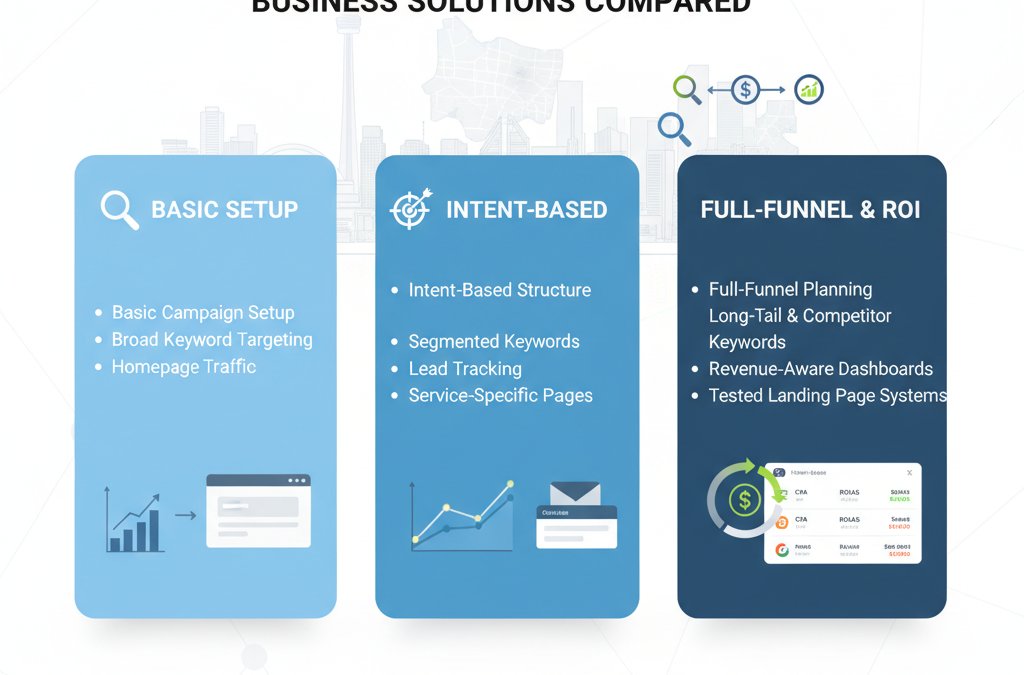
Comparing PPC providers is easier when the conversation moves past platform access and monthly reports. Three areas reveal how an agency thinks: campaign architecture, tracking discipline, and the way the team handles underperforming spend.
Campaign setup and keyword control
A) Basic account setup: This usually includes campaigns, ad groups, keywords, and ads, but it may not include deeper segmentation by intent or lead value.
- How it works: Campaigns are launched quickly with a limited number of themes and a broad testing structure.
- Best fit: This can suit a very small budget or a short validation test where speed is the main constraint.
- Example: A new home service company may test two core services before building dedicated landing pages.
B) Intent-based structure: Campaigns are separated by commercial intent, service type, geography, and expected lead value.
- How it works: Search terms are grouped so high-intent searches are not mixed with research-heavy traffic.
- Best fit: This fits businesses that care about lead quality, not only lead volume.
- Example: A clinic can separate emergency, consultation, and general research searches to protect budget quality.
C) Full-funnel paid search planning: Search, remarketing, landing pages, and follow-up measurement are planned together.
- How it works: Campaign data influences content, landing page revisions, email follow-up, and remarketing audiences.
- Best fit: This suits companies where each lead has a high potential value or a longer decision cycle.
- Example: A B2B company can separate demo requests from whitepaper downloads and judge each path differently.
Reporting and conversion tracking
A) Click and impression reports: These reports show activity, but they rarely explain whether campaigns are creating sales conversations.
- How it works: The report focuses on spend, clicks, impressions, and average cost per click.
- Best fit: This is only useful as a starting view, not as a decision system.
- Example: A campaign may show a strong click-through rate while producing unqualified phone calls.
B) Lead tracking reports: These reports separate calls, forms, chats, booked appointments, and sales-qualified leads.
- How it works: Conversion actions are named clearly and reviewed against search intent and campaign source.
- Best fit: This fits companies that want to compare campaign performance against actual follow-up quality.
- Example: A professional service firm may treat a consultation request differently from a generic newsletter signup.
C) Revenue-aware dashboards: These dashboards connect advertising activity with CRM stages, closed sales, or e-commerce transactions when the systems allow it.
- How it works: Tracking is configured through GA4, Google Tag Manager, call tracking, CRM fields, and platform conversion imports.
- Best fit: This fits businesses ready to judge PPC by pipeline quality instead of surface-level activity.
- Example: An e-commerce brand can compare shopping campaign spend against product-level revenue and margin pressure.
Landing pages and conversion quality
A) Sending traffic to the homepage: This is common, but it often forces visitors to search for the reason they clicked.
- How it works: Ads send users to a general page that contains multiple services, links, and distractions.
- Best fit: This may work for branded searches where the visitor already knows the company.
- Example: A branded search for a company name can land on the homepage without losing much context.
B) Service-specific landing pages: Dedicated pages match the ad message, search intent, proof points, and conversion action.
- How it works: The page answers the exact search theme and removes unrelated navigation choices where appropriate.
- Best fit: This fits lead generation campaigns where the visitor needs fast confidence before calling or submitting a form.
- Example: A renovation company can use separate pages for bathroom, kitchen, and basement inquiries.
C) Tested landing page systems: Pages are revised based on call quality, form completion, scroll behaviour, and conversion rate changes.
- How it works: Headlines, proof sections, forms, calls to action, and page speed are reviewed alongside campaign data.
- Best fit: This suits advertisers that run PPC continuously and want compounding improvements over time.
- Example: A lead generation agency toronto campaign may shorten a form after reviewing mobile drop-off patterns.
Questions a PPC manager should answer clearly
A capable PPC manager should be able to explain the account without hiding behind platform jargon. If a campaign is working, the manager should know which search themes are driving qualified outcomes. If a campaign is struggling, the manager should identify whether the issue is targeting, offer fit, landing page friction, tracking quality, or sales follow-up.
Before hiring a digital marketing agency toronto business owners should ask practical questions that reveal how the team thinks:
- How will qualified leads be defined? A form fill, a phone call, and a booked appointment should not be treated as equal without context.
- Which searches will be excluded? Negative keywords protect budget from irrelevant research, job seekers, free-service searches, and mismatched locations.
- How often will search terms be reviewed? Search term analysis is where wasted spend and new opportunities often become visible.
- Who owns tracking accuracy? A campaign manager should coordinate GA4 setup, Google Tag Manager, call tracking, and CRM handoff instead of assuming those pieces are already correct.
- How will landing pages be improved? Paid traffic should influence page copy, form layout, proof sections, and mobile speed priorities.
Where SEO and PPC should work together
PPC is often the fastest way to test search intent, but it should not sit apart from organic search. A search term that converts well in Google Ads may deserve a dedicated SEO page. A landing page that struggles in paid search may also reveal weak messaging for organic visitors. A strong seo company toronto perspective can help paid and organic teams share evidence instead of working in separate silos.
Zigma Internet Marketing connects paid media with SEO Services, technical seo services, content marketing toronto, and website conversion work. That matters most when a company wants stable lead flow over time. PPC can create immediate visibility for high-intent searches, while SEO can reduce dependence on paid clicks for recurring educational and local search demand.
For companies comparing online marketing toronto providers, the strongest fit is usually a team that can diagnose the full path: search query, ad promise, landing page message, tracking accuracy, and sales follow-up. If one piece is weak, the campaign may look busy while underperforming commercially.
How to choose the right PPC and digital marketing partner
The right partner should make performance easier to understand, not harder. During sales conversations, listen for how the agency talks about constraints. A serious marketing agency gta team will discuss budget limits, tracking gaps, landing page readiness, competition, and the time needed to collect useful data.
Ask for a clear view of the first 30, 60, and 90 days. The first month often focuses on setup, tracking checks, campaign structure, and launch quality. The second month usually reveals early search term patterns, weak landing page signals, and budget allocation issues. By the third month, the agency should be able to discuss what has been tested, what has been paused, and what deserves more budget.
A partner should also be transparent about what PPC cannot fix. Paid search cannot compensate for slow response times, unclear offers, poor website usability, or a sales process that does not follow up. It can, however, reveal those issues quickly when tracking and reporting are configured well.
Signals of a strong fit
- Clear conversion definitions: The agency separates calls, forms, purchases, appointments, and low-value actions in reporting.
- Search term discipline: The team reviews real queries and adds negative keywords before waste becomes a pattern.
- Landing page involvement: The agency can improve message match, page speed, forms, and mobile usability through Website Design & Development support.
- Channel awareness: The agency understands where PPC fits alongside SEO, content, social ads, and local search.
- Plain reporting: The team can explain performance in language tied to leads, sales conversations, and efficiency.
What impacts ROI in modern PPC campaigns
Return from PPC is shaped by more than bids and keywords. Four areas usually decide whether a campaign becomes more efficient over time: intent quality, conversion tracking, landing page relevance, and follow-up speed. A campaign with moderate click costs can perform well if the leads are qualified; a campaign with cheap clicks can waste budget if the searchers are not ready to act.
Campaign data should be reviewed against business realities. For example, a high call volume may look positive until call recordings show repeated questions about services the company does not provide. A strong form completion rate may be less valuable if the CRM shows that most submissions are outside the service area. Real PPC management compares platform data against what the business sees after the lead arrives.
This is also where Digital Marketing Services can support PPC. Analytics setup, dashboards, CRO, SEO content, and local search work all influence how paid traffic performs after the click.
Practical ROI drivers to review
- Lead source clarity: Every conversion should identify the campaign, keyword theme, device, and landing page where possible.
- Lead quality feedback: Sales teams should feed back which inquiries were qualified, booked, sold, or rejected.
- Landing page speed: Slow mobile pages can reduce conversion rates before a visitor reads the offer.
- Offer-message match: The ad promise and landing page headline should answer the same user intent.
- Budget concentration: Spend should shift toward campaigns with stronger qualification signals, not just more clicks.
SEO vs PPC: when each channel fits
SEO and PPC solve different timing problems. PPC can place a business in front of commercial searchers quickly, which is useful for new services, seasonal campaigns, competitive launches, and urgent lead generation. SEO takes longer, but it can build durable visibility for service pages, local pages, technical content, and question-based searches.
A business may use PPC first to validate which search terms convert, then invest in seo services toronto content for those themes. Another business may already have strong organic visibility but use PPC to protect branded searches, promote high-margin services, or test a new neighbourhood. The channels work best when data moves both ways.
For Toronto companies, the comparison should be tied to sales cycles and margin. A high-value professional service may justify PPC while SEO assets mature. A lower-margin service may need stricter campaign controls and stronger organic support before paid search can scale comfortably.
Simple channel fit comparison
- Use PPC for speed: Paid campaigns are useful when the business needs immediate visibility for high-intent searches.
- Use SEO for compounding reach: Organic content and technical improvements can support search visibility beyond active ad spend.
- Use both for clearer decisions: PPC query data can guide SEO priorities, while SEO pages can improve landing page quality and trust signals.
How Toronto businesses can compete online
Local competition in Toronto is often shaped by neighbourhood intent. Someone searching from Liberty Village may behave differently from a buyer in Scarborough, a homeowner in Leaside, or a business owner near Yorkville. Campaigns should reflect where buyers are, what they expect, and how quickly they want to speak with a provider.
For service-area companies, PPC should work alongside local SEO gta signals, location pages, reviews, and google business profile optimization. For e-commerce brands, product feed quality, shopping ads, remarketing, and content depth may carry more weight. For professional services, credibility, intake forms, phone handling, and appointment availability can affect paid search performance as much as the ads themselves.
A practical digital marketing toronto plan does not treat every channel as separate. It connects PPC, SEO, website design, content, social media marketing, and analytics so the business can see where demand is coming from and which efforts are producing qualified conversations.
Local competitive factors to check
- Neighbourhood targeting: Campaigns may need different messages for Downtown Toronto, North York, Scarborough, Etobicoke, and nearby GTA markets.
- Mobile readiness: Many local searches happen on phones, so tap-to-call, short forms, and fast pages directly affect performance.
- Review visibility: Paid clicks often trigger brand checks, so reputation signals can influence whether a visitor converts.
- Service-area clarity: Ads and landing pages should make coverage limits clear to reduce unqualified inquiries.
FAQs About best ppc campaign management toronto
A strong PPC agency should explain which campaigns produce qualified leads, which search terms waste budget, and which landing pages need improvement. In Toronto, Ontario, the agency should also account for neighbourhood targeting, service-area limits, mobile calls, and local competition.
Early signals can appear within the first few weeks, but campaign judgement is more reliable after enough clicks, conversions, and search term data have accumulated. Many accounts need an initial setup period, then recurring optimization cycles based on lead quality and conversion tracking.
Dedicated landing pages are not required for every campaign, but they often improve message match and conversion quality. A service-specific page can answer the exact search intent, reduce distractions, and make it easier to measure which campaigns create real inquiries.
Yes. PPC can test high-intent keywords quickly, while SEO can build longer-term visibility for the same themes. For Toronto, Ontario businesses, combining paid search with local SEO, technical SEO, and content can reduce dependence on a single traffic source.
A useful PPC report should include conversions, cost per conversion, search term findings, lead quality notes, landing page performance, and recommended next actions. If CRM or call tracking data is available, the report should connect ad spend to booked appointments or sales conversations.
Choosing a PPC partner with clearer accountability
The best PPC relationship is built around clarity: what was spent, what changed, what converted, and what the business should do next. Zigma Internet Marketing supports Google Ads (PPC), SEO, landing pages, CRO, web development, content, social media, analytics setup, and reporting for Toronto and GTA businesses. The team brings Google Partner-certified expertise, practical tracking implementation, and a focus on calls, forms, sales, and acquisition efficiency.
Want a clearer PPC plan before you spend more?
Speak with Zigma Internet Marketing about campaign structure, tracking accuracy, landing page gaps, and realistic next steps. You can also reach the team at (647) 556-6071 or info@zigma.ca.
Related Topics:
