
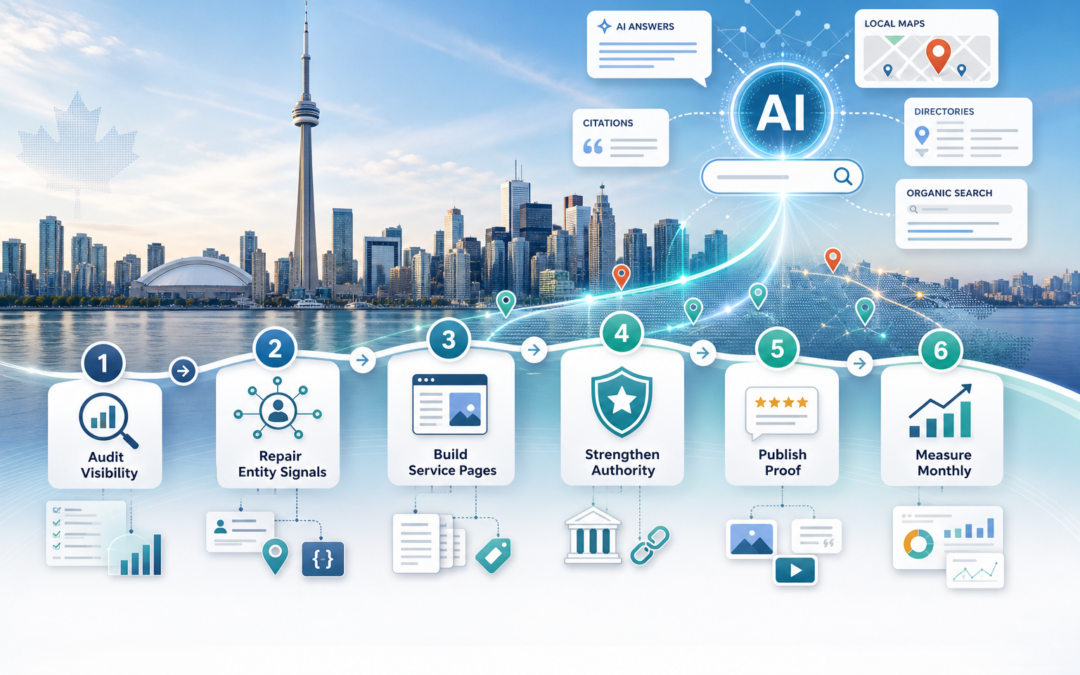
An AI search visibility roadmap for Toronto businesses in 2026 is a practical plan for being found, cited, and trusted inside AI-generated answers, not only in traditional search rankings. The roadmap combines local SEO, structured business data, authority signals from third-party sources, proof-rich content, and monthly tracking across Google AI Overviews, ChatGPT, Perplexity, Claude, Gemini, Google Maps, and relevant directories.
For business owners comparing agencies or planning next year’s marketing budget, the shift is not “SEO versus AI.” The stronger path is building a search presence that machines can understand and people can trust. Zigma Internet Marketing helps businesses connect those pieces through SEO Services, paid search, technical improvements, content systems, and clear reporting tied to leads, calls, forms, and sales activity.
Quick Facts: AI Search Visibility Roadmap for Toronto Businesses in 2026
The practical version, without the jargon.
- What: A visibility plan that helps a business appear in AI answers, Google AI Overviews, local packs, maps, directories, and traditional organic search.
- Who: Service businesses, B2B companies, e-commerce brands, professional firms, and multi-location teams that rely on search-assisted buying decisions.
- Where: Search visibility should be checked across Google Search, Google Maps, ChatGPT-style answers, Perplexity, Claude, Gemini, review platforms, and trusted industry sites.
- How: Strong signals come from complete business profiles, schema markup, service pages, reviews, citations, case studies, expert content, and third-party mentions.
- Why: AI systems often recommend businesses based on clear entity data, credible proof, and repeated authority signals from sources beyond the company website.
Why AI Search Visibility Is Becoming a Buying Channel
AI search visibility is the ability of a brand, service, product, or expert to appear inside an AI-generated answer when a person asks a buying or research question. A traditional ranking might show a page link. An AI answer may summarize a few choices, cite sources, name businesses, compare categories, or recommend the next step before the searcher visits any website.
That changes the job of SEO. A page still needs crawlable content and sound technical structure, but the business also needs a clear identity across the web. AI systems look for entity consistency: who the business is, where it serves, which services it provides, whether other sources confirm those claims, and whether the content answers specific questions in a way that can be quoted accurately.
For teams already investing in digital marketing toronto campaigns, the AI layer adds a new measurement question: “Are we being mentioned or cited where buyers are asking for recommendations?” A business may rank for a keyword and still be absent from an AI answer if stronger third-party sources, clearer service pages, or better-reviewed competitors are easier for the system to interpret.
The AI Search Visibility Roadmap for Toronto Businesses in 2026
A useful roadmap starts with visibility auditing, then moves into entity repair, content improvements, authority building, and monthly measurement. The sequence counts because AI search performance is usually a compound effect. A business profile with inconsistent hours weakens trust. A service page without proof gives the system little to cite. A strong website with no third-party mentions may still lose to a competitor that appears across directories, publications, review sites, and community discussions.
Phase 1: Audit Where the Business Appears Now
Start by testing prompts that reflect real buying behaviour. Searchers may ask for a recommended provider, a comparison between service types, a company near a neighbourhood, or help solving a specific operational problem.
Track: Google AI Overviews, ChatGPT search-style responses, Perplexity, Claude, Gemini, Google Maps, local pack results, industry directories, and review platforms.
Example: A professional services firm could test prompts such as “recommended firms for [service] in Toronto,” “who handles [problem] for small businesses,” and “compare [service] providers in the GTA.”
Phase 2: Repair Local Entity Signals
Entity signals tell search engines and AI tools that the business is real, specific, and consistently described. The core assets include the Google Business Profile, name-address-phone data, operating hours, service categories, review patterns, directory listings, and schema markup.
Track: Profile completeness, service accuracy, duplicate listings, category alignment, review recency, citation consistency, and whether the business name is used the same way across the web.
Example: A business serving Toronto, Markham, Vaughan, and Mississauga should make service areas clear without creating thin duplicate pages for every city.
Phase 3: Build AI-Readable Service Pages
AI-readable service pages answer direct commercial questions. Each page should state what the business does, who it serves, where it operates, which problems it solves, what proof supports the claim, and what a buyer should compare before choosing a provider.
Track: Clear service definitions, FAQs, case studies, comparison sections, schema markup, internal links, conversion tracking, and crawlability.
Example: A page for Google Ads Management should explain campaign structure, query control, negatives, landing page alignment, tracking setup, and reporting cadence.
Phase 4: Strengthen Third-Party Authority
AI systems often rely on sources beyond the brand website. Directories, local publications, partner websites, supplier pages, certification profiles, review platforms, LinkedIn profiles, association listings, and credible community discussions can all reinforce business identity.
Track: Mentions, citations, reviews, directory accuracy, profile completeness, source quality, and whether competitors are cited by stronger third-party pages.
Example: A B2B firm may need a stronger LinkedIn footprint, partner-page mentions, and industry directory profiles before AI systems consistently recognize the brand as a relevant recommendation.
Phase 5: Publish Proof That Can Be Cited
AI-friendly proof content includes case studies, local buying guides, service comparisons, founder commentary, customer success stories, FAQ pages, and data-backed posts. The content should be specific enough for a system to quote without guessing.
Track: Which pages are cited, whether AI tools quote the correct service details, whether pages answer buying questions, and whether branded search grows after publication.
Example: A case study should show the client type, constraint, tactics used, measurement setup, and observed outcome without exaggerating the result.
Phase 6: Measure AI Search Performance Monthly
AI visibility should be reviewed on a monthly cycle because answers can change as sources update, competitors publish new content, and search platforms refine how responses are generated.
Track: Brand mentions in AI answers, competitor mentions, cited sources, Google Business Profile actions, referral traffic from AI platforms, branded search demand, assisted leads, and the prompts that produce sales-qualified visibility.
Example: If a competitor appears in Perplexity because a directory page cites that competitor, the next action may be improving the business’s own directory profile rather than rewriting the website homepage.
Where Traditional SEO Still Carries the AI Search Work
Traditional SEO is still the base layer. Search engines and AI answer systems need clean pages, crawlable content, credible links, structured data, internal navigation, and strong topical coverage. The difference is that rankings are no longer the only visible output. A business also needs to become an entity that answer engines can confidently name.
Strong Digital Marketing Services should connect SEO, PPC, landing pages, analytics, CRO, content, and web development. A company searching for a digital marketing agency toronto partner should ask how the agency measures visibility beyond ranking reports. Monthly reporting should show search demand, conversion actions, AI mentions, map performance, lead quality, and campaign efficiency.
Search terms such as seo company toronto, seo services toronto, online marketing toronto, and marketing agency gta still reflect buying intent. AI visibility does not remove those searches. It changes how much supporting evidence is required for the business to be considered credible before the user reaches the website.
How AI Tools Evaluate Business Information
AI answer systems do not evaluate a business the way a human salesperson would. They process structured and unstructured signals: business profiles, website copy, schema markup, reviews, citations, third-party pages, public profiles, internal links, headings, FAQs, and content clarity. The more consistent those signals are, the easier it is for a system to connect the business to a service category and buying need.
Clear schema can help define the business, service area, service type, and page purpose. LocalBusiness schema, Service schema, FAQ schema, Organization data, breadcrumbs, author information, and product or review markup where appropriate can reduce ambiguity. Schema does not replace content, but it helps machines interpret content more precisely.
Review language also affects confidence. A business with reviews mentioning specific services, locations, outcomes, response quality, and customer experience gives search systems stronger context than a business with only vague praise. The same principle applies to third-party profiles: a complete directory listing with accurate categories and descriptions is more useful than a bare listing with only a phone number.
AI Search vs Traditional SEO vs Paid Search
Business owners should compare channels by function, not by hype. AI search visibility, organic SEO, and paid search can support different stages of the buyer journey. The right mix depends on lead urgency, sales cycle, competition, and whether the business already has strong search foundations.
Visibility Channels Compared
A) AI search visibility: This focuses on being cited, recommended, or accurately described inside AI-generated answers.
- How it works: The business builds clear entity data, credible proof, structured pages, and third-party mentions that AI systems can interpret.
- Best fit: Brands that want influence before a user clicks, especially where buyers ask comparison or recommendation questions.
- Example: A buyer asks Perplexity to compare providers, and the answer cites a service page, directory listing, or case study.
B) Organic SEO: This focuses on ranking useful pages in search results for commercial, informational, and local queries.
- How it works: The website earns visibility through technical health, relevant content, internal links, authority, and page experience.
- Best fit: Businesses that need steady visibility across service, location, and problem-based searches.
- Example: A service page ranks for technical seo services after the site improves crawlability, content depth, and internal linking.
C) Paid search: This focuses on controlled visibility for high-intent search terms through ads and landing pages.
- How it works: Campaigns target queries, manage negatives, test ad copy, and send users to conversion-focused pages with tracking.
- Best fit: Businesses that need faster lead flow while organic and AI visibility assets develop.
- Example: A company uses google ads management toronto support to separate high-value service queries from low-quality searches.
How to Choose the Right Digital Marketing Agency
A capable agency should be able to explain how search visibility becomes business activity. That means connecting keyword strategy, local SEO, content, paid search, landing pages, analytics, and reporting into one operating system. A narrow vendor may complete tasks; a stronger partner identifies which task should happen first and why.
For AI-era search, the agency should also understand entity consistency, AI answer tracking, structured data, third-party authority, and local search behaviour. Ask how the team would audit visibility in Google AI Overviews, ChatGPT, Perplexity, Claude, Gemini, Google Maps, directories, and review platforms. Ask which sources competitors are being cited from, not only which keywords they rank for.
Zigma Internet Marketing works across SEO, PPC, web design, development, content, social media, analytics, dashboards, and CRO. That full-service structure is useful when the issue is not only traffic. Sometimes the blocker is a weak landing page, broken conversion tracking, unclear service copy, poor citation consistency, or a campaign sending budget to the wrong search terms.
Questions worth asking before hiring
- Reporting clarity: The agency should report on leads, calls, forms, sales signals, cost efficiency, and search visibility, not only impressions and rankings.
- Technical ability: The team should be comfortable with crawling, indexing, schema, GA4, Google Tag Manager, page speed, WordPress, Shopify, and conversion tracking.
- Local search skill: The agency should understand google business profile optimization, review signals, local citations, service-area pages, and map visibility.
- Paid and organic balance: A strong plan may combine SEO with a ppc agency toronto strategy while longer-term authority assets are built.
- Content quality control: The agency should produce pages that answer buyer questions with proof, not thin copy designed only to target keywords.
What Impacts ROI in Modern Digital Campaigns
Return from digital campaigns is shaped by more than traffic volume. Lead quality, sales cycle length, landing page clarity, tracking accuracy, follow-up speed, market demand, offer strength, and trust signals all affect whether visibility becomes revenue. AI search adds another layer because users may form an opinion before visiting the website.
For service businesses, the practical question is: “Which signals are influencing a buyer before they speak with us?” A user may see a Google AI Overview, compare providers in ChatGPT, check reviews, scan Google Maps, visit a directory profile, and then fill out a form. If analytics only credits the last click, the business may underestimate the role of AI-assisted research and third-party authority.
A stronger measurement plan combines channel data with business outcomes. That includes GA4 setup, Google Tag Manager, conversion tracking, call tracking where appropriate, CRM source notes, landing page testing, and monthly commentary that separates useful movement from noise.
Campaign factors that should be measured
- Search intent quality: Queries should be separated by buying intent, research intent, brand intent, and irrelevant searches.
- Landing page fit: A page should match the ad, search term, service, proof, and next action expected by the visitor.
- Conversion friction: Forms, phone links, page speed, trust proof, mobile layout, and copy clarity all affect whether visitors take action.
- AI-assisted touchpoints: Monthly prompt testing can show whether buyers see the brand, a competitor, or a third-party source before clicking.
- Sales feedback: Lead volume is less useful without notes on close rate, fit, service type, and revenue relevance.
SEO vs PPC: When Each Strategy Fits
SEO and PPC should not be treated as rivals. SEO builds durable visibility across service, educational, and local searches. PPC can create faster visibility for high-intent terms, seasonal services, new offers, or markets where organic rankings are still developing.
For example, a business may use paid search for immediate lead generation while building organic assets for local seo gta searches, service comparisons, and AI-citable proof content. A lead generation agency toronto plan should explain which keywords deserve paid budget, which topics deserve content investment, and where landing pages need CRO support.
AI search visibility can strengthen both channels. Better content improves organic relevance and gives paid visitors more confidence after they click. Stronger reviews and third-party mentions can raise trust before a buyer ever sees an ad. Better tracking can show whether users who first encounter the brand through AI-assisted research later convert through paid or organic channels.
Practical channel fit
- Use SEO for compounding search assets: Service pages, local pages, technical fixes, content clusters, FAQs, and case studies can support long-term visibility.
- Use PPC for controlled demand capture: Search ads can help test messaging, drive leads faster, and protect visibility for high-value terms.
- Use CRO to improve both: conversion rate optimization toronto work can improve landing page clarity, form completion, phone actions, and lead quality.
- Use analytics to avoid guessing: Dashboards should connect spending, ranking changes, AI mentions, calls, forms, and sales notes.
How Local Businesses in Toronto Can Compete Online
Local competition is not only about who has the largest ad budget. A smaller business can compete by being clearer, more specific, and more verifiable. Search systems and buyers both respond to accurate service information, credible reviews, strong pages, and evidence that the business understands the customer’s situation.
Toronto businesses often serve distinct neighbourhoods, industries, and buyer types. A contractor, clinic, law firm, retailer, SaaS provider, or professional services firm may need different content architecture. A company serving Liberty Village startups, North York households, Scarborough communities, Etobicoke offices, or Markham B2B buyers should avoid generic service copy that could fit any market.
Website structure also plays a role. Website Design & Development should support fast loading, clear navigation, schema, landing page testing, mobile usability, and content expansion. Searches such as website design toronto and content marketing toronto are connected because the website must both present the business clearly and support ongoing search visibility.
Local competition signals to strengthen
- Google Business Profile accuracy: Service categories, descriptions, photos, hours, products, services, and review responses should reflect current operations.
- Neighbourhood relevance: Pages should mention real service fit and customer needs rather than repeating city names without detail.
- Proof depth: Case studies, testimonials, project notes, FAQs, before-and-after context, and expert commentary help buyers compare firms.
- Third-party confirmation: Directories, associations, media, partners, suppliers, and review platforms can confirm the business beyond its own website.
- Technical reliability: Crawl errors, duplicate pages, slow templates, weak internal links, and missing schema can weaken both organic and AI search interpretation.
What Toronto Businesses Should Track Each Month
AI search visibility should be measured as a repeatable reporting process. The goal is not to chase every answer variation. The goal is to identify where the brand appears, where competitors appear instead, which sources are being cited, and which improvements are likely to change future visibility.
A monthly report should combine search data with business data. For example, a business may see more branded search after publishing expert commentary or earning a credible third-party mention. Another business may see Google Business Profile actions increase after reviews, categories, and service descriptions are corrected. The signal becomes more useful when it is tied to forms, calls, sales notes, and campaign spend.
Recommended monthly visibility checks
- AI answer presence: Record whether the brand appears in Google AI Overviews, ChatGPT-style responses, Perplexity, Claude, and Gemini for priority prompts.
- Source citations: Note which pages AI tools cite, including company pages, directories, publications, profiles, reviews, and competitor sources.
- Local visibility: Review Google Maps rankings, local pack presence, profile actions, review activity, and service category alignment.
- Organic performance: Track rankings, indexed pages, impressions, clicks, technical issues, content gaps, and internal link opportunities.
- Lead outcomes: Connect forms, calls, campaigns, landing pages, and sales feedback so visibility is judged by business relevance.
Common Gaps That Keep Businesses Out of AI Answers
Many visibility gaps are not caused by one large failure. They come from small inconsistencies that accumulate. A service page may be unclear. A directory listing may use an old phone number. Reviews may mention services that are missing from the website. Schema may identify the organization but not the service page. A competitor may be cited because a trusted third-party article explains that competitor more clearly.
The City of Toronto’s Open Data 2026 roadmap also reflects a wider shift toward better indexing and AI-enabled search in public digital systems. That municipal context reinforces a broader lesson for businesses: searchable, structured, well-described information is becoming a core digital asset.
Short-term visibility vs durable visibility
Paid ads can create fast visibility for priority search terms.
Organic SEO can build crawlable, service-specific assets that compound over time.
AI search visibility depends on both website clarity and credible confirmation from outside sources.
The strongest plan connects all three rather than treating them as separate projects.
FAQs About AI Search Visibility Roadmap for Toronto Businesses in 2026
Start with a prompt audit across Google AI Overviews, ChatGPT-style answers, Perplexity, Claude, Gemini, Google Maps, and relevant directories. Test service, neighbourhood, comparison, and problem-based questions. Record whether the brand appears, whether competitors appear, and which sources are cited.
No. AI search visibility depends heavily on SEO foundations such as crawlable pages, schema, internal links, reviews, service clarity, and third-party authority. For Toronto businesses, stronger local SEO often becomes the base layer that helps AI systems understand and cite the business accurately.
Improve core service pages first because they answer the highest-value buying questions. Each page should define the service, audience, location coverage, problems solved, proof, FAQs, comparisons, and next steps. Then strengthen supporting content such as case studies, guides, and review profiles.
A monthly review cycle is practical for most businesses. Track mentions, recommendations, competitor citations, cited sources, branded search, Google Business Profile actions, referral traffic from AI platforms, and leads influenced by AI-assisted research. The value comes from trend tracking, not one-off prompt checks.
Yes. Zigma Internet Marketing supports Toronto and GTA businesses with SEO, local SEO, Google Ads, website development, content, CRO, analytics, dashboards, and reporting. The team can audit current visibility, identify search gaps, and build a practical plan tied to leads and sales activity.
Build Trust Into Your AI Search Visibility Roadmap
AI search visibility is strongest when the business is easy to verify. Zigma Internet Marketing is a Google Partner-certified digital marketing agency with full-service execution across SEO, PPC, web design, content, social, CRO, analytics setup, and performance reporting. For a practical discussion about your visibility gaps, call (647) 556-6071 or email info@zigma.ca.
Plan AI Search Visibility With Clear Reporting
Zigma Internet Marketing can review your current search footprint, identify where competitors are being cited, and build a roadmap across SEO, PPC, content, local profiles, tracking, and CRO.
Related Topics
