
How an online marketing business helps growth become measurable
An online marketing business plans, builds, measures, and improves the digital channels that bring qualified visitors, leads, and sales to a company. That work can include search engine optimization, paid search, website updates, content, landing pages, social campaigns, and analytics setup. The strongest digital marketing work connects activity to outcomes such as calls, forms, purchases, booked appointments, and acquisition cost.
For a business owner, the confusing part is rarely whether digital marketing has value. The harder question is which channel deserves attention first. SEO may build durable visibility over time, while Google Ads can test demand faster. A website redesign may help only after tracking confirms that visitors are arriving but not converting. A clear plan keeps those decisions tied to evidence rather than guesswork.
Zigma Internet Marketing supports that kind of planning through Digital Marketing Services that connect strategy, execution, reporting, and ongoing refinement.
Quick facts about online marketing business planning
A fast scan before the deeper details.
- Core role: An online marketing business helps companies attract relevant traffic, convert visitors, and measure which campaigns create real enquiries or sales.
- Main channels: SEO, PPC, landing pages, content, social media, email, analytics, and conversion rate optimization often work together rather than separately.
- Key metrics: Lead quality, conversion rate, cost per lead, revenue influenced, search visibility, ad efficiency, and website engagement reveal whether marketing activity is producing useful outcomes.
- Common risk: Spending on campaigns before conversion tracking is working can hide waste and make good decisions harder.
- Practical starting point: Audit tracking, website conversion paths, search demand, ad account structure, and content gaps before increasing spend.
Where online marketing business work usually starts
Effective online marketing starts with diagnosis. Before a company invests more time or budget, someone needs to check whether the website can convert visitors, whether search demand exists, whether ads are sending traffic to useful pages, and whether analytics can separate useful leads from casual browsing.
That diagnosis often exposes simple but costly gaps. A campaign may be generating traffic, but the landing page may load slowly or ask for too much information. An SEO program may be publishing content, but not targeting terms that match buying intent. A paid search account may have broad-match queries eating budget without enough negative keywords. These details are not glamorous, but they often explain why marketing feels busy without producing enough pipeline.
For companies trying to build long-term visibility, SEO Services can clarify technical barriers, content gaps, internal linking issues, and search intent mismatches that limit organic performance.
Comparing the main digital growth channels
Different channels answer different business problems. The right mix depends on demand, sales cycle, website quality, margin, internal follow-up, and how quickly feedback is needed.
| Channel | Best use | Common constraint | What to measure |
|---|---|---|---|
| SEO | Building search visibility for services, products, questions, and high-intent topics over time. | SEO usually needs technical fixes, content depth, and patience before patterns become clear. | Organic leads, indexed pages, ranking movement, click-through rate, conversions, and assisted revenue. |
| Google Ads | Testing demand quickly and reaching people who are already searching for a specific service or product. | Weak keyword targeting, poor landing pages, and missing conversion tracking can raise waste quickly. | Cost per lead, conversion rate, search terms, impression share, quality score signals, and lead quality. |
| Content marketing | Answering buyer questions, supporting SEO, improving sales conversations, and building topical depth. | Content that is broad or shallow may attract readers who are not close to taking action. | Organic entrances, engagement, assisted conversions, keyword coverage, and sales enablement use. |
| Social media | Building familiarity, retargeting warm audiences, promoting offers, and supporting brand recall. | Social activity can look active while producing limited revenue if goals and tracking are vague. | Qualified traffic, engagement quality, assisted leads, audience growth, and campaign-specific conversions. |
| Conversion rate optimization | Improving forms, landing pages, calls to action, page speed, trust cues, and message clarity. | CRO needs enough traffic and clean tracking before tests can be interpreted with confidence. | Form starts, form completions, call clicks, checkout progress, bounce signals, and lead quality. |
How strategy turns separate tactics into a system
Separate tactics can create scattered effort. A useful strategy connects every channel to a role in the buyer journey: attracting the right visitor, answering the next question, reducing friction, and helping the sales team follow up with context.
A search ad may send someone to a focused landing page. That landing page may answer the pricing, trust, and process questions that block action. A remarketing campaign may bring back people who were not ready the first time. SEO content may support the same topic from an educational angle, lowering reliance on paid traffic over time.
Website quality sits at the centre of that system. If a site is slow, unclear, or difficult to use on mobile devices, traffic growth can simply expose conversion problems faster. For companies rebuilding a site, Website Design & Development should account for search structure, page speed, tracking, content hierarchy, and conversion paths from the start.
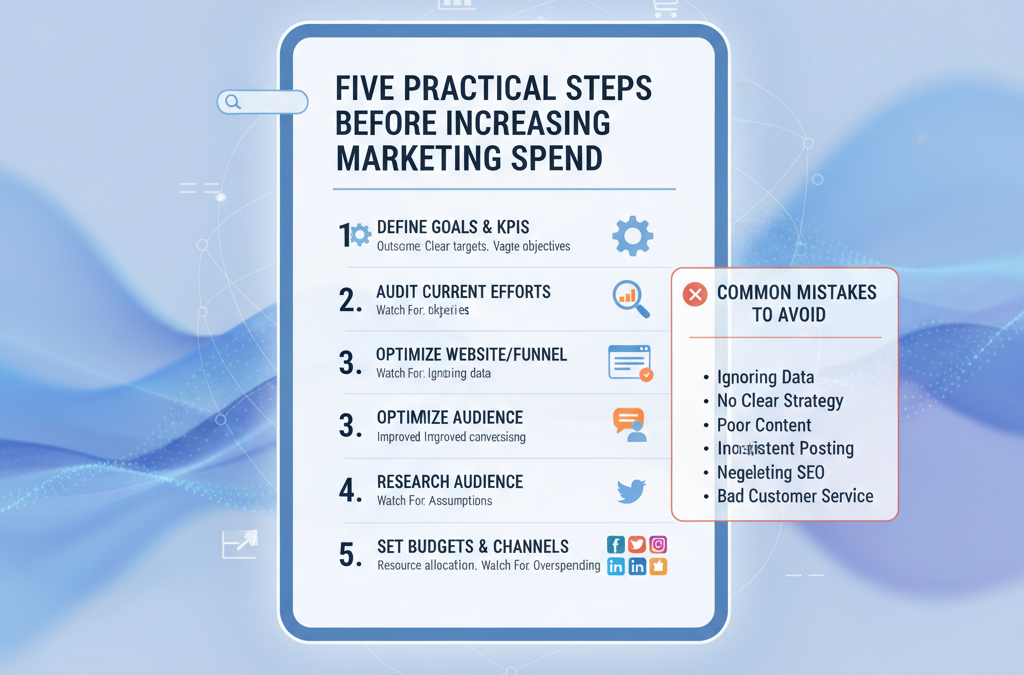
Five practical steps before increasing marketing spend
Step 1: Confirm conversion tracking
Tracking should capture form submissions, phone clicks, purchases, booked appointments, and other actions that carry business value. Without clean tracking, marketing decisions often rely on surface-level numbers such as clicks or impressions.
Outcome: Better visibility into which campaigns create real enquiries.
Watch for: Duplicate conversions, missing phone tracking, untagged forms, and analytics events that fire before a user completes an action.
Example: A campaign may appear successful because traffic rose, but call tracking may show that only one landing page is producing qualified enquiries.
Step 2: Review search intent before creating content
Search intent explains what a person expects to find after typing a query. A page built for research queries should answer questions clearly, while a page built for service queries should support comparison, trust, and action.
Outcome: Content that matches the visitor’s stage instead of forcing every page to sell.
Watch for: Blog posts targeting service keywords, service pages written like essays, and thin pages created only to hold keywords.
Example: A page about “technical SEO services” should address crawlability, indexing, site architecture, speed, structured data, and reporting rather than offering a generic SEO overview.
Step 3: Check landing page friction
Landing pages should make the next action clear, answer the visitor’s most likely objections, and avoid unnecessary fields or distractions. Friction is anything that makes a qualified visitor hesitate, leave, or delay contact.
Outcome: More value from existing traffic before new budget is added.
Watch for: Slow load times, weak headings, hidden contact details, generic copy, unclear proof points, and forms that ask for too much too early.
Example: A landing page for Google Ads traffic may need a stronger headline, clearer service fit, visible trust cues, and a shorter form before bids are increased.
Step 4: Separate lead volume from lead quality
More leads do not automatically create better growth. A campaign can generate many forms from the wrong audience, while a lower-volume campaign may produce higher-value conversations.
Outcome: Budget decisions based on sales usefulness rather than raw enquiry count.
Watch for: Spam forms, low-intent queries, unqualified calls, duplicate leads, and campaigns that look efficient before sales feedback is included.
Example: A paid search campaign may need negative keywords and tighter match types if the sales team reports that many calls are unrelated to the service.
Step 5: Build a reporting rhythm
Reporting should translate activity into decisions. A useful report does not stop at rankings, traffic, or clicks; it explains what changed, why it may have changed, and what action should happen next.
Outcome: Continuous improvement based on visible signals.
Watch for: Dashboards with too many vanity metrics, reports without recommendations, and campaigns that keep running without review.
Example: A monthly review might connect organic traffic changes, ad spend efficiency, landing page conversion rate, and sales feedback in one discussion.
SEO versus PPC: choosing the right timing
SEO and PPC solve different timing problems. SEO is usually stronger for compounding visibility, trust-building content, and reducing dependence on paid traffic over time. PPC is usually stronger for fast testing, controlled targeting, and demand capture when the business needs near-term feedback.
A sensible comparison looks at urgency, budget tolerance, search demand, website quality, and sales follow-up. If a company needs to test whether a service converts, PPC may produce faster data. If a company already knows demand exists and wants a stronger content base, SEO may deserve heavier focus. Most growth plans eventually use both, but not always with equal weight at the same time.
For paid search programs, Google Ads Management should include query review, negative keywords, landing page alignment, conversion tracking, and efficiency checks rather than campaign setup alone.
What affects return from digital campaigns
Return from digital marketing is shaped by more than channel selection. A strong campaign can underperform if the website is unclear, tracking is broken, the sales team responds slowly, or the offer does not match searcher intent.
Several factors deserve close attention:
- Message match: Ads, search snippets, landing pages, and sales conversations should speak to the same problem in consistent language.
- Conversion path clarity: Visitors need a clear next action, whether that action is a form, a call, a checkout, or a downloadable resource.
- Traffic quality: Search terms, audience filters, content topics, and referral sources influence whether visitors are likely to become customers.
- Sales feedback: Marketing data becomes more useful when the team knows which leads turned into serious conversations or revenue.
- Iteration speed: Campaigns improve when teams review evidence, make focused changes, and avoid changing too many variables at once.
Common mistakes that weaken online marketing performance
Most weak digital marketing programs do not fail because of one dramatic error. They usually drift because small issues stack up: unclear goals, incomplete tracking, unfocused content, weak landing pages, and reports that describe activity without explaining business impact.
- Starting with channels instead of goals: Choosing SEO, PPC, or social before defining the desired outcome can lead to activity that does not support revenue.
- Publishing content without a search purpose: Content should answer a real query, support a buying decision, or strengthen a topic cluster.
- Ignoring technical SEO: Crawl issues, slow pages, duplicate content, weak internal links, and poor site structure can limit organic visibility even when the writing is strong.
- Treating reporting as a monthly formality: Reports should guide action. If no decision follows the report, the data is not being used well.
- Sending paid traffic to generic pages: Ads usually perform better when the landing page closely reflects the user’s search, concern, and next step.
How to judge a digital marketing partner
A good partner should be able to explain trade-offs clearly. That includes what should be fixed first, which channels may need more time, where budget may be wasted, and which metrics deserve attention. If the explanation feels vague, the work will probably feel vague too.
Useful questions include: Which conversions will be tracked? How will lead quality be reviewed? What technical issues could limit SEO? Which landing pages need improvement before ads scale? How often will campaigns be reviewed, and what decisions will each report support?
Look for practical evidence rather than polished promises. Google Partner-certified execution, clear reporting, analytics setup, conversion tracking, and experience across SEO, PPC, web development, content, and social media create a stronger foundation for accountable work.
FAQs About online marketing business
These answers address common questions business owners ask before investing more time or budget into digital growth.
Paid campaigns can often produce early traffic and conversion signals within weeks, while SEO usually needs more time because technical fixes, content, indexing, and authority signals develop gradually. The first priority should be clean tracking, so early data reflects real enquiries rather than clicks alone.
A smaller company should start with the channel that matches its immediate constraint. If the website already converts and fast demand testing is needed, paid search may help. If the company needs durable visibility and has time to build authority, SEO and content may be stronger starting points.
Lead quality becomes clearer when marketing data is connected to sales feedback. Track which campaigns produce calls, forms, qualified conversations, proposals, purchases, or booked appointments. Raw lead count can be misleading if enquiries are unqualified, duplicated, or outside the company’s service fit.
A full rebuild is not always required, but the landing experience should be checked before ad spend increases. Page speed, mobile usability, message clarity, trust cues, forms, tracking, and call buttons can strongly affect whether paid traffic turns into useful enquiries.
Campaigns should be reviewed often enough to catch waste and interpret patterns, but not so frequently that decisions are made from tiny data sets. Paid search may need weekly checks, while SEO reviews often work better through monthly technical, content, and performance analysis.
A clearer path from activity to evidence
An online marketing business should reduce uncertainty. The work should clarify who is arriving, what they want, which pages help them act, and which campaigns create outcomes worth repeating. Strong digital marketing is not simply more traffic or more posts; it is a connected system of tracking, testing, content, search visibility, paid media, and conversion improvements.
Zigma Internet Marketing brings Google Partner-certified expertise, full-service execution, and transparent reporting across SEO, PPC, web, content, analytics, and social media. If you want a practical review of where your digital marketing is helping or leaking value, 📩 Ask an SEO/PPC question.
Related topics
