
If you run a Google Local Services Ad — the one with the green “Google Guaranteed” checkmark — you may have seen the panic bubbling up in local business groups lately: business owners insisting Google billed them for a call they never even picked up.
It’s a real feature of how Local Services Ads work. It’s just not the villain-origin story it sounds like in a screenshot. Let’s break down what’s actually happening, straight from Google’s own billing documentation.
First — this isn’t your regular Google Ads campaign
Local Services Ads (LSA) are a different animal from standard Search or Display campaigns. Instead of paying per click, you pay per valid lead — a phone call, message, or booking that Google decides was a genuine potential customer. You set a weekly budget based on roughly how many leads you want, and a max price you’re willing to pay per lead. Once you hit your monthly cap, your ad stops showing for the rest of the month.
The missed-call clause that’s freaking people out
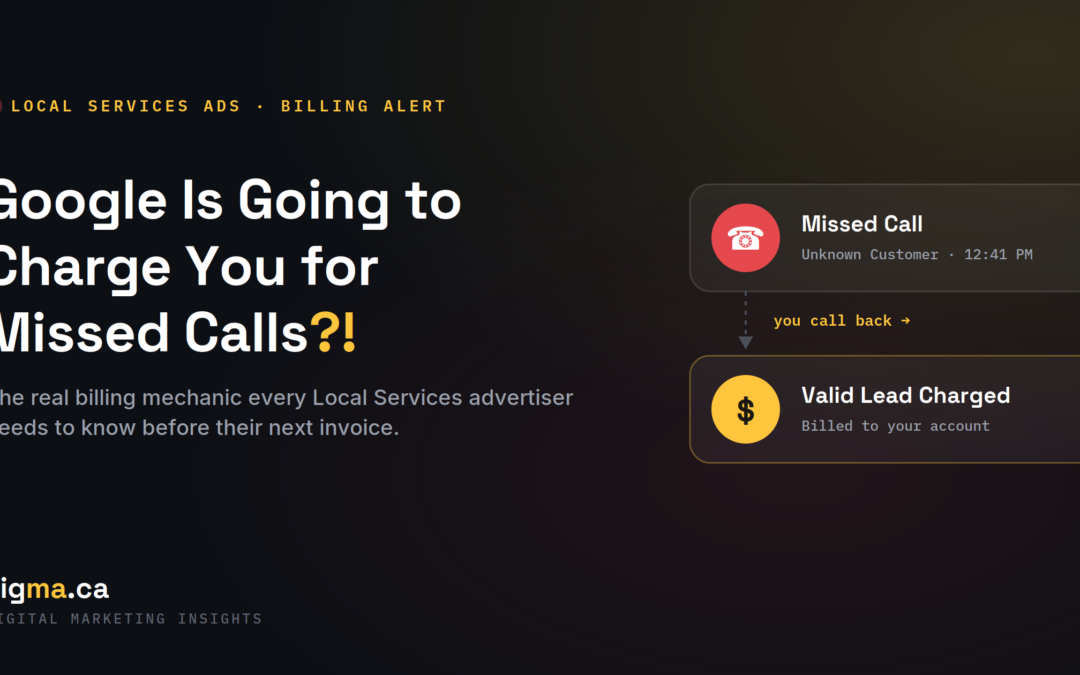
Here’s the twist. A missed call that goes to voicemail-less silence, on its own, isn’t billed. Google has to see genuine engagement first. But if that customer’s missed call sits there and you call, text, or email them back — and you either reach them directly or leave a voicemail — Google counts that as a valid lead. And valid leads get charged.
|
IN PLAIN ENGLISH Doing the responsible thing — following up on a missed call — is the exact action that can trigger the charge. The missed call isn’t free just because you didn’t answer it live. |
That’s the part nobody reads in the fine print, and it’s exactly why it feels like a bait-and-switch when it happens to you for the first time.
What actually counts as a billable lead
Straight from Google’s Local Services Help documentation, here’s the full list of what makes a lead “valid” — and therefore billable:
✓ You’ll be billed |
✗ Not billed / credited back |
|
✓ Customer texts or emails you (Canada & U.S.) ✓ They leave a voicemail, or complete a meaningful step through an automated system — requesting a callback, booking, or adding job details ✓ You answer the phone and actually speak with them ✓ They call, don’t leave a voicemail, and you call/text/email back and connect or leave a voicemail ✓ They submit a booking request (Canada & U.S.) |
✗ Contact came in outside your listed business hours ✗ They were just researching prices or projects, no booking intent ✗ They canceled a booking ✗ You don’t actually offer the specific service they asked about ✗ They never responded to your return call or message ✗ You referred them to another provider instead |
Google also runs charged leads back through its quality models over time, and can auto-credit ones it later decides were low quality — plus you can flag a bad lead yourself through the in-app Feedback Survey, which sometimes results in a credit too.
Why this matters for your ad budget
Two things worth internalizing here. First, your business hours setting isn’t cosmetic — a call landing outside your posted hours won’t be billed, which means getting your hours wrong can quietly cost you either leads or budget accuracy. Second, message leads are often priced lower than phone leads, so a channel mix that leans on text and booking requests can sometimes stretch your budget further than a call-only setup.
None of this changes the core math, though: LSA is still a pay-for-outcome model, not pay-for-impressions. You’re not being charged for visibility — you’re being charged when Google decides a real customer tried to reach your business.
|
3 things worth checking in your LSA account this week 01 Confirm your business hours are accurate. Wrong hours mean Google is misjudging which calls should even be eligible for billing. 02 Keep following up on missed calls anyway. A missed call you never return doesn’t cost you a lead fee — but it can cost you the customer entirely, which is a far worse trade. 03 Use the Feedback Survey on every questionable lead. Disputing poor-quality leads is the built-in mechanism for getting credited — most advertisers never touch it. |
The bottom line
Google isn’t charging you for ignoring your phone. It’s charging you for a customer successfully connecting with your business — even when that connection happens on the second try. Once you see the logic, it stops looking like a gotcha and starts looking like exactly what LSA has always promised: pay for real leads, not for noise.
Want a second set of eyes on your Local Services Ads?
Our team at Zigma audits lead quality, business-hour settings, budget pacing, and feedback disputes for clients running Local Services Ads across the GTA — so you’re only paying for leads worth paying for.