
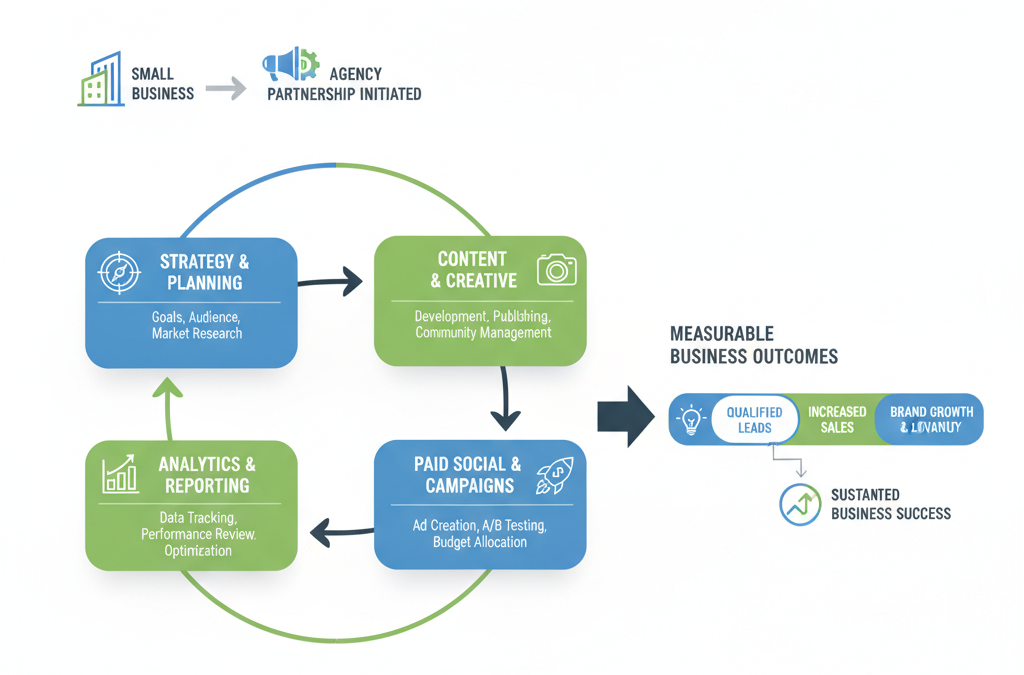
A social media marketing agency for small business helps plan, create, publish, promote, and measure social content so social channels support real business outcomes instead of becoming another task on an already full plate. The right agency does more than post graphics; it connects audience research, creative testing, paid social campaigns, tracking, and reporting to goals such as leads, calls, store visits, email signups, or sales. For small businesses, the main question is not “Should we be on every platform?” It is “Which channels can create measurable value with the time and budget available?”
Social media can support visibility, trust, customer education, hiring, retention, and remarketing. It works best when it fits into a broader digital system that may include Digital Marketing Services, search visibility, paid ads, website improvements, and analytics. Without that connection, social media activity can look busy while contributing very little to revenue.
How a social media marketing agency for small business actually helps
A small business social media agency usually supports four connected areas: strategy, content production, community management, and performance measurement. Strategy defines the audience, platform focus, content themes, posting rhythm, creative direction, and campaign goals. Content production turns those decisions into posts, videos, stories, ads, captions, and landing-page messaging.
Community management covers comment replies, inbox monitoring guidelines, review response support, and escalation planning. Performance measurement connects social activity to business signals such as form submissions, booked calls, product views, purchases, or newsletter signups. Without measurement, a business may only see likes and impressions, which rarely explain whether marketing spend is helping the business grow.
For example, a service business may use Instagram and Facebook for trust-building content, paid retargeting, and lead forms. A B2B company may focus more heavily on LinkedIn marketing, founder-led content, case narratives, and traffic to high-intent pages. An e-commerce brand may need product videos, catalogue ads, remarketing, and product feed improvements. The agency’s role is to match the channel mix to the business model.
What social media support usually includes
Social media marketing can include organic work, paid advertising, creative testing, reporting, and coordination with SEO or PPC campaigns. A strong plan defines what each channel is responsible for. Organic social may build familiarity and answer customer questions, while Facebook ads, Instagram ads, or LinkedIn ads may drive more direct traffic and lead activity.
Small businesses often need a practical mix rather than a large content machine. A manageable monthly plan may include a content calendar, short-form video ideas, post design, caption writing, campaign setup, audience testing, pixel or conversion tracking, and performance reporting. If paid social is part of the plan, the agency should also review landing pages and tracking quality before scaling spend.
- Audience and platform research: The agency identifies where buyers spend attention and how they evaluate businesses before contacting them.
- Content planning: The agency turns services, products, FAQs, proof points, and seasonal priorities into a repeatable publishing plan.
- Creative production: The agency prepares visuals, short videos, carousels, captions, ad copy, and campaign variations for testing.
- Paid social management: The agency builds campaigns, tests audiences and creative, manages budgets, and reviews lead quality.
- Analytics and reporting: The agency connects social activity to measurable actions through GA4, Google Tag Manager, conversion tracking, and dashboards.
When an agency makes sense, and when it may not
An agency is a good fit when a business needs consistent execution, clearer reporting, campaign testing, or help connecting social media to leads and sales. It is also useful when the owner or internal staff can provide subject knowledge but cannot plan, design, publish, advertise, and measure consistently. Social media rewards repetition, but repetition without direction can waste time.
An agency may not be the right starting point if the business has no clear offer, no working website, no sales follow-up process, or no way to handle new enquiries. In those cases, the better first move may be fixing the conversion path: service pages, lead forms, calls, CRM process, or product pages. Social media can send attention, but a weak follow-up system can lose that attention quickly.
A useful guiding question is simple: if social media created more leads next month, could the business respond quickly, qualify them properly, and measure which enquiries became customers? If the answer is no, the agency plan should include operational fixes before increasing campaign volume.
Agency, freelancer, or in-house: which structure fits?
Small businesses often compare agency support with hiring a freelancer or assigning social media to an employee. Each path can work, but the trade-offs are different. The right structure depends on the number of channels, content workload, ad complexity, reporting needs, and how much internal time the business can provide.
Agency support
A) Full-service social media agency: A full-service agency handles planning, creative, ads, tracking, and reporting through a coordinated process.
- How it works: Specialists cover strategy, content, paid campaigns, analytics, and conversion recommendations.
- Best fit: This structure fits businesses that need reliable execution and want social media connected to broader marketing activity.
- Example: A company running social ads may also need landing pages, Google Ads Management, and conversion tracking reviewed together.
Freelance support
B) Independent freelancer: A freelancer can be efficient for design, caption writing, scheduling, or short-form video editing.
- How it works: The business usually provides direction, approvals, product knowledge, and performance expectations.
- Best fit: This structure fits businesses that already have a clear strategy and need help with production tasks.
- Example: A business with an internal marketing lead may hire a freelancer to turn monthly promotions into posts and reels.
In-house execution
C) Internal employee or owner-led posting: In-house work can feel authentic because the person creating content is close to customers, products, and daily operations.
- How it works: The internal person captures photos, answers questions, publishes updates, and shares real customer moments.
- Best fit: This structure fits businesses with strong internal time, simple campaign needs, and a clear voice.
- Example: A founder may create LinkedIn posts while an agency supports analytics, paid campaigns, and content repurposing.
How to judge whether a small business social plan is sound
A sound social media plan should explain the link between content and business outcomes. If the plan only lists posting frequency, platforms, and generic creative themes, it may be too thin. Posting three times per week is not a strategy by itself; it is a production schedule.
Look for a plan that answers specific questions. Who is the content for? Which buyer concerns will be addressed? Which services or products deserve more attention? Which posts are meant to build trust, which posts are meant to drive action, and which posts are meant to retarget warm audiences?
- Clear goal hierarchy: The plan separates awareness metrics from business metrics such as leads, bookings, sales, and customer acquisition cost.
- Platform logic: The agency explains why each channel is included and what role it plays in the funnel.
- Creative testing plan: The agency tests different hooks, formats, offers, visuals, and calls to action instead of relying on one creative direction.
- Tracking setup: The agency confirms that GA4, Google Tag Manager, pixels, events, and forms are configured properly before judging campaign performance.
- Reporting rhythm: The agency reports what changed, why it changed, and what will be adjusted next.
Metrics worth tracking beyond likes and followers
Likes, comments, shares, and follower growth can show whether content is getting attention, but those numbers do not automatically show business value. A post can receive strong engagement from people who are not buyers. A quiet campaign can still produce qualified enquiries if the audience, offer, and landing page are aligned.
Small businesses should separate platform metrics from conversion metrics. Platform metrics show how content performs inside the social network. Conversion metrics show what people do after clicking, messaging, calling, filling out a form, or purchasing. Both are useful, but they answer different questions.
- Reach and impressions: These numbers show how many times content was displayed and whether visibility is growing.
- Click-through rate: This metric shows whether the creative and message are strong enough to move people from the platform to the next step.
- Cost per lead: This metric helps compare paid social performance against other channels when lead tracking is accurate.
- Lead quality: This signal shows whether enquiries match the business’s ideal customer profile, budget level, location requirements, and service fit.
- Conversion rate: This metric shows how effectively landing pages, forms, product pages, or booking flows turn traffic into action.
Reporting should also connect social media with SEO Services when content supports search demand. For example, a frequently asked question that performs well on social media may also deserve a service-page section, blog post, or FAQ entry on the website.
Common mistakes that weaken social media results
Small businesses often struggle with social media because the work becomes reactive. Someone posts when there is time, boosts a post without a campaign structure, or changes direction after a few weak results. The consequence is inconsistent data, inconsistent messaging, and little clarity about what actually influenced enquiries.
Another common problem is separating social media from the website. A campaign may send visitors to a slow page, unclear offer, weak form, or product page with missing details. In that scenario, the ad creative may be blamed even though the conversion path is the real issue. Social media and Website Design & Development often need to be reviewed together.
- Posting without a conversion path: Content should guide interested people toward a clear next action, such as an enquiry form, product page, resource, or consultation request.
- Judging too quickly: Paid social needs enough data to compare audiences, creative, placements, and landing-page behaviour before major decisions are made.
- Using one message for every audience: New prospects, warm website visitors, past customers, and referral audiences usually need different messaging.
- Ignoring creative fatigue: Ads can weaken after audiences see the same creative repeatedly, so fresh variations are part of campaign maintenance.
- Tracking only platform leads: Phone calls, website forms, checkout events, CRM outcomes, and offline sales can change the real performance picture.
What to prepare before hiring an agency
A social media agency can move faster when the business has a clear offer, access to brand assets, customer insights, and basic performance history. The agency does not need perfect materials on day one, but scattered information slows down strategy and production. Even a simple shared folder with logos, photos, videos, service descriptions, testimonials, and FAQs can save time.
It also helps to define constraints early. Some businesses can film weekly content; others can only provide product photos once a month. Some owners want a personal voice on LinkedIn; others prefer brand-led posts. Those constraints are not problems if they are clear before the plan is built.
- Business goals: Define whether the priority is lead generation, sales, recruitment, retention, referrals, or customer education.
- Audience details: Share buyer types, common objections, sales cycle length, and questions customers ask before purchasing.
- Offer clarity: Identify which services, products, bundles, or promotions should receive attention first.
- Access and assets: Prepare social account access, ad account access, brand files, photos, videos, website logins, and analytics access.
- Sales feedback: Share which leads became good customers, which leads were poor fits, and which questions appeared during follow-up.
How Zigma builds trust around social media marketing
Zigma Internet Marketing supports social media as part of a wider performance system that can include SEO, PPC, landing pages, conversion rate optimization, content strategy, analytics setup, and dashboards. That matters operationally because social media performance often depends on more than the post or ad. Tracking, landing-page speed, page clarity, audience quality, and follow-up all influence the outcome.
For small businesses that want clearer reporting and fewer disconnected marketing tasks, Zigma brings Google Partner-certified expertise, full-service execution, and KPI-focused optimization across channels. If you want a practical review of how social media could connect with your website, ads, and reporting, you can use 📩 Book a Free Strategy Call. You can also reach Zigma at (647) 556-6071 or info@zigma.ca.
FAQs About social media marketing agency for small business
Your business is likely ready if you have a clear offer, a working website or sales path, and enough capacity to respond to new enquiries. If tracking, follow-up, or landing pages are weak, an agency should address those items before increasing campaign activity.
Organic content usually needs consistent publishing and review over several months. Paid campaigns can produce earlier signals, but they still need enough data to compare audiences, creative, placements, and conversion quality. Fast reactions based on limited data often lead to poor decisions.
Organic social helps build credibility and answer customer questions, while paid ads can reach specific audiences faster. A small business with limited content history may start with organic foundations, then use paid social once the message, offer, and tracking are clearer.
The right platform mix depends on buyer behaviour, content capacity, and business model. Instagram and Facebook often suit visual consumer brands and service businesses. LinkedIn can fit B2B and professional services. TikTok or YouTube Shorts may fit brands that can create frequent video content.
A useful report should show reach, engagement, clicks, leads, conversion activity, lead quality notes, campaign changes, and next actions. The report should explain what the numbers mean for the business, not just list platform metrics without context.