
How an hvac marketing agency should improve lead quality
An hvac marketing agency helps heating and cooling companies generate demand, track enquiries, and turn more website visits into qualified service, replacement, and maintenance leads. The real test is not traffic by itself. The real test is whether calls, forms, booked visits, and closed jobs can be traced back to the campaigns that created them.
HVAC marketing has several moving parts: search visibility, paid ads, landing pages, reviews, service-area content, call tracking, and follow-up processes. If one part is weak, the whole lead system can suffer. For example, strong ads can still waste budget when the landing page loads slowly, the phone number is hard to tap, or tracking cannot separate emergency repair leads from low-intent browsing.
A useful agency should help an HVAC company answer practical questions: Which services deserve ad spend first? Which search terms bring real jobs rather than price shoppers? Which pages help people trust the company enough to call? Those answers require both marketing skill and clean measurement.
Why HVAC marketing needs different planning than general service advertising
HVAC buyers often search with urgency, seasonality, and high financial stakes. A furnace repair enquiry on a cold morning behaves differently from a planned air conditioner replacement search, and a maintenance plan lead has a different path again. Treating every enquiry as equal can distort campaign decisions.
Good HVAC marketing separates intent. Emergency repair campaigns should focus on fast contact paths, strong call tracking, and service availability signals. Installation campaigns need educational content, comparison pages, financing or rebate explanations when applicable, and forms that capture project details. Maintenance campaigns often work better with reminders, email follow-up, and repeat visibility instead of a single ad click.
This is where services such as SEO Services, paid search, conversion rate testing, and analytics setup need to operate together. Search rankings may create steady demand over time, while paid campaigns can fill short-term gaps when weather, capacity, or inventory changes the business priority.
The signals that separate useful leads from noisy enquiries
A lead is only useful when the HVAC team can act on it, qualify it, and connect it to revenue. Form volume alone can hide problems. A campaign may produce many submissions, yet few booked visits, if the form attracts renters asking about landlord approvals, homeowners outside the service footprint, or people searching for DIY troubleshooting only.
Strong lead evaluation usually includes several observable signals:
- Service type: Repair, installation, tune-up, indoor air quality, and maintenance plan leads should be tracked separately because each one has a different value and sales process.
- Lead source: Organic search, paid search, social ads, referrals, and repeat visitors should be tied to calls and forms so budget decisions are based on actual source behaviour.
- Contact quality: Missed calls, voicemail rates, call duration, duplicate submissions, and incomplete forms can reveal friction that keyword reports will not show.
- Job progression: A lead that becomes a booked diagnostic visit, proposal, installation, or maintenance agreement provides clearer feedback than a raw enquiry count.
For HVAC companies, the better question is not “How many leads did we get?” A sharper question is “Which campaigns created jobs our team could actually sell and service?”
SEO, PPC, and CRO roles in an HVAC growth plan
Search engine optimization, pay-per-click advertising, and conversion rate optimization serve different jobs inside the same growth system. Comparing them fairly prevents wasted expectations and budget pressure.
SEO for compounding demand
A) Service pages: Service pages help search engines and homeowners understand exactly what the HVAC company provides.
- How it works: Each page focuses on a specific service, such as furnace repair, AC installation, heat pumps, or ductless systems.
- Best fit: Service pages fit companies that want steady non-paid enquiries for core jobs over time.
- Example: A furnace repair page can answer symptoms, process, safety concerns, and contact paths without forcing every searcher through the homepage.
B) Educational content: Educational content supports buyers who are researching symptoms, replacement timing, maintenance, or equipment comparisons.
- How it works: Articles and guides answer real questions before a person is ready to speak with a contractor.
- Best fit: Educational content fits HVAC companies with longer sales cycles for replacements, upgrades, and maintenance plans.
- Example: A heat pump comparison page can help a homeowner understand operating conditions before requesting a consultation.
C) Technical SEO: Technical SEO supports crawlability, page speed, indexation, structured data, and site architecture.
- How it works: The website is checked for crawl errors, slow templates, duplicate content, weak internal linking, and tracking gaps.
- Best fit: Technical SEO fits HVAC websites that have many services, service areas, blog posts, or legacy pages.
- Example: Fixing duplicate title tags and thin service pages can help search engines understand which pages should rank for each service.
PPC for controlled lead flow
A) Search ads: Search ads capture people actively typing high-intent HVAC queries.
- How it works: Campaigns target selected search terms, locations, devices, schedules, and landing pages with conversion tracking attached.
- Best fit: Search ads fit repair demand, seasonal pushes, and service lines that need faster visibility.
- Example: A campaign can separate emergency furnace repair from furnace replacement so bids and landing pages match intent.
B) Remarketing: Remarketing keeps the HVAC brand visible after someone visits the website but leaves without calling.
- How it works: Ads are shown to past visitors based on page visits, form behaviour, or audience rules.
- Best fit: Remarketing fits replacement projects and maintenance plans where buyers compare several companies before deciding.
- Example: A visitor who viewed an AC installation page may later see a reminder about consultation steps or system sizing questions.
C) Negative keyword management: Negative keywords reduce wasted clicks from irrelevant searches.
- How it works: Search term reports are reviewed to block queries tied to jobs, parts manuals, training, DIY repairs, or unrelated products.
- Best fit: Negative keyword work fits any HVAC account where spend must be protected from low-fit traffic.
- Example: Blocking “HVAC jobs” or “thermostat manual” can help budget stay focused on service enquiries.
CRO for turning visits into enquiries
A) Landing page testing: Landing page testing improves the path from visit to call or form submission.
- How it works: Headlines, forms, buttons, trust signals, and page sections are adjusted based on user behaviour and conversion data.
- Best fit: Landing page testing fits HVAC companies already receiving traffic but not enough qualified enquiries.
- Example: A repair page may perform better when the phone number, service process, and emergency contact path appear above long explanations.
B) Call tracking: Call tracking connects phone enquiries to campaigns, keywords, and pages.
- How it works: Dynamic numbers and analytics events identify which traffic sources generate calls and how those calls behave.
- Best fit: Call tracking fits HVAC businesses where phone leads are more valuable than form leads.
- Example: A paid search campaign may look expensive until call tracking shows it produces the highest rate of booked diagnostic visits.
C) Form design: Form design balances lead volume with qualification.
- How it works: Fields are chosen to capture useful details without creating too much friction for serious buyers.
- Best fit: Form refinement fits replacement, maintenance plan, and installation enquiries that benefit from project details.
- Example: Asking for service type and preferred contact time can help dispatch or sales teams respond more effectively.
How to judge whether an agency understands HVAC buyers
An agency does not need to use dramatic claims to show competence. The stronger signs are practical: clear campaign structure, clean tracking, readable reporting, and questions that match how an HVAC company actually operates.
During an evaluation, listen for whether the agency asks about capacity, margins by service line, dispatch workflow, seasonality, call handling, and sales follow-up. Those details affect campaign design. Sending more replacement leads during a week when installers are fully booked may create stress rather than growth.
Useful questions to ask before choosing a partner
- How will repair, replacement, and maintenance leads be tracked separately? Separate tracking helps prevent one strong category from hiding weak performance in another.
- Which pages or campaigns should be built first? A practical answer should mention demand, business priority, website condition, and sales capacity.
- How will wasted ad spend be reduced? Search term reviews, negative keywords, landing page alignment, and conversion tracking should be part of the answer.
- What will reporting show beyond clicks and impressions? Strong reporting should connect spend, calls, forms, booked visits, and lead quality indicators.
- How will website improvements be handled? HVAC growth often requires technical SEO, page speed work, better forms, and clearer service pages, not campaigns alone.
Zigma Internet Marketing works across SEO, PPC, web design, content, social campaigns, analytics, and dashboards. That full-service structure can be useful for HVAC companies because lead quality often depends on several connected fixes rather than one channel in isolation.
What affects return from HVAC campaigns
Return from HVAC marketing is shaped by more than ad spend. Campaign settings, website clarity, phone handling, sales follow-up, offer structure, and job profitability all influence the final outcome. A campaign can look strong in the ad platform while still underperforming inside the business.
The most useful reporting connects marketing activity to operational reality. If calls are missed after hours, the campaign may need scheduling changes. If forms arrive without service details, the form may need refinement. If paid search produces many repair calls but few replacements, the landing page and keyword set may need a clearer split.
Metrics worth reviewing together
- Cost per qualified lead: This metric is more useful than cost per click because it filters out irrelevant or low-intent enquiries.
- Call answer rate: Missed calls can make a campaign appear weak even when demand is present.
- Lead-to-booked-visit rate: This number helps identify whether the problem sits in marketing, qualification, scheduling, or sales follow-up.
- Conversion rate by page: Comparing repair, installation, and maintenance pages can show where visitors hesitate.
- Search term quality: Reviewing the actual queries behind paid clicks helps reduce spend on jobs, manuals, parts, and DIY searches.
SEO vs PPC for HVAC: when each channel fits
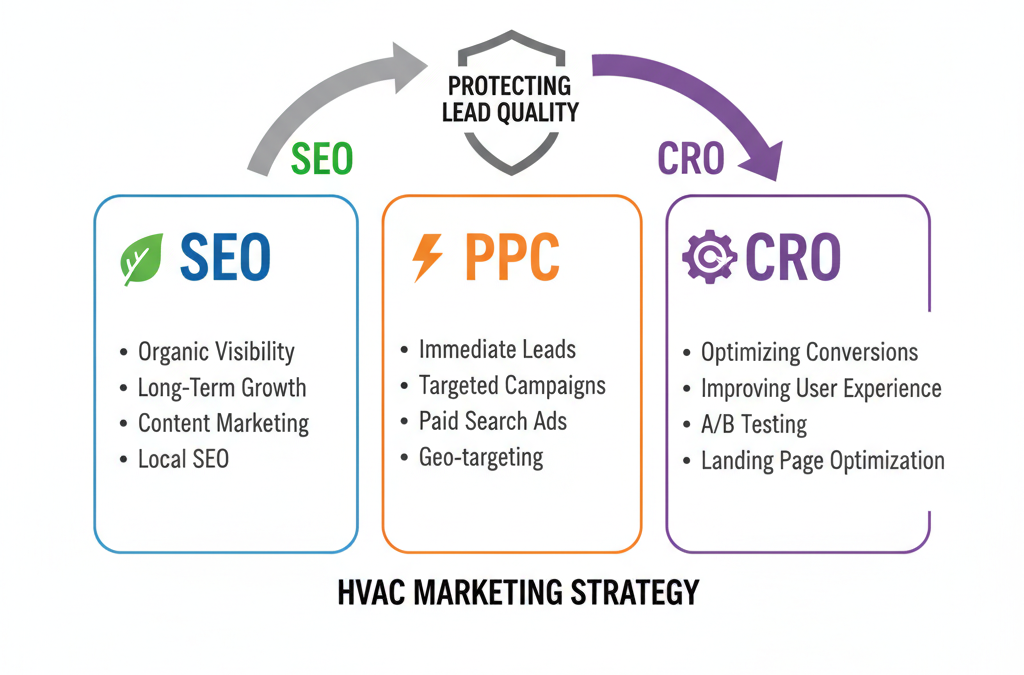
SEO and PPC should not be treated as rivals. SEO builds durable visibility for service pages, educational resources, and brand trust signals. PPC gives faster control over which services receive visibility, when ads appear, and which landing pages receive traffic.
An HVAC company with a weak website may need foundational SEO and conversion work before scaling ads aggressively. A company with strong service pages but seasonal demand swings may use PPC to support specific repair or replacement categories. The right balance depends on how urgently the business needs enquiries and how ready the website is to convert visitors.
A practical channel split
- Use SEO for durable service visibility: Service pages, technical fixes, content, and internal linking help the website earn search visibility without paying for every click.
- Use PPC for speed and control: Paid search can prioritize specific services, schedules, and audience segments when lead flow needs tighter management.
- Use CRO to protect both channels: Better page structure, call paths, forms, and trust signals can improve the value of traffic from both SEO and PPC.
For companies comparing support models, Google Ads Management and Website Design & Development should be reviewed alongside content and analytics. HVAC marketing performs better when the channel plan and website experience support the same business goal.
How HVAC companies can compete online without chasing every channel
HVAC companies do not need to appear everywhere to compete effectively. A focused plan usually starts with the services that are most valuable, most profitable, or most urgent to stabilize. Then the marketing system is built around those priorities.
For example, a company trying to grow installation work may need stronger comparison content, financing explanations where applicable, review placement, and project qualification forms. A company trying to stabilize repair volume may need paid search structure, better call tracking, and fast-loading repair pages. A maintenance plan campaign may rely more on email, remarketing, and clear recurring-service messaging.
The danger is spreading effort across too many channels before the foundation is clear. Social ads, search ads, SEO content, email, and landing pages can all help, but each one should have a defined job. If the goal is not defined, reporting becomes noisy.
Focus areas that often create cleaner growth
- Service-line priority: Decide which HVAC services deserve the most visibility before building campaigns.
- Tracking accuracy: Configure analytics, call tracking, form events, and dashboard views before judging performance.
- Page-level clarity: Give each core service a page that answers buyer concerns, explains process, and makes contact easy.
- Ad query control: Review paid search terms regularly so spend is not drained by irrelevant searches.
- Sales feedback loop: Share lead quality notes back into marketing decisions so campaigns improve based on actual conversations.
Common mistakes that weaken HVAC marketing
Most HVAC marketing problems are not caused by one bad ad or one weak page. They usually come from small gaps that stack up: unclear tracking, thin service pages, generic ads, slow pages, and reports that do not separate lead types.
These mistakes are especially costly because HVAC demand can change quickly with weather, equipment failures, and seasonal planning. If measurement is unclear during a busy period, the company may not know which campaigns created profitable work until after the opportunity has passed.
- Sending all ad traffic to the homepage: Visitors searching for AC repair, furnace replacement, or maintenance plans need pages that match the specific service they searched for.
- Counting every form as equal: A low-fit enquiry should not be valued the same as a ready-to-schedule homeowner with a clear service need.
- Ignoring call handling data: Marketing reports can look weak when the real issue is missed calls, delayed callbacks, or unclear intake scripts.
- Publishing thin service pages: Pages that only list services without process details, trust signals, and buyer questions often fail to convert serious visitors.
- Reviewing campaigns without sales feedback: Platform data can show conversions, but the sales team can identify which enquiries were workable.
FAQs About hvac marketing agency
A strong setup tracks calls, forms, booked visits, and lead quality by service type. Repair, replacement, maintenance, and indoor air quality enquiries should be separated so reporting shows which campaigns create useful conversations, not only raw submissions.
Early feedback can come from technical fixes, indexing changes, and page engagement within weeks, but organic search growth usually needs ongoing content, internal linking, and authority building. The timeline depends on website condition, competition, and how clearly each service page answers search intent.
Ads can create traffic quickly, but a weak website can waste that traffic. If pages load slowly, lack service detail, or make contact difficult, conversion rate work should happen before or alongside paid campaigns.
Start with qualified lead volume, cost per qualified lead, call answer rate, booked-visit rate, and conversion rate by service page. These metrics connect marketing activity to sales and operations more clearly than clicks or impressions alone.
Yes, if the agency has the technical and strategic depth to connect those areas. HVAC lead generation often improves when SEO, Google Ads, landing pages, conversion tracking, and reporting are managed as one system with shared goals.
A practical next step for cleaner HVAC lead tracking
The strongest HVAC marketing systems usually share the same foundation: clear service priorities, channel-specific planning, accurate tracking, and regular feedback from the people answering calls and closing jobs. Without that foundation, campaigns can create activity without giving owners a reliable picture of demand.
Zigma Internet Marketing brings Google Partner-certified expertise, SEO and PPC execution, WordPress and Shopify development, CRO support, and reporting dashboards into one planning process. If you want a second set of eyes on your HVAC lead system, review your services, tracking, and campaign structure with a team that connects spend to calls, forms, and sales outcomes.
Need a clearer view of HVAC lead quality?
Ask Zigma Internet Marketing how SEO, PPC, landing pages, and analytics can work together for a more accountable lead generation system.
Related Topics:
