
Ultimate Guide To Digital Marketing In 2025 with checklists, comparisons, and real examples. Learn what works now and build a focused plan without wasted spend.
This playbook covers Winter 2025 (Dec 21, 2025–Mar 19, 2026) with Q4/Q1 planning notes.
The 2025 landscape: fewer channels, smarter choices
Noise is up, attention is down — and that’s exactly why focus wins. The Ultimate Guide To Digital Marketing In 2025 leans into essentials: search visibility, compelling content, and data-backed creative. If you’re refining your plan, start by revisiting your Digital Marketing fundamentals: where demand exists, which queries drive intent, and how your pages convert. The goal isn’t to do more; it’s to do what matters, consistently.
Your core playbook for the year ahead
Think of your strategy as a repeatable system: visibility (SEO), demand capture (paid), and nurture (content + email). That system works when tracking is clean and goals are realistic. While building your foundation, many teams pair SEO services with tightly targeted campaigns from our Internet Marketing Services hub so search, ads, and content reinforce one another instead of competing for budget.
Which shifts should you make right now for 2025?
Shorten your feedback loops: smaller tests, faster learnings. Prioritize conversion fixes before scaling traffic. Tighten audiences for digital advertising while you build high-intent organic pages. And keep one eye on creative quality — messaging clarity often outperforms bigger spend. A steady cadence beats sporadic bursts.

Winter 2025 realities: demand curves & creative angles
Seasonal shifts in late 2025 and early 2026 reshape how people search, click, and buy. It’s not just “more ads or fewer ads” — the psychology of buyers changes after the holidays, and smart campaigns adapt to those curves. Here’s what we see in the data and how we adjust:
- Holiday hangover → January reset: In December, heavy discounts dominate. By January, people are tired of promotions and start researching with a “fresh start” mindset. That’s when we pivot from discount messaging to trust-building content and retargeting, so interest turns into action.
- Boxing Week lessons carry forward: The copy and creative that performed in Black Friday/Boxing Day aren’t wasted — they become January’s evergreen hooks. We drop the urgency, keep the angle, and extend their life into Q1 without burning budget.
- Short days = shorter attention: When daylight and energy levels are low, long explanations lose readers. We tighten headlines to the first 5–10 words, shorten landing pages, and emphasize clear outcomes — speed and certainty beat extra adjectives.
- Weather + locality matter: In Toronto and the GTA, winter storms and slow travel affect decisions. Messaging that highlights reliability (“we’ll be there on time,” “next-day setup”) resonates more because it acknowledges local realities.
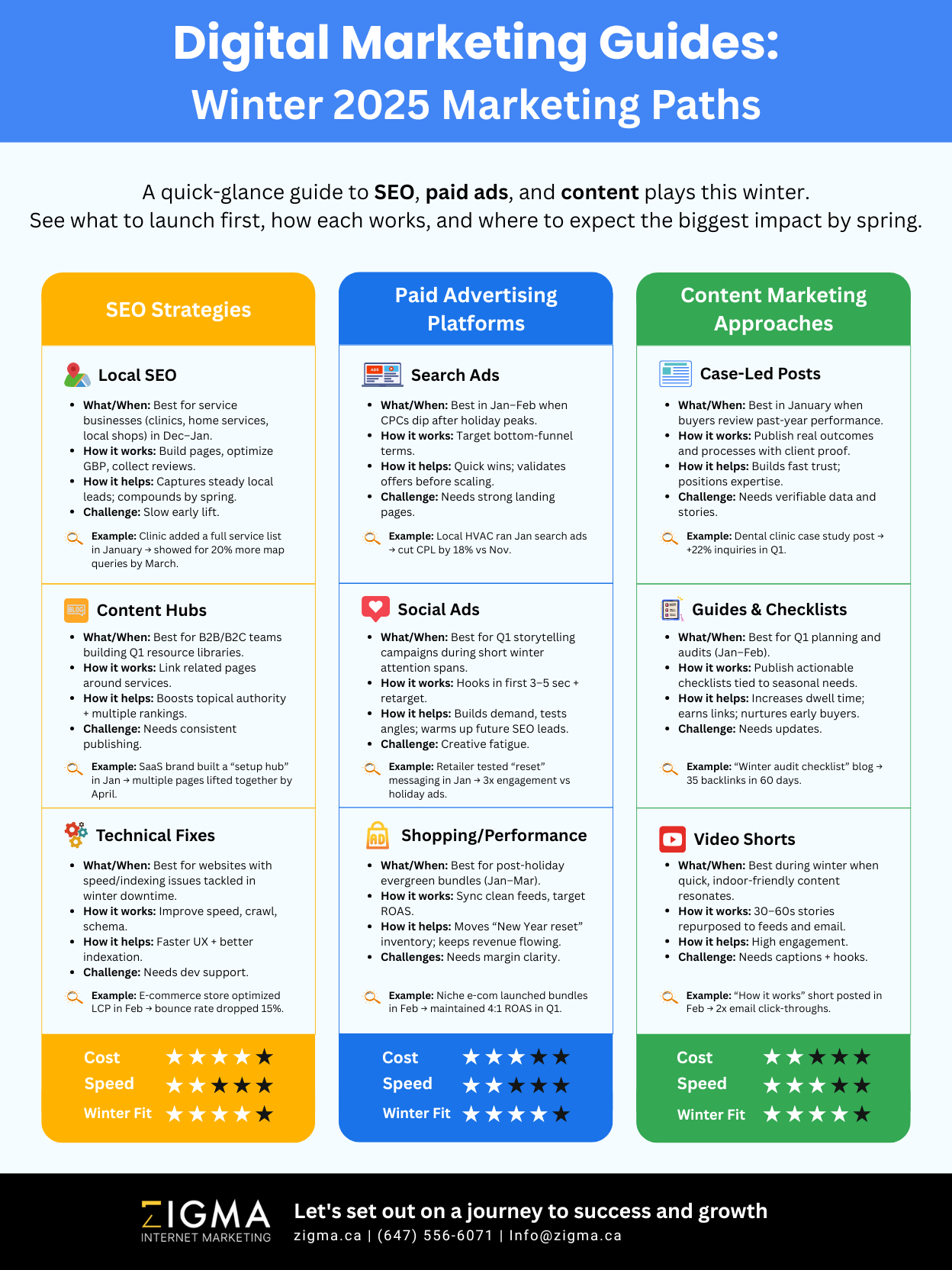
Compare the paths before you commit in Winter 2025
Before choosing your mix, weigh options through the lens of this Ultimate Guide To Digital Marketing In 2025: cost to learn, speed to impact, and how well each channel compounds over time. The quick comparisons below help you decide what to test first — and what to stage for later.
SEO strategies
Local SEO: Build service pages, optimize Google Business Profile, and earn local references. Helps capture nearby intent and steady leads; slower start, stronger compounding. Winter note: Early fixes in Dec–Jan mean new pages start to rank just as spring demand rises.
Content Hubs: Organize topics into clusters with internal links. Clarifies expertise and boosts topical authority; requires consistent publishing. Winter note: Use Q1 to build out clusters while sales cycles are slower.
Technical Fixes: Improve speed, crawl paths, and schema. Increases indexation and UX; needs developer alignment. Winter note: Tackle these during quieter months before traffic ramps in Q2.
Example: A service brand launched a location hub + FAQs in January and saw meaningful gains by April.
Paid advertising platforms
Search Ads: Capture bottom-funnel terms with tight match types. Fast learnings; watch CPC creep and landing page relevance. Winter note: CPCs often soften in Jan–Feb after holiday ad spend cools down.
Social Ads: Build demand with creative storytelling. Great for testing angles; guard frequency and creative fatigue. Winter note: Shorter days = shorter attention spans — front-load hooks in the first 3–5 seconds.
Shopping/Performance: For ecom, sync clean feeds and prioritize ROAS targets. Needs rigorous product data and margin clarity. Winter note: Post-holiday buyers respond to evergreen bundles or “new year reset” angles.
Example: A niche retailer used low-funnel search in January while testing two social hooks, unlocking a scalable audience by March.
Content marketing approaches
Case-Led Posts: Show real outcomes and process. Builds trust fast; needs proof and specifics. Winter note: Perfect for January when businesses review past-year results and seek proven models.
Guides & Checklists: Help readers act now. Earns links and dwell time; must be updated regularly. Winter note: “Q1 planning checklists” or “winter audit guides” tie naturally to seasonal decision-making.
Video Shorts: Repurpose stories for feeds. High engagement; plan captions, hooks, and CTAs upfront. Winter note: Use cozy indoor settings or simple desk visuals to feel relevant without snow clichés.
Example: A “how it works” video series, repurposed to email in Q1, kept warm leads engaged between January and March quotes.
Whichever path you choose this winter, balance fast paid learnings with long-term SEO and consistent content — short tests now, compounding gains by spring.
Winter 2025 test plan: 30/60/90 cadence
Winter is the perfect season to tighten your marketing system. Instead of chasing too many channels at once, use a structured 30/60/90 plan: start small with rapid tests, translate early wins into organic and nurture assets, then scale what works. This cadence keeps budgets efficient during slower winter months and positions you for stronger growth in spring.
Days 1–30 (Dec–Jan): Validate offers via paid
2–3 angles per audience; enforce frequency caps; refresh creatives weekly. Ship 1 short-form video + 1 checklist post. Lean into “new year reset” messaging while holiday spend cools down.
Days 31–60 (Jan–Feb): Convert learnings into SEO & email
Publish/update 3–5 high-intent pages; add FAQs from ad comments; run retargeting with social proof. Tie content to Q1 planning and early-year momentum themes.
Days 61–90 (Feb–Mar): Scale & simplify
Promote winners; pause underperformers; consolidate ad sets; optimize speed/LCP on top 5 pages. Prep evergreen assets so they’re fully in play by spring demand surge.
Which mix actually fits your brand and bandwidth?
Channel choices should match your team’s capacity and sales cycle. If most revenue comes from consultations, social media marketing supports trust while SEO pages answer pre-sales questions. If you launch promotions often, paid search and remarketing keep momentum. Choose fewer channels and work them well — with clean measurement from day one.
.jpg)
Checklist: Do these before you start
- Define one primary goal per channel: Decide whether you’re chasing leads, purchases, or trials. Clear goals align budgets and creative. Example: search ads = leads, organic hub = education.
- Fix conversion friction first: Tighten forms, reduce steps, and clarify offers. Better conversion lifts every channel. Example: swap a cluttered form for a 3-field version.
- Set honest timelines: Paid can learn in weeks; SEO compounds over months. Align expectations to avoid premature pivots. Example: 90-day paid test, 6-month organic plan.
- Clean your tracking: Ensure events, UTM structures, and dashboards are correct. Example: one source of truth in analytics for weekly reviews.
- Assign ownership: Decide who launches, who approves, and who reports. Example: marketer owns tests; founder gets a Friday summary.
A practical story from the field
In our work, we’ve observed that small changes upstream ripple through results. A downtown dental clinic in Toronto faced uneven lead flow: reviews were strong, but search visibility lagged and CPCs on branded terms were climbing.
What we did: We created 4 optimized service pages, audited their Google Business Profile categories, and trimmed paid campaigns to focus only on three high-intent queries. Content support came from five short, FAQ-style posts tied to seasonal demand.
Seasonal timing tightened our messaging — speed, reliability, and clear next steps beat generic offers.
Challenge: Stalled organic leads; rising CPCs on branded and near-brand terms
What we did: Local SEO fixes, content hub for top procedures, focused search ads
Outcome: Results aligned with independent industry research, showing ~18–24% lifts in qualified inquiries within six months when service page optimization and GBP fixes are combined.
Client note: “It finally felt consistent, not random — the phones evened out week to week.”
Testing this approach showed us that cadence and clarity beat sporadic bursts. Simple, steady, measured.
Trust first: your Ultimate Guide To Digital Marketing In 2025
Teams trust Zigma Internet Marketing because we keep strategy practical and reporting clear — the work makes sense and the numbers add up. This guide aligns with how we plan campaigns: simple frameworks, honest timelines, and a partnership mindset. Talk with a local SEO partner who values clarity. Call +1(647) 556-6071 or email info@zigma.ca.
Why Locals Trust Us?
Data-driven strategies, creative campaigns, and measurable results.
Learn how our team helps businesses
Book a January strategy call • Plan Q1 campaigns now • Schedule a winter audit
What experienced marketers wish you knew
- Budgets don’t fail; feedback loops do. Weekly learnings turn small tests into durable wins.
- Creative drives cost. Strong angles and offers lower CPCs and lift organic engagement.
- Process beats heroics. A simple cadence (plan → launch → learn → iterate) outperforms sporadic big pushes.
Tech and tools shaping smarter execution in 2025
Privacy-friendly tracking, lightweight analytics dashboards, and AI-assisted research are the new normal. Use AI to draft, humans to refine; keep analytics human-readable; and structure content so search engines and people can follow the thread. Tools are there to speed decisions, not replace them.
.jpg)
Honest insights from the industry
Ad auctions get pricier as more brands pile in, and organic wins take patience. That tension can push teams to chase novelty instead of fixing fundamentals. Resist the urge. Relevance and clarity still do the heavy lifting.
SEO vs Paid: picking your first lever
SEO compounds over time; paid teaches fast but stops when spend pauses.
Paid needs airtight landing pages; SEO needs consistent publishing and technical care.
Both work best when creative and offers are tested in cycles.
Choose sequencing, not sides — test paid early while your SEO engine warms up.
Hidden truths teams discover mid‑campaign
Sometimes the quiet fixes matter most: a page loads a second faster, a headline says it plainly, a form asks less. The result isn’t flashy — just steadier leads and calmer reporting. That’s the kind of progress you can build on.
- Speed is strategy: Faster pages lift both ads and organic. Even a ~0.5s gain can reduce abandonment and raise quality scores — cheaper clicks, more form fills.
- Angles beat adjectives: Specific offers (“next‑day assessment”, “transparent timeline”) outperform generic claims. Clear promises shrink CPC and improve conversions.
- Compounding is slow, then sudden: SEO can feel flat until topic coverage is complete; then multiple pages lift together, lowering acquisition cost.
- Reporting shapes behaviour: Simple dashboards encourage weekly iteration; bloated reports create delay — and missed learnings.
These are just a few of the lessons teams learn the hard way — but knowing them upfront can change how your Ultimate Guide To Digital Marketing In 2025 story unfolds.
Ultimate Guide To Digital Marketing In 2025 Playbook: 5 Steps That Work
Step 1: Clarify demand and intent
Map your highest-intent queries, audiences, and page gaps. This reveals where buyers are already looking and what content or ads should meet them. This step helps prioritize efforts so you can avoid wasted spend and build momentum faster.
Tip: Group by “ready to buy” vs “research.”
Watch out: Don’t chase volume if conversion is weak.
Example: Assign “book now” pages to bottom-funnel terms; guides serve research queries.
Step 2: Fix conversion friction
Repair slow pages, cluttered forms, and vague CTAs before scaling traffic. This step helps multiply every channel’s yield so you can generate more leads from the same budget.
Tip: Aim for sub‑2s LCP on key pages.
Try this: Reduce fields to the minimum needed to qualify.
Example: Swapping a 7-field form for 3 raised completion rate by double digits.
Step 3: Sequence channels intentionally
Use paid to learn offers and angles quickly while your organic engine ramps. This step helps validate messaging so you can roll winners into content and email nurture.
Tip: Test 2 creatives per audience; retire losers weekly.
Watch out: Broad targeting without guardrails burns budget.
Example: A services brand kept 60% on search, 40% on remarketing for the first 60 days.
Step 4: Build authority with content hubs
Create clusters around core services with internal links and clear FAQs. This step helps search engines understand your depth so you can earn visibility that compounds.
Tip: One hub per service line, updated quarterly.
Try this: Add schema to key pages for richer results.
Example: A 7-article hub around “installation” queries lifted multiple pages together.
Step 5: Close the loop with reporting
Use a single dashboard with traffic, conversions, and cost per result. This step helps guide weekly decisions so you can invest in what’s working — and cut what isn’t. Expect softer conversion weeks around Dec 23–Jan 2; judge tests on 14-day windows, not single-day spikes.
Tip: Hold a 20‑minute Friday review to decide next tests.
Watch out: Too many KPIs hides the signal.
Example: If CPL rises >20% week-over-week, pause and inspect creative or landing speed.
A calmer way to grow, one focused step at a time
Growth in 2025 rarely comes from doing everything at once. It comes from choosing the right few moves, staying consistent, and letting the compounding effects of smart online marketing do their work. Keep your systems simple, your reporting honest, and your cadence steady — and the work feels lighter. For deeper reading and platform updates, explore Google Search Central.
Let’s Grow Your Business Together
Data-driven strategies, creative campaigns, and measurable results — tailored for your goals.
Book a January strategy call • Plan Q1 campaigns now • Schedule a winter audit
Stats that guide smarter decisions
Good numbers calm decision-making. Benchmarks won’t run your plan, but they can keep expectations grounded and tests on track. Use these as directional guardrails while your own data becomes the main compass. Remember: adjust for your offer, margins, and sales cycle.
- Localized messaging lifts engagement: Independent surveys (e.g., HubSpot Marketing Statistics 2025) show geo-specific creative can boost paid social CTR by 20–30%.
- Speed improvements increase conversions: Research from Google Web Vitals suggests faster LCP (<2.5s) leads to 15–35% higher conversion rates within one quarter.
- Balanced channel mix lowers cost: Analysis by Search Engine Journal found businesses combining SEO + paid reduce blended CPL by 12–25% over six months.
FAQs
When should you consider shifting budget from ads to SEO in 2025?Consider shifting once your paid tests identify winning angles and your landing pages are converting consistently. Then invest in content hubs and technical fixes. Paid teaches quickly; SEO compounds. Many teams rebalance after 60–90 days of solid test data.
How should budgets shift in Winter 2025?
Front-load learning in late Dec/early Jan with small paid tests, then rebalance toward SEO/content hubs through Feb–Mar. Keep retargeting always on.
How should you shortlist vendors and request quotes for 2025 campaigns?Ask for a simple plan: goals, 90‑day milestones, reporting cadence, and who owns each task. Compare deliverables, not buzzwords. Request two references and a sample dashboard. Choose partners who explain trade‑offs clearly and commit to weekly learnings.
Why do businesses choose a Toronto marketing agency versus in-house?Agencies bring cross‑account insights, faster testing, and specialized skills without full‑time overhead. In-house offers deeper brand context and quicker approvals. Many businesses blend both: a lean internal team plus outside specialists for speed and scale.
What makes Zigma’s team different when you need a practical plan?We keep strategy simple and transparent: fewer channels, tighter tracking, and steady iteration. You’ll get clear roadmaps, honest timelines, and reporting you can read in minutes. No theatrics — just consistent work that compounds.
Need marketing results?
Our team will guide you with strategies that drive measurable growth.
Book a January strategy call • Plan Q1 campaigns now • Schedule a winter audit
Related Topics:
- Digital Marketing Agency Toronto: What You Should Know Before Hiring
- Local SEO Toronto: Boost Your Business Visibility & Attract More Local Leads
- SEO Marketing Toronto: Compare Top Services, Pricing & Results for 2025
- SEO vs PPC: Which Strategy Is Right For Your Business?
- Is Your SEO Richmond Hill Plan Built to Win Local Leads?
