
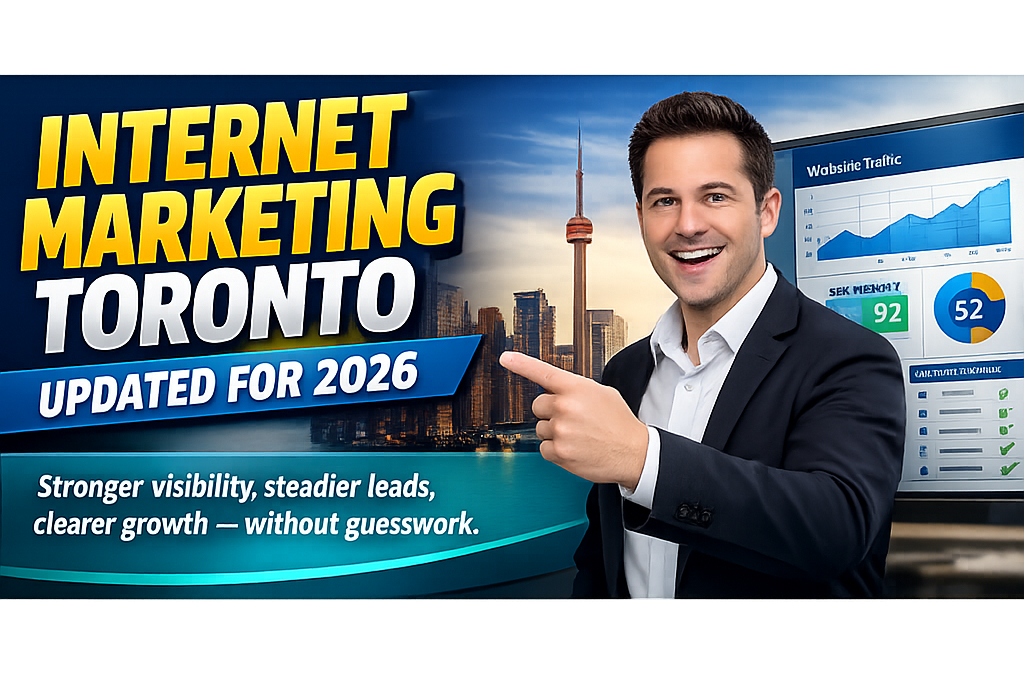
Internet Marketing by a trusted Toronto team. Clear process and timely results that earn confidence — request a quick, no-pressure consult.
Toronto brands are raising the bar with Internet Marketing
In Toronto, the competition is driving businesses to be clearer, faster, and more consistent online. Internet Marketing isn’t one channel — it’s how search, ads, content, and analytics work together so people find you and trust you. If you’re mapping your next move in Digital Marketing, start with small, testable steps. Think of it as “smart online marketing”: targeted, measurable, and paced to your budget.

From click to customer: how Internet Marketing actually works
At its core, Internet Marketing builds demand across channels, then converts it on-page. Search visibility captures intent, paid campaigns accelerate reach, and content earns trust — all measured by leads and revenue. You’ll often pair SEO services with quick-win campaigns, then layer remarketing and email to keep interest warm. For a clear picture of what’s included, browse our Internet Marketing Services and pick a starting lane that fits your timeline.
Where Internet Marketing meets Toronto’s neighbourhoods
Toronto is varied — Queen West boutiques need discovery, Danforth clinics need local intent, and Scarborough contractors need reliable phone leads. Seasonality matters (holiday retail spikes, summer service calls), and competition can be intense in midtown and the downtown core. As a Toronto marketing agency, we tune messaging to commuter patterns, neighbourhood language, and the mix of mobile vs. desktop usage you’ll actually see.
- Queen West and Leslieville retail: content that spotlights style, hours, and map-rich snippets helps foot traffic decide quickly.
- Midtown professionals: weekday lead forms perform better around commute windows; refine bid schedules accordingly.
- Danforth health and wellness: reputation and reviews near the map pack often drive first calls; support with FAQs and FAQs schema.
- Trades in Scarborough/North York: high-intent search terms plus call tracking clarify which jobs are worth scaling.
Local nuance reduces wasted spend and shortens decision time. With those anchors in place, you can choose the right campaign model for your goals.
Which Internet Marketing path pays off fastest in Toronto?
Before you commit budget, compare practical routes. The right structure for Internet Marketing in Toronto balances cost control with learning speed — especially if you’ll mix SEO with digital advertising and content.
Partnering Models
Option A: In‑house DIY — You keep everything internal. Control is high, but speed depends on your team’s learning curve and bandwidth. Works best when you already have a marketer and developer who can test and iterate weekly.
- How it works: Your team manages channels, tools, and reporting, often starting with search and social basics.
- Best fit: Early-stage teams with time to build processes, or firms with a generalist marketer in place.
- Example: A Junction pop-up runs self-serve paid social to validate offers, cutting CAC by ~12% in 6 weeks.
Option B: Hybrid (you + partner) — You keep strategy in-house and lean on a partner for execution and specialist skills (SEO, analytics, CRO). This often balances cost and speed nicely.
- How it works: Shared roadmap; your team handles content and approvals, your partner runs sprints.
- Best fit: Teams wanting control with access to specialist depth on-demand.
- Example: A St. Clair clinic pairs in-house content with agency-led search ads; form fills up ~28% in 90 days.
Option C: Full‑service agency — Strategy, execution, and reporting delivered end-to-end. Faster launches and deeper skill coverage; higher monthly fees offset time saved and risk reduced.
- How it works: Dedicated team runs campaigns, optimization, and reporting cadence (biweekly or monthly).
- Best fit: Growth-focused brands needing speed, structure, and cross-channel coordination.
- Example: A Bloor West retailer scales search + shopping; ROAS lifts ~2.4x over 4 months.
Campaign Focus Areas
Option A: Search‑led (SEO + SEM) — Capture existing demand fast with ads while SEO builds durable visibility. Ideal for service areas with strong “near me” intent.
- How it works: Launch paid search for quick wins; fix technical SEO; publish helpful local pages.
- Best fit: Clinics, trades, legal, finance — any high-intent local service.
- Example: A North York contractor sees calls up ~35% in 60 days; map views rise steadily by month 4.
Option B: Social‑led (paid + content) — Build awareness and nurture. Great for visual brands and community engagement; pair with retargeting to convert interest.
- How it works: Paid social targets audiences; content educates and retargets website visitors.
- Best fit: Retail, fitness, wellness, food — where creative drives discovery.
- Example: A Liberty Village studio lifts trial signups ~22% with UGC + local offers in 8 weeks.
Option C: Commerce‑led (CRO + email + retargeting) — Squeeze more from existing traffic. Improve product pages, test offers, and automate follow-ups.
- How it works: Run A/B tests, refine checkout, build abandoned-cart flows, segment email.
- Best fit: Shopify/WordPress stores with ≥5k monthly sessions.
- Example: A Queen West boutique lifts conversion rate from 1.2% to 1.7% in ~10 weeks.
Measurement Approach
Option A: Last‑click attribution — Simple and fast, but undervalues upper-funnel work. Helpful early to gauge direct response, then evolve.
- How it works: Credit goes to the final touch before conversion.
- Best fit: Early-stage tracking or limited tooling.
- Example: A pilot search campaign shows CPA clarity in week 2; later, model shifts to multi-touch.
Option B: Multi‑touch models — Balanced view across discovery and conversion. Better decisions, slightly more setup.
- How it works: Weighted credit by position or time decay using GA4 and ad platforms.
- Best fit: Brands investing in mixed media (search, social, email).
- Example: A Midtown clinic sees awareness assist ~40% of booked consults over 90 days.
Option C: Incrementality testing — Proves what truly moves the needle. Requires discipline but prevents over-spend on “vanity” channels.
- How it works: Geo or audience holdouts; compare lift vs. control groups.
- Best fit: Larger spends or mature teams validating scale.
- Example: A GTA retailer confirms paid social adds ~18–24% lift beyond organic in 6 weeks.
Case story: a Danforth clinic steadies leads and cuts waste
A family dental clinic near Danforth and Pape wanted steadier bookings and less wastage in ad spend. Map visibility had slipped; search ads were broad; landing pages weren’t tuned to local concerns like parking and evening hours. We combined local search fixes with tighter keyword themes and simple on-page improvements so patients could act quickly.
Challenge: Unpredictable appointment flow; paid clicks not converting
What we did: Local SEO cleanup, precise search campaigns, focused landing pages
Outcome: ~38% more booked consults in 5 months; cost-per-lead down ~19% by month 3
Client note: “We finally see which channels drive real bookings, not just clicks.”
Trust first: a smarter path to Internet Marketing
Teams choose Zigma because we show our work: clear roadmaps, practical testing, and plain-language reporting. As a digital marketing agency Toronto businesses rely on, we connect channel choices to outcomes you can measure. Talk with a strategist at +1(647) 556-6071 or email info@zigma.ca to see what’s realistic for your timelines and goals.
Why Locals Trust Us?
Data-driven strategies, creative campaigns, and measurable results.
A quick look: see how a multi‑channel plan comes together
This is a highlight video slot where we usually showcase a short walkthrough of planning, launch, and optimization — from audience research to first learnings and adjustments. Picture a 3–4 minute tour showing how search, ads, and content support each other, and how we report on progress. Prefer a live demo? We’ll share a screen and walk you through sample dashboards.
.jpg)
– Insert Image #1
immediately BEFORE ``.
.jpg)
– Insert Image #2 inside
immediately BEFORE ``.
Hidden truths that shape better Internet Marketing bets
Sometimes the most helpful lessons are the quiet ones — the findings discovered late at night in dashboards or in the margin notes of a test plan. They’re not flashy, but they bend results over time. Here are a few we share early to save teams budget and stress.
- Speed without feedback burns cash: Launching fast matters, but only if you capture clean data and act on it weekly. Tight feedback loops cut waste and protect growth budgets.
- Creative fatigue is real: Even strong ads fade in ~4–8 weeks. Plan fresh angles and formats up front to keep CPMs and CPAs from creeping up.
- Landing pages do the heavy lifting: Channel tweaks help, but a focused page often lifts conversions ~15–30%. That compounds across every campaign.
- Attribution is a compass, not a ruler: Use models to guide, not to “prove” a single truth. Smart direction beats false precision and prevents knee-jerk cuts.
These are just a few of the lessons teams learn the hard way — knowing them early can change how your Internet Marketing story unfolds.
Five practical steps to align Internet Marketing with growth
Step 1: Define one primary KPI per channel
Give each channel a clear job: leads for search, reach for social, conversion rate for landing pages. This focus prevents mixed signals in reporting. This step helps align expectations so you can compare apples to apples across campaigns.
Hint: Tie budgets to KPIs; don’t chase vanity metrics.
Second tip: Use GA4 conversions that match sales reality, not just clicks.
Example: A service brand set “qualified form fills” for search and “reach” for awareness; weekly reviews became obvious and fast.
Step 2: Build a 90‑day test plan
Outline hypotheses, timelines, and success thresholds. Decide in advance what you’ll pause, scale, or rewrite. This step helps remove emotion from decisions so you can scale winners confidently.
Hint: Plan at least two creative angles per ad set.
Second tip: Keep a simple changelog to connect shifts to outcomes.
Example: A retailer tested two offers and three headlines; the winner cut CPA by ~23% by week 7.
Step 3: Pair awareness with retargeting
Awareness creates interest; retargeting turns it into action. Use audience pools from site visits and video views. This step helps transform attention into pipeline so you can lift conversion rates without huge spend.
Hint: Refresh retargeting creative every 4–6 weeks.
Second tip: Cap frequency to avoid fatigue in social media marketing.
Example: A studio used 30‑day warm audiences; trial signups rose ~18% in two months.
Step 4: Fix the path to action
Simplify forms, clarify next steps, and make contact options prominent. This step helps reduce drop‑offs so you can capture more value from the same traffic.
Hint: Add sticky CTAs on mobile and concise proof near the fold.
Second tip: Test short vs. long forms based on lead quality.
Example: A clinic cut fields from 9 to 5; booked consults increased ~21% in 6 weeks.
Step 5: Report weekly, decide monthly
Weekly checks catch issues early; monthly reviews guide bigger shifts. This step helps balance agility with signal quality so you can avoid reacting to noise.
Hint: Keep a single-page scorecard with KPIs and notes.
Second tip: Flag anomalies (seasonality, promos) right in the deck.
Example: A home services team used a 10‑minute Friday review and a monthly plan; wasted spend dropped ~15%.
A quiet close: progress that stacks, week by week
Growth rarely arrives all at once. It shows up in cleaner dashboards, steadier leads, and small creative wins that compound. Choose one lane to start, measure honestly, then add pieces as confidence builds. If you prefer to read first, many practitioners keep notes and step-by-steps at places like Moz’s SEO Learning Hub — simple, practical, and grounded.
Let’s Grow Your Business Together
Data-driven strategies, creative campaigns, and measurable results — tailored for your goals.
Relevant stats that guide smarter Internet Marketing
Numbers won’t run your business, but they can steer better choices. Industry reports suggest localized ad messaging lifts engagement in dense cities, and independent surveys indicate clear landing pages improve conversion more than ad tweaks alone. Recent analysis of local campaigns shows mixed-channel reporting prevents overspending on last‑click heroes.
- Optimized landing pages are linked with ~20–40% conversion lifts across North American SMBs (independent summaries).
- Localized copy in urban markets like Toronto often improves ad engagement by ~15–30% versus generic variants.
- Teams adopting multi-touch attribution report ~10–25% better budget allocation within 2–3 months (industry analyses).
In Summary: Key Insights from This Guide
A steady Internet Marketing plan blends quick wins with durable gains. Keep goals simple per channel, test in 90‑day blocks, and let measurement guide your next spend.
- Start fast, measure weekly, adjust monthly — momentum beats perfect plans.
- Balance search intent with creative reach to capture and nurture demand.
- Invest in landing pages early; small fixes there compound across channels.
- Choose a partnering model (DIY, hybrid, or agency) that matches in‑house bandwidth.
Next Steps: How We Can Support Your Goals
If you want a light lift, we’ll map a 90‑day test plan you can run. If you’d rather move faster, we’ll run sprints and share clear weekly notes.
- Channel fit review: which mix suits your timelines and risk.
- Measurement setup: GA4, conversions, and a one‑page scorecard.
- Creative roadmap: angles, formats, refresh cadence, and approvals.
- Local lens: Toronto context for neighbourhoods, seasons, and commuter patterns.
FAQs About Internet Marketing
Because it meets customers where they’re already searching, scrolling, and comparing. In a dense market like Toronto, smart targeting and clear offers shorten decision time. The right mix helps you capture intent now while building brand signals that keep working long after the ad spend is off.
If you need leads quickly, start with paid search and social while SEO groundwork begins. If you can wait for compounding gains, prioritize technical fixes and content, then layer paid for testing. Many brands run both: ads for speed, SEO for durable visibility and trust.
Ask for a 90‑day plan, KPIs per channel, and two recent examples from a similar industry. Confirm who executes the work and how reporting is handled. Request a simple, itemized proposal so you can compare apples to apples without hidden fees or vague deliverables.
Service-led businesses often see the fastest lift: clinics, trades, legal, finance. High-intent searches plus strong map presence can raise calls and form fills in weeks. Retail and gyms typically win with creative + retargeting to turn interest into trials and store visits across Toronto neighbourhoods.
We keep one KPI per channel, report with plain-language notes, and run 90‑day sprints so decisions feel calm and clear. You’ll know what’s working, what’s next, and how it affects leads and revenue — without getting lost in jargon or dashboard noise.
Need marketing results?
Our team will guide you with strategies that drive measurable growth.
Related Topics:
- Digital Marketing Agency Toronto: What You Should Know Before Hiring
- Local SEO Toronto: Boost Your Business Visibility & Attract More Local Leads
- SEO Marketing Toronto: Compare Top Services, Pricing & Results for 2025
- SEO vs PPC: Which Strategy Is Right For Your Business?
- Is Your SEO Richmond Hill Plan Built to Win Local Leads?

? Metadata Output (Required at End):