
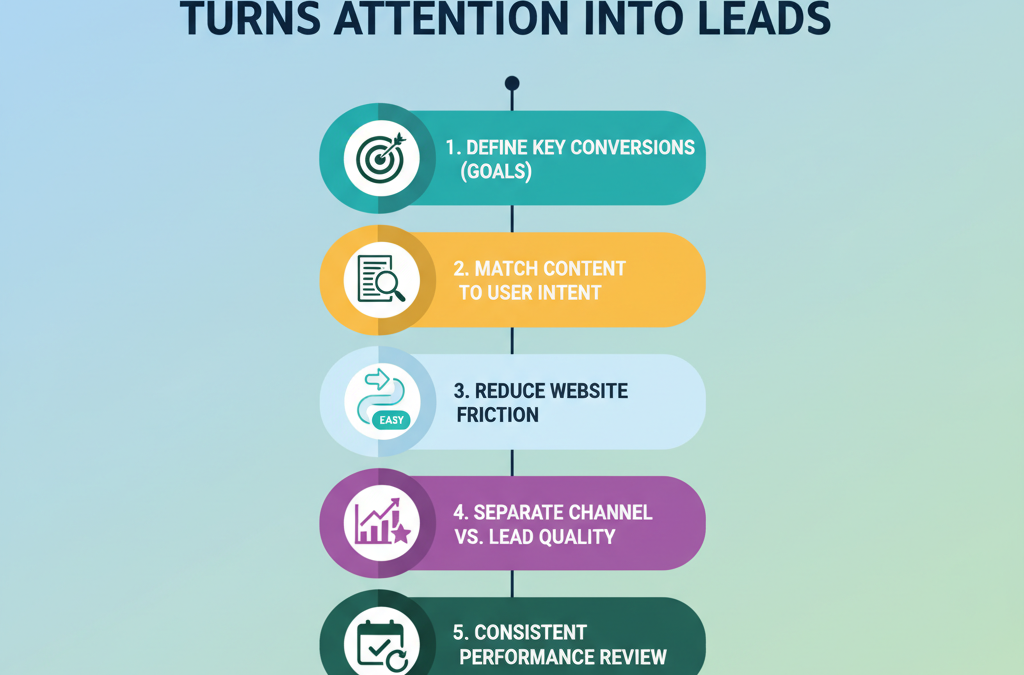

Web marketing is the planned use of digital channels—search, paid ads, websites, content, email, analytics, and social platforms—to attract the right audience and turn that attention into measurable business actions. Good web marketing is not just posting more or buying more traffic. It connects your message, website, tracking, and follow-up process so a visitor can move from curiosity to enquiry with less friction.
For a business owner or marketing manager, the challenge is usually not a lack of tools. The harder problem is deciding which channels deserve attention first, how to measure quality, and how to avoid spending time on activity that does not produce calls, forms, sales, or qualified conversations.
How web marketing works across the full customer path
Web marketing works by matching a person’s intent with the right channel and message. Someone searching for a service may need a search result, a useful landing page, and a clear form. Someone comparing providers may need case details, proof of expertise, and a page that answers practical questions before they speak with a team.
A complete digital program usually includes three layers: visibility, conversion, and measurement. Visibility brings qualified people to your website. Conversion helps those visitors take a useful action. Measurement shows which campaigns, pages, and keywords are creating value rather than just traffic.
This is where a connected service mix can help. A business may use SEO Services to build search visibility, paid search to reach high-intent visitors faster, and website improvements to raise the percentage of visitors who become leads.
The core channels behind effective web marketing
Each web marketing channel plays a different role. The right mix depends on the sales cycle, competition, website quality, budget discipline, and how quickly the business needs feedback. A campaign with weak tracking can look active while hiding waste, so channel selection should start with business goals and measurement setup.
Search visibility channels
A) SEO: Search engine optimization improves how well website pages can rank for relevant searches. SEO is usually strongest when the business needs durable visibility for service pages, educational content, and comparison searches.
- How it works: SEO improves technical structure, page relevance, internal links, content depth, and authority signals so search engines can understand and rank the site more confidently.
- Best fit: SEO fits businesses that want steady lead flow from search and can invest in compounding visibility over time.
- Example: A service business may create detailed pages for high-intent services, then support those pages with helpful blog content that answers buyer questions.
B) PPC search ads: Pay-per-click search ads place sponsored listings in front of people actively searching. PPC is useful when a business needs faster testing, clearer keyword data, or campaign control by service category.
- How it works: PPC campaigns target search terms, use ad copy to qualify clicks, and send visitors to landing pages built for enquiries or purchases.
- Best fit: PPC fits campaigns where lead quality, negative keywords, conversion tracking, and landing page clarity can be managed closely.
- Example: A company may run ads for one priority service while SEO pages are being strengthened for longer-term visibility.
C) Content marketing: Content supports search, trust, and decision-making. Strong content answers the questions people ask before they are ready to speak with a provider.
- How it works: Content maps topics to search intent, explains trade-offs, and connects readers to relevant service pages when the next step is natural.
- Best fit: Content fits businesses with complex services, longer sales cycles, or audiences that compare providers carefully.
- Example: A technical blog post can explain process, risks, timelines, and decision criteria before a visitor requests advice.
Conversion channels and website support
A) Landing pages: Landing pages focus a visitor’s attention on one clear action. They work well when the traffic source has a specific promise or audience segment.
- How it works: A landing page aligns headline, proof, service details, form fields, and calls to action with the search or ad that brought the visitor there.
- Best fit: Landing pages fit paid campaigns, high-value services, and any campaign where message match can improve lead quality.
- Example: A PPC ad for a specific service should not send visitors to a generic homepage if a focused page can answer the search more clearly.
B) Conversion rate optimization: Conversion rate optimization improves the percentage of visitors who take a useful action. CRO focuses on behaviour, friction, and trust barriers.
- How it works: CRO reviews page layout, forms, calls to action, mobile usability, page speed, trust signals, and analytics patterns.
- Best fit: CRO fits websites receiving traffic but seeing weak enquiry volume, low form completion, or high drop-off on key pages.
- Example: Shortening a form, clarifying service fit, or adding proof near a call to action can change how visitors respond.
C) Website development: Website development supports marketing by improving structure, speed, tracking, and usability. A visually attractive site can still underperform if technical barriers block search engines or frustrate visitors.
- How it works: Development work may address technical SEO, page templates, CMS structure, schema, performance, and form integrations.
- Best fit: Development fits businesses with outdated websites, slow pages, poor mobile layouts, or tracking gaps.
- Example: A WordPress or Shopify site can be rebuilt with cleaner templates, stronger internal linking, and clearer conversion paths.
Measurement and decision channels
A) Analytics setup: Analytics setup gives teams a reliable view of what visitors do after they arrive. Without clean tracking, budget decisions often rely on impressions and clicks rather than business outcomes.
- How it works: Analytics setup connects GA4, Google Tag Manager, form events, phone tracking, e-commerce data, and dashboards where appropriate.
- Best fit: Analytics fits any business spending time or money on digital channels and needing clearer evidence of lead quality.
- Example: A dashboard can separate traffic growth from actual enquiries so the team can see which pages assist revenue.
B) Search query review: Search query review shows the real phrases people use before clicking. This review is especially useful for paid search and SEO content planning.
- How it works: Marketers compare actual queries against campaign goals, add negative keywords, and identify content gaps or new page ideas.
- Best fit: Query review fits campaigns where irrelevant clicks, vague searches, or mismatched intent are lowering efficiency.
- Example: A campaign may exclude research-only searches while building educational content for those terms separately.
C) Reporting and review cycles: Reporting turns campaign data into decisions. A useful report explains what changed, why it changed, and what the next adjustment should be.
- How it works: Reporting reviews traffic sources, conversions, lead quality, cost efficiency, landing page behaviour, and content performance.
- Best fit: Reporting fits teams that need accountability, budget clarity, and a regular rhythm for campaign improvement.
- Example: A monthly review may show that a page gets traffic but few enquiries, making CRO a stronger next move than publishing another page.
Where web marketing breaks down
Most weak campaigns do not fail because one platform is useless. They fail because the parts do not connect. Ads may send traffic to a slow page. SEO content may attract visitors who are not ready to buy. A website may generate form fills that are not tracked back to the campaign that created them.
A common example is judging success by traffic alone. More visitors can be useful, but only if the visitors match the service, audience, and buying stage. A page that brings ten qualified enquiries can be more valuable than a post that attracts thousands of readers with no commercial fit.
Another breakdown happens after the lead arrives. Web marketing can generate a form submission, but response speed, sales follow-up, call handling, and CRM discipline influence whether that lead becomes revenue. Marketing data should therefore connect to operations wherever possible.
Traffic versus qualified demand
Traffic tells you how many people arrived.
Engagement shows whether visitors found the page useful.
Conversions show whether the page created a business action.
Lead quality shows whether the action had real sales value.
A practical web marketing checklist before spending more
Before increasing ad budgets or publishing more content, review the foundations. These checks help reveal whether your current system can convert additional attention into useful outcomes.
Step 1: Define the conversion that counts
Choose the business action that signals meaningful progress, such as a qualified form submission, booked consultation, phone call, product purchase, or demo request. This step helps reduce reporting confusion so you can judge campaigns by outcomes rather than activity.
Measurement focus: Track the action in analytics and confirm that the event fires only when the action is completed.
Common risk: Counting every click on a button as a lead can make a campaign look healthier than it is.
Example: A form-start event may show interest, while a thank-you page event confirms that the person submitted the enquiry.
Step 2: Match each page to a clear search intent
A service page, blog post, and landing page should not all try to do the same job. This step helps align content with the visitor’s stage so you can answer the right question at the right moment.
Measurement focus: Review rankings, search queries, bounce patterns, and assisted conversions by page type.
Common risk: A page written for broad awareness may struggle to convert visitors who are ready to compare providers.
Example: An educational post can explain a process, while a service page can cover scope, proof, and next steps.
Step 3: Check whether the website removes friction
Visitors should be able to understand the offer, confirm fit, and take action without searching through several pages. This step helps improve conversion rates so existing traffic has a stronger chance of becoming revenue.
Measurement focus: Review mobile layout, form completion, page speed, call tracking, and scroll behaviour on high-value pages.
Common risk: A campaign can appear expensive when the real issue is a confusing landing page.
Example: Moving proof, service details, and the enquiry form closer together can reduce hesitation on a paid traffic page.
Step 4: Separate channel performance from lead quality
A channel may produce many enquiries that the sales team cannot close, or fewer enquiries that are highly relevant. This step helps protect budget decisions from surface-level data.
Measurement focus: Compare source, campaign, keyword, form details, call notes, and closed-won outcomes where data is available.
Common risk: Cutting a channel too early may remove a source that generates fewer but stronger opportunities.
Example: A branded search campaign may show low volume but support high-intent visitors who already know the company.
Step 5: Review performance on a consistent cadence
Web marketing improves through measured adjustments, not constant resets. This step helps keep testing disciplined so campaign changes can be linked to actual outcomes.
Measurement focus: Review trends every few weeks for paid campaigns and over longer windows for SEO, content, and technical improvements.
Common risk: Changing headlines, budgets, targeting, and landing pages all at once can make performance harder to interpret.
Example: A PPC campaign may need weekly search query checks, while SEO content may need a longer review window before judging impact.
SEO, PPC, and content have different jobs
SEO, PPC, and content often work better together than they do in isolation. SEO builds durable visibility for searches that align with your services. PPC creates faster feedback and controlled exposure. Content supports both by answering questions that influence trust and conversion.
For example, paid search may reveal which service terms convert well. Those findings can inform SEO page priorities and future content topics. SEO performance can also reduce overreliance on paid traffic by creating search visibility that does not require a click cost each time someone visits.
The comparison becomes clearer when each channel is tied to a role:
- Use SEO for long-term search presence: SEO is valuable when the business wants relevant service pages and educational resources to keep attracting qualified visitors.
- Use PPC for speed and controlled testing: PPC is useful when the business needs immediate visibility, search term data, or campaign control by audience and service.
- Use content to support decision-making: Content helps buyers understand problems, compare providers, and arrive at sales conversations with clearer expectations.
- Use CRO to improve every channel: Conversion rate optimization can make SEO traffic, PPC clicks, and referral visitors more productive by reducing friction on key pages.
Businesses that need support across channels can review Zigma Internet Marketing’s Digital Marketing Services, including SEO, PPC, web design, content, and analytics setup.
How to measure whether web marketing is working
Measurement should answer a simple question: which activities create qualified opportunities for the business? Clicks, impressions, and traffic can help diagnose performance, but they do not prove that marketing is contributing to revenue.
A cleaner measurement setup usually tracks both platform data and website behaviour. For paid campaigns, that includes ad spend, queries, negative keywords, conversion actions, and landing page outcomes. For SEO, that includes rankings, organic sessions, indexed pages, technical health, assisted conversions, and the quality of enquiries generated by organic search.
Useful web marketing dashboards often include:
- Traffic source clarity: The dashboard should show whether visitors came from organic search, paid search, social, email, referral, or direct traffic.
- Conversion tracking: Forms, calls, purchases, and other key actions should be tracked accurately rather than estimated from page views.
- Lead quality signals: Notes from sales teams, CRM stages, or closed revenue can show whether campaign leads are actually useful.
- Landing page behaviour: Engagement, form completion, mobile performance, and drop-off points can reveal where visitors hesitate.
- Channel comparison: Reports should separate awareness metrics from business outcomes so each channel is judged fairly.
Zigma Internet Marketing often supports this work through GA4 setup, Google Tag Manager, conversion tracking, and reporting dashboards that connect marketing activity to business actions.
Web marketing decisions that deserve a second look
Some decisions seem efficient at first but create hidden problems later. A campaign can generate cheap clicks from weak search terms. A website redesign can improve appearance while damaging technical SEO. A content calendar can publish frequently without supporting the pages that generate leads.
Three checks can prevent a lot of wasted effort:
- Do not judge paid search by clicks alone: Search terms, conversion quality, and landing page fit reveal more than click volume.
- Do not treat SEO as only content publishing: Technical SEO, internal linking, page structure, and crawlability affect whether strong content can perform.
- Do not separate marketing from sales follow-up: Slow responses, unclear handoffs, or weak call handling can reduce the value of otherwise qualified leads.
A useful guiding question is: if more traffic arrived tomorrow, would the website and tracking system be ready to turn that traffic into clear decisions? If the answer is uncertain, the next improvement may be measurement or CRO rather than another campaign launch.
Choosing support for web marketing with less guesswork
The right marketing partner should be able to explain how each recommendation connects to visibility, conversion, or measurement. Vague promises are not enough. Ask how campaigns will be tracked, how lead quality will be reviewed, and how technical website issues will be handled if they affect performance.
Strong support usually includes both strategy and implementation. For example, Google Ads Management should include search query review, negative keywords, conversion tracking, landing page feedback, and budget pacing. Website work should support SEO, speed, usability, and accurate measurement rather than focusing only on design preferences.
Zigma Internet Marketing brings Google Partner-certified expertise, full-service execution across SEO, PPC, web, content, and social media, and reporting built around KPIs such as calls, forms, sales, and acquisition efficiency. If you want a second opinion on your current setup, you can ask an SEO/PPC question and share what you are trying to measure.
FAQs About Web Marketing
Start by defining the business action you want more of, such as qualified calls, form submissions, purchases, or demo requests. Then review your website, tracking, and current traffic sources. A clear starting point prevents teams from spending on channels before conversion paths and measurement are ready.
Paid campaigns can produce early data within days or weeks, while SEO and content usually need longer review windows. The useful timeline depends on traffic volume, tracking accuracy, competition, and the number of conversions recorded. Small datasets should be read carefully before major decisions are made.
Web marketing does not need to replace referrals. It can strengthen them. A referred prospect may still search the company, read service pages, compare proof, and check whether the website answers practical questions. Strong digital assets can make referral traffic more confident before enquiry.
Start with the channel that matches your urgency, website readiness, and sales process. PPC can test demand quickly. SEO builds durable visibility. Content supports education and comparison. CRO should be prioritized when traffic exists but enquiries are weak or lead quality is unclear.
Web marketing is working when the data connects activity to business outcomes. Look beyond impressions and traffic. Track qualified enquiries, call quality, form submissions, purchases, cost efficiency, and sales feedback. A useful report should explain what changed and what action follows from the data.
Related Topics:
