
Why internet advertising still deserves a careful look
Internet advertising is the paid promotion of a business through digital channels such as search engines, websites, social platforms, video platforms, shopping feeds, and apps. It helps businesses place the right message in front of a defined audience, then measure what happens next—clicks, calls, form fills, sales, or repeat visits. For many companies, it sits alongside SEO Services rather than replacing them, because paid traffic can create short-term visibility while organic growth builds over time.
The appeal is easy to understand. A local service company can appear for urgent searches, an e-commerce brand can promote specific products, and a B2B firm can reach buyers during research. Still, internet advertising is not simply a matter of turning on ads and waiting for leads. The difference between wasted spend and steady performance usually comes down to targeting, tracking, landing-page quality, and the discipline to keep refining what the data is showing.
That is why business owners often need more than a surface-level definition. They need to know where internet advertising fits, how it works in practice, and what signals point to a campaign that is actually helping the business. Once those basics are clear, the channel becomes far easier to judge.
How internet advertising works from click to conversion
At its core, internet advertising works through auctions, targeting rules, creative assets, and conversion tracking. A business chooses who it wants to reach, where the ads should appear, what action it wants the user to take, and how success will be measured. In search advertising, bids and relevance influence whether an ad appears for a query. In display or social campaigns, audience signals and creative quality play a bigger role. Either way, the system rewards campaigns that match user intent well.
A simple example helps. A company offering emergency repairs may run search ads for high-intent queries, while an online retailer may run product ads tied to inventory feeds. A professional services firm may use remarketing to stay visible after an earlier website visit. In each case, the campaign is trying to connect message, audience, and timing. That is also where Google Ads Management becomes more than account setup—it becomes a process of tightening search terms, filtering weak traffic, improving ad copy, and aligning the landing page with the promise in the ad.
Misunderstandings usually start when businesses focus on impressions or clicks alone. A campaign can generate traffic and still underperform if the page loads slowly, the offer is unclear, or conversion tracking is incomplete. Internet advertising works best when the full path is connected: query or audience, ad, landing page, follow-up, and reporting.
Which kinds of internet advertising fit different business goals?
Not every ad format solves the same problem. Some campaigns are built for demand that already exists, while others are built to create awareness earlier in the buying cycle. If the business goal is lead generation, the strongest setup may look very different from a campaign designed for catalogue sales or brand reach. A useful comparison is the difference between a hand raised now and a reminder placed for later.
Search intent campaigns
A) Search ads: Search ads place a business in front of people actively looking for a product or service.
- How it works: Ads appear for keyword-based queries, and relevance between search term, ad, and landing page strongly affects efficiency.
- Best fit: This format suits businesses that need high-intent traffic, such as home services, legal, healthcare, B2B lead generation, or urgent local enquiries.
- Example: A company targeting “lead generation agency toronto” or “ppc agency toronto” is trying to capture users already comparing providers.
B) Shopping ads: Shopping ads show products, pricing, images, and merchant information directly in search results.
- How it works: Product feed data powers the ad, so clean titles, categories, and feed health heavily influence visibility.
- Best fit: This format suits retailers, Shopify stores, and e-commerce teams managing many SKUs.
- Example: A store selling niche equipment can pair product feed accuracy with e-commerce landing pages to reduce wasted clicks.
C) Local service and map-driven ads: These campaigns support businesses that depend on nearby demand and quick contact actions.
- How it works: They blend location signals, business profile strength, and service relevance to appear during local searches.
- Best fit: This format suits trades, clinics, agencies, and other firms where phone calls and local trust influence the sale.
- Example: Businesses investing in “google business profile optimization” often pair that work with local paid visibility.
Audience-building campaigns
A) Social media advertising: Social campaigns are useful when the audience may not be searching yet but can still be qualified by interests, behaviours, or demographics.
- How it works: Platforms use audience data, creative format, and engagement signals to deliver ads across feeds, stories, and video placements.
- Best fit: This format suits visual brands, event offers, promotions, and awareness campaigns that benefit from repeated exposure.
- Example: A firm launching a new service may use paid social to introduce the offer before search volume grows.
B) Display advertising: Display ads place banner or responsive creative across websites and apps.
- How it works: Targeting can be based on audience categories, placements, topics, or remarketing lists.
- Best fit: This format suits awareness support, retargeting, and broad category visibility rather than immediate bottom-funnel conversion alone.
- Example: A B2B firm can stay visible to visitors who read a service page but did not fill out a form on the first visit.
C) Video advertising: Video ads create more room to explain value, demonstrate a product, or frame a service problem clearly.
- How it works: Video placements use audience and contextual targeting, often with shorter attention windows than landing-page traffic from search.
- Best fit: This format suits demonstrations, testimonials, and category education where trust is built visually.
- Example: A software or professional service brand may use short case-based video to pre-qualify viewers before sending them to a form page.
Follow-up and efficiency campaigns
A) Remarketing: Remarketing reconnects with people who already visited the site or engaged with the brand.
- How it works: Audience lists are built from site visits, platform engagement, or past customer actions, then matched with follow-up messaging.
- Best fit: This format suits businesses with longer sales cycles or repeat consideration.
- Example: A visitor who reads a service page on “technical seo services” can later see a reminder ad tied to that interest.
B) Performance Max or multi-network automation: These campaigns use machine learning to place ads across several channels from one campaign structure.
- How it works: The platform combines assets, audience signals, and conversion history to allocate spend dynamically.
- Best fit: This format suits advertisers with strong tracking, enough conversion data, and clear asset quality.
- Example: An e-commerce account with reliable purchase tracking may use automation to scale after search structure is already sound.
C) Landing-page testing tied to ad traffic: This is not a channel on its own, but it often determines whether the campaign improves.
- How it works: Headlines, forms, layouts, and trust cues are adjusted to improve the rate at which visitors turn into leads or customers.
- Best fit: This suits almost every advertiser once traffic volume is steady enough to compare outcomes.
- Example: A campaign for “conversion rate optimization toronto” should demonstrate that paid media and landing-page performance are inseparable.
What business owners should check before spending more on ads
More budget rarely fixes weak campaign structure. Before expanding spend, it helps to review a short list of basics that usually separate promising accounts from expensive ones. The aim is simple: keep the campaign honest about what is producing revenue or qualified leads.
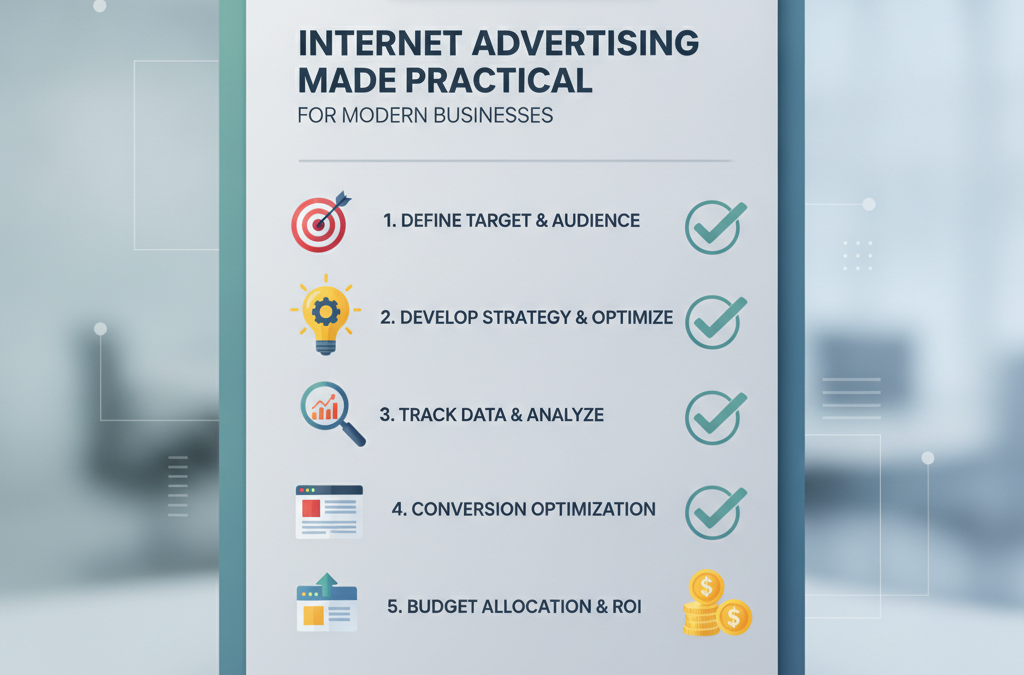
Step 1: Define the conversion before launching
Internet advertising performs better when the business chooses one main action to optimize for, such as a phone call, form submission, purchase, or booked consultation. A campaign without a clear conversion target often chases cheap traffic instead of useful traffic. This step helps focus the account so you can judge performance against a business result rather than activity alone.
Main check: Make sure the conversion is trackable and tied to a real business outcome.
Common issue: Businesses sometimes count every click or page view as success, which hides weak lead quality.
Example: A company investing in “online marketing toronto” may care far more about qualified enquiries than about raw session volume.
Step 2: Match campaign type to buying intent
A search campaign reaches people who are already looking, while social or display campaigns often reach people earlier in the decision cycle. If the offer requires urgency or clear existing demand, search usually carries stronger intent. This step helps reduce mismatch so you can avoid paying for attention that does not convert.
Main check: Ask whether the audience is searching now or needs to be introduced to the problem first.
Common issue: A business may expect immediate leads from awareness-heavy campaigns without enough follow-up or remarketing.
Example: A “google ads management toronto” campaign may be more direct than a broad awareness ad if the buyer is already comparing providers.
Step 3: Clean up targeting and exclusions
Targeting determines who sees the ad, but exclusions determine who does not. Negative keywords, location settings, audience refinements, and device analysis often make a visible difference. This step helps reduce irrelevant spend so you can protect budget for traffic that is more likely to convert.
Main check: Review where traffic is coming from and which searches or audiences consistently underperform.
Common issue: Broad targeting with no exclusions can inflate clicks while reducing lead quality.
Example: A “local seo gta” provider may want local commercial traffic, not informational searches from users outside the service area.
Step 4: Align the landing page with the ad promise
If the ad speaks to one need and the page answers another, conversion rates usually fall. Visitors need a fast-loading page, a clear headline, visible trust cues, and a friction level that matches the offer. This step helps improve response quality so you can turn paid traffic into action instead of bounce rate.
Main check: Compare the exact wording and promise in the ad with the first screen of the landing page.
Common issue: Sending paid clicks to a generic homepage often weakens performance.
Example: A user clicking an ad for “website design toronto” should land on a page that speaks directly to design scope, platform fit, and conversion goals.
Step 5: Review search terms, lead quality, and reporting weekly
Campaigns drift when no one checks the actual queries, form quality, call outcomes, or attribution setup. Paid media is less like a switch and more like an ongoing tuning process. This step helps keep improvement steady so you can spot wasted spend, weak messaging, or tracking gaps before they become expensive habits.
Main check: Look at search term reports, conversion paths, and actual sales feedback together.
Common issue: A campaign may appear healthy in-platform while offline sales teams report poor-fit leads.
Example: A “content marketing toronto” campaign may generate enquiries, but only reporting tied to revenue will show whether they are the right enquiries.
What experienced advertisers usually wish clients knew earlier
- Attribution is rarely neat. A prospect may click a search ad, leave, return through organic search, and convert after a direct visit. If the reporting model is too narrow, internet advertising can look weaker or stronger than it really is.
- Lead quality can outrank lead volume. Ten strong enquiries can outperform fifty weak ones if the sales team spends less time filtering and more time closing.
- Creative and offer fatigue are real. Even solid campaigns can flatten out when the same message runs too long without testing new angles, tighter segmentation, or updated landing pages.
How to choose the right digital marketing agency for internet advertising
Agency selection has a direct effect on campaign efficiency because the account structure, tracking quality, and reporting discipline all shape what decisions get made later. A strong partner should be able to explain how paid traffic connects to business outcomes, not just platform activity. That is especially relevant when a business needs support across SEO, ads, analytics, and landing-page performance instead of isolated campaign management.
It helps to ask practical questions. Who owns the ad account and conversion data? How are search queries reviewed? What does monthly reporting include? How are landing-page tests prioritized? Clear answers usually indicate process maturity. Vague answers usually lead to vague results.
For businesses comparing a Digital Marketing Services partner, it is also worth checking whether the team can support adjacent needs such as GA4 setup, content alignment, technical fixes, and CRO. Paid traffic often exposes problems elsewhere on the site. If the agency can only buy clicks, the business may still struggle to turn attention into revenue.
What to screen for
- Tracking ownership: The business should retain access to ad platforms, analytics, and tag management so reporting stays transparent.
- Query and audience discipline: A credible team should explain negatives, exclusions, feed hygiene, and audience refinement in plain language.
- Landing-page accountability: Paid traffic and page performance should be reviewed together, especially for lead generation.
- Reporting tied to outcomes: Dashboards should connect spend to calls, forms, sales quality, or revenue where possible.
- Cross-channel judgment: A good agency knows when ads should support SEO, local search, content, or remarketing instead of trying to force one channel to do everything.
What shapes ROI in internet advertising campaigns
ROI in internet advertising is usually shaped by a chain of smaller decisions rather than one dramatic lever. The traffic source matters. The landing page matters. Follow-up speed matters. So does the difference between an informative click and a buyer-ready click. If any one link in that chain is weak, returns can flatten quickly even when ad delivery looks healthy inside the platform.
There is also a timing issue. Search campaigns can create demand capture quickly, but they still need refinement time. Display and social campaigns may support later conversions rather than instant ones. For that reason, businesses should separate early indicators from final business outcomes. A drop in cost per click may help, but not if conversion rate or lead quality drops at the same time.
Internet advertising works best when ROI is treated as an operating system, not a vanity metric. That means connecting spend to intent quality, landing-page clarity, tracking accuracy, and sales feedback. A business that does this well can usually make calmer budget decisions because the numbers point to causes, not just symptoms.
Common ROI drivers
- Search intent quality: Queries close to a buying decision usually perform differently from broad research traffic.
- Conversion friction: Long forms, unclear calls to action, or weak mobile layouts can lower return even when traffic quality is decent.
- Speed of follow-up: Lead generation campaigns often perform better when calls or email replies happen quickly.
- Offer clarity: Ads and pages that state the service, audience, and next step clearly tend to waste less spend.
- Measurement accuracy: Without solid conversion tracking, bid strategy and budget decisions can drift away from real outcomes.
SEO vs PPC in internet advertising decisions
SEO and PPC are often framed as rivals, but for most businesses they solve different timing problems. SEO builds unpaid visibility over time by improving relevance, authority, and site quality. PPC buys immediate visibility for selected searches or audiences. One is cumulative. The other is immediate but rented.
If a business needs leads soon, PPC can start generating data faster. If the business wants durable visibility and lower dependency on paid clicks over time, SEO becomes essential. Many companies use both because the channels can inform each other. Paid search reveals converting queries quickly, while SEO builds deeper topical coverage around those same themes.
The better question is not which channel wins in theory. It is which channel fits the current stage of the business. A newer company may need paid traffic while its organic footprint is still thin. An established site may use SEO to reduce paid reliance in categories where it can rank well. For some firms, the strongest path is a blended model supported by Website Design & Development, strong tracking, and disciplined conversion reporting.
A practical comparison
- SEO: Better for long-term visibility, informational coverage, and compounding lead flow when the site can sustain ongoing content and technical work.
- PPC: Better for immediate search presence, launch periods, testing offers, and filling visibility gaps where rankings are still weak.
- Blended use: Better when the business wants both near-term lead generation and longer-term traffic resilience.
How local businesses can compete online with internet advertising
Local competition is often less about who spends the most and more about who aligns message, location intent, and trust signals better. A smaller company can outperform a larger one in paid media if the targeting is tighter, the service area is defined properly, and the landing page addresses local buying concerns clearly. Relevance tends to reward focus.
That is why local campaigns often work best when they combine search ads, strong local landing pages, accurate business profile details, and follow-up systems that respond quickly. For service businesses, that may mean dedicated pages by service category. For retail, it may mean location-aware inventory or pickup messaging. For professional services, it may mean clearer proof of fit and more specific enquiry paths.
One useful question for any local advertiser is simple: does the ad reflect the real search behaviour of nearby customers, or is it speaking too broadly? Narrowing that gap often produces a better cost structure than broadening the campaign.
Ways local advertisers improve competitiveness
- Tighter geography: Show ads where delivery is realistic and profitable rather than covering broad areas by default.
- Stronger local proof: Use reviews, service details, and business information that reduce hesitation for nearby buyers.
- Better page matching: Send users to pages that reflect the exact service or product searched, not a generic homepage.
- Conversion tracking with context: Distinguish calls, forms, and qualified leads so budget shifts follow business value.
Quick facts that keep internet advertising grounded
Some businesses treat internet advertising as a traffic tool, while others treat it as a decision system. The second view is usually healthier. Paid media can show where demand exists, which messages attract the wrong audience, and where the website is introducing friction. That makes ad performance useful even before a campaign is fully mature.
- Internet advertising is measurable, but only if tracking is trustworthy. Broken conversion setup can distort bidding and reporting.
- High click volume does not guarantee business value. Lead quality, sales follow-up, and page clarity often explain the gap.
- Smaller refinements compound. Better search terms, better negatives, and better pages can improve results more steadily than sudden budget jumps.
FAQs About internet advertising
Paid campaigns can begin driving traffic shortly after launch, but useful business results usually depend on more than going live. Tracking, targeting, ad relevance, landing-page quality, and follow-up all affect early performance. Many advertisers use the first few weeks to identify search patterns, remove wasted traffic, and improve conversion quality.
Internet advertising can work for both, but the campaign structure changes by business model. Lead generation often needs strong search intent targeting, call or form tracking, and tight landing pages. E-commerce usually depends more on product feed quality, merchant data, remarketing, and clear checkout performance.
Waste often comes from weak keyword control, poor audience targeting, missing exclusions, generic landing pages, or incomplete conversion tracking. Another common issue is measuring surface activity instead of qualified outcomes. A campaign may look busy in-platform while the sales team receives enquiries that do not fit the business.
The answer depends on timing and goals. Paid ads can create immediate visibility and faster testing, while SEO builds long-term traffic and authority. Many businesses use paid campaigns for faster demand capture, then strengthen organic visibility over time so they are less dependent on purchased clicks.
Ask who owns the ad account, how conversions are tracked, how search terms are reviewed, what reporting includes, and whether landing-page improvements are part of the process. Those questions reveal whether the provider is managing a business outcome or simply managing ad spend.
Clear next steps if internet advertising is under review
Internet advertising tends to work best when it is treated as part targeting system, part measurement system, and part website test. If results feel inconsistent, the issue is often not the channel itself. It is usually the connection between intent, message, page quality, and reporting. For businesses that want a clearer view of where paid traffic fits alongside SEO, CRO, and analytics, Zigma Internet Marketing brings Google Partner-certified expertise, transparent reporting, and practical implementation support across tracking, landing pages, and campaign refinement. If tailored advice would help, 📩 Ask an SEO/PPC question.