
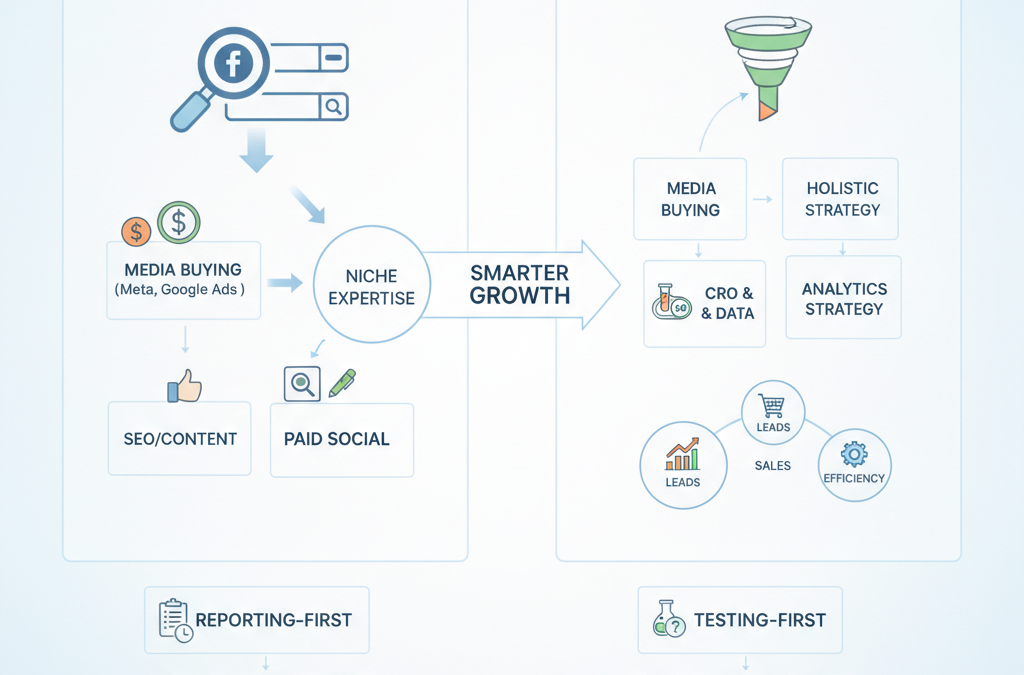
Performance marketing agencies help businesses track marketing spend against real outcomes such as leads, sales, booked calls, and customer acquisition cost. Rather than judging success by impressions alone, a strong agency connects channels, landing pages, tracking, and conversion data so each campaign can be measured and improved over time. For companies comparing performance marketing agencies, the central question is usually simple: can the agency turn traffic into measurable business growth without wasting budget?
That question matters because many businesses invest in campaigns before their tracking, messaging, or website experience are ready. The result is familiar — ads generate clicks, reports look busy, and revenue still feels inconsistent. A more disciplined approach usually starts with strategy, channel fit, clean analytics, and realistic benchmarks. If you want a broader view of how this connects to search visibility and lead generation, review Digital Marketing Services.
What performance marketing agencies actually do day to day
Performance marketing agencies manage campaigns where results can be tracked against defined business goals. That often includes paid search, paid social, remarketing, landing page testing, conversion rate optimization, analytics setup, and reporting. The agency’s role is not just to launch ads. It is to build a measurement system that shows which keywords, audiences, creatives, and pages are producing qualified action.
In practice, that means the work sits at the intersection of media buying, messaging, data, and website performance. A campaign can attract the right search but still underperform if the landing page is slow, the form is too long, or conversion tracking is incomplete. Strong execution usually combines channel management with on-site fixes, especially for businesses that rely on lead generation, e-commerce sales, or booked consultations. That is why businesses often pair performance work with Google Ads Management and landing page improvements rather than treating ads as a standalone tactic.
A useful comparison is this: buying traffic without measurement is like increasing foot traffic to a store while never checking which visitors actually buy. Performance marketing agencies are brought in to close that gap. The better ones also clarify where performance marketing stops. For example, it will not fix weak product-market fit, poor sales follow-up, or unclear offers on its own.
How to tell whether a performance-focused agency is the right fit
Not every business needs the same agency model. A local service company may need local SEO gta, google business profile optimization, and lead generation agency toronto support alongside paid campaigns. An online retailer may need product feed management, remarketing, technical fixes, and tighter attribution across multiple channels. A B2B company may need narrower targeting, longer sales-cycle reporting, and stronger content support before paid campaigns become efficient.
The fit question becomes clearer when you ask two things. First: what action needs to improve — calls, forms, demos, online sales, or repeat purchases? Second: where is the current bottleneck — traffic quality, offer clarity, landing page friction, or tracking gaps? Performance marketing agencies tend to add the most value when the business already has a viable offer but needs sharper execution and cleaner measurement.
For businesses in Toronto, Ontario, the right fit often includes a mix of paid acquisition and organic visibility. Search behaviour in a dense market can be expensive, especially for competitive categories. That is one reason many firms combine seo company toronto, seo services toronto, and ppc agency toronto support rather than expecting one channel to carry the full workload.
How performance marketing agencies compare by service model
Comparing performance marketing agencies gets easier when you separate them by operating style, scope, and level of technical involvement. The differences affect reporting quality, campaign efficiency, and how quickly problems get fixed.
Channel specialist vs full-funnel agency vs in-house support partner
A) Channel specialist: A narrow agency focuses on one area such as paid search or paid social and often works well when the business already has strong internal support.
- How it works: The agency manages one channel deeply, such as google ads management toronto or paid social buying, while internal teams handle creative, web updates, and analytics.
- Best fit: Businesses with mature operations, existing designers or developers, and clear internal ownership.
- Example: A company with a strong website and CRM may only need tighter paid search management and negative keyword control.
B) Full-funnel agency: A broader agency connects media, landing pages, CRO, reporting, and organic support under one plan.
- How it works: Paid media decisions are tied to page performance, tracking accuracy, and follow-up metrics rather than ad metrics alone.
- Best fit: Businesses that want fewer handoffs and need help across strategy, execution, and measurement.
- Example: A service business may pair online marketing toronto, landing page testing, and call tracking to improve lead quality.
C) In-house support partner: Some agencies work more like a technical and strategic extension of an internal team.
- How it works: The agency helps with audits, campaign guidance, dashboards, and specialist execution where internal capacity is limited.
- Best fit: Mid-sized teams that need experienced support without fully outsourcing growth operations.
- Example: A growing brand keeps day-to-day content in house but relies on an agency for tracking, media efficiency, and technical seo services.
Reporting-first agencies vs testing-first agencies vs implementation-first agencies
A) Reporting-first agencies: These firms emphasise dashboards and visibility, which helps, but reporting alone does not improve results.
- How it works: The agency organises campaign data and explains performance trends in regular reviews.
- Best fit: Businesses with strong internal marketers who can act on insights.
- Example: A leadership team may want spend, lead quality, and pipeline reporting tied to each source.
B) Testing-first agencies: These firms focus heavily on experimentation across ads, audiences, and landing pages.
- How it works: The team runs structured tests, measures outcomes, and reallocates budget based on conversion data.
- Best fit: Businesses with enough traffic volume to support reliable A/B testing.
- Example: An e-commerce brand tests feed titles, creative angles, and checkout friction to improve return from paid traffic.
C) Implementation-first agencies: These agencies are valuable when core setup issues are holding campaigns back.
- How it works: The work begins with fixing tracking, pages, technical errors, and campaign structure before scaling spend.
- Best fit: Businesses that suspect their current data is incomplete or unreliable.
- Example: A company seeing inconsistent leads may need GA4 events, form tracking, and clearer attribution before expanding media budget.
Lead generation agencies vs e-commerce growth teams vs local market specialists
A) Lead generation agencies: These agencies optimise for form fills, calls, demos, and booked appointments.
- How it works: Campaigns are built around high-intent searches, strong offers, and lead qualification signals.
- Best fit: Home services, professional services, B2B firms, and clinics.
- Example: A firm may need conversion rate optimization toronto support to reduce wasted clicks and improve inquiry quality.
B) E-commerce growth teams: These teams optimise revenue, average order value, product feeds, and retention signals.
- How it works: The agency manages shopping campaigns, remarketing, product data, and site conversion friction.
- Best fit: Shopify and multi-product retailers with ongoing inventory and feed needs.
- Example: A brand may combine paid acquisition with product feed improvements and email capture flows.
C) Local market specialists: These agencies understand the overlap between paid channels and regional search demand.
- How it works: The strategy blends location-targeted ads, map visibility, and landing pages built for nearby demand.
- Best fit: Multi-location or service-area businesses competing in crowded metro regions.
- Example: A marketing agency gta may combine search ads with content marketing toronto and profile optimisation to support both short-term leads and longer-term visibility.
What experienced marketers usually notice early
- Tracking quality shapes every decision: If calls, forms, purchases, or offline conversions are not being captured properly, campaign reporting can look healthy while business performance stays flat. Clean measurement often improves decision-making before campaign volume changes at all.
- Landing page friction is often underestimated: A fast campaign audit may reveal that the real problem is not the ad account. It may be a weak page headline, a slow mobile experience, or missing trust signals. That is where website design toronto or landing page refinement starts to influence paid efficiency.
- Lead quality depends on the whole system: Keywords, ad copy, forms, qualifying questions, CRM response time, and sales follow-up all influence results. Paid traffic can generate poor leads if the offer is too broad or the intake process is unclear.
How to choose the right performance marketing agency
Choosing among performance marketing agencies is less about polished sales language and more about operational fit. A capable agency should be able to explain how it defines success, what it will measure first, which channels fit your business model, and what constraints might slow progress. If those answers stay vague, the relationship will likely stay vague too.
A practical selection process usually starts with an audit conversation. Ask how the agency approaches tracking, landing pages, attribution, and testing cadence. Ask what happens in the first 30 to 60 days. Ask who implements technical fixes if conversion tracking is incomplete. These questions quickly separate presentation-heavy firms from agencies that can actually improve performance.
Businesses in Toronto, Ontario often benefit from agencies that understand both local competition and channel economics. Search demand can be strong, but cost efficiency depends on segmentation, negative keywords, page relevance, and reporting depth.
What to check before signing
- Measurement discipline: Confirm that goals are tied to leads, sales, or qualified actions rather than soft visibility numbers alone.
- Implementation support: Check whether the agency can assist with pages, tracking, feeds, or technical fixes instead of stopping at media buying.
- Reporting clarity: Ask for examples that connect spend to outcomes such as cost per lead, sales quality, or revenue trends.
- Testing rhythm: A useful partner should explain how campaigns are reviewed, adjusted, and prioritised over time.
What influences results in modern digital campaigns
Performance is usually shaped by a handful of variables working together. Traffic quality is one. Offer strength is another. The rest often comes down to conversion friction and measurement quality. A campaign that sends the right visitors to the wrong page can underperform just as badly as a weak ad campaign.
Three areas tend to drive the biggest swings. First, targeting quality: are campaigns reaching people with real intent or broad curiosity? Second, page clarity: does the visitor understand the offer within a few seconds? Third, follow-up speed: does the business respond quickly enough to convert interest into action? For lead generation in particular, a delay of even a few hours can reduce close rates noticeably.
There is also a long-term dimension. Paid campaigns can generate demand quickly, while organic channels build compounding visibility. That is why businesses often get stronger results when search engine optimization, pay per click advertising, local search marketing, and analytics and tracking setup are treated as connected parts of the same growth system.
Signals that usually affect ROI most
- Intent match: High-intent searches, relevant ad copy, and tightly matched landing pages often reduce wasted spend.
- Conversion path: Shorter forms, faster pages, clear proof, and stronger calls to action usually improve completion rates.
- Data quality: Better attribution improves budget decisions and prevents false confidence.
- Sales handoff: Strong marketing can still underperform if leads are contacted slowly or inconsistently.
SEO or PPC: which path fits the situation better?
The choice between SEO and paid media is rarely absolute. SEO usually builds momentum gradually and supports durable visibility for terms that matter to your business. PPC can put your offer in front of high-intent searchers almost immediately, but it depends on ongoing spend and close attention to campaign efficiency. Performance marketing agencies should be able to explain where each channel fits instead of pushing one universal answer.
For a newer business, paid search may help validate offers and messaging faster. For an established company with a strong service library, SEO can reduce long-term dependence on paid traffic. In many cases, the most stable model is a blended one: use PPC for immediate demand capture while building organic visibility for priority terms, service pages, and informational searches that support trust.
A simple way to think about it: PPC is often faster feedback, while SEO is often stronger compounding. Businesses comparing digital marketing agency toronto support should look for teams that understand both timelines and do not pretend they behave the same way.
When each channel tends to fit
- SEO fits well when: The business wants durable traffic growth, has useful service depth, and can commit to ongoing technical and content improvements.
- PPC fits well when: Immediate lead flow, testing speed, or controlled targeting is the priority.
- A blended approach fits well when: The business wants short-term lead capture and long-term visibility at the same time.
How Toronto businesses can compete more effectively online
Toronto, Ontario is competitive across paid and organic channels, which means efficiency matters more than surface activity. Broad campaigns tend to get expensive quickly. Generic service pages often struggle to convert. Businesses that perform better usually narrow their targeting, improve page relevance, and measure lead quality instead of chasing traffic volume for its own sake.
Local competition also changes how trust is built. Searchers often compare several providers in a single session. That means messaging, page clarity, response speed, and proof carry more weight. For local firms, strong visibility in maps, tighter location pages, and properly configured campaigns can create meaningful advantages even without the largest budget.
Neighbourhood context matters too. Search behaviour can differ across downtown commercial districts, North York service queries, and suburban demand across Scarborough or Etobicoke. The same campaign structure rarely fits every area equally well.
Ways local businesses usually gain ground
- Tighter geo intent: Campaigns and pages aligned to actual service areas often convert better than citywide generic messaging.
- Stronger local proof: Reviews, clear service coverage, and visible contact details reduce hesitation.
- Better page experience: Mobile speed, short forms, and clearer service explanations often improve lead quality.
- Integrated local strategy: Paid search works better when supported by local pages, GBP visibility, and content built around real search demand.
FAQs About performance marketing agencies
Performance marketing agencies are usually judged by trackable business actions such as leads, purchases, booked calls, or customer acquisition cost. Traditional marketing support may include brand awareness work that is harder to tie directly to conversion outcomes. Both can be useful, but the reporting model and day-to-day focus are different.
Ask how the agency defines success, how conversion tracking is set up, what happens in the first few weeks, and who handles landing page or analytics issues. You should also ask how results are reported and how lead quality is evaluated, not just lead volume.
No. Many also support landing pages, CRO, analytics, feed management, remarketing, and organic visibility. In Toronto, Ontario, businesses often need a mix of paid campaigns and search visibility because crowded markets reward both immediate demand capture and longer-term organic presence.
Some issues can be identified quickly, especially tracking errors, wasted search queries, or weak page alignment. Stronger performance usually takes longer because testing, data collection, and implementation need time. Paid campaigns may show useful direction earlier than SEO, while organic improvements often build more gradually.
Yes, especially when the strategy is built around service areas, high-intent searches, conversion tracking, and clear local messaging. For Toronto, Ontario businesses, performance improves when campaigns are tied to real lead outcomes and supported by local SEO, page quality, and fast follow-up.
Clearer decisions usually start with clearer measurement
Most businesses do not need more dashboards. They need cleaner signals, better campaign-to-page alignment, and a realistic view of what is creating leads or sales. Performance marketing agencies are most useful when they reduce guesswork, not when they add more activity around weak fundamentals.
If you are weighing different agency models and want a practical second opinion, Zigma Internet Marketing brings Google Partner-certified experience across SEO, PPC, landing pages, analytics, and conversion-focused execution. For tailored advice on your current setup, 📩 Ask an SEO/PPC question.