
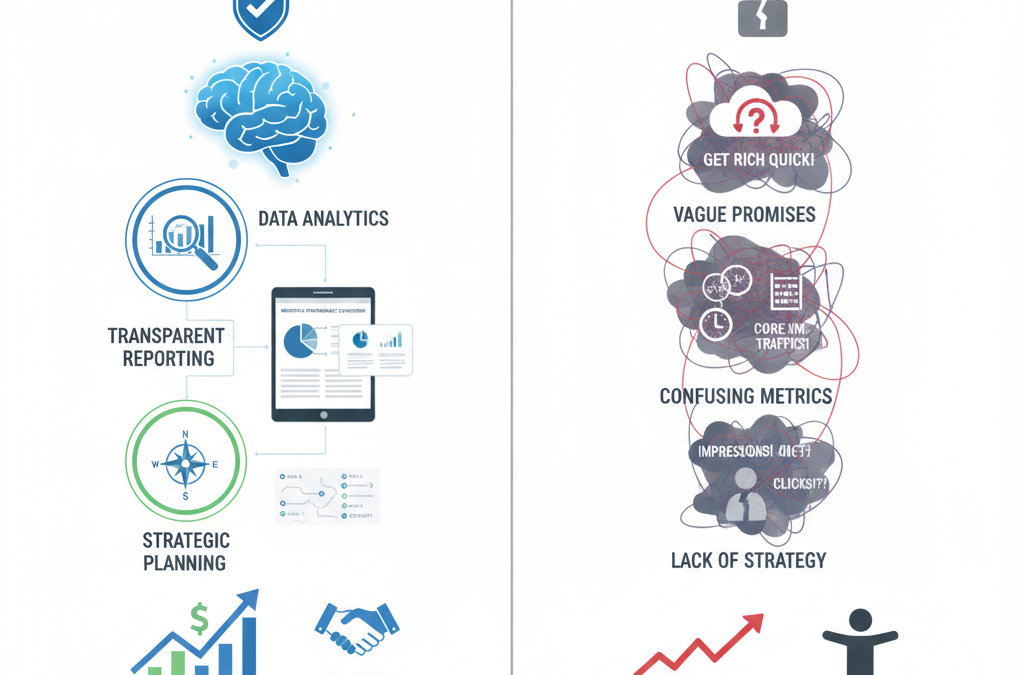
The best digital marketing agencies help businesses turn marketing activity into measurable signals: qualified traffic, stronger conversion rates, cleaner tracking, lower wasted spend, and clearer sales follow-up. A good agency does not rely on vague promises; it explains the work, shows how each channel supports the sales process, and reports on outcomes a business can act on.
For business owners, the challenge is separating polished presentation from operational skill. A strong agency should be able to explain search engine optimization, paid search, landing pages, content, analytics, and conversion improvement in plain language. More importantly, the agency should show how those pieces connect instead of treating every service as a separate campaign.
If you are comparing providers, start by understanding the core services behind a complete marketing system. Zigma Internet Marketing outlines its service structure through Digital Marketing Services, including SEO, paid ads, website work, content, social campaigns, and reporting.
How the best digital marketing agencies create growth
Strong agencies build around the full customer path: search visibility, ad relevance, page experience, conversion tracking, and sales feedback. Search engine optimization helps a site earn visibility through technical fixes, content quality, internal structure, and authority signals. Paid search gives faster query data, controlled testing, and measurable lead acquisition when campaign tracking is set up correctly.
Website and landing page work often determines whether traffic turns into enquiries. A campaign can bring the right visitor, but slow pages, unclear calls to action, weak forms, or missing trust signals can reduce lead volume. Conversion rate optimization focuses on those friction points by testing page layouts, forms, headlines, offers, and tracking events.
The strongest agency relationships usually include clear ownership across the system. For example, an SEO plan should account for technical fixes and content production, not only keyword rankings. A PPC plan should include query analysis, negative keywords, ad copy, landing page review, and conversion tracking. If paid traffic and organic search are managed separately without shared reporting, useful patterns can be missed.
For deeper channel planning, compare SEO Services with Google Ads Management. The right mix depends on time horizon, competition, website condition, and how quickly the business needs reliable demand data.
Signals that separate credible agencies from noisy pitches
Agency evaluation becomes easier when you focus on observable behaviour. Credible agencies ask specific questions before recommending a channel. They want to know your sales cycle, margins, current traffic quality, lead handling process, previous campaign data, website limitations, and internal capacity. Those details shape the plan.
Weak agency pitches tend to sound confident before the agency has reviewed the business context. Stronger agencies slow down long enough to understand whether the problem is visibility, conversion, offer clarity, tracking accuracy, lead quality, or sales follow-up.
- Clear diagnosis before tactics: The agency should explain whether growth is being limited by traffic, conversion rate, tracking gaps, poor targeting, weak content, or website performance.
- Channel fit: SEO, PPC, content, social media, and website work should be recommended based on business goals, not sold as a fixed bundle.
- Tracking discipline: The agency should confirm form submissions, phone calls, ecommerce events, ad conversions, and analytics setup before judging campaign performance.
- Reporting tied to decisions: Reports should show what changed, what the data indicates, and what action comes next.
- Plain-language communication: Technical details should be explained clearly enough for a non-specialist to make informed decisions.
The agency evaluation checklist
A practical checklist helps reduce guesswork. Before comparing proposals, define what success means inside your business. Does the business need more form submissions, better call quality, ecommerce revenue, repeat purchases, demo requests, appointment bookings, or sales-qualified leads? The answer affects the channel mix and reporting structure.
Use these questions during agency conversations:
- How will tracking be audited before campaigns are judged? This checks whether the agency understands that poor measurement can make good work look bad or weak work look better than it is.
- Which metrics will appear in monthly reporting? Strong reports include qualified leads, conversion rate, cost per lead, return on ad spend where relevant, keyword movement, landing page performance, and spend efficiency.
- Who handles implementation? Strategy has limited value if technical SEO fixes, landing page edits, tracking updates, or content publishing are delayed.
- How are priorities set? The agency should be able to rank work by expected impact, effort, dependencies, and risk.
- How will poor-performing campaigns be corrected? Look for a clear cycle: test, measure, diagnose, adjust, and document the reasoning.
A business with limited internal resources may need an agency that can execute across strategy, website changes, content, paid media, and analytics. A business with a strong internal team may need specialist support for technical SEO, advanced paid search, or dashboard setup.
SEO, PPC, content, and web work should not operate in silos
Search engine optimization and PPC often support different stages of growth. SEO builds compounding visibility through technical health, content depth, internal linking, and authority. PPC can test messages, offers, keywords, and landing pages faster because traffic can be directed with more control.
Content sits between both channels. Strong content can support organic search rankings, paid landing page relevance, sales enablement, email nurturing, and social distribution. Website design and development support all of it because page speed, mobile usability, layout clarity, and technical structure affect both users and search systems.
- Use SEO when long-term visibility is a priority: SEO is useful when customers research before buying, when organic search demand exists, and when the website can support technical and content improvements.
- Use PPC when faster testing is needed: Paid search can reveal which queries, messages, locations, devices, and landing pages produce stronger conversion signals.
- Use CRO when traffic exists but enquiries are weak: Conversion rate optimization reviews forms, copy, page structure, trust elements, and user paths to reduce friction.
- Use website development when the site blocks performance: Technical SEO, page speed, mobile design, structured content, and tracking setup can affect every marketing channel.
If the website needs structural improvement before campaigns scale, Website Design & Development can become part of the marketing plan rather than a separate design project.
How reporting should connect activity to revenue signals
Marketing reports should not stop at impressions, clicks, and rankings. Those signals can be useful, but they do not tell the full story. A better report connects activity to the next business question: did the work attract qualified visitors, reduce wasted spend, improve conversion rate, or produce better lead quality?
Useful reporting often includes a mix of channel metrics and business signals. SEO reporting may include indexed pages, ranking movement, organic sessions, conversion events, technical issues resolved, and content performance. PPC reporting may include search terms, negative keyword changes, conversion rate, cost per lead, impression share, wasted spend reduction, and landing page testing notes.
Analytics setup is the foundation. Without clean tracking in GA4, Google Tag Manager, ad platforms, phone tracking, form tracking, and ecommerce events where relevant, the agency may be reporting on incomplete data. The right question is not simply “Did traffic increase?” A better question is: “Did the right traffic take the action we wanted?”
Mistakes that make agency comparisons harder
Businesses often compare agencies using surface-level details because the deeper work is harder to see. Proposal design, meeting confidence, or a long service list can create comfort, but those details do not reveal whether the agency can diagnose the right problem.
Common mistakes include:
- Comparing deliverables without comparing strategy: Two agencies may both list SEO content, but one may base content on search intent, technical structure, and conversion paths while another simply produces pages.
- Ignoring implementation capacity: Recommendations do not create results until tracking, technical fixes, campaign changes, and page improvements are shipped.
- Judging too early with incomplete data: PPC can show useful signals quickly, while SEO often needs more time because search engines must crawl, index, and reassess pages.
- Accepting reports without interpretation: A report should explain what the data suggests and what change will be made next.
- Separating marketing from sales feedback: Lead quality, response time, close rate, and customer fit help refine campaigns beyond platform metrics.
A stronger comparison looks at process, accountability, technical depth, communication, and how the agency reacts when results are mixed. Good agencies do not pretend every campaign will move perfectly from day one; they show how they will adjust based on evidence.
Questions to ask before signing an agency agreement
Before committing, ask questions that reveal how the agency thinks. The answers should be specific enough to show process, but clear enough that a business owner can understand the plan without needing to decode jargon.
- Which channel should come first, and why? The answer should connect to your current website condition, sales goals, demand level, and budget constraints.
- What needs to be fixed before campaign scaling? Listen for tracking, landing pages, technical SEO, speed, content gaps, and offer clarity.
- How will lead quality be reviewed? The agency should ask about call recordings, CRM status, form details, sales feedback, and close rates where available.
- What happens in the first 30, 60, and 90 days? A realistic ramp often includes auditing, tracking cleanup, early campaign adjustments, content planning, technical fixes, and reporting setup.
- How will priorities change if data contradicts the original plan? Strong agencies adapt without hiding the reason for the change.
FAQs About best digital marketing agencies
A credible agency explains its diagnosis before recommending services. Look for clear questions about tracking, sales process, website quality, previous campaigns, and lead quality. The agency should also show how reporting will connect marketing activity to business decisions.
SEO, PPC, landing pages, conversion tracking, content, and analytics often work best when planned together. A paid campaign may reveal useful keyword data for SEO, while landing page testing can improve both paid and organic conversion performance.
PPC can produce useful traffic and conversion signals within weeks if tracking is clean. SEO usually needs a longer review period because technical updates, content changes, crawling, indexing, and authority signals take time to influence search visibility.
One agency can manage both if it has channel specialists, clear reporting, and a shared strategy. The advantage is better data sharing across search queries, landing pages, conversion rates, and content priorities. The risk is weak execution if the agency lacks depth in either channel.
Monthly reports should show leads, conversion rate, traffic quality, campaign changes, keyword movement, spend efficiency, technical fixes, and next actions. A useful report explains what changed, why it changed, and which decision the data supports.
A practical way to judge agency fit
The best digital marketing agencies make complex work easier to evaluate. They define the problem, map the channel mix, clean up measurement, execute the work, and explain the next decision. The process should feel organized rather than mysterious.
Zigma Internet Marketing supports strategy and implementation across SEO, PPC, website design and development, content, social campaigns, analytics setup, dashboards, and conversion improvement. The team’s Google Partner-certified experience is useful for businesses that need paid search discipline, tracking accuracy, and continuous campaign refinement.
If you want a second opinion on your current SEO, PPC, tracking, or landing page setup, you can ask an SEO/PPC question and share the context behind your marketing goals.
