


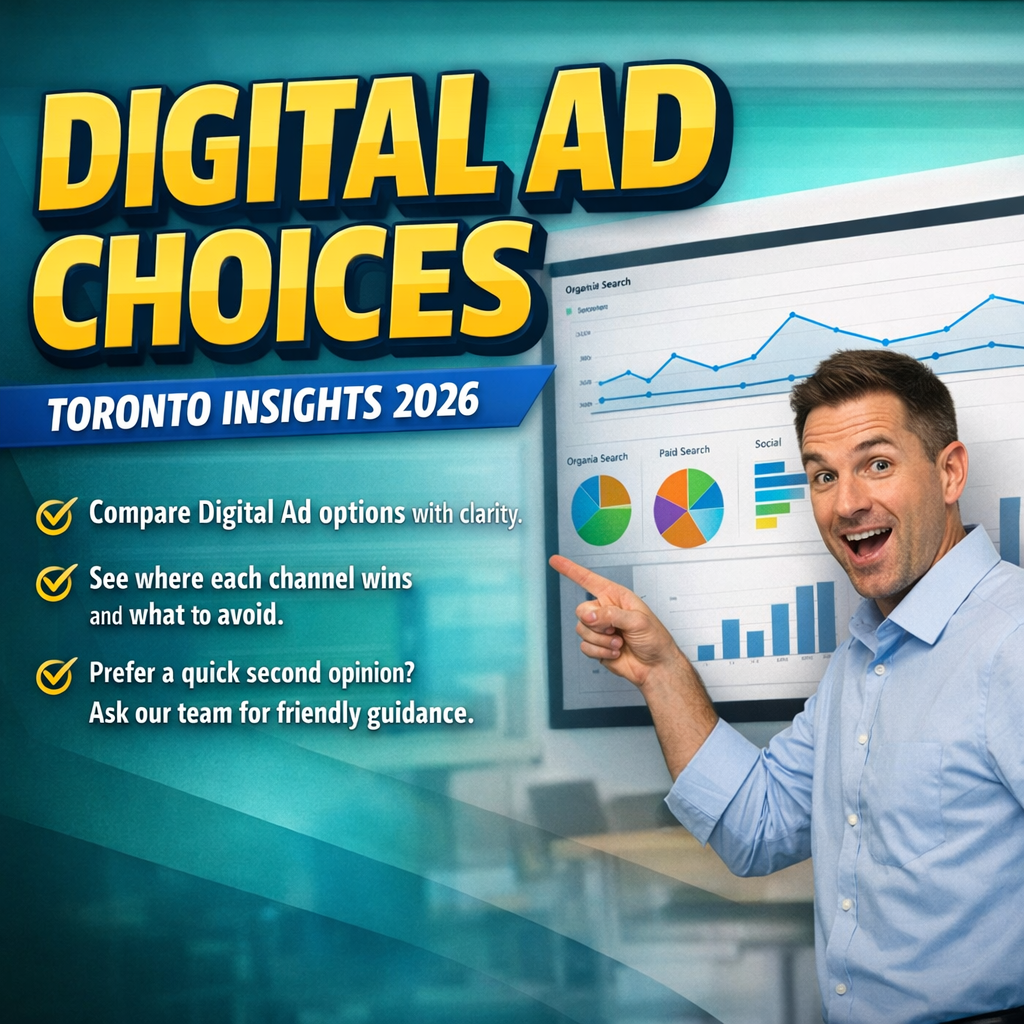
Digital Ad options in Toronto compared by reach, speed, and cost. See formats, examples, and timelines so you pick with confidence — practical tips inside.
Toronto’s fast lane to attention: how Digital Ad campaigns fit
Across Toronto, brands move quickly — launches, promos, and seasonal pushes can’t wait weeks. A well-built Digital Ad campaign helps you show up now while your strategy matures. Think of it as the accelerator alongside your broader Digital Marketing plan. If you’ve relied mainly on online marketing via organic channels, paid placements can bridge the gap between intent and action the same day.
Digital Ad fundamentals made simple
Digital Ad programs place your message where people already search, scroll, and read — on Google, YouTube, Instagram, Facebook, LinkedIn, and premium sites. You set a goal (leads, calls, sales), define an audience, and pay per click or impression. Budgets scale up or down in real time, so you learn fast and adapt faster. Many teams run paid alongside SEO services to cover immediate demand while building long-term visibility.

Channels vary by intent: search is “I need it now,” social is “show me something interesting,” and video/display is “remind me when I’m ready.” If you’re mapping the full journey or comparing platforms, review our broader Internet Marketing Services to see how campaigns work together.
Is a Digital Ad plan practical for Toronto budgets?
Toronto costs can climb in competitive verticals, but control is the advantage: caps, daily pacing, and geographic filters keep spend sensible. We often start with tight radius targeting (e.g., downtown, midtown, or the GTA ring) and expand only when performance proves it. Timelines matter too — short promos benefit from search or remarketing; longer brand plays lean on creative and video. A local, test-and-learn approach helps teams avoid waste and build a stable baseline.
- Start narrow, then widen: launch with high-intent keywords and a small radius; expand after you see steady cost-per-lead.
- Match offer to intent: urgent services pair well with search; discovery-friendly offers fit video or social feeds.
- Seasonal reality: winter spikes for home services, spring rush for events — align bids and budgets to real demand.
- Creative refresh rhythm: big city audiences burn out faster; plan monthly swaps to keep results steady.
- Local proof points: “near Union Station” or “serving the Annex” converts better than generic copy.
Once the basics run smoothly, layer in audience testing and landing page upgrades to lift conversions without raising media costs.
Which Digital Ad route fits your goals in Toronto?
Before you choose a path, compare these options to balance control, speed, and learning. Each approach to a Digital Ad program in Toronto has trade-offs. This side-by-side will help you avoid waste in your digital advertising budget and find a fit that matches your team’s time and appetite for testing.
Ad management approaches
Option A — DIY in-house: You run campaigns directly in Google, Meta, or LinkedIn. It’s flexible and cost-efficient, but learning curves and time pressure can hide leaks. Works well if one person “owns” the channel and can iterate weekly.
- How it works: You set budgets, bids, audiences, and creatives; platforms provide reports and testing tools.
- Best fit: Teams with hands-on marketers and simple funnels (e.g., calls or short lead forms).
- Example: A Leslieville clinic trims cost-per-lead ~22% in 6 weeks after adding call extensions and negative keywords.
Option B — Freelancer support: A specialist manages builds and optimizations part-time. It’s lighter lift than DIY and cheaper than an agency, but coverage can be thin during vacations or scale-ups.
- How it works: Contract hours per month for audits, creative swaps, and bid adjustments.
- Best fit: Small budgets or single-channel campaigns where quick tweaks go far.
- Example: A Junction café sees a 30% CTR lift by restructuring ad groups and adding site links in one month.
Option C — Agency partner: A dedicated team handles strategy, creative, landing pages, tracking, and reporting. It’s comprehensive and consistent, often delivering steadier gains — with a higher management fee.
- How it works: Cross-functional specialists coordinate ads, analytics, and CRO under one plan.
- Best fit: Growth-focused brands, multi-location businesses, or multi-channel programs.
- Example: A Midtown retailer cuts CPA 28% in 90 days combining search + remarketing + quick landing page tests.
Ad format choices
Option A — Search ads: Capture active intent on Google when people are ready to act. Great for urgent services and high-intent product queries where relevance and landing page speed decide outcomes.
- How it works: Bid on queries; show text ads with extensions; pay per click; optimize with match types and negatives.
- Best fit: Service businesses, B2B with clear problems, local “near me” demand.
- Example: A Scarborough contractor improves call volume ~35% adding call-only campaigns and dayparting.
Option B — Social feed ads: Build attention and demand through visuals and short videos. Strong for new offers, creative storytelling, and audiences who don’t know you yet.
- How it works: Target by interests, lookalikes, and remarketing; optimize for conversions or leads.
- Best fit: Consumer brands, events, subscriptions, and visual products.
- Example: A Distillery District gallery drives 2.1x more RSVPs in 4 weeks with carousel + video split-tests.
Option C — Display/Video: Stay top-of-mind and re-engage visitors. Ideal for remarketing and brand lift, especially when paired with strong landing pages and email follow-up.
- How it works: Serve banners and pre-roll to custom audiences; pay by click or view.
- Best fit: Longer consideration cycles and product education.
- Example: A Liberty Village SaaS brand sees 18% higher demo rates using 30-sec explainers + remarketing.
Optimization focus
Option A — Conversion-led: Everything orbits a tracked action (purchase, form, call). You prioritize clean data and landing page speed to drive real outcomes over vanity metrics.
- How it works: Attach pixels, set conversion events, and optimize around CPA or ROAS.
- Best fit: Clear offer, tight funnel, reliable follow-up process.
- Example: A Bloor West clinic lowers CPL 26% after fixing form tracking and trimming slow pages.
Option B — Reach-led: Prioritize awareness for launches, rebrands, or seasonal pushes. Useful when you need scale and recall before heavy conversion focus.
- How it works: Optimize for impressions/views; rotate creative fast to prevent fatigue.
- Best fit: New markets, broad consumer plays, event promos.
- Example: A Harbourfront event lifts attendance 19% after a 3-week reach burst plus short retargeting.
Option C — Retargeting-first: Re-engage site visitors and cart abandoners to recover value. Often the highest-ROI layer when paired with email or SMS follow-up.
- How it works: Build audiences from site traffic; serve specific creative based on behaviour.
- Best fit: E-commerce, bookings, and quote-driven funnels.
- Example: A St. Clair boutique lifts revenue 14% in 6 weeks by combining retargeting + free-ship offer.
Case study: a Toronto retailer steadies costs and grows orders
In our projects, we’ve seen how small adjustments shift outcomes fast. A Queen West boutique needed predictable orders before a new collection drop. Their ads were running, but costs were volatile and tracking missed half the conversions. We reorganized the structure, rebuilt the landing page, and tuned audiences to match real buyers — not just browsers.
Challenge: High cost-per-acquisition; inconsistent tracking
What we did: Search restructure, remarketing layer, landing page speed fixes
Outcome: 24% lower CPA and 31% more orders within 8 weeks
Client note: “Once the tracking and page speed were fixed, everything clicked. We finally trusted the numbers.”
Why trust shapes Digital Ad choices
Toronto teams trust steady process and transparent reporting — not promises. As a digital marketing agency Toronto companies rely on, Zigma aligns goals, tracking, and creative so your Digital Ad spend tells a clear story. Reach us at +1(647) 556-6071 or info@zigma.ca to compare options with a calm, data-first lens.
Why Locals Trust Us?
Data-driven strategies, creative campaigns, and measurable results.
See a Digital Ad blueprint come to life
We typically showcase a quick walkthrough video here — budget setup, audience mapping, and the first 48 hours of learning. Until our next upload, imagine a side-by-side of search vs. social builds, with notes on pacing and bid checks. It’s the same calm, practical flow we use to launch campaigns across the GTA.
.jpg)
.jpg)
Hidden truths from real campaigns
There’s a quiet moment after the first week — when the graphs settle and the real story appears. It’s rarely about flashy clicks. It’s about the parts of your funnel that whisper: tracking gaps, sticky forms, and headlines that make people pause.
- Data before drama: Most “bad” campaigns are untracked ones. Clean events and load speeds turn guesses into decisions — and lower CPLs follow.
- Audiences drift fast: Urban feeds tire quickly. Refresh creative every 3–4 weeks to prevent steady CPC creep and engagement drop-offs.
- Landing pages carry half the win: A faster, clearer page can lift conversions ~15–30% without raising spend — the cheapest scale you’ll find.
These are just a few of the lessons teams learn the hard way — but knowing them early can change how your Digital Ad story unfolds.
5 steps to pick a Digital Ad plan with confidence
Step 1: Define a single success metric
Choose one primary goal (calls, form fills, purchases). This avoids mixed signals and makes optimization straightforward. This step helps your team align budgets with outcomes so you can scale what truly works.
Hint: Tie the metric to revenue, not just clicks.
Metric to watch: Cost per qualified action (not generic leads).
Example: A downtown clinic picked “booked consults,” cutting wasted spend on low-intent inquiries within 3 weeks.
Step 2: Start where intent is hottest
Prioritize high-intent search terms and remarketing audiences. Cold awareness can come later once you’ve proven conversion paths. This step helps validate messaging quickly so you can expand with confidence.
Hint: Use exact and phrase matches first; add broad after you see stability.
Metric to watch: Search term report coverage and negative keyword growth.
Example: A service brand lifted conversion rate 21% by trimming broad matches in the first month.
Step 3: Fix tracking and speed before scaling
Install pixels, verify events, and test forms. Improve Core Web Vitals to reduce friction. This step helps ensure every click is measured so you can invest with clarity.
Hint: Run a test conversion on each device type after launch.
Metric to watch: Event match quality and page load under ~2.5s.
Example: A retailer found 40% of iOS form submits missing — after a fix, CPA fell 19% in two weeks.
Step 4: Pair ads with tight landing pages
Match the promise in your ad to the first screen of your page. Remove extra navigation and keep forms simple. This step helps reduce drop-offs so you can convert more of the traffic you already paid for.
Hint: Lead with the strongest proof: reviews, guarantees, or demo snippets.
Metric to watch: Bounce rate and scroll depth on campaign pages.
Example: Rewriting a headline to mirror the ad lifted submissions 17% in 10 days.
Step 5: Test small, learn fast, then widen
Use 2–3 variations per element (headline, image, audience) and keep budgets even during tests. This step helps you isolate winners so you can scale spend without guesswork.
Hint: Change one variable at a time for clean reads.
Metric to watch: Confidence after ~500–1,000 impressions per variant.
Example: A B2B team hit a 28% CPL drop after a two-week creative test before expanding to new geos.
Benchmarks that keep Digital Ad choices honest
Numbers ground expectations and prevent overreactions to early swings. Industry reports suggest that pairing focused keywords with relevant landing pages consistently outperforms generic traffic buys. Across comparable North American markets, companies see steadier outcomes when testing in short sprints and reviewing weekly.
- Independent surveys indicate localized ad copy lifts engagement by ~15–30% in urban markets.
- Industry reports suggest landing page improvements can raise conversions ~20–50% without extra media spend.
- Recent analysis of local campaigns shows remarketing often contributes ~10–25% of total conversions in the GTA.
In Summary: Key Insights from This Guide
Choosing a Digital Ad path is easier when you break it into format, management, and optimization focus. Use small tests, clean tracking, and simple landing pages to learn fast and spend wisely.
- Start with intent: search + remarketing prove value quickly, then add creative channels.
- Tidy the funnel: tracking and speed upgrades often cut CPL before new spend.
- Refresh creative: rotate every 3–4 weeks in busy Toronto feeds to avoid fatigue.
- Review weekly: short feedback loops stabilize results and prevent budget drift.
Next Steps: How We Can Support Your Goals
If you’re weighing options, a short comparison call can clarify fit, timeline, and the first two tests to run. We’ll review goals, tracking, and the best starting format for your audience.
For example, a Toronto services brand began with search + retargeting for 30 days, then added video in month two — steady leads, calmer reporting, and fewer surprises.
FAQs About Digital Ad
High-intent search and remarketing usually show movement first because they meet people closer to action. In Toronto, pairing call extensions with tight location targeting often speeds up lead flow in the first 2–3 weeks while you refine keywords and pages.
Pause when tracking is unreliable, pages are slow, or results trend poorly after a fair read (e.g., several hundred clicks or two sales cycles). Fix measurement and page friction first; otherwise, you can’t tell if ads or the funnel caused weak performance.
Most teams can shortlist 3–4 partners and request quotes within ~1–2 weeks. Compare scope (strategy, creative, landing pages, reporting), confirm references, and ask for the first 90‑day plan. This keeps momentum while giving you enough detail to choose confidently.
Paid drives immediate visibility while organic builds compounding reach. In busy Toronto niches, running both balances quick wins with durable growth. Teams often use paid insights (keywords, creatives) to inform future content and improve overall efficiency.
Start with cost per qualified action, conversion rate, and impression share for priority terms or audiences. Track device splits and page speed too. Early clarity on these basics helps you scale winners and trim waste without guessing.
A quiet, confident close
Good campaigns don’t shout — they listen, test, and keep score. When the first data rolls in, decisions get calmer: the right audience shows itself, and the right message feels obvious. Keep your Digital Ad plan simple, review weekly, and build from what works. For deeper reading on structure and search foundations, browse Google Search Central.
Let’s Grow Your Business Together
Data-driven strategies, creative campaigns, and measurable results — tailored for your goals.
Need marketing results?
Need marketing results?
Our team will guide you with strategies that drive measurable growth.
Related Topics:
- Digital Marketing Agency Toronto: What You Should Know Before Hiring
- Local SEO Toronto: Boost Your Business Visibility & Attract More Local Leads
- SEO Marketing Toronto: Compare Top Services, Pricing & Results for 2025
- SEO vs PPC: Which Strategy Is Right For Your Business?
- Is Your SEO Richmond Hill Plan Built to Win Local Leads?


? Metadata Output (Required at End):
Metadata Block: (for backend reference only, not visible on frontend)

Slug:

Meta Title: Digital Ad Options in Toronto: Compare Reach, Speed, Cost

Meta Description: Digital Ad options in Toronto compared by reach, speed, and cost. See formats, examples, and timelines so you pick with confidence — practical tips inside.

------------

Keyword: Digital Ad

Intent: Commercial

Competition: Medium

TopicMode: ComparisonFocus

Tier: Tier 2

Target Location: Toronto

------------

Feature Image File Name: digital-ad.jpg

Feature Image Title: Digital Ad comparison guide for Toronto businesses

Feature Image ALT: Digital Ad service available in Toronto

------------

social_heading: DIGITAL AD CHOICES

social_subheading: TORONTO INSIGHTS 2026

intro_copy: Compare Digital Ad options with clarity. See where each channel wins and what to avoid. Prefer a quick second opinion? Ask our team for friendly guidance.