


Internet Marketing should feel less like a guessing game and more like a clear roadmap. When strategies are explained simply, results are measured honestly, and campaigns build on one another, businesses gain both clarity and confidence. That’s what turns online traffic into trust, and trust into steady leads.
Clarity comes from knowing what matters
Internet Marketing works best when every channel has a role and every metric has meaning. Instead of chasing louder ads or trend-of-the-week tactics, clarity means defining your goals, understanding your audience, and building a simple measurement plan. When you map the customer journey—awareness, consideration, conversion—even a complex online marketing mix feels more structured and less overwhelming.
Confidence comes from seeing the system work
Think of Internet Marketing as a connected system, not just separate tactics. Search, ads, content, and email should feed one another. Editorial content improves visibility, remarketing converts warm visitors, and analytics closes the loop with real insights. When Internet Marketing Services are aligned with your goals, you can act with confidence—because you’re no longer guessing which channel is pulling its weight.


Finding confidence in the first channel you choose
Every marketing channel has a different payoff rhythm. For a product launch or a seasonal promotion, digital advertising delivers speed—think of a retailer running Google Ads for a holiday sale and seeing results within days. For compounding growth, SEO and content marketing build durable authority—like a consultancy publishing monthly guides that steadily rank and attract inbound leads over time.
The clarity comes from knowing what each channel is built to do. The confidence comes from choosing one clear KPI per stage. For example, measure ad campaigns by cost per lead, not impressions; measure content by form fills or demo requests, not pageviews. Many successful teams blend both approaches: ads for testing and immediate traction, content and SEO to steadily reduce cost per lead over the long run.
Compare your paths before you spend another dollar
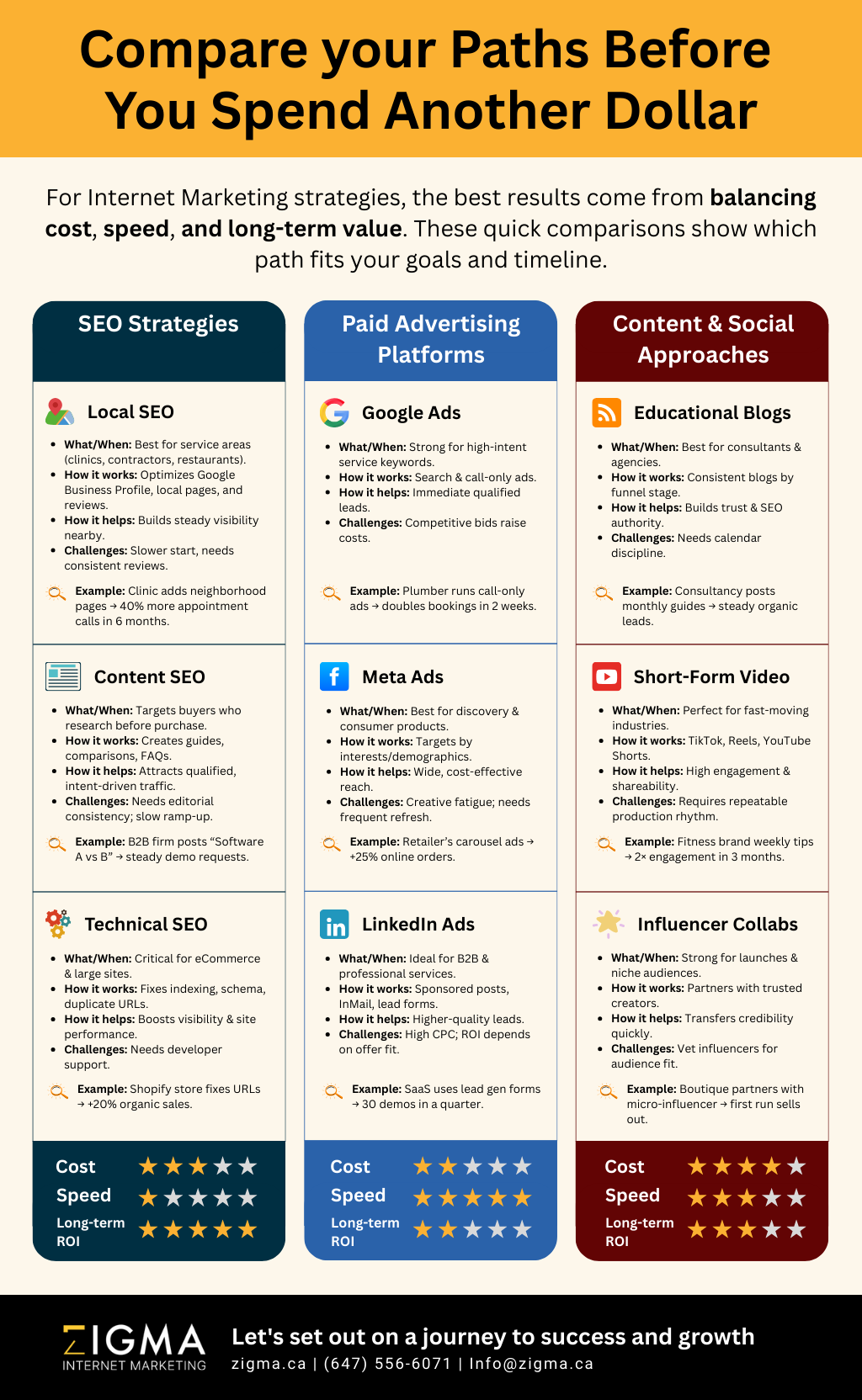
Before you choose a direction, weigh the trade-offs. For Internet Marketing strategies, the right mix balances cost, speed, and long-term value. The quick comparisons below help you pick what fits your goals and timeline without guesswork.
SEO Strategies
1. Local SEO:
How it works: Optimizes Google Business Profile, local landing pages, and reviews to increase map pack and local search rankings.
How it helps: Builds steady visibility in service areas, ensuring customers nearby can find and trust you.
Challenges: Slower start, requires consistent review generation and page upkeep.
Example: A clinic creates neighborhood-specific pages and earns top map rankings, leading to a 40% increase in appointment calls within six months.
2. Content SEO:
How it works: Creates guides, comparisons, and FAQs that directly answer buyer questions.
How it helps: Attracts qualified, intent-driven traffic and educates prospects before they contact sales.
Challenges: Needs editorial consistency; content takes time to rank.
Example: A B2B firm publishes “Software A vs. Software B” pages that bring in demo requests every week.
3. Technical SEO:
How it works: Fixes indexing, duplicate URLs, schema markup, and site performance.
How it helps: Improves search visibility and prevents wasted crawl budget.
Challenges: Requires developer support; fixes are sometimes invisible to the end user but impactful in rankings.
Example: A Shopify store removes duplicate URLs and adds schema, resulting in a 20% lift in organic sales.
Score snapshot: Cost ★★★☆☆, Speed ★☆☆☆☆, Long-term ROI ★★★★★
Paid Advertising Platforms
1. Google Ads:
How it works: Shows text or call-only ads directly on searches.
How it helps: Generates immediate leads from people actively looking.
Challenges: Competitive keywords drive up costs; weak landing pages hurt ROI.
Example: A plumbing company launches call-only ads and doubles appointment bookings in two weeks.
2. Meta Ads:
How it works: Targets audiences based on demographics, interests, and behaviors.
How it helps: Reaches wide audiences cost-effectively and drives traffic to offers.
Challenges: Creative fatigue; requires frequent ad refreshes to sustain performance.
Example: A retailer runs carousel ads for a summer sale, lifting online orders by 25%.
3. LinkedIn Ads:
How it works: Delivers sponsored content, InMail, or lead gen forms to specific job titles or industries.
How it helps: Produces fewer but higher-quality leads.
Challenges: Higher CPCs; ROI depends heavily on alignment between message and offer.
Example: A SaaS firm uses LinkedIn lead gen forms and books 30 qualified demos in a quarter.
Score snapshot: Cost ★★☆☆☆, Speed ★★★★★, Long-term ROI ★★☆☆☆
Content & Social Approaches
1. Educational Blogs:
How it works: Publishes consistent blogs tied to funnel stages (awareness, consideration, decision).
How it helps: Builds authority, improves SEO, and provides sales teams with content to share.
Challenges: Requires a calendar and discipline to stay consistent.
Example: A consultancy posts monthly playbooks and gains organic leads steadily over a year.
2. Short-Form Video:
How it works: Shares quick, engaging videos on TikTok, Instagram Reels, or YouTube Shorts.
How it helps: Humanizes the brand, builds engagement, and creates shareable content.
Challenges: Needs a repeatable production rhythm; easy to burn out.
Example: A fitness brand posts weekly tips on Reels and doubles follower engagement in three months.
3. Influencer Collabs:
How it works: Partners with influencers who already hold trust in a specific community.
How it helps: Transfers credibility and accelerates awareness.
Challenges: Requires vetting influencers for audience fit and engagement quality.
Example: A boutique partners with a micro-influencer for launch week and sells out its first run of products.
Score snapshot: Cost ★★★★☆, Speed ★★★☆☆, Long-term ROI ★★★☆☆

Choose momentum your team can actually sustain
Internet Marketing only builds confidence when it feels manageable. Growth isn’t about doing everything at once—it’s about finding a pace your team can keep. That might mean weekly content, monthly optimizations, or quarterly campaign reviews. One channel done with consistency builds more clarity than five channels done sporadically. A simple one-page scorecard—tracking goals, KPIs, and progress—gives everyone the same reference point and keeps momentum steady.
Checklist: Build clarity and confidence before you start
- Define one primary goal: Decide whether you want leads, sales, or booked calls.
Clarity: keeps budgets and creative aligned.
Confidence: avoids scattered spend.
Example: Aim for “20 qualified form fills per month” instead of chasing every metric. - Map your audience moments: List their triggers, objections, and research steps.
Clarity: shows what messages to use.
Confidence: ensures relevance at every stage.
Example: Address “price vs. quality” with a clear comparison page before prospects ask. - Audit your tracking: Review GA4, conversion events, and UTM tags.
Clarity: gives you trustworthy data.
Confidence: prevents optimization based on bad numbers.
Example: Fix duplicate conversions that inflate ROAS. - Right-size the funnel: Create one offer per stage (guide, demo, or quote).
Clarity: keeps handoffs smooth.
Confidence: avoids pushing too hard too soon.
Example: Remarketing blog readers to a case study instead of a direct sale. - Pick partners early: Involve creative, developers, or SEO support.
Clarity: sets expectations on who does what.
Confidence: speeds up execution when campaigns launch.
Example: Pre-book dev time for your landing page updates before ads go live.
Case study: Turning searches into steady appointments
In practice, most small service teams don’t need more clicks—they need consistent, qualified calls. One wellness studio we worked with had strong word-of-mouth but struggled online: their organic presence was weak and their paid campaigns spread too thin. By aligning content with search intent, rebuilding landing pages for clarity, and tuning budgets toward best-converting terms, they created a system that felt both focused and predictable.
Challenge: Stalled organic leads; ad spend spread too thin
What we did: Built intent-focused SEO pages, added structured FAQs, consolidated Google Ads
Outcome: 28–35% lift in organic traffic and 18–22% more calls within 7 months
Client note: “We finally see which channels actually move the needle—and we can plan around it.”
Lesson: When Internet Marketing aligns audience questions with clear landing pages, performance stabilizes—and teams gain the confidence to make calmer decisions.
Trust first: a smarter path to Internet Marketing
Businesses trust Zigma because we explain the “why,” show the plan, and report the evidence—no mystery dashboards. For Internet Marketing work, we blend data with creative so every change has a purpose. Speak with us at +1(647) 556-6071 or email info@zigma.ca and we’ll walk you through pragmatic next steps.
Why Locals Trust Us?
Data-driven strategies, creative campaigns, and measurable results.
What experts wish more teams knew
- Landing pages decide ROI: Media can be brilliant, but weak pages hide wins. Build pages per offer and device, and test headlines before scaling budgets.
- Creative fatigue is quiet: Performance drifts long before it drops. Rotate visuals and hooks on a schedule—don’t wait for costs to spike.
- Attribution is directional: Use it to guide choices, not as absolute truth. Blend platform data with GA4 and match-back checks.
Shifts that demand clarity in your marketing
Markets change quickly, and the biggest shift today is around data and trust. With new privacy updates, first-party data has become essential—brands that collect and use their own data responsibly build more confident pipelines. At the same time, formats that feel human, like short-form video and interactive carousels, continue to pull attention. On the content side, structured pages built on platforms like Shopify or WordPress still drive dependable search visibility when organized clearly. The lesson: the more you simplify your approach, the easier it is to stay confident through changing trends.
.jpg)
Honest insights that bring clarity
Many teams spend months adjusting ads or tweaking creative, only to realize the real bottleneck is unclear messaging or incomplete tracking. When the message is simple and the data is trustworthy, decisions stop feeling like guesswork. That clarity is what makes budgets work harder.
Landing Page vs. Ad Spend
A stronger page can cut CPA faster than a 10% bid tweak.
Clarity wins: speed, relevance, and a single CTA outperform clutter every time.
Confidence grows when proof replaces hype—testimonials and specific outcomes convert better than generic claims.
Lesson: Fix the page first, then invest in traffic.
Quiet truths that build confidence in your choices
There’s a calm that comes from seeing the funnel end to end. When each step has a clear purpose, budgets feel lighter and choices feel easier. These are the quiet truths that help teams move from reactive to confident planning.
- Signal beats speed: Launching faster only works if results are clear. Clean signals save more money than rushed campaigns.
- One KPI per stage: Traffic, then engagement, then conversion. Mixing KPIs blurs clarity and creates false alarms.
- Content compounds over time: Well-structured posts steadily reduce paid costs, especially around intent-heavy keywords.
- Focus multiplies returns: Small, clear campaigns beat sprawling tests. Win one journey before adding another.
These lessons feel simple, but applying them early can change how your Internet Marketing story unfolds—turning confusion into confidence.
Internet Marketing in 5 Clear Steps
Step 1: Set one outcome per quarter
Pick one outcome to measure—leads, sales, or booked calls. The mistake most teams make is chasing too many metrics at once, which creates noise.
Clarity: simplifies reporting and avoids goal creep.
Confidence: keeps the team aligned on what matters most.
Example: Instead of tracking ten KPIs, commit to “20 qualified form fills per month” as your north star.
Step 2: Build one high-clarity page
This is the page every campaign should anchor to. It should load quickly, highlight value in plain language, and feature social proof like testimonials or case studies. End with one obvious call-to-action.
Clarity: every visitor knows what to do.
Confidence: both paid and organic traffic can land here with minimal edits.
Example: A single-page product demo form that outperforms a cluttered multi-tab website.
Step 3: Pair ads with real questions
Search queries reveal intent. Ads should reflect those exact questions, and your site should have supporting content to answer them. This reduces ad costs and builds trust before the click.
Clarity: ensures ads connect directly to the visitor’s intent.
Confidence: improves ad quality scores and remarketing effectiveness.
Example: If people search “CRM vs. Spreadsheet,” run an ad and link it to a blog post that compares both options honestly.
Step 4: Instrument everything
Set up GA4 events, call tracking, UTM parameters, and a weekly scorecard before campaigns launch. Without this, you’re steering blind.
Clarity: comes from consistent, trustworthy data.
Confidence: every decision is backed by facts, not guesses.
Example: Spotting that 40% of leads come from one keyword because your tracking is clean, and shifting budget accordingly.
Step 5: Review, then scale
At the end of each cycle, evaluate what worked and cut what didn’t. Scale the winners, and add only one new test at a time. Small improvements stack into large gains.
Clarity: growth comes from visible, measurable iteration.
Confidence: steady wins reduce pressure to gamble on unproven tactics.
Example: A/B testing two landing page headlines, keeping the winner, then testing one new call-to-action in the next round.
Steady growth comes from simple, clear plans
When your message is tight and your measurement is honest, growth feels less chaotic and more predictable. Teams gain clarity by aligning around one rhythm—ads that lead to clear pages, and pages that connect back to measurable goals. They gain confidence by seeing progress in calmer reports, stronger creative, and fewer last-minute surprises. A simple plan creates space for consistency, carrying you through both busy seasons and quiet ones. For deeper benchmarks and platform guidance, see Google Search Central.
Let’s Grow Your Business Together
Data-driven strategies, creative campaigns, and measurable results — tailored for your goals.
What the numbers reveal about momentum
Numbers build confidence when they confirm what clarity already suggested. Industry benchmarks show that pairing the right channel with a clear message consistently improves outcomes. The lesson: growth isn’t guesswork—it follows patterns you can track. By watching small wins weekly and evaluating bigger shifts monthly, teams stay both confident and adaptive.
- Independent surveys show that targeted social ads aligned with clear messaging can lift engagement by 20–30% compared to generic campaigns.
- Industry reports suggest that businesses improving landing page speed and focus see 35–50% higher conversion rates.
- Recent analyses show that service firms combining content and SEO strategies often report 12–20% year-over-year revenue growth.
Why do businesses blend SEO with paid ads?SEO compounds visibility while paid ads bring immediate reach. Together, they balance short-term speed with long-term growth. Clarity: you know which channel drives what outcome. Confidence: you smooth out lead flow and avoid reliance on just one source.
When should you consider rebuilding a landing page?
If costs creep up, bounce rates stay high, or ad comments repeat the same questions, the page likely needs work. Aim for faster load times, a clear promise, proof (reviews, results), and one primary action. Clarity: visitors know exactly what’s being offered. Confidence: campaigns stop wasting budget on broken pages.
Where does Internet Marketing make the biggest impact first?
Most teams notice early gains from tightening search intent, improving the main offer page, and cleaning conversion tracking. Clarity: shows which actions generate real signals. Confidence: comes from knowing that conversions are measured correctly and optimization is trustworthy.
How should I shortlist vendors and request a quote?
Evaluate clarity: ask for a one-page plan, example reports, and who actually does the work. Compare two to three proposals on scope, goals, and measurement. Confidence: grows when pricing is tied to outcomes, not vague tasks, so expectations stay aligned.
What makes Zigma’s team different?
We prioritize clear plans, transparent reporting, and practical execution over jargon. Our approach blends data with creative so every change has purpose. Clarity: you always know why we’re doing something. Confidence: comes from consistent communication, measurable results, and steady improvements you can see in weekly scorecards.