


Why businesses start looking at an online marketing agency
An online marketing agency helps a business plan, run, measure, and improve digital campaigns across channels such as search engine optimization, paid advertising, website design, content, and analytics. For many companies, the real value is not “more marketing” in the abstract. It is better lead quality, cleaner tracking, lower waste, and a clearer view of which activities are actually producing calls, forms, and sales.
That distinction matters because business owners often reach out after trying disconnected tactics: a few blog posts, some ad spend, a redesigned homepage, maybe a social campaign that produced attention but not enquiries. A capable agency brings those pieces together. If organic visibility is weak, SEO Services can improve search presence over time; if demand needs to be captured quickly, paid campaigns may carry more of the load in the short term.
The better question is not whether an agency is “worth it.” The better question is: where is growth being blocked right now, and does the agency know how to fix that specific bottleneck? That is the lens that makes the rest of the decision easier.
What an online marketing agency actually does day to day
A strong agency does far more than publish posts or launch ads. In practice, the work usually starts with diagnosis: traffic sources, search visibility, landing page friction, conversion tracking, call quality, sales follow-up, and competitive gaps. From there, the agency builds a plan around the channels that match the business model instead of forcing every client into the same package.
For example, a local service company may need google business profile optimization, local seo gta, stronger service pages, and tighter call tracking. An e-commerce brand may need product feed improvements, technical fixes, content expansion, and paid search support. A B2B firm may need a more deliberate mix of content marketing toronto, search intent mapping, and better conversion paths. Paid media work such as Google Ads Management also depends on disciplined query targeting, negative keywords, offer alignment, and landing pages that remove hesitation.
The most useful agencies are also honest about sequencing. Not every issue should be tackled at once. A site with broken tracking and weak landing pages may not benefit much from more traffic until those basics are repaired.
How the right agency fit changes in Toronto, Ontario
Search competition and buyer behaviour are different in Toronto
Businesses targeting Toronto, Ontario usually face a noisier search landscape than firms in smaller markets. More advertisers bid on the same terms. More service providers compete for local intent. More buyers compare several companies before reaching out. That often raises the standard for both digital marketing toronto execution and website performance.
In practical terms, a campaign for Toronto has to do more than appear. It has to earn the click and then reduce friction once the visitor lands. That is why conversion rate optimization toronto, message clarity, page speed, and trust signals often have as much impact as traffic generation itself.
Neighbourhood and industry context shape campaign structure
Marketing that works across downtown Toronto, North York, Scarborough, and Etobicoke may share the same core offer, but the search patterns and competitive mix can still vary. A firm serving dense urban areas may see stronger mobile and urgency-driven queries. A company working across industrial corridors or professional services hubs may see longer research cycles and more comparison behaviour.
That is one reason many businesses look for a digital marketing agency toronto or marketing agency gta that understands regional intent instead of treating the whole area as a single audience. The local layer is not decorative; it affects ad copy, landing page structure, local page strategy, and lead qualification.
Execution needs to match local growth goals
For some Toronto-area businesses, the priority is lead volume. For others, it is lead quality, lower acquisition cost, or stronger visibility in a specific service line. A retail brand may care about online marketing toronto visibility tied to store or e-commerce performance. A service business may care more about calls from high-intent searches. A growing company may need website design toronto support because the site is limiting conversion before traffic even becomes a problem.
The fit question is simple: does the agency connect traffic, intent, landing pages, tracking, and follow-up into one system? If not, results often stall after the first round of campaign activity.
How to choose the right online marketing agency
Agency selection gets easier when you move past broad claims and look at operating habits. A useful partner should be able to explain how they set priorities, what success looks like, how they measure it, and what they need from your team to keep progress moving. Clear thinking usually shows up early.
A simple comparison helps here: hiring an agency is a bit like hiring both a strategist and an implementation team. Advice without execution creates delays. Execution without strategy creates busy work. The best fit usually combines both.
Step 1: Start with the business goal
Define whether the priority is more qualified leads, more e-commerce revenue, stronger local visibility, or better efficiency from existing ad spend. That clarity helps the agency focus on the actual constraint rather than pitching every service at once. This step helps align channel selection so you can judge progress against business outcomes.
What to check: Ask how success will be measured in calls, form submissions, sales, or pipeline quality.
What can go wrong: If the goal stays vague, reporting often fills up with traffic charts that do not help decision-making.
Example: A lead generation agency Toronto search may point to dozens of providers, but the right one for a clinic is not necessarily the right one for a manufacturer.
Step 2: Review channel depth, not just service lists
Many agencies say they handle SEO, ads, content, and social. The difference is in depth. Ask how they approach technical seo services, landing page testing, negative keyword management, feed quality, and attribution. Specific answers usually reveal whether the agency works at the tactical level or mainly manages vendors. This step helps qualify expertise so you can avoid surface-level execution.
What to check: Look for process details around audits, testing cycles, reporting, and campaign refinement.
What can go wrong: Broad promises without process often lead to slow progress and unclear accountability.
Example: A firm claiming to be an seo company toronto should be able to explain indexing issues, internal linking, service page structure, and content gaps without defaulting to generic language.
Step 3: Look closely at tracking and attribution
If conversion tracking is weak, channel decisions become guesswork. A capable agency should be comfortable with GA4, tag management, form tracking, call tracking, dashboarding, and channel attribution limits. This step helps protect budget so you can see what is producing enquiries and what is merely generating visits.
What to check: Ask how they verify conversions, separate primary from secondary actions, and report on lead quality.
What can go wrong: Businesses often scale campaigns too early because the reporting looks healthy while sales teams report poor lead quality.
Example: Strong google ads management toronto depends on clean conversion signals; without them, bidding and budget allocation can drift in the wrong direction.
Step 4: Assess the website as part of marketing, not a separate project
The website is usually where campaign efficiency is won or lost. Page speed, mobile layout, offer clarity, navigation, form length, and trust elements all shape conversion performance. That is why many businesses need support across both marketing and Website Design & Development. This step helps improve conversion so more of your existing traffic turns into real opportunities.
What to check: Ask how the agency handles landing pages, page testing, and design decisions tied to conversion behaviour.
What can go wrong: Even good traffic can underperform if visitors reach slow, confusing, or weakly structured pages.
Example: Businesses searching seo services toronto sometimes need on-site changes before content expansion becomes the most valuable next move.
Step 5: Judge communication quality before the contract
The working relationship usually tells you a lot before onboarding begins. Are answers direct? Are limitations acknowledged? Does the team distinguish between short-term wins and long-term gains? Strong communication tends to correlate with more dependable execution. This step helps reduce friction so you can make decisions faster and adjust campaigns with less confusion.
What to check: Look for straightforward reporting, realistic timelines, and a willingness to explain trade-offs.
What can go wrong: If every answer feels polished but vague, accountability often becomes difficult once campaigns are live.
Example: A business comparing a ppc agency toronto with a broader full-service team should hear a clear explanation of where paid search fits and where it does not.
What impacts ROI in modern digital campaigns
Campaign efficiency is rarely decided by one channel alone. It is usually shaped by the handoff between intent, message, landing page quality, and tracking accuracy. A paid search campaign can look expensive when the real problem is a weak page. SEO can look slow when technical barriers prevent good pages from being indexed or trusted properly.
Three factors tend to drive performance more than business owners expect. First, search intent alignment: are you appearing for the right query types? Second, conversion friction: are users being asked to do too much, too soon? Third, measurement quality: can the business separate useful leads from low-quality ones? Those issues often have a bigger impact than simply increasing spend or publishing more content.
A practical way to think about ROI is this: traffic generation creates opportunity, while conversion systems determine how much of that opportunity becomes revenue. Both matter, but they do not contribute in equal ways at every stage.
Key ROI drivers
- Intent fit: High-intent service searches usually convert differently from broad research queries, so campaign structure should reflect that.
- Landing page relevance: Ad copy and organic snippets need a page that continues the same promise without adding confusion.
- Tracking quality: Reliable attribution keeps budget decisions tied to outcomes instead of assumptions.
- Offer clarity: Buyers often hesitate when the next step, service scope, or value proposition is not obvious.
- Ongoing refinement: Search terms, ad negatives, page tests, and content improvements add up over time.
SEO vs PPC: when each strategy earns its place
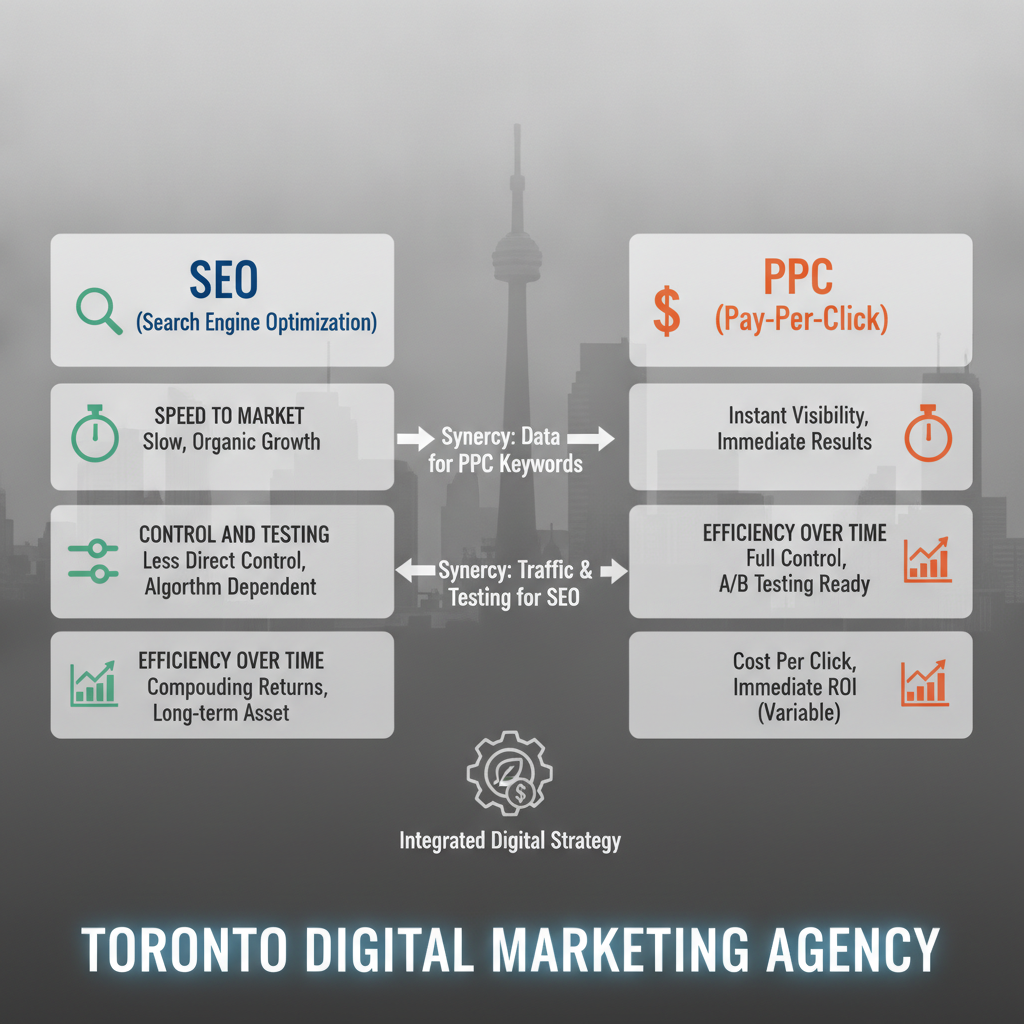
Businesses often frame this as a choice between two competing channels, but the better comparison is timing and function. SEO tends to build durable visibility over time, while PPC is useful when speed, controlled targeting, or immediate demand capture is the priority. Both can work well; each solves a different part of the growth problem.
Speed to market
A) SEO: SEO builds visibility gradually as pages are improved, expanded, and trusted by search engines.
- How it works: The agency improves technical health, on-page structure, internal links, and content targeting over time.
- Best fit: Businesses that want compounding visibility and can invest patiently in organic growth.
- Example: A service company building multiple location or service pages to increase qualified non-paid enquiries.
B) PPC: PPC can start generating visibility quickly once campaigns and tracking are in place.
- How it works: Ads appear for selected searches, with targeting controlled by bids, keywords, negatives, and creative.
- Best fit: Businesses that need faster lead flow, tighter query control, or support during seasonal pushes.
- Example: A company launching a new service line and needing qualified traffic before SEO gains build.
C) Combined approach: Combining SEO and PPC often creates better coverage across research and purchase-ready searches.
- How it works: Paid search captures immediate demand while SEO expands non-paid visibility and lowers dependence on ads over time.
- Best fit: Businesses with growth goals that require both short-term pipeline support and long-term acquisition efficiency.
- Example: A multi-location company using ads for fast coverage while organic pages mature.
Control and testing
A) SEO: SEO offers strong control over site content and structure, but testing cycles are usually slower.
- How it works: Changes are made on-site, then measured through ranking, traffic, and conversion trends.
- Best fit: Businesses willing to improve content systems, technical foundations, and site architecture.
- Example: A B2B firm expanding content around service-specific search intent.
B) PPC: PPC is useful for faster message testing because copy, offers, and landing pages can be adjusted quickly.
- How it works: The agency tests ad groups, match types, audiences, and pages against conversion data.
- Best fit: Businesses that need quicker feedback on offers or lead magnets.
- Example: A campaign testing two booking messages to see which one produces stronger form quality.
C) Combined approach: Paid search can inform organic messaging, while SEO insights can improve keyword targeting in ads.
- How it works: Search query data and on-site behaviour are shared across channels to sharpen decision-making.
- Best fit: Teams that want marketing channels to reinforce each other instead of operating in silos.
- Example: A company using ad search terms to identify which service-page themes deserve deeper SEO investment.
Efficiency over time
A) SEO: SEO often improves acquisition efficiency over a longer horizon if the site and offer are strong.
- How it works: Once pages rank and convert, they can continue producing demand without paying for each click.
- Best fit: Businesses focused on durable lead flow and lower dependence on fluctuating ad conditions.
- Example: A firm building evergreen service content that attracts recurring enquiries month after month.
B) PPC: PPC efficiency depends heavily on query quality, creative relevance, landing page strength, and tracking accuracy.
- How it works: Performance improves through ongoing exclusions, bid control, and page refinement rather than passive spend.
- Best fit: Businesses with the discipline to manage paid campaigns actively.
- Example: A local service brand reducing wasted clicks by tightening match types and adding negatives weekly.
C) Combined approach: A mixed strategy can balance efficiency and speed if each channel has a distinct role.
- How it works: SEO builds the long-term base while PPC fills timing gaps and supports high-priority campaigns.
- Best fit: Businesses that want steadier lead flow across different growth stages.
- Example: A business using PPC for immediate visibility during expansion while organic rankings mature in parallel.
How local businesses in Toronto can compete online
Local competition is not won by copying large brands. Smaller and mid-sized businesses usually perform better when they tighten focus: clearer service pages, stronger local signals, better review generation processes, reliable tracking, and faster follow-up once a lead arrives. That tends to outperform broad, unfocused activity.
For Toronto-area companies, local growth often starts with a few practical moves. Service pages should reflect specific search intent, not generic brand copy. Location relevance should be built into page structure where it helps the user. Paid campaigns should separate high-intent searches from broader discovery terms. And the website should make the next step feel simple on mobile, because hesitation grows quickly on smaller screens.
Another overlooked factor is operational readiness. A business can improve visibility and still feel disappointed if calls go unanswered, forms route poorly, or sales follow-up drags. Marketing can open the door; operations still need to walk through it.
Where smaller businesses often gain ground
- Local intent coverage: Build pages around real service and geography combinations instead of relying on one broad homepage.
- Reputation signals: Reviews, case examples, and trust elements often improve conversion more than extra design flourishes.
- Faster follow-up: A business that replies quickly can outperform a larger competitor with more visibility but slower response times.
- Lean testing: Small changes to forms, headlines, and ad structure can improve lead quality without requiring a full rebuild.
Useful signals experienced marketers watch closely
- Traffic quality beats traffic volume: A page attracting fewer visitors but generating stronger calls is usually more valuable than a page that only grows sessions.
- Search query detail reveals intent drift: In paid search, wasted spend often hides inside loosely matched queries that sound related but convert poorly.
- Technical problems can quietly cap growth: Slow templates, duplicate pages, indexing issues, or tracking errors can suppress results even when strategy is sound.
Practical takeaways before choosing an agency
An online marketing agency is most helpful when it can diagnose the real growth constraint, connect channels into one measurement system, and improve the site experience that turns traffic into leads or sales. For businesses in Toronto, Ontario, that often means balancing local search visibility, paid efficiency, conversion design, and cleaner attribution rather than chasing one channel in isolation.
It also helps to keep expectations grounded. SEO usually needs time. PPC needs careful management. Website improvements often affect every channel at once. The strongest agency relationships are built on that kind of realism, along with transparent reporting and steady testing.
If you want tailored advice on Digital Marketing Services for your business, Zigma Internet Marketing brings together SEO, PPC, web, content, and analytics with clear reporting and conversion-focused execution. 📩 Ask an SEO/PPC question.
FAQs About online marketing agency
If the main problem sits in one area, such as tracking cleanup or paid search restructuring, a specialist may be enough. If traffic, conversion, messaging, and reporting all need attention together, an agency is often more practical because those pieces affect each other.
That depends on the channel and the starting point. Paid campaigns can produce useful feedback relatively quickly if tracking is sound. SEO usually takes longer because technical improvements, content work, and trust signals build over time rather than all at once.
Ask how the agency handles competitive local search, conversion tracking, landing page improvements, and channel prioritization. For Toronto, Ontario, it is especially useful to hear how they deal with dense competition, mobile search behaviour, and lead qualification across different service areas.
Yes, if each channel has a defined role. PPC can capture immediate high-intent demand, while SEO builds broader and more durable visibility. The overlap becomes useful when search terms, landing page tests, and conversion data are shared instead of managed separately.
Usually, yes. Local intent still influences how people search, compare, and choose providers. For businesses serving Toronto, Ontario and the wider GTA, location relevance often improves both visibility and conversion because buyers want a provider that understands their area and service context.
Related Topics:
- search engine optimization
- pay per click advertising
- local search marketing
- conversion optimization
- analytics and tracking setup