


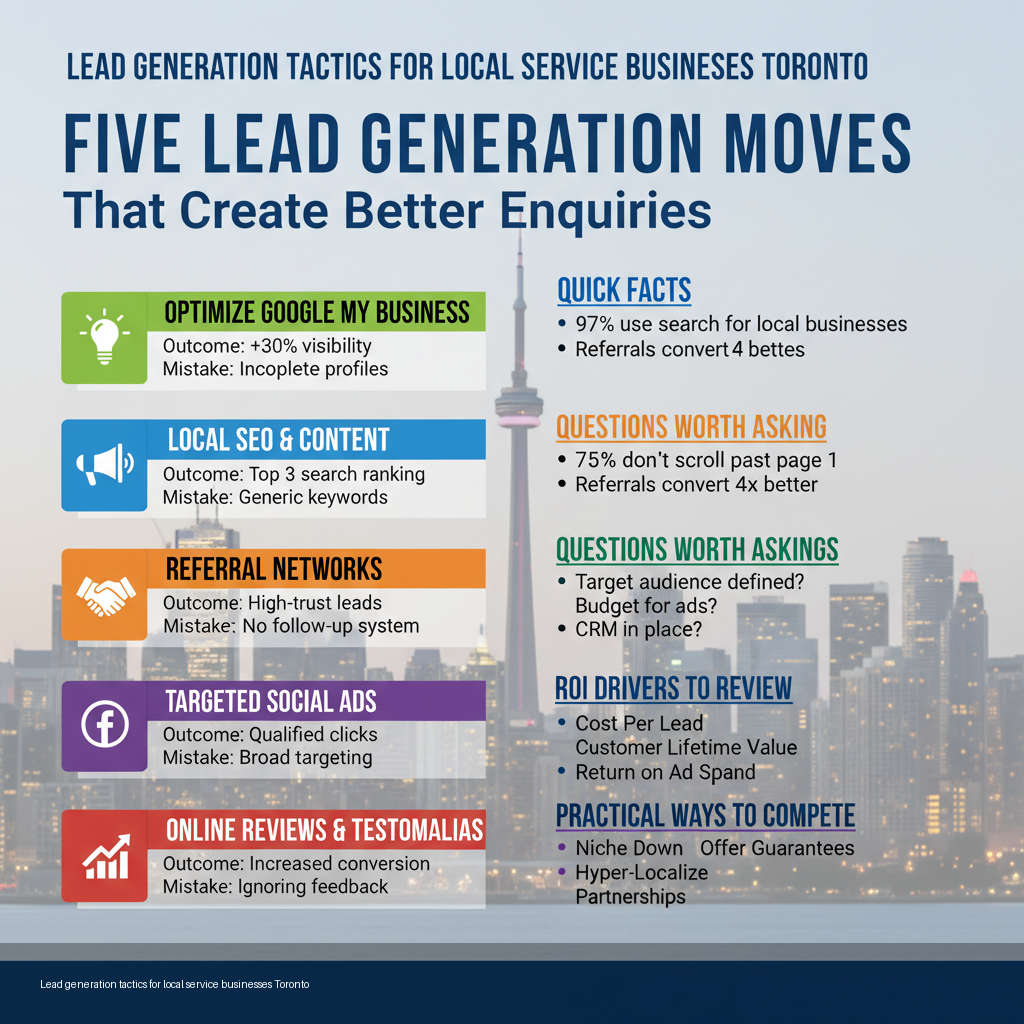
Lead generation tactics for local service businesses Toronto owners can rely on usually combine three things: local visibility, paid search control, and a website that turns intent into calls or form submissions. For service companies competing across Toronto, Ontario, the goal is not simply more traffic. The goal is qualified enquiries from people who need a plumber, clinic, contractor, consultant, repair company, home service provider, or professional service near them.
Toronto search behaviour is highly specific. Someone searching from Liberty Village may compare different providers than someone in Scarborough, North York, or The Beaches. A strong lead system accounts for that by matching keywords, neighbourhood intent, service pages, landing pages, reviews, tracking, and follow-up speed.
Zigma Internet Marketing helps local service businesses connect SEO, Google Ads, landing pages, content, and analytics into one measurable growth system. If your team is comparing agencies, channels, or campaign priorities, this breakdown will help you judge what deserves budget first and what should wait.
Quick Facts: Lead generation tactics for local service businesses Toronto
A practical snapshot before the details.
- What: A coordinated plan using local SEO, Google Ads, landing pages, conversion tracking, reviews, and follow-up systems to increase qualified calls and form fills.
- Who: Best suited for local service businesses that rely on booked appointments, consultations, inspections, estimates, recurring clients, or service-area demand.
- Where: Toronto neighbourhood demand can vary across Downtown, North York, Scarborough, Etobicoke, and surrounding GTA service areas.
- How: Strong campaigns connect keyword intent, Google Business Profile visibility, paid search targeting, landing page clarity, and call tracking.
- Why: Clear tracking shows which channels produce real enquiries, not just clicks, impressions, or social engagement.
How lead generation tactics for local service businesses Toronto should work
Lead generation for a local service company is the process of attracting people who are actively researching or ready to hire, then making it easy for them to contact the business. The core channels are usually search engine optimization, local SEO, Google Ads, service-area landing pages, review signals, and conversion rate optimization.
A common mistake is treating each channel as separate. SEO brings long-term visibility, Google Ads creates controlled demand capture, and landing pages convert interest into measurable actions. If tracking is weak, a business may see traffic rising while the sales team still cannot tell which source created the best conversations.
For service companies that want organic visibility, SEO Services should be tied to real lead intent: service pages, location pages, review content, technical fixes, and content that answers buying questions. For businesses that need faster demand capture, Google Ads Management can help test keywords, offers, and landing pages before waiting months for organic rankings to mature.
Why Toronto, Ontario changes the lead generation plan
Toronto, Ontario is not a single search market. A homeowner in East York, a condo owner near CityPlace, and a business manager in North York may use different search phrases, expect different service timelines, and compare providers differently. Local campaigns need to reflect those differences without creating thin, repetitive pages for every neighbourhood.
For example, a local HVAC company may need urgent-call visibility during weather shifts, while a legal, dental, accounting, or renovation business may need content that builds confidence before a consultation. A campaign that works for emergency services may not fit a considered purchase where the customer compares reviews, credentials, galleries, and service explanations before calling.
Toronto also has dense competition in paid search. If ads send every click to a generic home page, the campaign often wastes budget on unclear intent. Better performance usually comes from matching the search term to a focused landing page, showing service-area relevance, and tracking the full path from click to call, form submission, booking, or sale.
Which lead channels deserve attention first?
Channel priority depends on the sales cycle, margin, urgency, and current website condition. A business with no tracking should not rush into larger ad spend before call tracking, form tracking, and analytics are working. A business with strong conversion data may be ready to scale SEO, PPC, or both.
SEO, PPC, and referral traffic compared
A) Local SEO: Local SEO builds visibility across Google Maps, organic results, and service-area searches. It usually needs consistent work across website structure, Google Business Profile optimization, reviews, and local content.
- How it works: Local SEO improves relevance, proximity signals, content depth, technical health, and trust indicators that search engines use to rank local businesses.
- Best fit: Local SEO fits service businesses that want steady lead flow and can invest in long-term visibility rather than only immediate clicks.
- Example: A contractor may build pages for core services, add project content, strengthen reviews, and improve internal links so Toronto searchers can find the right page faster.
B) Google Ads: Google Ads captures high-intent searches quickly, but performance depends on query control, negative keywords, landing pages, and conversion tracking. Poor setup can spend heavily on weak clicks.
- How it works: Search campaigns show ads for selected queries, then measure calls, forms, and other conversion actions tied to each keyword and ad group.
- Best fit: Google Ads fits businesses that need demand capture now, have defined service areas, and can respond quickly to enquiries.
- Example: A repair company may run ads for urgent service phrases while excluding research-only searches that rarely turn into booked jobs.
C) Referral and repeat-client systems: Referral traffic can be valuable, but it is often hard to scale without a deliberate review, email, and follow-up process. Digital channels should support those relationships rather than replace them.
- How it works: Referral systems use review requests, client reminders, email follow-up, and partner pages to turn satisfied customers into future leads.
- Best fit: Referral systems fit businesses with strong service quality, repeatable customer communication, and a team that can ask for reviews at the right moment.
- Example: A clinic or professional services firm may send post-appointment review prompts and build content that answers the questions referred prospects ask before booking.
Five lead generation moves that create better enquiries
Step 1: Build service pages around buying intent
Each core service should have a page that explains the problem, the service process, who it fits, and what the customer should expect after contacting the business. This step helps improve relevance for searchers so your team can receive enquiries that match the services you actually want to sell.
What to measure: Track organic entrances, form submissions, phone calls, and assisted conversions by service page.
Common miss: Many businesses describe all services on one page, which makes ranking, ad relevance, and conversion analysis harder.
Example: A home services company may separate repair, installation, maintenance, and emergency pages because each searcher has a different timeline and decision process.
Step 2: Strengthen Google Business Profile signals
Google Business Profile optimization supports Maps visibility and customer confidence. Categories, services, photos, posts, Q&A, review responses, and accurate contact details all shape how people judge the business before visiting the website.
What to measure: Track calls, direction requests, website clicks, and review growth alongside booked jobs.
Common miss: Businesses often update the website but leave old services, hours, or weak photos on the profile.
Example: A Toronto-area service company can use specific service descriptions and review responses to reinforce the jobs it wants more often.
Step 3: Use PPC to test demand before scaling content
Paid search can reveal which queries convert, which service messages resonate, and which landing pages need improvement. This step helps reduce guesswork so SEO content and landing page priorities are based on real search behaviour.
What to measure: Track cost per qualified lead, search term quality, call duration, form quality, and closed-job feedback where available.
Common miss: A ppc agency toronto campaign can look healthy on click-through rate while still producing low-quality calls if search terms are not reviewed often.
Example: A service business may test ads for two service categories, then use conversion quality to decide which category deserves deeper SEO content.
Step 4: Improve landing pages before increasing spend
A landing page should match the searcher’s need, explain the service clearly, show trust signals, and make the next action easy on mobile. This step helps conversion rate optimization toronto campaigns produce more enquiries from the same traffic.
What to measure: Track mobile calls, form completion rate, scroll depth, page speed, and enquiry quality.
Common miss: Sending ad traffic to a slow, crowded home page often hides the service details that a ready-to-hire searcher needs.
Example: A landing page for emergency service should place phone contact, service coverage, response expectations, and proof points near the top.
Step 5: Connect analytics to sales feedback
Analytics setup should show which marketing activities create real conversations, not only website visits. This step helps owners compare channels accurately so they can invest in the sources that produce qualified opportunities.
What to measure: Track source, campaign, keyword, landing page, call outcome, form quality, and booked revenue where the sales process allows it.
Common miss: Without GA4 setup, Google Tag Manager, and conversion tracking, teams often debate opinions instead of reviewing evidence.
Example: A lead generation agency toronto plan should separate spam forms, job-seeker submissions, repeat customers, and new qualified enquiries in reporting.
How to choose the right digital marketing agency
A good agency should ask about margins, service capacity, close rates, target neighbourhoods, response times, and past lead quality before recommending channels. If the conversation begins and ends with rankings, clicks, or impressions, the plan may miss the business outcome.
For a Toronto service company, the right digital marketing agency toronto partner should be comfortable discussing SEO, paid search, website design toronto considerations, content strategy, technical SEO services, and reporting. The agency does not need to push every channel at once. It should be able to explain the sequence.
Zigma Internet Marketing works across SEO, PPC, WordPress and Shopify development, landing pages, content, social media, and analytics. That full-service delivery is useful when a lead problem crosses multiple areas, such as a campaign that has good traffic but weak landing page conversion.
Questions worth asking before hiring
- Tracking clarity: Ask how calls, forms, booked appointments, and lead quality will be measured across SEO and PPC.
- Channel sequencing: Ask whether the agency would fix the website, run ads, build SEO content, or improve reporting first, and why.
- Local experience: Ask how the agency handles local seo gta campaigns across neighbourhoods without creating duplicate or thin pages.
- Reporting habits: Ask whether reports connect activity to business outcomes or only show rankings, traffic, and clicks.
- Implementation support: Ask who handles landing pages, technical changes, tags, dashboards, and copy updates after strategy is approved.
What affects ROI in modern digital campaigns
ROI depends on more than ad budget or ranking position. A campaign can create more enquiries while still underperforming if the leads are outside the service area, too low in value, or poorly matched to the company’s capacity. Strong reporting separates lead volume from lead quality.
Modern online marketing toronto campaigns often fail at handoff points. A person clicks an ad but lands on a generic page. A form is submitted but not tagged correctly. A call comes in but the team does not know which campaign created it. Each gap makes it harder to improve spend efficiency.
Good ROI analysis looks at the full path: search term, ad or page, landing experience, conversion action, follow-up speed, qualification, and close outcome. What happens after the lead arrives is part of marketing performance, especially for high-consideration services.
ROI drivers to review
- Search intent quality: High-intent service searches usually deserve different treatment than early research searches.
- Landing page alignment: A page should answer the exact service need that brought the visitor there.
- Speed and mobile usability: Slow pages and hard-to-tap phone numbers reduce enquiries from mobile users.
- Follow-up process: Missed calls, delayed replies, and unclear intake questions can weaken an otherwise strong campaign.
- Measurement accuracy: Dashboards should show qualified leads, not every click or form as equal.
SEO vs PPC: when each channel makes sense
SEO and PPC solve different timing problems. SEO services toronto campaigns build durable visibility for service pages, location relevance, and useful content. Google ads management toronto campaigns can test demand faster and capture high-intent searches while SEO work develops.
For a new service page, PPC may show whether the offer converts before months of content work are invested. For a proven service, SEO can reduce dependence on paid clicks over time by improving organic rankings and Maps visibility. The strongest plans usually use both channels with shared data.
A seo company toronto strategy should not ignore paid search data, and a paid search plan should not ignore organic landing page quality. Query reports, conversion data, and content performance can all guide better decisions across channels.
Clear use cases
- Use SEO for compounding visibility: Build service pages, location relevance, internal links, reviews, and content that keeps working after publication.
- Use PPC for controlled testing: Test service demand, landing page messaging, and call quality before scaling a larger campaign.
- Use both for competitive searches: Pair organic credibility with paid visibility when high-value services face strong competition.
- Use CRO across both: Better pages improve the value of organic traffic and paid traffic at the same time.
How local businesses in Toronto can compete online
Local businesses in Toronto can compete online by being more specific than larger competitors. A national brand may have budget, but a local service business can show neighbourhood familiarity, real reviews, service-area clarity, faster communication, and more useful service explanations.
Competition is especially visible in dense areas such as Downtown Toronto, North York, Scarborough, Etobicoke, and midtown corridors. A marketing agency gta plan should account for commute patterns, service radius, parking or access constraints, seasonal demand, and the difference between residential and commercial customers.
Content marketing toronto work can also support sales conversations. Pages that explain process, eligibility, preparation, timelines, warranties, or maintenance reduce repeated questions and help prospects arrive more informed.
Practical ways to compete
- Clarify service areas: Show where the company works and which services are available in each area without duplicating the same page repeatedly.
- Use proof near action points: Place reviews, certifications, project details, or service guarantees close to phone numbers and forms.
- Build helpful service content: Answer the questions customers ask before they trust a provider with their home, business, health, or budget.
- Improve the website foundation: A strong Website Design & Development process supports speed, SEO structure, mobile usability, and conversion paths.
- Review data monthly: Use reporting to refine keywords, landing pages, negative keywords, and content gaps based on lead quality.
What service businesses often miss behind the scenes
Many lead problems are not caused by a single weak channel. The issue is often a broken chain: unclear positioning, weak tracking, slow pages, poor query control, thin service content, or delayed follow-up. Fixing one part helps, but the best gains usually come from improving the full path.
Another hidden issue is treating every lead as equal. A form from outside the service area, a student asking for a job, and a homeowner ready to hire should not carry the same weight in reports. Better dashboards separate marketing activity from sales opportunity.
Basic reporting vs decision-ready reporting
Basic reporting shows clicks, impressions, rankings, and total form submissions.
Decision-ready reporting separates qualified enquiries, source quality, landing page performance, and campaign waste.
Basic reporting tells you what happened on the surface.
Decision-ready reporting helps decide what to improve next.
This is where a full-service digital marketing toronto partner can be valuable. SEO, PPC, landing pages, technical fixes, and analytics need to work together, especially for service companies that cannot afford vague attribution.
FAQs About lead generation tactics for local service businesses toronto
Google Ads and landing page improvements can often create clearer lead data faster than SEO, but lead quality depends on tracking, search terms, and follow-up. In Toronto, Ontario, competitive services usually need both short-term testing and long-term organic visibility.
Start with tracking and website conversion paths before increasing spend. If calls and forms are not measured correctly, it is difficult to know whether SEO, PPC, social media, or referral traffic is producing qualified enquiries.
Service-area pages can help when they contain useful, distinct information about the service, coverage area, customer concerns, and proof. Thin pages that only swap city names rarely support strong local SEO performance.
Toronto businesses should review source, service requested, location, urgency, budget fit, contact accuracy, and close potential. A smaller number of qualified enquiries can be more useful than high form volume filled with poor-fit submissions.
They can, but the page must satisfy both organic search expectations and paid traffic intent. Some campaigns need dedicated PPC landing pages, while core SEO pages can support broader education and internal linking.
Trust your lead generation plan to measurable execution
Zigma Internet Marketing is a Google Partner-certified digital marketing agency serving Toronto, the GTA, and businesses across Ontario from its Markham office. The team connects strategy and implementation across SEO, Google Ads, landing pages, website development, content, social media, analytics, and reporting.
If your service business needs a clearer plan for lead quality, tracking, and channel priority, speak with Zigma Internet Marketing at (647) 556-6071 or email info@zigma.ca.
Build a lead plan you can measure
Get a practical review of your SEO, PPC, landing pages, and tracking so your next marketing decision is based on real lead data.
Related Topics:

