


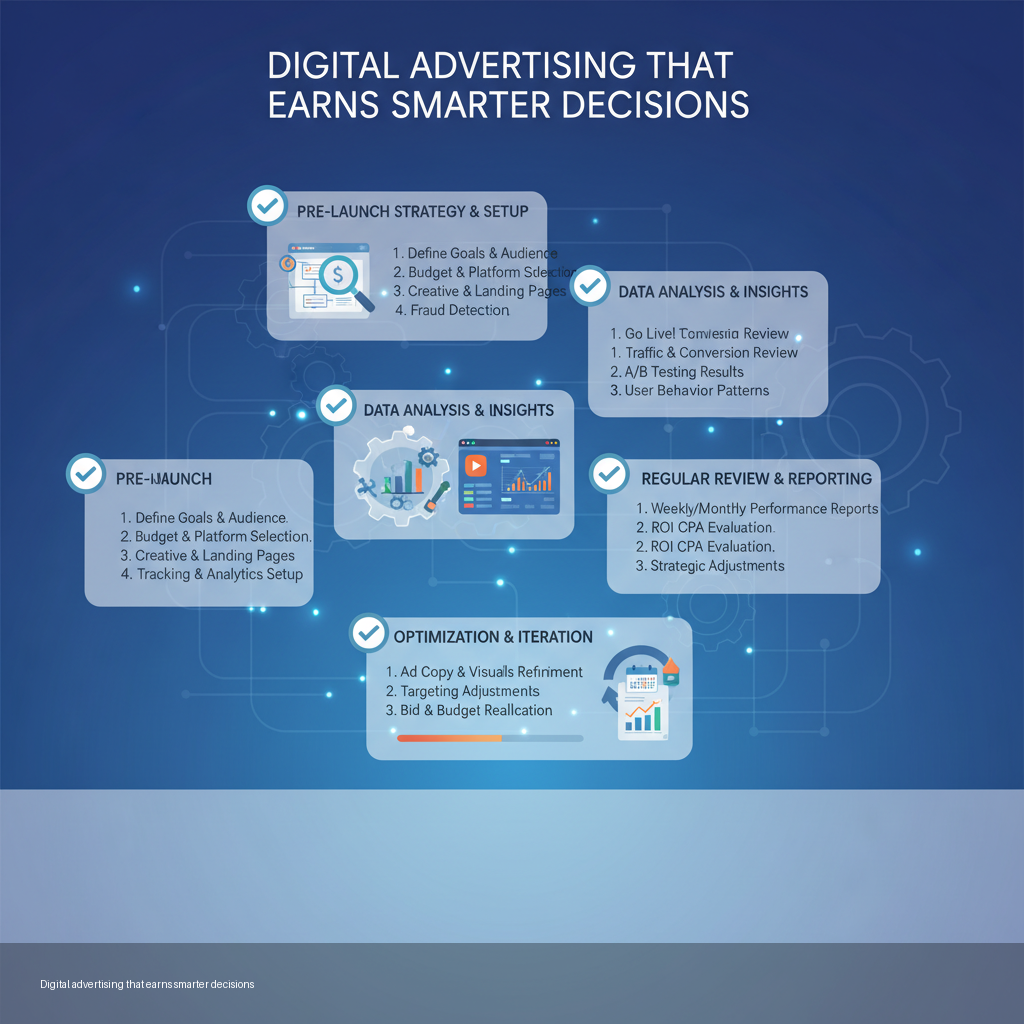
Digital advertising that earns smarter decisions
Digital advertising is the use of paid online placements to reach defined audiences, measure response, and improve campaigns based on real performance signals. It can include search ads, display banners, paid social media, shopping ads, retargeting, and video placements. The value comes from control: advertisers can set budgets, choose who sees the message, track clicks and conversions, and refine campaigns as data builds.
For business owners, the challenge is rarely “Should we advertise online?” The harder question is where paid media fits beside search engine optimization, content, website conversion work, and analytics. A campaign that brings traffic to a slow page, an unclear offer, or broken tracking will look worse than it really is. That is why strong digital advertising starts before the first ad goes live.
Zigma Internet Marketing works across paid search, SEO, landing pages, analytics, and conversion rate optimization, so the team views ads as part of a larger acquisition system. For a broader view of how these channels connect, see Digital Marketing Services.
How digital advertising works before the first click
A digital advertising campaign starts with a business goal, not a platform. The goal may be form submissions, phone calls, online purchases, demo requests, newsletter signups, or booked appointments. Once the goal is clear, the campaign can be built around the audience, search intent, offer, landing page, budget controls, and measurement plan.
The basic flow is simple: a person sees an ad, clicks or taps, lands on a page, and decides whether to act. Behind that simple journey are several moving parts. Audience targeting decides who may see the ad. Bidding controls how aggressively the platform competes for placement. Creative explains the value. Tracking records what happened after the click.
Good campaigns connect those parts tightly. A search ad for “emergency plumbing repair” should not land on a generic home page. A paid social campaign for a new product should not judge success only by likes if the business needs purchases. Paid traffic is useful only when the click has a clear path to a measurable result.
Digital advertising also works differently from SEO Services. SEO builds organic visibility over time, while paid advertising can test demand faster. The strongest plans often use both: paid campaigns generate immediate data, while organic work builds durable search presence.
Digital advertising channels and where each one fits
Each advertising channel solves a different problem. Search ads capture people who are already expressing intent. Paid social can reach people based on interests, behaviours, job roles, or engagement patterns. Display and video placements can help with awareness, while retargeting brings previous visitors back after they have shown interest.
Search ads for active demand
Search ads appear when people type queries into search engines. They tend to work well for service requests, product comparisons, urgent needs, and high-intent research. The main performance signals include click-through rate, cost per click, conversion rate, cost per lead, and search term quality.
- How it works: Advertisers bid on keywords or query themes, then refine traffic using match types, negative keywords, ad copy, extensions, and landing pages.
- Best fit: Search ads are useful when people already know the problem they need solved and are ready to compare providers or products.
- Common risk: Poor query control can spend budget on irrelevant searches that look similar to valuable ones.
Paid social for demand creation and audience building
Paid social placements appear in feeds, stories, reels, message environments, and professional networks. These campaigns usually rely on audience signals and creative quality rather than exact search intent. They can work well for offers that need visual explanation, repeated exposure, or audience education.
- How it works: Campaigns use audience criteria, creative testing, engagement data, and conversion tracking to find the strongest combinations.
- Best fit: Paid social suits products, events, professional services, and brands that need to create demand before a person searches.
- Common risk: A campaign may generate low-cost clicks that do not convert if the message attracts curiosity rather than qualified interest.
Retargeting for people who already showed interest
Retargeting reaches people who visited a website, viewed a product, watched a video, or engaged with a brand’s content. The purpose is to bring a warm audience back with a more relevant message. Retargeting usually works best when audiences are segmented by behaviour, not grouped into one broad bucket.
- How it works: Tracking tags or platform audiences identify prior visitors and show follow-up ads based on pages viewed or actions taken.
- Best fit: Retargeting suits longer decision cycles, abandoned carts, lead nurturing, and reminders for visitors who did not act the first time.
- Common risk: Repeating the same message too often can create wasted impressions and audience fatigue.
The numbers that reveal whether paid media is healthy
Digital advertising produces many numbers, but not every number deserves equal attention. Impressions show reach, clicks show initial response, and conversions show action. A campaign can have strong click volume and still fail if the landing page does not persuade the right visitors to take the next step.
The most useful measurement view connects platform data to business outcomes. For a lead generation campaign, that may include cost per qualified lead, booked-call rate, close rate, and lead source quality. For e-commerce, that may include return on ad spend, average order value, product margin, cart abandonment, and repeat purchase behaviour.
Several metrics deserve regular review:
- Click-through rate: This shows whether the ad message earns attention from the audience seeing it.
- Cost per click: This shows how expensive traffic is, but it does not prove whether traffic is valuable.
- Conversion rate: This shows how often visitors take the desired action after reaching the page.
- Cost per acquisition: This connects spend to the action the business actually cares about.
- Lead quality: This separates raw form fills from prospects who match the business’s sales criteria.
The healthiest campaigns are not judged from one dashboard tile. They are evaluated by the full path from impression to revenue-related action.
Common advertising mistakes that quietly waste budget
Wasted spend usually comes from small gaps that compound over time. A campaign may have the right product and a reasonable budget, yet still underperform because the targeting, page experience, or measurement setup is incomplete. The fix is usually practical, not dramatic.
Mistake 1: Sending every ad to the same page
A generic page asks visitors to work too hard. If the ad promises a specific service, category, or offer, the landing page should continue that same message. Mismatched pages often reduce conversion rate because the visitor has to search for the reason they clicked.
Mistake 2: Judging campaigns by clicks alone
Clicks are only a signal of interest. A high-click campaign can still attract people who are not ready, not qualified, or not relevant. A better review asks: which campaigns created calls, forms, purchases, or pipeline value?
Mistake 3: Skipping negative keywords and audience exclusions
Traffic quality improves when irrelevant searches and audiences are actively filtered out. Negative keywords, placement exclusions, frequency controls, and audience exclusions help prevent spend from drifting into low-value traffic.
Mistake 4: Running ads without reliable tracking
Without conversion tracking, campaigns are forced to optimize around incomplete signals. Proper setup through tools such as GA4 and Google Tag Manager helps connect ad spend to meaningful actions, including calls, forms, purchases, and key page events.
SEO vs PPC: how the two channels support different timelines
Search engine optimization and pay-per-click advertising both connect a business with people using search, but the timeline and control are different. PPC can create visibility quickly once campaigns are approved and funded. SEO takes longer because organic rankings depend on technical health, content quality, authority signals, and search engine crawling.
PPC is often useful for testing. A business can test messages, offers, landing pages, and keyword themes before committing months of SEO effort to the wrong angle. SEO is often useful for compounding visibility. A strong organic page can keep attracting qualified traffic without paying for every click.
The practical comparison looks like this:
- PPC gives faster feedback: Campaign data can show which queries, messages, and landing pages create action within a shorter testing window.
- SEO builds durable visibility: Organic search can reduce dependence on paid traffic when rankings, content, and technical performance improve.
- Both need conversion work: Neither channel performs well if the website is slow, confusing, or missing clear proof and next steps.
For paid search specifically, Zigma Internet Marketing supports campaign structure, query control, landing page alignment, and tracking through Google Ads Management.
What stronger landing pages do differently
A landing page is the bridge between ad spend and business value. If the page does not match the ad, answer the visitor’s main concern, and make the next action clear, the campaign pays for traffic that may not convert. Better landing pages reduce friction and make the decision easier to evaluate.
Effective landing pages usually include a clear headline, relevant proof, concise service or product details, visible contact paths, fast load time, mobile-friendly layout, and a form that asks only for necessary information. The page should also address objections before they become reasons to leave.
- Message match: The page should reflect the ad’s promise so visitors immediately know they arrived in the right place.
- Specific proof: Case examples, certifications, reviews, or process details can reduce uncertainty.
- Focused action: The page should guide visitors toward one primary action rather than competing requests.
- Technical performance: Slow pages can reduce conversion rate, especially on mobile traffic.
For campaigns where the page needs design, development, or conversion improvements, Website Design & Development can be part of the advertising plan rather than a separate afterthought.
A practical checklist before spending on ads
Before budget goes live, a short readiness check can prevent avoidable waste. The goal is not to make a campaign perfect before launch. The goal is to make sure the campaign has enough structure to produce useful data.
Step 1: Define the business action
Choose the action the campaign should create, such as a purchase, booked consultation, qualified form submission, or phone call. This step helps align campaign settings with business priorities so you can judge performance by outcomes rather than surface activity.
Check: The action should be specific enough to track inside analytics or the ad platform.
Risk if skipped: The campaign may optimize toward clicks or impressions that do not support sales.
Example: A service campaign may count a completed form as a conversion, but only sales review can confirm whether those forms are qualified.
Step 2: Match each ad group to a clear intent
Group ads by the reason someone is searching, browsing, or comparing. This step helps create more relevant copy and landing pages so you can separate high-intent traffic from research-stage traffic.
Check: Each ad group should have a distinct message and destination page.
Risk if skipped: Mixed intent can make reporting unclear and reduce conversion rates.
Example: A “pricing research” audience should not receive the same message as a “ready to request service” audience.
Step 3: Build tracking before launch
Set up conversion events, call tracking where appropriate, form tracking, and analytics views before spend begins. This step helps protect decision quality so you can improve campaigns using real behaviour rather than assumptions.
Check: Test each conversion event before the campaign starts collecting data.
Risk if skipped: Missing or duplicated conversions can lead to poor bidding decisions.
Example: A thank-you page view, form submission event, and CRM record should not accidentally count the same lead three times.
Step 4: Review the landing page like a visitor
Read the landing page from the perspective of a person who clicked the ad with a specific need. This step helps reduce confusion so you can give visitors a clear path from interest to action.
Check: The page should answer who the service is for, what happens next, and why the business is credible.
Risk if skipped: The campaign may pay for qualified visitors who leave because the page fails to answer basic concerns.
Example: A landing page for a consultation request should explain what the consultation covers before asking for contact details.
Step 5: Set a review rhythm
Decide how often performance will be checked and which changes will be made at each stage. This step helps avoid overreacting to early noise so you can improve campaigns with enough data to support the change.
Check: Early reviews should focus on tracking, search terms, spend pacing, and obvious mismatches.
Risk if skipped: Too many changes at once can make it difficult to know what actually improved performance.
Example: A first review may remove irrelevant search terms, while later reviews may test new landing page sections or ad messages.
What experienced advertisers check behind the scenes
Strong campaign management is often quiet work. The biggest gains may come from cleaning up search terms, improving landing page clarity, fixing tracking, or separating audiences that behave differently. These tasks are less visible than launching new ads, but they often shape performance more.
- Search term quality: The actual queries that triggered ads may reveal waste, missed intent, or wording that should become new campaign structure.
- Lead source accuracy: A lead should be traceable from campaign to form, call, CRM status, and sales result whenever the systems allow that connection.
- Creative fatigue: Ads that performed well at launch may weaken after repeated exposure, especially in social and retargeting campaigns.
- Landing page behaviour: Scroll depth, form starts, abandoned forms, and mobile speed can show why paid traffic is not converting.
A useful question to ask during any review is simple: did the campaign fail to reach the right people, or did the page fail to convert them after they arrived? Those are different problems, and they require different fixes.
FAQs About Digital Advertising
A new campaign usually needs enough time to gather meaningful click and conversion data before major decisions are made. Early checks should focus on tracking accuracy, traffic quality, and obvious waste. Deeper judgments should use conversion quality, not only clicks or impressions.
The first channel should match how buyers behave. Search ads fit people actively looking for a product or service. Paid social fits offers that need visual explanation or repeated exposure. Retargeting fits visitors who showed interest but did not act.
Paid ads can run without SEO, but the two channels often support each other. PPC can test messages and demand quickly. SEO can build long-term organic visibility. Both perform better when the website is fast, clear, and built around user intent.
Clicks can rise because targeting is broader, ad copy is more attractive, or placements are cheaper. Leads may stay flat if the traffic is less qualified, the landing page does not match the ad, or conversion tracking is missing key actions.
Before increasing spend, review conversion tracking, search terms, landing page speed, form usability, audience quality, and lead outcomes. Scaling a campaign with weak tracking or unclear landing pages can amplify waste instead of improving acquisition.
A clear way to think about your next campaign
Digital advertising works best when it is treated as a measurable system: audience, message, landing page, tracking, and review rhythm. The platform is only one part of that system. A business that fixes the full path from impression to qualified action is usually in a better position to reduce waste and make calmer decisions.
If you are reviewing paid media and want a second set of eyes, Zigma Internet Marketing can help assess campaign structure, PPC tracking, landing pages, SEO alignment, and reporting. The team brings Google Partner-certified expertise and practical implementation across ads, analytics, CRO, content, and website development.
Ask a digital advertising question or reach Zigma Internet Marketing by phone at (647) 556-6071 or email at info@zigma.ca.

