


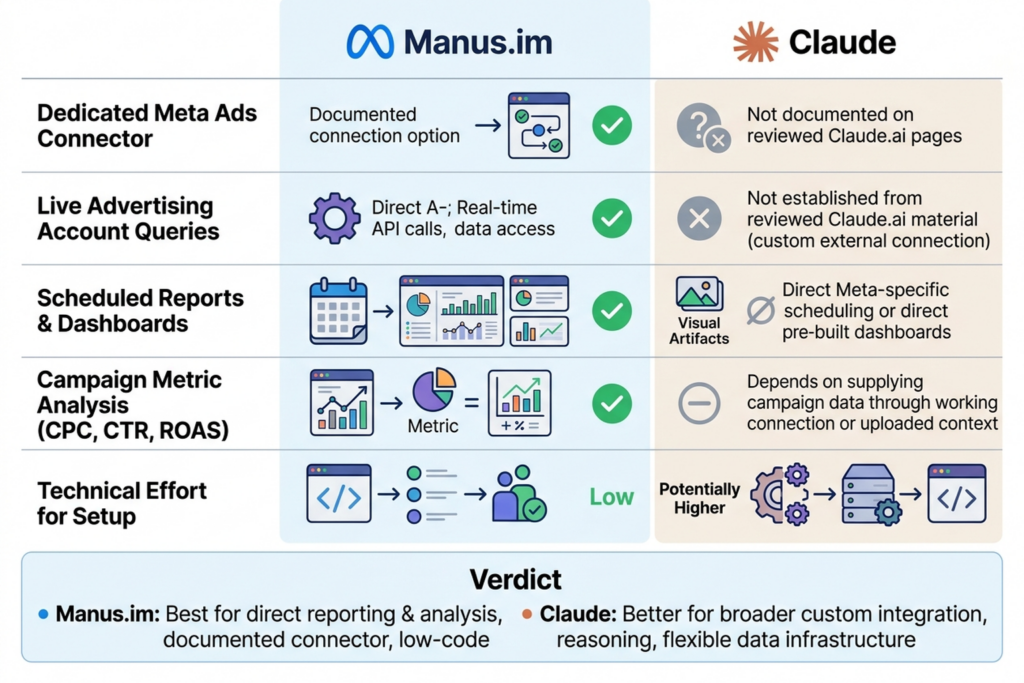
Best Meta ads connector – Manus.im vs Claude: Manus.im is the stronger choice for direct Meta Ads reporting and analysis as of August 31, 2026. Manus documents a dedicated Meta Ads Manager connector with live data queries, recurring reports and dashboard creation. Claude supports broader integrations through remote Model Context Protocol connections, but the reviewed Claude.ai pages do not document a comparable native Meta Ads connector.
Quick facts about Manus.im and Claude
The central difference is direct access versus custom integration.
- Verdict: Manus.im currently provides the clearer out-of-the-box path for connecting an AI workspace to Meta Ads Manager.
- Manus access: The documented connector is read-only, so Manus can retrieve and analyse advertising data without changing campaigns.
- Claude access: A Meta Ads workflow may be possible through a remote MCP server or another external integration, but that requires a separate data connection.
- Reporting: Manus documents real-time questions, scheduled summaries, dashboards, presentations and creative comparisons.
- Important limit: Neither the documented Manus connector nor an unverified Claude workflow should be treated as proof of autonomous campaign management.
Best Meta ads connector – Manus.im vs Claude verdict
Choose Manus.im when the main requirement is connecting Meta Ads Manager with minimal technical setup. Its documented connector supports direct account questions, campaign comparisons and recurring reports without requiring routine CSV exports.
Choose Claude when a business already has a functioning Meta Ads MCP server or wants Claude to serve as the reasoning and content layer within a broader custom system. Claude’s flexibility may suit a technical team, but flexibility is not the same as a ready-to-use advertising connector.
Decision in one sentence: Manus.im wins for a documented, low-code Meta Ads connection; Claude is better considered for a custom workflow whose data infrastructure already exists.
What does a Meta Ads connector actually do?
A Meta Ads connector authorizes an AI workspace to retrieve advertising information from Meta Ads Manager. Once access is approved, a user can ask questions about spend, click-through rate, cost per click, conversions and return on ad spend without rebuilding the same spreadsheet every reporting period.
The connector determines what the AI can see and whether it can take action. Manus describes its Meta Ads connection as secure and read-only. Read-only access allows reporting and analysis, but it prevents Manus from changing budgets, pausing ads, editing audiences or publishing new campaigns.
This distinction is useful for agencies and in-house teams. A reporting assistant can reduce manual analysis while leaving campaign controls inside Meta Ads Manager. Businesses should still verify account permissions, data scope and internal approval procedures before connecting any advertising platform.
How Manus.im and Claude compare
The comparison below separates documented product capabilities from technically possible workflows. A capability is marked as unconfirmed for Claude when the reviewed Claude.ai material does not establish Meta-specific support.
| Capability | Manus.im | Claude |
|---|---|---|
| Dedicated Meta Ads Manager connector | Yes, documented by Manus | Not documented on the reviewed Claude.ai pages |
| Typical setup | Select Meta Ads Manager, connect and authorize access | Likely requires a remote MCP server or another external integration |
| Live advertising account queries | Yes | Not established from the reviewed Claude.ai material |
| Campaign metric analysis | Yes | Possible when campaign data is supplied through a working connection or uploaded context |
| Scheduled reports | Yes | Meta-specific scheduling was not established |
| Dashboards | Yes | Claude can create visual artifacts, but direct Meta data access was not established |
| Slides and visual summaries | Yes | General content and artifact creation are supported |
| Campaign editing | No; the documented connection is read-only | Depends on the permissions and functions of the external integration |
| Technical effort | Low-code or no-code connection | Potentially higher when an MCP server must be configured and maintained |
Where Manus.im has a practical advantage
Manus removes a significant integration step. Instead of building a bridge between Meta’s advertising data and an AI model, an authorized user can connect Meta Ads Manager through the Manus interface and begin querying available account information.
Direct questions about campaign performance
Manus can answer questions involving total spend, CTR, CPC and ROAS. Those metrics become more useful when the prompt includes a date range, campaign set and comparison basis.
- “Create a dashboard showing advertising performance over the last seven days.”
- “Compare CPC and ROAS for the prospecting and retargeting campaigns.”
- “Which audience demographic recorded the highest CTR during the selected period?”
- “List three account recommendations and identify the data supporting each recommendation.”
Recurring reports for teams and stakeholders
Manus documents support for daily or weekly summaries. A recurring report can help an account manager monitor spend, flag performance changes and prepare stakeholder updates without manually assembling identical views each week.
Automation does not remove the need for quality control. Reporting instructions should define attribution settings, date ranges, comparison periods and the business outcome being measured. Otherwise, a polished report may still present an incomplete interpretation.
Visual outputs built from connected data
The Manus connector can support dashboards, slide decks, infographics and websites. Manus also states that users can create advertising images based on creative-performance analysis. That feature connects reporting with creative production, although a marketer should review brand fit, claims and campaign context before using generated assets.
Where Claude can still fit a Meta Ads workflow
Claude supports integrations through remote MCP, a protocol that lets an AI system work with external tools and context. A developer could potentially connect Meta Ads data to Claude through a custom or third-party MCP server, provided the server exposes the required account data and follows appropriate authentication controls.
That architecture may appeal to a company already using Claude for analysis, documentation or content production. It can also support a custom data layer that combines Meta Ads with customer relationship management records, analytics events or internal reporting definitions.
The trade-off is technical ownership. Someone must configure authentication, define available tools, maintain the server and monitor changes to external APIs. Before choosing this route, ask: Who will maintain the connection when permissions, API behaviour or reporting requirements change?
Claude can also analyse exported Meta Ads files supplied in its working context. File analysis can be useful for occasional reviews, but it is different from a persistent connection that retrieves current account data on demand.
Three areas where the products differ most
Connection design, reporting workflow and operational control have more influence on this decision than general AI writing quality.
1. Connection and setup
Manus.im: Manus provides a documented connector that users can select and authorize from the product. This suits marketers who want to reach advertising data without building integration infrastructure.
Claude: Claude’s remote MCP support creates room for custom connections, but the reviewed Claude.ai pages do not identify a native Meta Ads setup. A business may need development support and an independently maintained MCP server.
Manual file workflow: Either AI system may analyse supplied exports, depending on product access and file support. Manual exports are adequate for occasional analysis but add friction to recurring reporting.
2. Analysis and reporting
Manus.im: The documented Meta connector can query connected data, compare campaigns and generate recurring summaries or visual reports. This provides the clearest workflow for routine account monitoring.
Claude: Claude can reason over advertising information provided through an integration or uploaded context. The quality of the workflow depends on the completeness, freshness and structure of that supplied data.
Traditional dashboards: A dedicated marketing dashboard remains useful for fixed KPI monitoring and governance. AI analysis adds conversational investigation, while a conventional dashboard provides stable definitions and repeatable views.
3. Control and campaign action
Manus.im: The documented connection is read-only. Manus can interpret account performance but cannot directly alter campaign settings.
Claude: Action permissions would depend on the external MCP implementation. Any write access should be constrained by approval steps, activity logs and narrowly defined permissions.
Human campaign management: Budget shifts, targeting changes and creative decisions still require accountable review. AI recommendations should be checked against conversion tracking, attribution limits and business constraints.
Limitations to check before connecting Manus
Manus is the more direct choice, but its connector has boundaries that affect how it should be used.
- Read-only access limits execution: Users must make approved campaign changes inside Meta Ads Manager or another authorized management system.
- Availability may vary: Manus introduced the connector through an early beta with progressive access, so availability may depend on the account, plan or rollout stage.
- Recommendations require review: A lower CPC or higher CTR does not automatically indicate stronger business performance. Lead quality, conversion value and attribution settings can change the interpretation.
- Tracking quality remains decisive: Missing events, duplicate conversions or inconsistent attribution can produce misleading analysis regardless of the AI system used.
- Security still requires governance: Read-only access lowers operational risk, but organizations should still control who can authorize accounts and view advertising information.
A practical selection checklist
Use the following checks to evaluate the connector itself rather than selecting a platform solely because its AI responses sound polished.
1. Confirm the required data source
List the account, campaign, ad set, ad and audience data required for reporting. Verify that the connector can retrieve the necessary fields and date ranges before designing dashboards around it.
2. Separate reporting from campaign control
Decide whether the AI should only interpret data or also trigger account changes. Read-only access is often appropriate for reporting because it creates a clear boundary between analysis and execution.
3. Test metric definitions
Use a known reporting period and compare AI results with Meta Ads Manager. Check spend, impressions, clicks, CTR, CPC, conversions and ROAS under the same attribution settings.
4. Define recurring report instructions
A useful weekly report should specify the comparison period, KPI thresholds and intended audience. For example, an executive summary may focus on spend, qualified leads and revenue, while an account manager needs campaign and creative detail.
5. Review access and maintenance
Identify who owns authorization, troubleshooting and permission removal. A custom Claude integration can be appropriate when technical ownership is assigned; Manus is more suitable when a marketing team needs a documented connection with less setup.
Recommendation by use case
The strongest choice changes with the workflow, available technical resources and level of customization required.
- Choose Manus.im for no-code reporting: The dedicated connector supports a more direct path from account authorization to campaign analysis.
- Choose Manus.im for scheduled stakeholder updates: Manus documents recurring summaries, dashboards and presentation creation from connected advertising data.
- Choose Claude for an established MCP environment: Claude can fit when a secure Meta Ads data service already exists and the organization wants Claude as its preferred reasoning layer.
- Choose Claude for broader custom orchestration: A technical team may prefer Claude when Meta Ads is one source within a larger internal workflow, provided the integration is built and maintained separately.
- Use conventional dashboards alongside either system: Stable KPI definitions and validated conversion tracking provide a reference point for checking AI-generated interpretations.
For teams managing paid media, connector choice is only one part of reliable reporting. Proper conversion tracking, landing-page analysis and campaign structure remain central to performance. Zigma Internet Marketing provides Google Ads Management and broader paid-media analysis grounded in business outcomes rather than isolated platform metrics.
Source scope and evidence limits
The Manus findings are supported by its help centre and product announcement. Those sources explicitly describe connection steps, read-only access, real-time data questions, scheduled reporting and visual output creation.
The Claude conclusion is narrower. The reviewed Claude.ai material confirms support for integrations through remote MCP, but it does not establish a first-party Meta Ads connector. Claude.ai also restricted direct crawling during the source review. Therefore, the comparison does not rule out third-party connectors, Anthropic documentation on other domains or future product changes.
FAQs about the best Meta Ads connector
No. Manus describes its Meta Ads Manager connector as read-only. It can retrieve and analyse campaign information, but it cannot edit budgets, pause ads, change targeting or publish campaigns through the documented connection.
The reviewed Claude.ai pages do not document a native Meta Ads connector. Claude supports remote MCP integrations, so a custom or third-party connection may be possible, but that is different from a documented Meta-specific workflow built directly into the product.
Yes. Manus documents scheduled daily and weekly campaign summaries. Report instructions should define the date range, attribution settings, campaign scope and KPIs so each report uses consistent criteria.
Manus currently has the simpler documented setup because users can select Meta Ads Manager and authorize the connection. A Claude workflow may require an MCP server, authentication configuration and ongoing technical maintenance.
AI recommendations should be reviewed before implementation. CTR, CPC and ROAS can be affected by attribution settings, conversion quality and campaign objectives. A marketer should confirm the underlying data and assess the business impact before changing spend or targeting.
Key takeaways
Manus.im is the better documented choice for direct Meta Ads reporting as of August 31, 2026. It provides a dedicated, read-only connection for account questions, campaign comparisons, scheduled reports and visual summaries. Claude remains a credible reasoning layer when campaign data reaches it through a functioning MCP server or another external connection.
- Manus provides the clearest low-code path to connected Meta Ads analysis.
- Claude requires a separately established data workflow based on the reviewed evidence.
- Manus analyses campaigns but does not modify them through its documented connector.
- Validated tracking and consistent attribution settings are essential for either platform.
- Product access and connector capabilities should be verified before adopting a reporting process.
Need a second opinion on advertising data?
Zigma Internet Marketing can review tracking, campaign KPIs and reporting workflows with a clear focus on leads, sales and acquisition efficiency.