


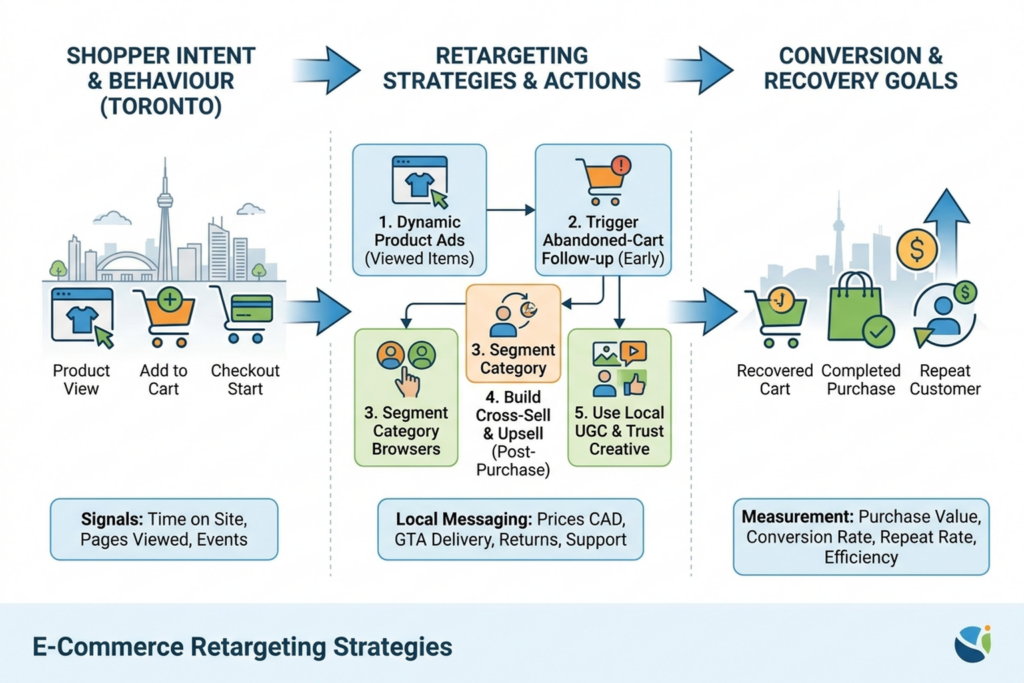
Recovering high-intent shoppers before they disappear
Retargeting campaign strategies for Toronto e-commerce businesses use ads and follow-up messages to reconnect with people who viewed products, added items to a cart, began checkout, or bought previously. With cart abandonment often reported at roughly 70%, a well-built retargeting programme can recover sales that acquisition campaigns leave behind—provided the message, timing, tracking, and offer match the shopper’s behaviour.
For Toronto retailers, the strongest campaigns reduce uncertainty that can stop a purchase: shipping speed, duties, currency, returns, product availability, and customer support. A shopper who leaves a product page is not necessarily uninterested; they may be comparing brands, waiting for a paycheque, checking delivery dates, or deciding whether a product is worth the price.
Retargeting works best as part of a connected acquisition and conversion system. Paid traffic may begin through Google Ads Management, but the follow-up experience should reflect what visitors did after they arrived on the store.
How retargeting turns browsing behaviour into relevant follow-up
Retargeting uses audience data from website tags, product feeds, customer lists, and platform signals to show relevant ads after a shopper leaves an e-commerce site. A product viewer may see the same item again on Meta or Google Display. A cart abandoner may receive an email reminder. A past customer may see complementary products after delivery.
The key difference is intent. Broad prospecting introduces a brand to new people, while retargeting speaks to shoppers who have already shown a measurable signal of interest. A visitor who spent time reading product details should not receive the same message as someone who reached the payment page.
Accurate event tracking is the foundation. Product views, add-to-cart actions, checkout starts, purchases, refunds, and email sign-ups should be recorded consistently through a platform pixel and a properly configured tag manager. Zigma can connect this work with Website Design & Development and conversion-rate improvements so campaigns send returning shoppers to pages that are ready to convert.
Why Toronto shoppers need a localised retargeting experience
Toronto shoppers have access to a crowded mix of Canadian, U.S., and global online stores. For brands serving Toronto, clarity can be more persuasive than another generic discount. Ads and landing pages should state practical details such as prices in CAD, delivery estimates within the GTA, local pickup where available, clear return terms, and whether duties are included.
Local creative can also make a brand feel more credible. User-generated content featuring real customers in a downtown condo, near the waterfront, or during a Toronto winter can provide useful context for apparel, home goods, outdoor products, and lifestyle purchases. The setting should support the product story rather than serve as a decorative city reference.
Use local promises only when operations can support them
“Fast GTA delivery” is valuable only if inventory, courier coverage, and fulfilment capacity support that statement. A Toronto e-commerce business should separate campaigns by delivery zone when service levels differ between downtown Toronto, North York, Scarborough, Etobicoke, and the wider GTA. A realistic message protects ad spend and prevents disappointed customers.
Six retargeting campaign strategies for Toronto e-commerce businesses
These campaigns should be sequenced by shopper intent. Start with the audiences closest to a purchase, then expand to category browsers, repeat customers, and longer consideration journeys. Frequency caps and purchase exclusions are essential; repeated ads after a completed order waste budget and can damage the customer experience.
Strategy 1: Use dynamic product ads for viewed items and carts
Dynamic product ads pull product names, images, prices, and availability from a product catalogue. Rather than sending a generic brand ad, the platform can show the exact item a visitor viewed or left in their cart. This is particularly useful for stores with many SKUs, sizes, colours, or seasonal collections.
Audience: Build separate groups for product viewers, cart abandoners, and checkout abandoners.
Creative detail: Add a Canadian value statement such as “Prices in CAD” or “Free GTA shipping” only where accurate.
Example: A shopper who viewed a pair of winter boots can see those boots, available sizes, and a clear delivery message rather than an ad for an unrelated collection.
Strategy 2: Trigger abandoned-cart follow-up earlier
Waiting until checkout starts misses people who add a product to a cart but hesitate before entering contact or payment information. An add-to-cart audience captures those earlier signals. For email, the first reminder is commonly sent within 30 to 60 minutes, while product interest is still fresh.
Timing: Keep early messages helpful: confirm the cart, answer shipping or returns concerns, and provide a direct path back.
Guardrail: Suppress customers immediately after a purchase and avoid sending repeated messages if stock has changed.
Example: A skincare retailer can remind a cart abandoner about the selected product, ingredient information, and Canadian shipping terms instead of leading with a discount.
Strategy 3: Segment category browsers from product-level visitors
A shopper who browsed “Men’s Boots” without viewing a product has weaker intent than someone who checked size availability on a specific boot. Category audiences need category-level creative featuring best sellers, practical use cases, or comparison points. Product audiences need a tighter return path to the item already viewed.
Audience: Use engagement depth, time on site, pages viewed, and event data to separate casual visits from strong buying signals.
Budget control: Allocate more budget to checkout and cart audiences before broad page-view audiences.
Example: A home décor store can show a collection ad to a lighting-category browser while showing a specific pendant light to a shopper who viewed that product twice.
Strategy 4: Build cross-sell and upsell campaigns after purchase
Retargeting does not end at the first sale. Post-purchase campaigns can introduce complementary items after the original order has shipped or after a reasonable product-use period. The recommendation should have a clear relationship to the original purchase.
Cross-sell: Promote products that complete the use case, such as gloves and scarves after a winter coat purchase.
Upsell: Show a premium version, extended accessory, bundle, or refill only when it genuinely adds value.
Example: An electronics retailer can show a protective case, warranty-related accessory, or upgraded storage product to customers who purchased a compatible device.
Strategy 5: Use local UGC and trust-building creative
Polished product shots remain useful, but customer photos, short reviews, product demonstrations, and creator videos can reduce hesitation for shoppers who need social proof. Toronto-focused UGC is especially helpful where the product benefits from context, such as outerwear, meal delivery, furniture, fitness products, or local gifting.
Creative test: Compare product-only images against UGC that shows the product in use, with the same audience and offer.
Compliance: Obtain permission before using customer photos, reviews, or creator content in paid advertising.
Example: A Toronto apparel brand can run a customer video showing how a jacket performs during a cold commute, paired with accurate shipping and returns details.
Strategy 6: Set frequency, exclusions, and measurement rules
Retargeting can become inefficient when the same audience sees the same ad too frequently. Use frequency controls, rotate creative, and exclude purchasers, refund recipients, and customers with unresolved support issues where data permits. Measurement should compare incremental sales and contribution margin, not only platform-reported revenue.
Measurement: Track purchase value, conversion rate, repeat-purchase rate, assisted conversions, and cost per recovered order.
Testing: Change one variable at a time—audience window, creative, offer, destination page, or frequency cap.
Example: A store may find that a seven-day cart audience produces more efficient recovered orders than a 30-day audience that keeps showing ads after intent has faded.
How to choose the right digital marketing agency
An agency managing e-commerce retargeting should be able to explain where audience data comes from, how purchases are excluded, and how campaign results are validated. Attractive ad creative alone does not solve poor tracking, weak product pages, or a feed that sends shoppers to unavailable products.
For a Toronto retailer, ask whether the agency can coordinate paid media with site speed, product feed quality, email flows, analytics, and landing-page testing. A digital marketing agency toronto retailers hire should be comfortable discussing acquisition costs alongside repeat purchases, margin constraints, and customer lifetime value.
- Tracking ownership: Confirm that you can access ad accounts, analytics, product feeds, and tag manager containers.
- Audience logic: Ask for a clear explanation of visitor, cart, checkout, purchaser, and customer-list segments.
- Reporting quality: Look for reporting that connects spend to orders, revenue, and efficiency rather than impressions alone.
- Technical support: Check whether the agency can fix broken events, feed disapprovals, slow product pages, and checkout friction.
Zigma Internet Marketing provides Digital Marketing Services across paid media, analytics, content, technical implementation, and e-commerce growth planning.
What impacts ROI in modern digital campaigns
Retargeting performance depends on more than bid settings. Product-market fit, stock availability, page speed, product descriptions, checkout usability, shipping clarity, and attribution quality can all affect whether returning visitors complete an order. A relevant ad cannot compensate for a confusing checkout.
For digital marketing toronto campaigns, a practical reporting view should separate prospecting from retargeting while showing how both contribute to sales. Retargeting frequently receives credit for a conversion that began with search, social, email, or organic content, so channel reporting needs context.
- Product feed accuracy: Dynamic ads need correct product titles, images, availability, variants, and destination URLs.
- Conversion rate optimization toronto: Faster product pages, visible delivery terms, and simpler checkout fields help returning traffic convert.
- Consent-aware tracking: Pixel and analytics configurations should reflect applicable privacy, consent, and platform requirements.
- Creative relevance: A cart abandoner usually needs a different message from a previous customer or category browser.
SEO vs PPC for e-commerce remarketing
SEO Services and paid retargeting serve different points in the customer journey. SEO can attract shoppers researching a product category or comparing brands through unpaid search results. PPC can re-engage qualified visitors after they have interacted with a store. Neither channel should be judged in isolation.
A seo company toronto may improve category visibility and product discovery, while google ads management toronto can support shopping ads, search ads, and retargeting audiences. Strong seo services toronto also improve product-page relevance, technical quality, and content that helps visitors make informed purchasing decisions.
- Use SEO for durable demand capture: Product categories, buying guides, comparison content, and technical site health can attract shoppers before they know the brand.
- Use PPC for controlled reach: Paid campaigns can target high-intent searches, shopping placements, and warm audiences with defined budgets.
- Use retargeting for return visits: Retargeting supports people who have already engaged but need another reason or reminder to complete a purchase.
How Toronto businesses can compete online
Toronto e-commerce brands compete with large marketplaces, established Canadian retailers, and international sellers. Competing effectively often starts with clearer information rather than louder ads: CAD pricing, dependable fulfilment, product expertise, responsive support, and return policies customers can understand before checkout.
Local seo gta work can support brands with showrooms, pickup locations, service areas, or locally relevant product searches. Google Business Profile optimization may help shoppers find accurate location, hours, reviews, and contact information when a business also has an in-person presence.
- Build trust before retargeting begins: Product pages should answer sizing, compatibility, shipping, warranty, and return questions clearly.
- Create a stronger first visit:website design toronto projects should prioritise mobile navigation, collection filters, speed, and checkout continuity.
- Use content to reduce hesitation:content marketing toronto can support product education, buying comparisons, seasonal use cases, and customer stories.
- Connect spend to revenue: A lead generation agency toronto with e-commerce capability should report on orders and sales quality, not only lead volume.
Common retargeting mistakes that reduce recovered sales
Many campaigns underperform because the audience definition is too broad or the campaign ignores the customer journey. Sending the same promotion to every previous site visitor creates weak relevance and uses budget on people who may have bought elsewhere, already purchased, or only visited briefly.
Another frequent issue is treating platform attribution as the full picture. Platforms can report a conversion after showing an ad, but the sale may also have been influenced by email, branded search, or organic product research. Use platform reporting alongside analytics and store data before shifting budget.
Useful retargeting is specific.
Product viewers need product-focused reminders.
Cart abandoners often need checkout reassurance.
Past customers need relevant follow-up, not repeated acquisition ads.
Choosing a practical retargeting partner in Toronto
A capable ppc agency toronto should audit tracking before scaling spend, confirm that product feeds are usable, and set up audiences around meaningful customer actions. The work should also include landing-page and checkout review, because paid traffic is only as effective as the store experience it returns to.
Zigma Internet Marketing is a Markham-based agency serving Toronto and the GTA. Our team combines paid advertising, product-feed support, GA4 and Google Tag Manager setup, technical SEO, and conversion-focused site work. As a Google Partner-certified team, Zigma uses transparent KPI reporting to connect advertising activity with orders, revenue, and efficiency.
For retailers assessing online marketing toronto support or a marketing agency gta partner, the first useful conversation should focus on your store’s data, product mix, customer journey, and operating constraints—not generic campaign promises.
Plan a more accountable e-commerce retargeting programme
Discuss audience segmentation, product-feed quality, conversion tracking, and landing-page priorities with Zigma Internet Marketing.
FAQs About retargeting campaign strategies for Toronto e-commerce businesses
For email, a first reminder within 30 to 60 minutes can be appropriate because the shopper still remembers the product. Paid retargeting can begin promptly after the event is recorded, but frequency should be controlled so the customer does not see repetitive ads throughout the day.
No. A product viewer may still need product education, reviews, sizing information, or a category comparison. A cart abandoner has shown stronger purchase intent and may respond better to a reminder that addresses delivery, returns, payment, or current inventory.
Useful Toronto details are operational facts shoppers can verify, such as CAD pricing, GTA delivery timing, local pickup, Toronto-based customer service, or Canadian return handling. Avoid location references that do not change the buyer’s decision or cannot be supported by fulfilment operations.
Yes. Post-purchase retargeting can support replenishment, accessories, bundles, upgrades, referrals, and repeat purchases. The product relationship should be clear, and purchasers should be excluded from ads for the item they have already bought unless a repeat order is genuinely relevant.
Review conversion rate, average order value, repeat-purchase rate, cost per recovered order, product availability, and contribution margin where available. Toronto businesses should also compare platform-reported conversions with analytics and store data to avoid making budget decisions from a single attribution view.
A practical final checklist
Effective retargeting begins with reliable tracking and ends with a purchase experience that answers customer concerns. Prioritise cart and checkout audiences, use dynamic product ads where the feed supports them, localise promises to Canadian operations, and remove purchasers from acquisition-style campaigns.
Review results by audience segment rather than treating retargeting as a single campaign. A Toronto e-commerce business can then identify whether the constraint sits in creative relevance, product-page clarity, shipping communication, checkout friction, or campaign measurement.