


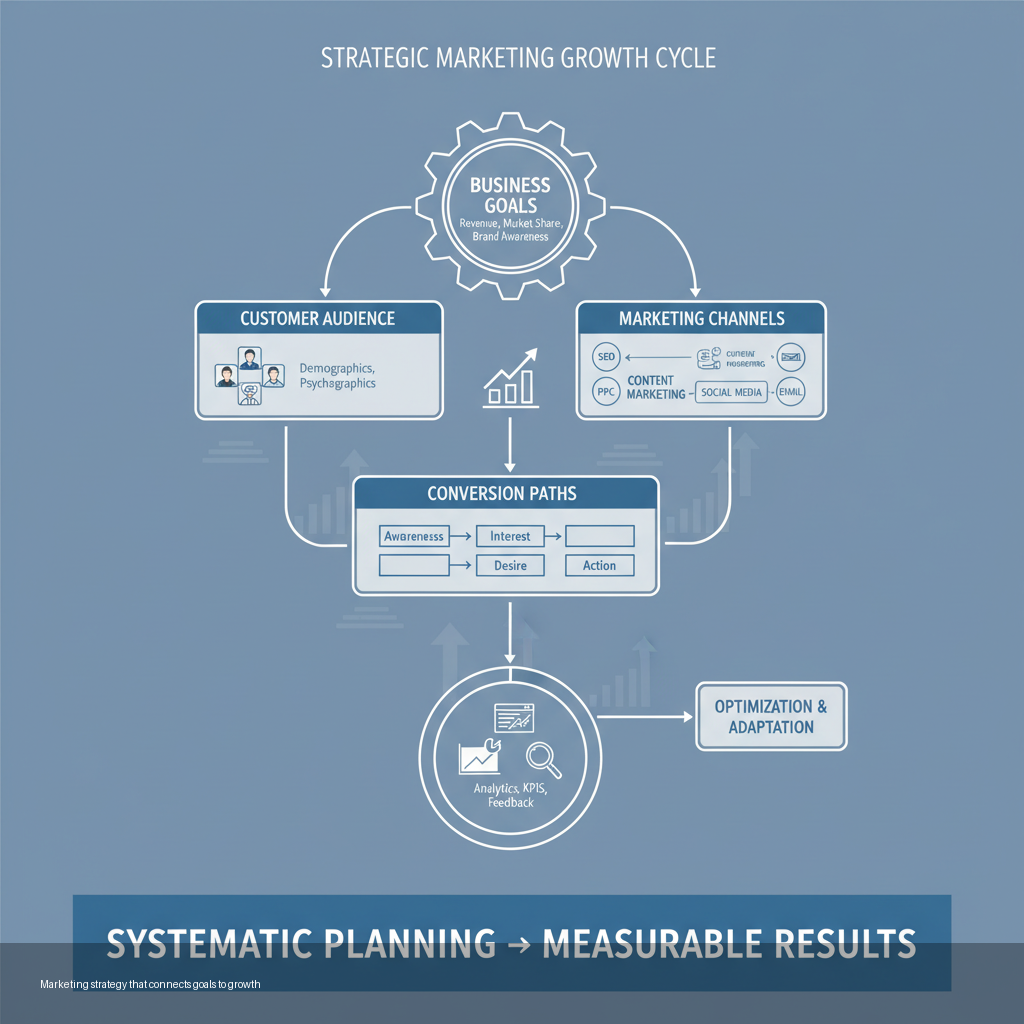
Marketing strategy that connects goals to growth
A marketing strategy is the plan that connects business goals, customer needs, channels, messaging, budget, and measurement into one working system. Without a clear marketing strategy, teams often spend time on posts, ads, pages, and campaigns without knowing which activity supports revenue, lead quality, or customer retention.
For a business owner or marketing lead, the real value is clarity. A sound strategy shows who the company is trying to reach, what those buyers care about, where attention is most likely to turn into action, and which performance signals should guide the next decision.
Digital channels make this both easier and harder. SEO, Google Ads, social media, content, email, landing pages, analytics, and conversion rate optimization can all support growth, but only when each channel has a defined role. Zigma Internet Marketing often sees stronger decision-making when businesses connect channel planning with tracking, not after campaigns are already running.
Marketing strategy starts with a clear business target
A practical marketing strategy begins with a specific business target, not a channel preference. “Get more traffic” is too broad because traffic can rise while lead quality falls. A better target might be more qualified consultation requests, more product sales from returning customers, or fewer low-intent form submissions.
The target shapes every downstream choice. A service business that needs phone calls may require stronger local intent pages, Google Ads search campaigns, and call tracking. An e-commerce brand may need product feed improvements, technical SEO, email segmentation, and landing page testing. The same channel can play a different role depending on the revenue path.
Clear targets also reduce internal debate. If a campaign is judged by impressions alone, almost any activity can look successful. If the team tracks lead source, conversion rate, close rate, and cost per qualified lead, weak assumptions become easier to spot.
For foundational planning across search, paid media, content, and web performance, Zigma’s Digital Marketing Services page outlines the core service areas that often support a complete strategy.
How a marketing strategy turns activity into decisions
A strategy is not a calendar of tasks. A content calendar, ad schedule, or social posting plan can support the strategy, but those pieces do not replace the deeper work of positioning, segmentation, channel selection, and measurement.
The mechanism is simple: strategy creates rules for making choices. If the target audience is problem-aware but not ready to buy, educational content and remarketing may be useful. If buyers already search for a specific service, SEO and PPC may deserve earlier attention. If visitors reach the site but leave without action, landing page changes and CRO may have more value than another traffic campaign.
Key terms should be plain. A customer segment is a group of people with shared needs or buying behaviour. A value proposition explains why a buyer should choose the business over a reasonable alternative. A conversion is a measurable action, such as a call, form submission, purchase, booking request, or email signup.
Search visibility is often part of the plan because buyer intent can be measured through queries and landing page behaviour. If search is a priority, SEO Services can support long-term visibility through technical fixes, content planning, and organic performance measurement.
Core parts of a strong strategy
Strong strategies are usually built from a few connected parts. Each part answers a decision question that affects budget, timing, execution, and reporting.
- Business goal: The plan should name the outcome the company wants, such as qualified leads, sales volume, retention, customer lifetime value, or lower acquisition waste.
- Audience definition: The target audience should be specific enough to guide messaging, channel choice, and landing page content.
- Positioning: The business needs a clear reason to be chosen, based on service model, proof, speed, specialization, inventory, quality, or support.
- Channel roles: SEO, PPC, social, content, email, and web design should each have a purpose rather than competing for attention.
- Measurement plan: Tracking should connect campaigns to calls, forms, purchases, revenue indicators, and lead quality signals.
The sequence matters. Starting with tactics can create noise. Starting with the business goal makes every tactic easier to accept, reject, or refine.
Choosing channels without guessing
Channel planning should be based on intent, sales cycle, budget control, and measurement quality. A fast-moving campaign may need paid search first. A complex buyer journey may need content and remarketing. A brand with poor site performance may need technical and conversion fixes before adding more traffic.
SEO, PPC, and content roles
A) SEO: Search engine optimization supports long-term visibility for queries that reflect research, comparison, and purchase intent.
- How it works: SEO improves technical access, content relevance, internal linking, and page experience so search engines can understand and rank useful pages.
- Best fit: SEO fits businesses that want durable visibility and can invest consistently in pages, content quality, and technical improvements.
- Example: A service business may build separate pages for core services, supporting questions, and comparison topics to capture buyers at different stages.
B) PPC: Pay-per-click advertising can create faster traffic and clearer query-level control, especially for high-intent search terms.
- How it works: PPC uses keyword targeting, ad copy, bidding, negative keywords, landing pages, and conversion tracking to manage paid acquisition.
- Best fit: PPC fits businesses that need testable demand, controlled campaign experiments, or near-term lead volume while organic visibility develops.
- Example: A company can run search ads for a priority service, then compare cost per lead and lead quality against organic traffic.
C) Content: Content supports trust, search coverage, sales enablement, and retention when topics match real buyer questions.
- How it works: Content addresses questions, objections, comparisons, use cases, and decision criteria across the customer journey.
- Best fit: Content fits businesses with longer sales cycles, recurring questions, complex services, or products that require education before purchase.
- Example: A buying guide can reduce repeated sales questions while also supporting organic search for research-stage queries.
Paid media and organic search often work better together than apart. Google Ads can reveal high-converting search terms quickly, while SEO can turn those insights into durable pages. For businesses using paid search, Google Ads Management can help connect queries, ads, landing pages, and tracking into one feedback loop.
What separates a plan from a useful strategy
A plan lists work. A useful strategy explains why the work should happen, what the work is expected to change, and how the team will judge whether the change was worth continuing.
The difference becomes visible during trade-offs. Should the next budget go toward more ads, better landing pages, technical SEO services, or content production? A plan may treat all four as tasks. A strategy ranks them by constraint. If traffic is strong but form submissions are weak, conversion rate optimization may deserve priority. If the website cannot be crawled properly, technical SEO may come first. If paid clicks convert but cost too much, query cleanup and landing page alignment may be the practical fix.
Useful comparison:
A task list says, “Publish four blog posts.”
A strategy says, “Build content around three recurring buyer questions that sales hears weekly.”
A measurement plan says, “Track assisted conversions, engaged sessions, and form submissions from those pages over a 90-day review window.”
The third version gives the team a way to improve instead of simply staying busy.
This is where analytics setup becomes central. GA4 setup, Google Tag Manager, conversion tracking, and marketing dashboards are not administrative details. They define whether the business can tell the difference between attention, interest, and real pipeline movement.
Building a marketing strategy in practical steps
Step 1: Define the commercial target
Name the business result before selecting channels. The target may be more qualified leads, higher repeat purchase activity, improved lead-to-sale rate, or lower wasted spend. This step helps reduce scattered execution so the team can judge performance against a shared outcome.
Key signal: The target should connect to revenue, sales quality, or customer retention rather than visibility alone.
Common issue: Teams often track clicks and impressions while the sales team cares about fit, urgency, and purchase readiness.
Example: A company may shift from “more website traffic” to “more form submissions from decision-makers in priority service categories.”
Step 2: Map the buyer journey
Separate research-stage, comparison-stage, and purchase-stage behaviour. Each stage needs different messaging, pages, and calls to action. This step helps remove message mismatch so visitors receive the right level of detail at the right time.
Key signal: Search queries, sales questions, ad engagement, and landing page behaviour can reveal where buyers are in the journey.
Common issue: Sending early-stage visitors to aggressive sales pages can reduce trust, while sending ready buyers to broad educational content can slow action.
Example: A research-stage visitor may need a comparison article, while a purchase-stage visitor may need a focused landing page with proof and clear next steps.
Step 3: Assign each channel a job
Every channel should have a defined role. SEO may capture recurring intent, PPC may test demand, social media may support awareness and retargeting, and email may support retention. This step helps avoid channel conflict so budgets are not judged by the wrong metric.
Key signal: A channel should have a primary KPI and a secondary diagnostic metric.
Common issue: Social media gets judged by direct leads, while paid search gets judged by reach, even though the buyer behaviour behind each channel is different.
Example: LinkedIn may support B2B credibility, while search ads capture people already comparing vendors.
Step 4: Fix the conversion path
Traffic has limited value if the website does not make action easy. Landing pages, forms, calls, page speed, trust signals, and mobile layouts can all affect conversion rate. This step helps turn attention into measurable action so acquisition spend has a fair chance to perform.
Key signal: Watch form completion rate, call clicks, scroll depth, page load behaviour, and conversion rate by traffic source.
Common issue: Teams increase ad spend before checking whether the landing page answers buyer objections clearly.
Example: A campaign may improve after the landing page adds service fit details, proof points, shorter forms, and clearer next-step language.
Step 5: Review, adjust, and document decisions
A strategy should create a review cycle. Teams need time to gather data, compare channels, identify weak points, and document what changed. This step helps prevent random pivots so future campaigns benefit from previous evidence.
Key signal: Review traffic quality, conversion rate, cost per qualified lead, lead-to-sale rate, and campaign notes together.
Common issue: Teams stop campaigns too early or keep weak campaigns running because nobody defined the decision threshold.
Example: A 30-day review may reveal tracking issues, a 60-day review may reveal creative or landing page patterns, and a 90-day review may support budget reallocation.
Common mistakes that weaken strategy
Most strategy problems do not come from a lack of effort. They come from disconnected effort. A business can publish often, spend consistently, redesign pages, and still struggle if the pieces are not connected to a measurable goal.
- Starting with channels instead of customers: Choosing SEO, PPC, or social first can hide the deeper question: where does the buyer already show intent?
- Measuring activity instead of movement: Posting frequency, clicks, and impressions are useful only when connected to pipeline, sales quality, or retention signals.
- Ignoring the website experience: More traffic will not fix weak messaging, slow pages, unclear forms, or missing trust signals.
- Separating reporting from decisions: Dashboards should help the team decide what to keep, pause, test, or repair.
- Changing too much at once: If ads, landing pages, tracking, and audiences all change together, the team may not know which change affected performance.
Good strategy creates focus. Not rigid focus, but enough structure to see whether effort is moving the business in the intended direction.
Where SEO, PPC, CRO, and analytics fit together
SEO, PPC, CRO, and analytics should not operate as isolated workstreams. Search engine optimization can increase qualified organic visibility. PPC can test messages and generate demand signals faster. CRO improves the path from visit to action. Analytics explains which signals are reliable enough to guide budget and content decisions.
A connected system works like a loop. PPC search terms can inform SEO content. SEO landing page behaviour can reveal objections. CRO tests can improve both paid and organic conversion rates. Analytics can show whether form submissions become qualified sales conversations.
Website design and development also affect strategy because page structure, speed, mobile usability, tracking scripts, and content management workflows influence execution. If the site blocks measurement or slows iteration, even strong campaigns become harder to improve. For site-related planning, Website Design & Development can support the technical foundation behind campaign performance.
How to judge whether your strategy is working
A strategy is working when the business can connect activity to a meaningful change. The change may not appear in every channel at the same speed, but the reporting should show whether the plan is moving in the right direction.
Useful performance signals
- Lead quality: Sales feedback should identify whether inquiries match the business’s target customer profile.
- Conversion rate: Website visitors should have a clear path to action, and weak pages should be visible in reporting.
- Cost per qualified lead: Paid campaigns should be judged by qualified opportunities, not only raw form fills.
- Organic visibility by topic: SEO progress should be tracked by page groups and search intent, not isolated rankings alone.
- Revenue connection: Whenever possible, campaigns should be tied to CRM stages, sales outcomes, or purchase behaviour.
The review should also include context. A campaign that produces fewer leads with higher close rates may be healthier than a campaign that fills the inbox with poor-fit inquiries. Volume without fit can waste sales time.
FAQs About marketing strategy
A strategy should be detailed enough to guide channel selection, messaging, tracking, budget allocation, and review cycles. It does not need to predict every campaign detail. The goal is to define the customer, target outcome, core message, channel roles, and success signals before execution begins.
Most businesses benefit from structured reviews every quarter, with lighter monthly performance checks. Major changes in offer, audience, sales capacity, inventory, or competitive pressure may require earlier adjustment. Strategy should be stable enough to measure, but flexible enough to respond to clear evidence.
Yes. A smaller budget often makes focus even more valuable. A practical strategy can begin with a narrow audience, a small group of priority services or products, a clear conversion path, and basic tracking for calls, forms, sales inquiries, or online purchases.
The right starting point depends on timing and demand signals. PPC can test search intent and messaging faster, while SEO builds long-term visibility through content and technical improvements. Many businesses use PPC data to guide SEO priorities and use SEO gains to reduce reliance on paid traffic over time.
A reset may be needed when campaigns generate traffic but poor-fit leads, reporting cannot connect spend to outcomes, or teams disagree on what success means. Before rebuilding everything, check tracking quality, offer clarity, audience fit, and the conversion path.
A clearer path from effort to evidence
A strong marketing strategy gives teams a practical way to choose, measure, and improve. The clearest plans define the business target, identify the buyer, assign each channel a role, strengthen the conversion path, and review performance with context.
Zigma Internet Marketing supports strategy and execution across SEO, Google Ads, landing pages, CRO, website development, content, social media, and analytics. The team is Google Partner-certified and focuses on reporting that connects marketing activity to calls, forms, sales signals, and efficiency. If you want a second set of eyes on your current plan, you can request a strategy review.

