


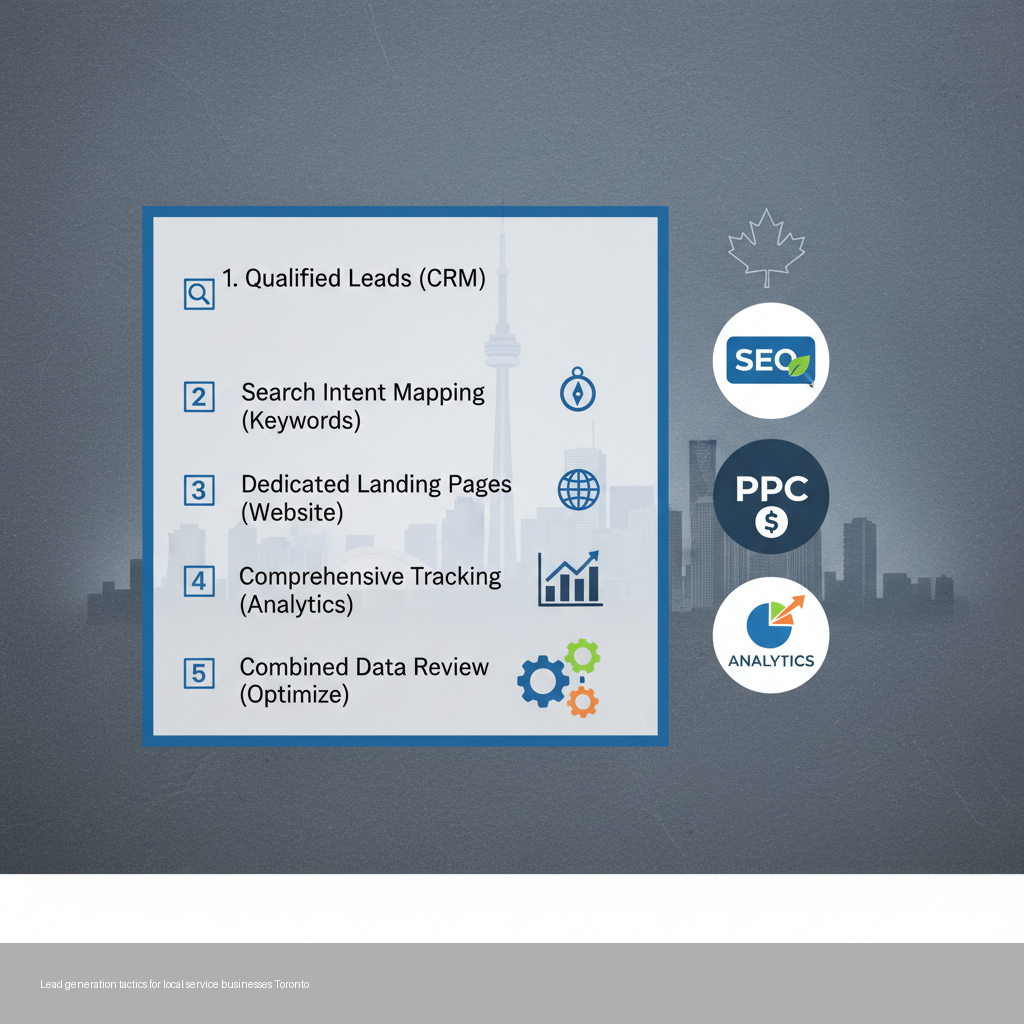
Lead generation tactics for local service businesses Toronto should connect search visibility, paid traffic, landing pages, conversion tracking, and follow-up into one accountable system. For service businesses in Toronto, Ontario, the practical goal is not more traffic by itself; the goal is more qualified calls, form submissions, booked consultations, and repeatable sales conversations from people who are ready to act.
A plumbing company, clinic, renovation contractor, law firm, cleaning company, or professional service provider can waste budget quickly if every channel is managed separately. Search engine optimization may bring strong long-term visibility, while Google Ads can create faster demand capture. The gains usually come from making the channels work together: search terms, service-area pages, Google Business Profile signals, landing page testing, and clear analytics.
Zigma Internet Marketing helps Toronto and GTA service businesses build lead systems across Digital Marketing Services, SEO, PPC, web development, content, and reporting. The focus is practical: measure calls and forms, improve lead quality, and reduce wasted spend where the data shows friction.
Quick Facts: Lead Generation in Toronto, Ontario
The short version, in plain terms.
- What: A lead generation system combines search visibility, paid ads, landing pages, call tracking, form tracking, and follow-up quality.
- Who: Local service businesses with defined service areas, repeatable service categories, and sales teams that can respond quickly to enquiries.
- Where: Toronto neighbourhoods and commercial hubs such as North York, Scarborough, Etobicoke, Downtown Toronto, and nearby GTA communities.
- How: SEO, Google Ads, Google Business Profile work, CRO, technical fixes, and reporting dashboards all support the same acquisition goal.
- Why: Better lead tracking helps owners compare channels by booked jobs, qualified calls, cost per lead, close rate, and revenue contribution.
Lead generation tactics for local service businesses Toronto owners can prioritize
The strongest lead generation plan usually starts with buyer intent. A person searching for emergency repair, legal consultation, home renovation, dental service, or B2B support is already signalling a need. Search campaigns and local SEO can capture that demand, but only if the message, page content, tracking, and response process match the searcher’s situation.
For example, a Toronto contractor may rank for a service keyword but still receive weak enquiries if the page does not show service-area details, project examples, trust signals, and a clear form. A professional service firm may have strong content but no call tracking, making it difficult to identify which pages actually produce revenue conversations. A clinic may run paid ads but send all traffic to a generic homepage, which often reduces enquiry quality.
The core channels are straightforward: organic search, paid search, local map visibility, conversion-focused website pages, retargeting, email follow-up, and referral prompts. The skill is in sequencing them. A business with poor tracking should fix analytics before scaling spend. A business with weak local visibility should strengthen service pages and Google Business Profile assets before expecting map-pack growth.
For long-term visibility, SEO Services can support service-area pages, technical crawlability, content depth, and authority signals. For faster demand capture, Google Ads Management can help test keywords, landing pages, locations, and lead quality before expanding budgets.
How Toronto, Ontario service buyers search before they call
Toronto buyers often compare several businesses before sending a form or making a call. They may search by neighbourhood, urgency, service type, review quality, pricing language, credentials, or availability. A person in Liberty Village may use different wording than a homeowner in Scarborough or a business owner near Yonge and Eglinton, even if the service need is similar.
That local behaviour changes how content and ads should be built. A single generic service page may miss neighbourhood intent, while a page with local proof, clear service coverage, and relevant FAQs can better match how people evaluate providers. The same principle applies to paid search: Toronto traffic can be expensive when campaigns target broad terms without negative keywords, geo controls, and landing page alignment.
Local SEO also needs more than citations. Effective google business profile optimization includes accurate categories, service descriptions, photos, posts, review response patterns, booking links where relevant, and consistent NAP details. For service businesses across the GTA, local seo gta work should also connect the website, Google Business Profile, reviews, and location signals so search engines can understand where the business operates.
SEO, PPC, and CRO work differently for local leads
Lead generation improves when each channel has a defined role. SEO builds durable visibility for services, questions, and locations. PPC captures high-intent searches quickly and gives faster data about which queries convert. CRO turns more visits into enquiries by reducing friction on forms, service pages, calls to action, and mobile layouts.
A useful comparison is long-term infrastructure versus controlled testing. SEO is like building a stronger storefront on a busy street: visibility can compound, but the work takes time and must be maintained. PPC is closer to renting traffic with strict controls: it can produce fast signal, but weak targeting or landing pages can drain budget. CRO sits between both because every channel benefits when the website is easier to use.
Organic search versus paid search
A) SEO-led growth: This route focuses on rankings, local visibility, service pages, content quality, site structure, and technical health.
- How it works: Search engines crawl pages, compare relevance and trust signals, and display pages for service and location searches.
- Strong fit: Businesses that want durable visibility across multiple services and neighbourhoods usually benefit from sustained SEO work.
- Example: A renovation company may build pages for kitchen renovations, basement renovations, and bathroom renovations in Toronto.
B) PPC-led growth: This route uses paid search ads to reach people who are actively searching for a service right now.
- How it works: Campaigns target keywords, locations, ad schedules, devices, and landing pages while tracking calls and forms.
- Strong fit: Businesses with urgent services, seasonal demand, or new service areas can use PPC to test demand faster.
- Example: An HVAC company may run ads for furnace repair during cold weeks while monitoring booked calls by postal code.
C) Combined search growth: This route uses paid and organic data together instead of treating them as separate campaigns.
- How it works: PPC query data can guide SEO pages, while organic winners can reduce reliance on expensive paid clicks.
- Strong fit: Service businesses with multiple lead sources often gain clearer insight from a combined reporting view.
- Example: A legal firm may use paid search for competitive terms while building organic pages for specific practice areas.
How to choose a digital marketing partner for leads
A service business should evaluate an agency by how well it connects strategy to real enquiries. Rankings, impressions, clicks, and traffic are useful diagnostic signals, but they are not the final business outcome. The stronger conversation is about qualified calls, form completions, booked appointments, sales quality, and which channels contribute to revenue.
If a company is comparing digital marketing toronto providers, the most useful questions are practical. Who owns the tracking setup? How are calls classified? How are poor-quality queries removed from campaigns? How often are landing pages tested? Does reporting separate lead volume from lead quality?
A capable digital marketing agency toronto should be comfortable discussing both channel execution and sales follow-up. A missed call, slow reply, unclear form, or weak intake script can reduce the value of a strong campaign. Marketing data becomes far more useful when the business can see where the lead came from and whether the lead turned into a real sales conversation.
Agency evaluation signals
- Tracking setup: The agency should configure GA4, Google Tag Manager, call tracking, form tracking, and conversion events before judging campaign quality.
- Channel clarity: SEO, PPC, social ads, content, and web design should each have a purpose instead of competing for credit.
- Lead quality review: Reporting should identify spam, irrelevant queries, duplicate submissions, missed calls, and low-intent traffic.
- Website accountability: The agency should connect campaign performance to page speed, mobile UX, service copy, forms, and landing page layout.
- Plain reporting: Owners should understand what changed, why it changed, and which decision comes next.
What affects ROI in modern digital campaigns
Campaign ROI is shaped by more than ad spend or ranking position. A service business can generate the same number of leads as a competitor and still produce weaker revenue if the leads are poorly qualified, sales response is slow, or the website attracts the wrong service category. The quality of the entire path matters: search term, ad or snippet, landing page, form, phone call, follow-up, and close.
For online marketing toronto, local competition adds another layer. Some service categories have dense advertiser activity, strong review profiles, and highly specific neighbourhood searches. A broad campaign that ignores geography may bring traffic from areas the business does not serve well, while a tight campaign can prioritize higher-value service zones and realistic capacity.
Common ROI drivers include:
- Search intent: A query such as “emergency drain repair Toronto” usually signals more urgency than a broad research query about plumbing materials.
- Landing page relevance: A dedicated service page usually converts better than a generic homepage when the visitor has a specific problem.
- Lead response time: A qualified enquiry loses value if the business misses the call or replies after the buyer has contacted competitors.
- Tracking accuracy: Decisions improve when calls, forms, booked appointments, and sales outcomes are connected inside a dashboard.
- Offer clarity: Service scope, service areas, credentials, reviews, and next steps reduce hesitation before a visitor reaches out.
SEO vs PPC: when each strategy fits
SEO and PPC solve different timing problems. A business that needs faster data may use paid search to test service demand, ad copy, landing page claims, and conversion rates. A business that wants stronger long-term visibility needs organic assets: service pages, technical structure, internal links, content, local relevance, and authority signals.
A seo company toronto should be able to explain how organic search supports lead flow, not just rankings. Effective seo services toronto usually include technical audits, local landing pages, content planning, internal linking, Google Business Profile alignment, and reporting that connects organic traffic to leads.
Paid search requires a different discipline. google ads management toronto should include search term review, negative keywords, conversion tracking, device and location analysis, ad testing, landing page feedback, and budget pacing. A ppc agency toronto that does not review lead quality may increase form volume while quietly lowering sales efficiency.
Practical comparison
SEO is stronger for compounding visibility across service categories and locations.
PPC is stronger for testing demand quickly and reaching urgent buyers.
CRO improves both channels because the website turns more qualified visits into enquiries.
The stronger plan uses each channel for the problem it solves best.
How local Toronto businesses can compete online
Toronto service businesses compete against national brands, franchise locations, directories, marketplace platforms, and well-established local companies. Smaller businesses can still compete by being more specific. A tightly written service page for a defined neighbourhood, supported by reviews, photos, clear service scope, and fast mobile UX, can outperform a generic page that says very little.
Neighbourhood relevance should feel useful rather than decorative. A moving company serving condos near CityPlace has different proof needs than a contractor working in detached homes in Leaside or a clinic serving patients near North York Centre. Service pages should answer the questions those buyers actually have: availability, travel area, project type, credentials, intake process, and what happens after the enquiry.
A marketing agency gta can help translate those local details into structure across search pages, ads, and reporting. For businesses that need a stronger website foundation, Website Design & Development can connect design, development, technical SEO, and conversion planning in one build.
Competitive moves that are realistic
- Build service pages around real buyer intent: Each page should address one service, one main audience need, and the local details that affect the decision.
- Strengthen Google Business Profile activity: Photos, services, posts, review responses, and accurate categories help reinforce local relevance.
- Improve mobile conversion paths: Phone links, short forms, clear service descriptions, and fast loading pages reduce friction for busy buyers.
- Use content to answer sales objections: Comparison pages, process pages, and FAQ content can reduce repetitive sales calls and improve lead readiness.
- Review data monthly: Query reports, call recordings, lead notes, and conversion paths show where budget or SEO effort should shift.
Website and tracking fixes that raise lead quality
A campaign can only perform as well as the page and tracking behind it. For service businesses, website design toronto should not be judged only by appearance. A high-performing site needs fast pages, clear navigation, service-specific copy, visible trust signals, accessible forms, click-to-call functionality, and analytics that show which pages create real enquiries.
conversion rate optimization toronto work usually starts with friction. Are forms too long? Is the call button hard to find on mobile? Does the page answer the visitor’s concern before asking for personal details? Are reviews placed near the decision point? Those small page changes can affect lead flow without adding more traffic.
technical seo services also support lead generation because search engines and visitors both need a stable site. Crawl errors, slow templates, duplicate pages, poor internal links, missing schema, and weak mobile layouts can reduce visibility and conversions at the same time. A technical fix may not look dramatic, but it can remove barriers that prevent strong content from being found and used.
Content and social channels can support search demand
content marketing toronto should answer the questions buyers ask before they contact a service provider. Those questions may involve cost drivers, timelines, warranties, eligibility, process, neighbourhood coverage, preparation steps, or how to compare providers. Strong content can also support sales teams by giving prospects a useful page to review before a consultation.
Social media can play a supporting role, especially for remarketing, visual proof, seasonal reminders, before-and-after content, and community credibility. Organic social rarely replaces search demand for high-intent service leads, but it can reinforce trust after a person has already seen the business in Google Search or Maps.
The most useful content plan is built from real sales conversations. If prospects keep asking the same question before booking, that question may deserve a page, section, short video, ad asset, or email response. Search data tells you what people type; sales data tells you what people need to believe before they move forward.
A practical lead generation checklist
Step 1: Define qualified leads before increasing traffic
A qualified lead should match your service area, service category, budget expectations, urgency, and capacity. Without that definition, campaign reports can reward volume while the sales team deals with poor-fit enquiries. This step helps align marketing with sales so you can judge lead quality instead of counting every form as equal.
Metric to review: Qualified calls, qualified forms, booked appointments, and closed revenue by channel.
Risk if skipped: Campaigns may appear healthy while staff spend time on low-value or irrelevant enquiries.
Example: A home service company may classify leads by emergency repair, planned project, warranty question, and outside-service-area request.
Step 2: Map services to search intent
Each main service should have a page that matches how buyers search and decide. A single page listing every service often fails because it does not answer specific questions deeply enough. This step helps improve relevance so you can match urgent, research, and comparison searches with the right page.
Metric to review: Organic landing page conversions, query relevance, and assisted conversions.
Risk if skipped: Search engines may struggle to understand the page, and visitors may leave before finding the service they need.
Example: A clinic may separate pages for family dentistry, emergency dentistry, cosmetic dentistry, and Invisalign rather than using one generic services page.
Step 3: Build landing pages for paid traffic
Paid search traffic should usually land on a page that mirrors the ad, keyword, service, and location. Sending every visitor to a homepage creates extra work for the buyer and can weaken conversion rates. This step helps reduce wasted clicks so you can judge campaigns by enquiry quality.
Metric to review: Conversion rate, cost per qualified lead, search term quality, and form completion rate.
Risk if skipped: Budget may go toward visitors who clicked with intent but left because the page did not match the promise of the ad.
Example: A locksmith campaign for car key replacement should land on a car key page, not a general locksmith homepage.
Step 4: Track every meaningful conversion
Calls, forms, chat leads, booking clicks, quote requests, and email clicks should be measured with clear event names. Tracking should also separate first-time enquiries from internal clicks, spam, and duplicate submissions. This step helps create trustworthy reporting so you can shift spend and SEO effort with more confidence.
Metric to review: Conversion source, lead status, missed calls, repeat leads, and channel-assisted conversions.
Risk if skipped: The business may invest in channels that generate activity without producing qualified conversations.
Example: A B2B service firm may track consultation requests separately from newsletter signups because the sales value is different.
Step 5: Review search terms and lead notes together
Search term reports show what people typed before clicking, while lead notes show whether those people were actually a fit. Reviewing both data sources together prevents overreacting to surface metrics. This step helps improve targeting so you can cut irrelevant traffic and strengthen the terms that produce real prospects.
Metric to review: Negative keyword impact, qualified lead rate, booked-call rate, and sales feedback by campaign.
Risk if skipped: Campaigns can keep paying for irrelevant searches because the ad platform sees a conversion even when sales rejects the lead.
Example: A cleaning company may block job-seeker searches if the campaign is meant to attract commercial cleaning clients.
Honest insights from local lead generation work
Lead generation problems often hide in the handoff between marketing and operations. A campaign may bring the right person to the site, but the enquiry can still fail because the phone is unanswered, the intake form is confusing, the response is slow, or the business does not record the outcome. Better marketing cannot fully compensate for a weak sales process.
Another common issue is channel bias. A business may prefer SEO because clicks feel free, or prefer PPC because reports appear faster. Both views are incomplete. Organic traffic still requires labour, technical work, and content investment; paid traffic still requires landing pages, tracking, and ongoing review. The better question is: which channel can produce the most useful next signal?
In Zigma Internet Marketing’s project work, the most useful conversations often happen after tracking is cleaned up. Once the team can see which enquiries are qualified, it becomes easier to refine keywords, rewrite pages, add negative keywords, improve forms, and adjust service-area targeting. Clear measurement turns marketing from opinion into a repeatable management process.
How to trust lead generation tactics for local service businesses Toronto campaigns
Trust comes from seeing how the work is planned, measured, and improved. Zigma Internet Marketing is a Google Partner-certified agency serving Toronto and the GTA from the Markham area, with delivery across SEO, PPC, web design and development, content, social media, analytics, dashboards, and conversion rate optimization. For questions about lead tracking, campaign structure, or service-area growth, you can reach the team at (647) 556-6071 or info@zigma.ca.
The most useful first step is a clear review of where leads currently come from, which leads are worth pursuing, and where tracking may be hiding waste. That conversation should cover SEO, PPC, landing pages, Google Business Profile, website performance, and sales follow-up without forcing a channel before the data is understood.
Request a lead generation strategy review
Zigma Internet Marketing can review your Toronto service-area visibility, paid search structure, landing pages, and conversion tracking so your next campaign decision is based on clearer data.
FAQs About lead generation tactics for local service businesses toronto
Lead quality can improve quickly when tracking, landing pages, and paid search targeting are fixed first. Organic search improvements usually take longer because search engines need time to crawl, compare, and reassess pages. In Toronto, Ontario, competition level and service category both affect timing.
Start with tracking if lead sources are unclear. After tracking is reliable, compare SEO, Google Ads, Google Business Profile, website conversion paths, and follow-up speed. The first channel to improve should be the one with the clearest link to qualified enquiries and sales conversations.
Google Ads can work for smaller Toronto service businesses when campaigns are tightly controlled by location, search intent, negative keywords, ad schedule, and landing page relevance. Broad campaigns can waste budget quickly, especially in competitive service categories with high buyer urgency.
Google Business Profile supports local trust and map visibility through categories, services, reviews, photos, posts, accurate contact details, and location relevance. For service businesses, the profile should match the website’s service areas and give searchers enough confidence to call or visit the site.
Compare qualified call rate, form quality, booked appointments, missed calls, spam submissions, close rate, and revenue by source. Lead volume alone can be misleading. A smaller number of qualified enquiries can be more valuable than a larger number of weak or irrelevant contacts.
Related Topics:

