


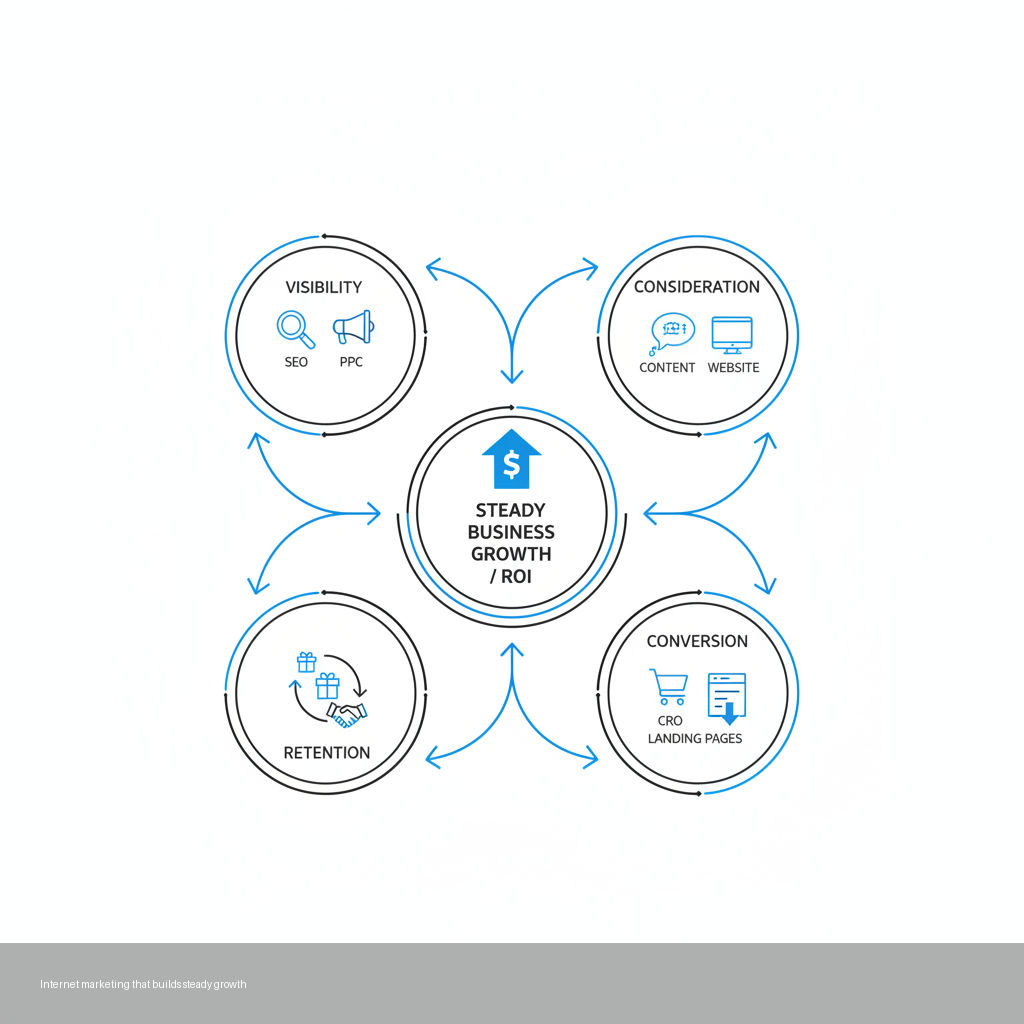
Internet marketing that builds steady growth
Why internet marketing still shapes how businesses grow
Internet marketing is the coordinated use of search, paid ads, websites, content, email, and social platforms to attract attention, generate leads, and turn interest into revenue. For most businesses, it is no longer a side channel. It is the place where buyers compare providers, check credibility, and decide whether to call, submit a form, or move on.
Good internet marketing is not about being visible everywhere at once. It is about showing up in the right places with the right message and a clear next step. A business that invests in Digital Marketing Services usually gets better results when strategy, tracking, creative, and conversion all work together instead of being handled in isolation.
That is also where many campaigns break down. Traffic can rise while lead quality falls. Ad spend can increase while enquiries stay flat. A polished site can still underperform if search intent, page speed, and offer clarity do not line up. The sections below break down how internet marketing works in practice and what to look for if you want it to support real business growth.
How internet marketing works across the full customer journey
At its core, internet marketing connects four stages: visibility, consideration, conversion, and retention. Visibility comes from channels such as search engine optimization, Google Ads, local listings, and social media marketing. Consideration depends on trust signals, clear positioning, useful content, and a site that makes comparison easy. Conversion happens when landing pages, offers, and calls to action remove friction. Retention improves when follow-up, remarketing, and customer experience stay consistent after the first sale.
Many business owners think of internet marketing as a single tactic, but it is really a system. A campaign can include SEO Services for long-term visibility, Google Ads Management for immediate demand capture, content marketing to educate prospects, and technical improvements that help a website convert more of the traffic it already gets.
That system works best when each channel has a job. SEO supports durable reach. PPC helps test intent and generate faster lead flow. Website design and development affect trust, speed, and usability. Conversion rate optimization improves the percentage of visitors who take action. Analytics and tracking tie everything back to outcomes so decisions are based on evidence, not guesswork.
Which internet marketing channels usually drive the strongest results
No single channel wins in every situation. The best mix depends on sales cycle length, competition, average order value, and how prospects prefer to buy. A local service business often gets strong returns from local SEO, Google Business Profile optimization, and lead generation ads. An e-commerce brand may need product feed optimization, paid search, remarketing, and stronger category-page SEO. A B2B firm often needs content strategy, technical SEO services, and landing pages built around high-intent queries.
In practice, the strongest internet marketing mix often looks like this:
- SEO and local SEO: Best for building sustained visibility, especially for searches with clear buying intent. This includes technical SEO, on-page content, local SEO GTA targeting, and Google Business Profile optimization.
- PPC and SEM: Useful when speed matters or when you need more control over budget, keywords, and testing. This is where a solid ppc agency toronto or google ads management toronto service can make a measurable difference.
- Website and landing page work: Traffic quality means little if pages are slow, confusing, or weak on trust. Website design toronto and conversion rate optimization toronto efforts often improve performance without increasing traffic.
- Content and social: Content marketing toronto campaigns and social media marketing help businesses stay visible during longer decision cycles and create more entry points into the funnel.
- Analytics and tracking: Conversion tracking, dashboards, and platform setup reveal which campaigns are producing calls, forms, and sales rather than just impressions or clicks.
What separates effective internet marketing from activity that just looks busy
The difference usually comes down to alignment. Effective internet marketing aligns traffic source, search intent, message, and landing page experience. Weak campaigns often fail because one of those pieces is missing. For example, a company can rank well for broad informational queries yet attract visitors who were never ready to buy. Another business may run paid campaigns with decent click-through rates, but if the landing page answers the wrong questions, conversions stay low.
There is also a reporting gap in many campaigns. Metrics such as impressions, followers, and sessions can be useful, but they are not enough on their own. A business needs to know which keywords lead to qualified calls, which ads produce profitable enquiries, and which pages support sales rather than simply attract traffic.
Teams that work across SEO, PPC, CRO, web development, and reporting tend to catch these gaps earlier. That is one reason many companies prefer a single digital marketing agency toronto partner rather than splitting work across disconnected vendors.
How to choose the right digital marketing agency
Choosing an agency should feel less like hiring a vendor and more like evaluating an operating partner. The right team should be able to explain how they think, what they measure, and what they will change during the first few months. If the conversation stays vague, results usually do too.
A useful test is to ask simple but revealing questions. What does success look like in the first ninety days? Which channels deserve priority first? How will lead quality be measured? What changes will happen on the website, in ad accounts, and in tracking? A credible answer will sound specific and grounded rather than overly polished.
Businesses comparing an online marketing toronto provider should also pay attention to implementation depth. Strategy alone is not enough. Strong agencies can handle technical SEO, ad structure, conversion tracking, landing pages, and ongoing optimisation without passing core work to too many external contractors.
What to check before choosing a partner
- Channel depth: Make sure the agency can support SEO, PPC, CRO, web, and reporting if your growth plan depends on more than one channel.
- Measurement standards: Ask how calls, forms, booked meetings, and sales are tracked. If tracking is weak, performance discussions will stay subjective.
- Decision process: A good marketing agency gta team should explain how they prioritise fixes, tests, and budget shifts.
- Fit with your business model: A lead generation agency toronto may suit local services, while an e-commerce brand may need stronger feed management and merchandising support.
- Communication style: Clear reporting and straightforward language are often better signs than flashy dashboards alone.
What impacts ROI in modern digital campaigns
Return from internet marketing usually depends on a few connected factors: demand quality, message accuracy, landing page clarity, conversion friction, and tracking accuracy. Businesses often focus on channel selection first, but ROI is shaped just as much by what happens after the click.
A simple example: two companies may run similar paid search campaigns. One sends users to a generic services page. The other sends them to a focused landing page with a clear headline, supporting proof, concise form, and strong mobile performance. The second campaign often converts more efficiently even if click costs are similar.
Another major factor is attribution. If calls are not tracked properly or form submissions are not tied back to source campaigns, budget decisions become less reliable. Internet marketing performs better when teams can connect spend to outcomes, then adjust bids, creative, content, and page structure accordingly.
Five common ROI levers
- Keyword intent: High-intent searches usually outperform broad awareness terms when lead generation is the goal.
- Landing page quality: Faster load times, clearer copy, and stronger UX often lift conversion rates more than extra traffic does.
- Offer strength: A weak consultation offer or vague value proposition limits otherwise strong campaigns.
- Tracking quality: Better GA4 setup, Google Tag Manager, and conversion tracking create cleaner decisions.
- Optimisation cadence: Campaigns improve when teams test, measure, and refine on a steady cycle instead of making one-time changes.
SEO vs PPC: when each internet marketing strategy fits best
SEO and PPC are often treated like competing choices, but they serve different timing needs. SEO usually builds momentum over time. PPC can create visibility faster and gives tighter control over queries, budget, and testing. The real question is not which channel is better in theory. It is which channel fits your sales goals, timeline, and level of competition right now.
If a business needs near-term lead flow, PPC often makes sense first. If the business wants lower dependency on paid traffic over time, SEO becomes increasingly important. For many brands, the better approach is phased coordination: use PPC to capture immediate demand and generate insight, then use that data to strengthen long-term search engine optimization and content priorities.
A practical side-by-side view
- Use SEO first: If you want compounding visibility, stronger non-paid lead flow, and authority around service terms such as seo company toronto or seo services toronto.
- Use PPC first: If timing is urgent, rankings are weak, or you need faster testing around offers and keyword intent.
- Use both together: If you want to cover branded, local, and high-intent search demand while also building long-term resilience.
- Be cautious with either: If conversion tracking is incomplete or your website still creates friction after the click.
How local businesses can compete online without matching big-brand budgets
Local businesses rarely need to outspend large competitors across every platform. They need to be more precise. Internet marketing gives smaller businesses an advantage when campaigns focus on local intent, tighter service pages, stronger reviews, clearer local trust signals, and faster follow-up on leads.
A business serving a defined area can often win by narrowing its targeting and sharpening its offer. That may mean improving local landing pages, building content around service-specific searches, strengthening google business profile optimization, or tightening paid campaigns around high-conversion terms rather than broad traffic.
Smaller companies also tend to benefit more from operational responsiveness. If lead handling is fast, landing pages are focused, and the site clearly explains service fit, a smaller advertiser can outperform a larger one with a less disciplined funnel.
Where smaller businesses often gain ground
- Local intent coverage: Build pages and campaigns around specific services, not just broad brand terms.
- Website clarity: Explain who you serve, what you do, and what the next step looks like without making users dig.
- Review and trust signals: Social proof, transparent contact information, and service detail reduce hesitation.
- Lead handling: Quick follow-up can turn the same traffic into more revenue.
- Focused testing: Small gains in forms, calls, or booked consultations often have a meaningful impact on total performance.
Practical signs your internet marketing needs attention
Some problems are easy to spot. Traffic falls, cost per lead rises, or form volume slows. Others are quieter. Sales says leads are weak. Paid campaigns generate clicks but little pipeline. Organic traffic grows, but enquiries do not. A website redesign launches, then search visibility slips because technical details were missed.
Those patterns usually point to one of a few issues: weak targeting, poor tracking, mismatched landing pages, technical SEO gaps, or insufficient conversion work. If you are not sure where the bottleneck sits, start by asking two questions. Which channels are driving qualified actions? And where do prospects lose confidence before they contact you?
Clear answers to those questions often reveal the highest-impact next step faster than another broad campaign expansion would.
Where Zigma Internet Marketing fits into that picture
Zigma Internet Marketing works with businesses that need internet marketing tied to lead generation, measurable growth, and ongoing performance improvement. The team supports SEO, PPC/SEM, landing pages, WordPress and Shopify websites, content strategy, social media marketing, technical SEO, and reporting. That mix is useful for businesses that want fewer disconnects between traffic, website experience, and conversion performance.
For companies that need support across more than one channel, integrated execution often reduces waste. Search campaigns can inform content. Content can support local SEO. Website development can remove friction that hurts paid and organic performance alike. Reporting can then connect those efforts back to calls, forms, and sales rather than surface-level activity.
Zigma also brings practical trust signals that many businesses value in a partner: Google Partner-certified expertise, end-to-end implementation support, KPI-focused reporting, and experience across both local lead generation and e-commerce growth. If you want a clearer view of what would actually improve performance, 📩 Ask an SEO/PPC question.
FAQs About internet marketing
PPC can generate usable data and enquiries relatively quickly if tracking and landing pages are already in place. SEO usually takes longer because visibility builds over time. The timing depends on competition, website condition, budget, and how quickly changes are implemented.
No. Internet marketing includes paid ads, but it also covers SEO, content, social media marketing, website improvements, email, analytics, and conversion work. Ads can create demand capture fast, while the other pieces improve long-term efficiency and conversion quality.
Start with qualified conversions: calls, form submissions, booked consultations, online sales, or other actions tied to revenue. After that, review lead quality, conversion rate, source performance, and landing-page behaviour. Sessions and impressions help with context, but they should not be the main scorecard.
They support different goals. SEO is usually better for compounding visibility over time. Google Ads is useful when a business needs faster testing or near-term lead flow. Many companies get stronger results when both channels are coordinated instead of treated as replacements for each other.
Underperformance often comes from mismatched targeting, weak landing pages, poor conversion tracking, unclear offers, or slow follow-up after a lead comes in. Sometimes the channel is not the problem at all. The real issue sits between the click and the sales process.
Key takeaways before you invest further
Internet marketing works best as a connected system, not a collection of disconnected tactics. Search visibility, paid acquisition, website experience, and conversion tracking all influence whether growth is steady or inconsistent. If results feel unclear, the most useful next step is usually an honest review of channel fit, landing-page performance, and measurement quality. That tends to reveal whether you need stronger SEO, better PPC structure, improved CRO, cleaner analytics, or a more coordinated strategy overall.

