


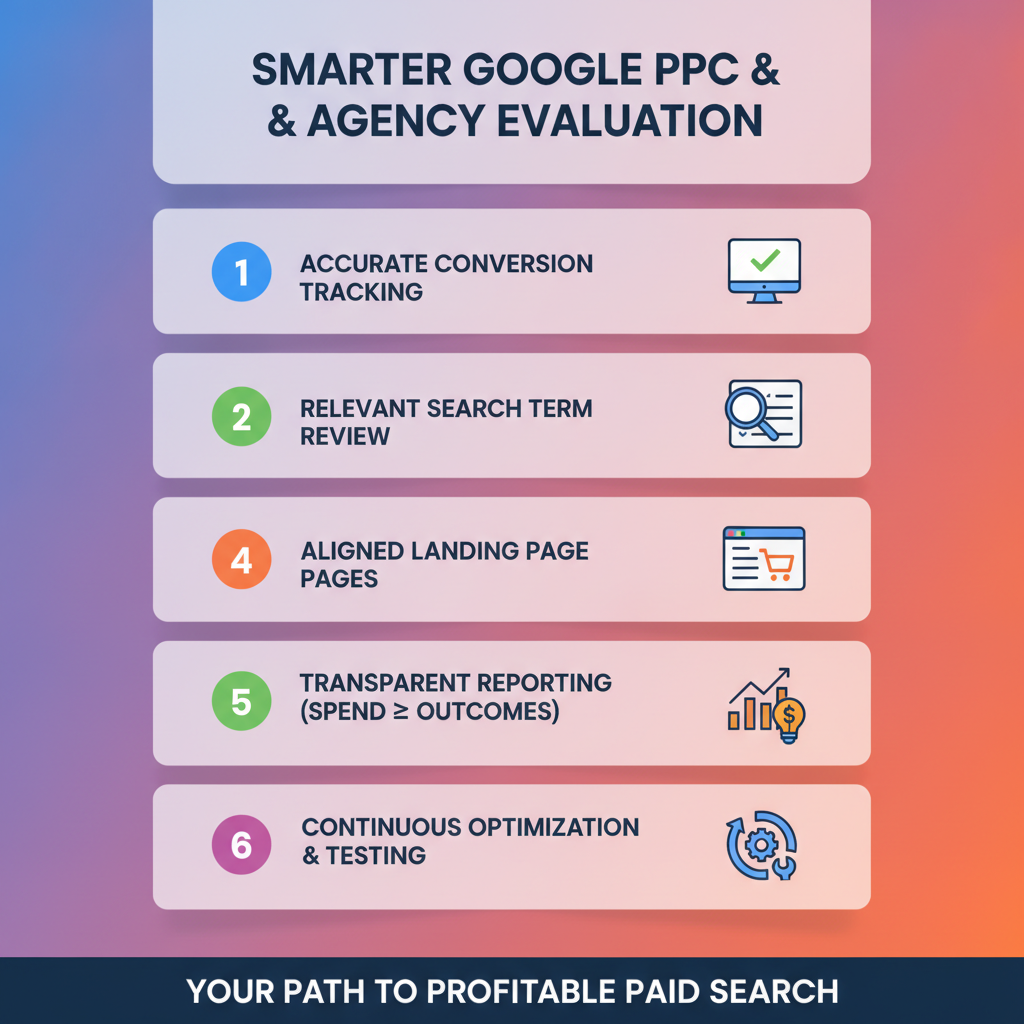
A Google PPC agency manages paid search campaigns so a business can reach people who are actively searching for products or services, then measure whether those clicks turn into calls, forms, purchases, or qualified leads. The work includes keyword research, bidding, ad copy, landing page alignment, conversion tracking, negative keywords, reporting, and ongoing campaign refinement. A strong agency should not treat ad spend as the only lever; the quality of the traffic, the page experience, and the tracking setup often shape whether paid search becomes profitable or wasteful.
For many business owners, Google Ads feels simple at first: choose keywords, write ads, set a budget, and wait for inquiries. The harder part starts after launch. Which search terms are attracting poor-fit clicks? Which landing pages are turning visitors away? Are form submissions being tracked correctly, or is the campaign reporting partial data? These are the questions that separate casual campaign management from accountable PPC work.
Zigma Internet Marketing supports paid search through strategy, implementation, landing pages, conversion tracking, and reporting. For readers comparing PPC support with broader digital strategy, Zigma’s Google Ads Management service page gives additional context on campaign execution.
How a google ppc agency manages paid search from click to conversion
A google ppc agency handles the full chain between a search query and a business outcome. The search query reveals intent, the ad earns the click, the landing page carries the message forward, and the tracking system confirms whether the visit produced value. If any part of that chain is weak, the account may spend money without producing useful data or qualified inquiries.
The core work begins with account structure. Campaigns are grouped by theme, service, product, match type, intent level, or funnel stage. A messy account often hides waste because strong and weak terms sit together in the same budget pool. A cleaner structure helps a manager see which themes deserve more attention and which search patterns need to be restricted.
Tracking is equally critical. Google Ads can report clicks and impressions by default, but business owners usually need deeper signals: phone calls, contact forms, purchases, qualified lead status, booked appointments, or revenue from e-commerce orders. Without that setup, a campaign may appear active while leaving the most useful performance questions unanswered. Zigma often connects PPC with analytics, dashboards, landing pages, and SEO Services so paid and organic channels can be evaluated together rather than in isolation.
Where Google PPC work often goes wrong
Paid search problems are not always caused by the ad platform itself. Poor campaign performance can come from weak tracking, broad targeting, thin landing pages, unclear offers, slow load times, unqualified search terms, or follow-up gaps after a lead arrives. A campaign can generate clicks and still fail commercially if the visitor experience does not match the promise made in the ad.
Common issues include:
- Too much reliance on broad matching: Broad match can find new search patterns, but it needs strong negative keywords, conversion signals, and close review. Without those controls, budget can drift toward vague or low-intent traffic.
- Conversion tracking that misses key actions: If phone calls, forms, purchases, or lead quality milestones are not tracked correctly, decisions are made from partial evidence.
- Landing pages that repeat the homepage: A visitor who clicked a specific ad often expects a focused page with a clear next step, relevant proof, and minimal distractions.
- Ad copy that attracts curiosity instead of intent: Click volume looks good in reports, but low-fit traffic can raise spend without improving sales conversations.
- Reporting that stops at clicks: Useful reporting connects spend to outcomes such as qualified leads, sales, cost per lead, conversion rate, search term quality, and return on ad spend where revenue data is available.
The practical takeaway is simple: PPC management is not only about launching ads. It is a feedback system. Search terms, conversion data, landing page behaviour, and sales feedback should all influence the next set of campaign changes.
Comparing in-house PPC, freelance support, and agency management
The right PPC support structure depends on how much campaign complexity, reporting depth, landing page work, and tracking discipline a business requires. A fair comparison should look beyond who can set up ads and focus on who can diagnose the full acquisition path.
Campaign ownership and daily execution
A) In-house management: An internal marketer may understand the business closely and communicate quickly with sales or operations. The trade-off is that PPC may compete with many other responsibilities.
- How it works: The business manages Google Ads inside its own team, often alongside email, content, social, or website tasks.
- Best fit: This fits teams with enough ad platform knowledge, analytics access, and time for weekly search term and performance review.
- Example: A company with an internal marketing manager may keep PPC in-house if campaigns are simple and conversion tracking is already reliable.
B) Freelance PPC support: A freelancer can be a good fit for focused campaign builds, audits, or smaller accounts. The main constraint is capacity when the work expands into design, development, tracking, or content.
- How it works: A specialist manages the account and may advise on landing page or tracking changes.
- Best fit: This fits businesses that already have strong web and analytics support elsewhere.
- Example: A business may use a freelancer for search campaign refinement while relying on a developer for landing page edits.
C) Agency management: A PPC agency can connect campaign work with landing pages, analytics, reporting, content, and conversion improvement. The value is strongest when paid search touches multiple parts of the digital funnel.
- How it works: Campaign strategy, tracking, reporting, landing page recommendations, and testing cycles are managed as connected workstreams.
- Best fit: This fits businesses that need accountability across the full path from search query to lead or sale.
- Example: A service business with several lead sources may need dashboards that show which campaigns produce qualified inquiries, not just clicks.
Signals that a google ppc agency is managing for quality
A reliable agency should be able to explain what has changed, why the change was made, and what the next signal will be. Reports should not rely only on impressions, click-through rate, and spend. Those numbers have value, but they do not confirm whether the campaign is creating business activity.
Look for these practical signals:
- Search term discipline: The agency reviews actual queries and adds negative keywords when search behaviour reveals poor-fit traffic.
- Conversion tracking accuracy: Forms, calls, purchases, and key events are tested so reports reflect meaningful actions rather than accidental page visits.
- Landing page alignment: Ads send users to pages that match the keyword theme, intent, and offer rather than defaulting to a generic homepage.
- Budget reasoning: Spend is allocated based on intent, evidence, and account constraints rather than guesswork.
- Clear reporting cadence: Reports explain what happened, what changed, and what will be watched next.
Quality PPC work also includes restraint. Not every keyword deserves a campaign. Not every campaign deserves more budget. Sometimes the correct move is to tighten targeting, repair tracking, simplify the landing page, or pause a segment until the data is cleaner.
How PPC connects with landing pages, SEO, and analytics
Google Ads can bring qualified visitors quickly, but the landing page decides whether those visitors understand the offer and take action. A landing page should usually match the ad’s language, reduce unnecessary navigation, present clear proof, and make the next step easy to complete. If the page loads slowly or asks too much before giving enough context, strong keywords may still underperform.
SEO and PPC can also support each other. PPC data can reveal which search terms produce leads quickly, while SEO can build longer-term visibility around themes that repeatedly show commercial value. The two channels should not be treated as rivals. Paid search can test demand; organic search can build compounding visibility; analytics can show how both channels contribute to lead flow and sales conversations.
For businesses reviewing their broader digital setup, Zigma’s Digital Marketing Services page outlines how PPC, SEO, web development, content, social media, and reporting can work together. If campaign performance is limited by page design or technical issues, Website Design & Development can become part of the PPC improvement plan.
A practical checklist before hiring PPC help
Before hiring a PPC partner, clarify what the business needs from paid search. A company seeking immediate lead volume may need a different setup than an e-commerce brand with product feeds, shopping campaigns, and revenue tracking. A company with unreliable tracking may need measurement repair before campaign scaling makes sense.
Step One: Confirm the conversion actions that count
Decide which actions should be treated as meaningful: phone calls, forms, purchases, demo requests, booked appointments, or qualified lead stages. This step helps remove reporting ambiguity so campaign decisions are based on business signals rather than surface activity.
Watch for: Accounts that count every form interaction or page visit as a conversion can inflate performance.
Useful check: Ask how the agency tests whether conversion tags are firing correctly.
Example: A lead generation campaign should separate a real form submission from a visitor who only clicked a button but did not complete the form.
Step Two: Review search terms, not only keywords
Keywords are the targets chosen in the account; search terms are the real queries people typed before clicking. This step helps reveal whether ads are attracting buyers, researchers, competitors, job seekers, or unrelated traffic.
Watch for: Broad keywords can bring traffic that looks relevant in summary reports but fails when queries are reviewed line by line.
Useful check: Ask how often negative keywords are added and how those decisions are documented.
Example: A campaign targeting a professional service may need to exclude searches tied to free templates, careers, or training if those clicks do not become leads.
Step Three: Match each ad group to a focused landing page
The closer the page matches the searcher’s intent, the easier it is for the visitor to decide whether to continue. This step helps improve conversion rate because the page answers the same need that triggered the click.
Watch for: Sending all ads to the homepage can dilute message match and make reporting harder.
Useful check: Ask whether the agency can recommend landing page changes, not just bid changes.
Example: A campaign for a specific service should usually land on a page that explains that service, shows relevant proof, and presents a clear action path.
Step Four: Ask how reporting connects spend to outcomes
Reporting should show what the account spent, what activity was generated, and which signals suggest quality. This step helps business owners understand whether PPC is improving lead flow, sales quality, or campaign efficiency.
Watch for: Reports that celebrate clicks without explaining lead quality can hide waste.
Useful check: Ask which metrics appear in the dashboard and how often the report leads to account changes.
Example: A useful report may compare campaign spend, conversions, cost per lead, lead source, and follow-up notes from sales.
Step Five: Check whether the agency can support implementation
PPC recommendations often require practical changes in analytics, landing pages, forms, tags, or website speed. This step helps avoid a common bottleneck where good insights sit unused because no one can implement them.
Watch for: An audit that lists problems but does not define who will fix them can stall progress.
Useful check: Ask whether tracking, dashboards, CRO, and landing page updates are available under the same workflow.
Example: If call tracking is missing and the agency can coordinate setup, the business can make better decisions about phone-led campaigns.
What a transparent PPC report should explain
A useful PPC report should answer three plain questions: where did the money go, what did it produce, and what will change next? The report does not need to overwhelm the reader with every platform metric. It should translate campaign activity into decisions a business owner can act on.
Strong reporting often includes:
- Spend and pacing: The report should show whether campaigns are spending as planned and whether budget is being restricted by settings, search demand, or performance limits.
- Conversion quality: The report should separate meaningful actions from weak signals where the data allows that distinction.
- Search term findings: The report should identify useful new queries and wasted patterns that need exclusions or structure changes.
- Landing page behaviour: The report should flag issues such as low engagement, weak form completion, or a mismatch between ad promise and page content.
- Next changes: The report should state what will be adjusted, tested, paused, or monitored before the next review.
For e-commerce campaigns, product feed health, shopping campaign segmentation, return on ad spend, and purchase value become central. For lead generation campaigns, call quality, form quality, follow-up speed, and sales feedback often carry more weight than click volume.
Common PPC myths that lead to poor decisions
Paid search attracts simple explanations, but campaign performance usually comes from several connected variables. Treating one metric as the whole story can lead to aggressive changes that make the account less stable.
- Myth: A higher budget fixes a weak campaign. More spend can amplify a strong structure, but it can also amplify waste if targeting, tracking, or landing pages are flawed.
- Myth: The lowest cost per click is the goal. A cheap click can be expensive if the visitor has little buying intent. A higher-cost click may be reasonable if it produces qualified leads or sales.
- Myth: More keywords produce more growth. More keywords can create noise if the account cannot control search terms, budgets, and conversion paths.
- Myth: Google Ads should be judged without sales feedback. Platform data can show conversions, but sales teams often know whether those leads were serious, reachable, and suitable.
The better question is not “Which metric looks strongest?” A more useful question is, “Which campaign activity is creating the most qualified business conversations, and what evidence supports that?”
Trust signals to expect from a Google Ads partner
Trust in PPC should come from clarity, access, documentation, and disciplined decision-making. A partner should be able to explain account changes in plain language and give the business visibility into the data behind those changes.
Zigma Internet Marketing brings Google Partner-certified expertise, full-service execution across PPC, SEO, web, content, social media, analytics, and practical implementation support. The work is built around measurable outcomes such as calls, forms, sales, lead quality, campaign efficiency, and reporting clarity. For a second set of eyes on your campaigns, you can use Zigma’s 📩 Book a Free Strategy Call.
FAQs About google ppc agency
A PPC agency can usually identify obvious setup issues quickly, such as missing tracking, weak account structure, or irrelevant search terms. Deeper performance judgement takes more campaign data, especially when lead quality, sales cycles, or purchase values need to be reviewed.
A business should keep ownership of its Google Ads, analytics, website, and tracking accounts while granting the agency the access needed to manage campaigns. Account ownership protects continuity if the business changes vendors or brings work in-house later.
PPC can run without a dedicated landing page, but performance may suffer if the destination page is too broad. A focused page often improves message match because it reflects the ad, the search intent, and the action the visitor is expected to take.
Useful PPC metrics include conversions, cost per lead, conversion rate, search term quality, impression share, lead source, call quality, and return on ad spend where revenue tracking is available. Clicks are only the starting point because they do not prove business value on their own.
PPC and SEO should work together when paid search reveals valuable queries that could also support organic visibility. PPC can test intent quickly, while SEO can build longer-term search presence for themes that repeatedly generate qualified leads or sales.
Related Topics:
- Search engine optimization
- Pay per click advertising
- Conversion optimization
- Analytics and tracking setup

