


Why businesses start searching for a google ppc agency
A google ppc agency helps businesses plan, build, manage, and improve paid search campaigns inside Google Ads so ad spend produces more qualified traffic, better leads, and cleaner reporting. For many owners, the real issue is not simply getting ads live. It is knowing whether the account structure, keyword targeting, landing pages, conversion tracking, and bidding strategy are working together well enough to support growth without wasting budget.
That is where professional guidance usually changes the picture. A strong agency does more than launch ads. It reviews search intent, matches campaigns to business goals, filters weak traffic, and uses data to improve results over time. If you also want the long-term visibility that paid media cannot fully replace, it helps to understand how SEO Services and paid search can support each other rather than compete for attention.
Before choosing any provider, it helps to know what a good PPC relationship should actually look like in practice. That starts with the basics: how Google PPC works, where agencies add value, and what separates steady campaign management from expensive guesswork.
What a google ppc agency actually does day to day
A google ppc agency manages pay-per-click advertising on Google, most often through search, display, remarketing, shopping, and video campaign formats. In practical terms, the agency researches queries, groups keywords by intent, writes ad copy, builds or recommends landing pages, sets bidding rules, adds negative keywords, and tracks conversions such as calls, forms, purchases, or booked appointments.
The strongest agencies also handle the less visible work that often decides campaign quality. That includes Google Tag Manager setup, GA4 validation, audience analysis, search term reviews, device adjustments, location settings, and ongoing testing. A business may think the problem is low lead volume, when the deeper issue is broken attribution, weak landing page relevance, or poor alignment between ad copy and the offer. That is why businesses searching for Google Ads Management should ask not only how ads will be run, but also how performance will be measured.
There are common misconceptions here. More clicks do not automatically mean better results. Automated bidding does not fix weak offer positioning. Broad targeting can fill the top of the funnel while quietly lowering lead quality. A good agency sees those trade-offs early and adjusts before wasted spend becomes a pattern.
How businesses can tell whether agency support is the right fit
A google ppc agency is usually the right fit when the business needs more than occasional ad maintenance. That often includes campaigns spread across multiple services, several landing pages, lead generation ads that need close monitoring, or e-commerce advertising that depends on feed quality and conversion data. In those situations, steady optimization tends to outperform sporadic edits.
Agency support also makes sense when the business is balancing paid media with broader digital goals. A company investing in online marketing, local visibility, and conversion improvement may need SEO, landing page refinement, and analytics tied together rather than managed in isolation. That is especially relevant for brands comparing a ppc agency toronto provider, a lead generation agency toronto team, or a full marketing agency gta partner. The better question is not “Do they run ads?” but “Can they connect spend to outcomes?”
On the other hand, not every account needs the same level of support. A narrow campaign with one service line and stable tracking may need lighter management than a multi-service business trying to scale across search engine marketing sem, local SEO gta, and content marketing toronto efforts. Scope should follow business complexity, not agency packaging.
Three comparisons that make agency selection easier
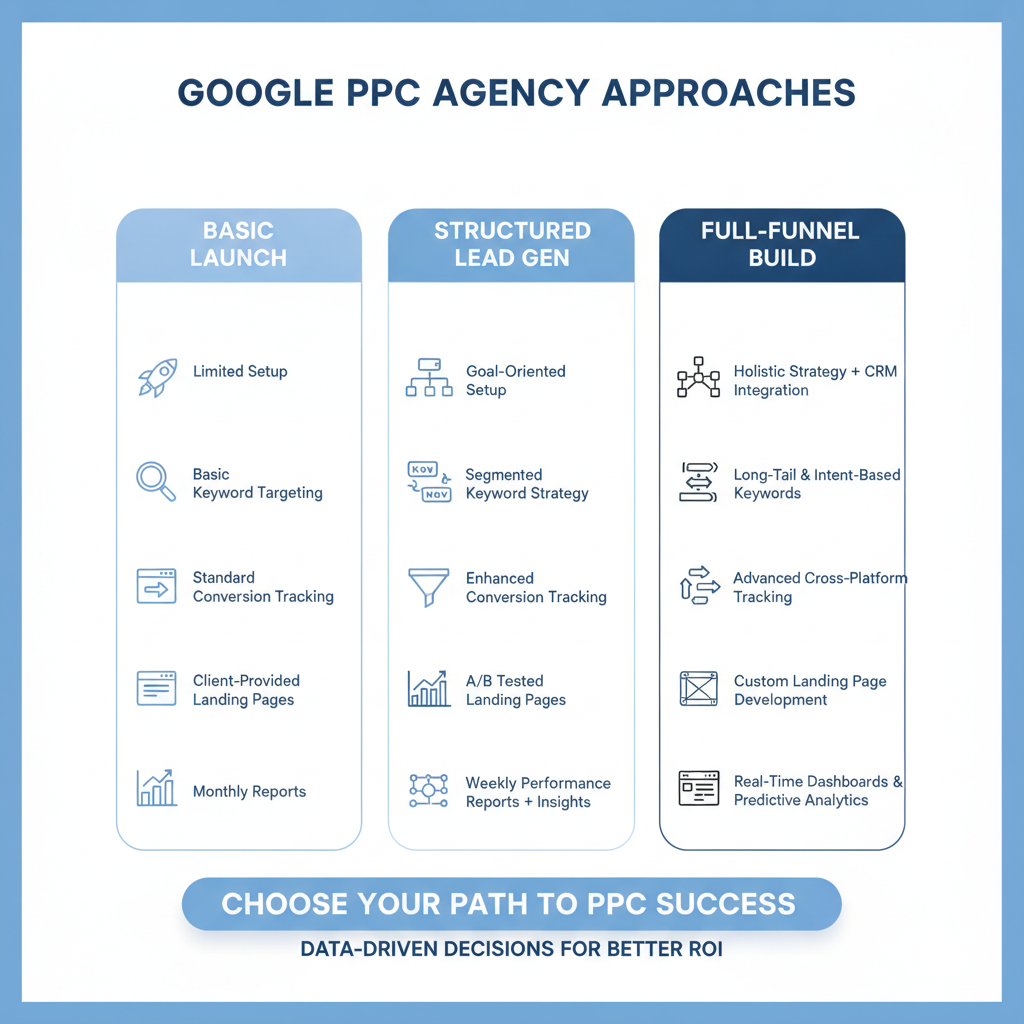
Choosing a google ppc agency gets easier when you compare how different teams handle strategy, execution, and accountability. Most disappointments happen because two providers can both promise campaign management while doing very different levels of work behind the scenes.
Campaign setup depth
A) Basic launch service: This usually gets ads active quickly, but setup is often thin.
- How it works: A small keyword list, limited ad variations, and simple targeting go live with minimal segmentation.
- Best fit: A business testing demand in one narrow service area.
- Example: A single-service advertiser running a small branded and non-branded campaign.
B) Structured lead generation setup: This approach builds campaigns around search intent and conversion paths.
- How it works: Keywords are grouped by service, match type, audience intent, and landing page relevance.
- Best fit: Businesses focused on booked calls, quote requests, or form submissions.
- Example: A service company separating high-intent searches from research-stage traffic.
C) Full-funnel build: This goes beyond search ads and considers the wider buying journey.
- How it works: Search, remarketing, landing pages, and analytics are planned together.
- Best fit: Brands that need both immediate demand capture and ongoing nurture.
- Example: A business combining Google Ads with email follow-up and remarketing audiences.
Optimization style
A) Reactive management: The agency makes edits mainly when results drop.
- How it works: Changes are made after problems become visible in spend or lead volume.
- Best fit: Smaller accounts with stable demand and modest growth goals.
- Example: Monthly bid tweaks with limited testing between reporting cycles.
B) Process-driven optimization: This is usually a healthier long-term model.
- How it works: Search terms, negatives, ad tests, landing page performance, and conversion quality are reviewed on a routine cadence.
- Best fit: Companies that need steady improvement and cleaner acquisition data.
- Example: Weekly search query pruning and monthly landing page refinements.
C) Automation-heavy management: This leans strongly on platform systems and broad inputs.
- How it works: Smart bidding, broad match, and machine learning drive a larger share of decisions.
- Best fit: Accounts with mature conversion tracking and enough data volume to support automation.
- Example: An established e-commerce account using strong product feed and purchase data.
Reporting and accountability
A) Surface-level reporting: Reports focus on clicks, impressions, and spend.
- How it works: The dashboard describes activity but not always business impact.
- Best fit: Early-stage campaigns where the first job is confirming visibility and traffic.
- Example: A report that highlights CTR but says little about lead quality.
B) KPI-linked reporting: This is where a google ads management toronto partner becomes more useful.
- How it works: Spend is tied to conversions, cost per lead, call quality, or sales data where available.
- Best fit: Businesses that need clear budget decisions.
- Example: A dashboard showing which campaigns produce calls and which mostly generate low-value traffic.
C) Business-integrated reporting: This is broader than ad platform reporting alone.
- How it works: Ad data is reviewed alongside CRM, sales, or operational outcomes.
- Best fit: Growth-focused companies that need better forecasting and channel planning.
- Example: A B2B advertiser comparing form volume against closed opportunities rather than just submissions.


What strong PPC management feels like from the client side
The day-to-day experience of working with a capable agency is often calmer and more transparent. You know what is being tested, why certain searches are being excluded, how landing pages are performing, and what numbers actually guide next steps. That reduces the stress of trying to interpret dashboards full of motion but little meaning.
There is also a practical difference between a channel manager and a broader digital marketing agency toronto team. A wider team can often connect paid search with website design toronto work, technical seo services, conversion rate optimization toronto priorities, and google business profile optimization where local demand depends on both ads and organic presence. For some businesses, that integration is the difference between decent ad performance and a healthier acquisition system overall.
A useful comparison is this: paid search can generate demand quickly, while SEO usually compounds over a longer horizon. Businesses that rely only on PPC may buy every visit. Businesses that pair PPC with stronger site structure, content, and local relevance often gain more control over both volume and efficiency over time.
A realistic campaign story that shows where the gains come from
In work like this, the biggest improvements rarely come from one dramatic change. They usually come from several smaller corrections that remove friction. A service-based business with multiple offers, for example, may launch campaigns and still feel disappointed because budget is spread across mixed-intent searches.
One lead generation account we have seen in practice followed a familiar pattern: broad keyword targeting, weak separation between service categories, and landing pages that answered only part of the visitor’s question. Over roughly one to two quarters, performance improved after the campaign structure was tightened, negative keywords were expanded, ad copy reflected clearer service intent, and landing pages were rewritten to match the search more closely.
The observable outcome in cases like that is often less waste before more scale. Clients tend to notice better lead quality first, then steadier conversion rates, and only after that a stronger basis for budget growth. The human part is simple: cleaner accounts create fewer surprises in weekly reviews, which makes decision-making easier for the business owner.
Five checks that help you choose a google ppc agency with fewer regrets
Step 1: Ask how conversion tracking is validated
Tracking is the foundation of every paid decision. If call tracking, form attribution, or purchase tracking is incomplete, the campaign can look healthy while producing weak business results. This step helps protect reporting accuracy so you can make budget decisions on real outcomes instead of assumptions.
What to ask: Which conversions are counted, how they are tested, and how duplicates or low-value actions are filtered.
Why it matters: Weak tracking can hide waste and reward the wrong campaigns.
Example: A campaign reporting strong volume may actually be counting repeat thank-you page visits rather than new leads.
Step 2: Review keyword targeting and negative keyword logic
Keyword lists alone do not tell you much. The real insight comes from how the agency separates high-intent searches from broad research traffic and how often search terms are reviewed. This step helps improve traffic quality so you can spend more of the budget on searches that are likely to convert.
What to ask: How are match types handled, and how often are negatives added?
Why it matters: A campaign can attract volume quickly while still pulling in irrelevant clicks.
Example: A service advertiser may need to block job-seeker, DIY, or informational terms that consume spend without producing leads.
Step 3: Check whether landing pages are part of the conversation
Ads do not convert on their own. The landing page has to continue the promise of the search and make the next step easy. This step helps increase conversion efficiency so you are not paying repeatedly for traffic that lands on a page built for general browsing.
What to ask: Will the agency review or improve landing pages, forms, and page messaging?
Why it matters: Even strong ad targeting can underperform when the page is slow, vague, or mismatched to search intent.
Example: A campaign for a specific service often performs better when it points to a focused service page instead of the homepage.
Step 4: Look at reporting through a business lens
A report should help you decide what to do next. That usually means seeing campaign performance in terms tied to pipeline or sales quality, not just platform activity. This step helps improve accountability so you can judge whether the agency is managing for business outcomes or just ad metrics.
What to ask: Which KPIs lead decision-making, and how are low-quality leads identified?
Why it matters: Click-through rate and impressions can rise while profit quality stays flat.
Example: Two campaigns may generate the same number of forms, but one may produce better-fit enquiries that close more often.
Step 5: Confirm whether the agency can support growth beyond ads
Many businesses eventually need more than campaign management. They need stronger site content, better user flow, or a clearer relationship between paid media and organic visibility. This step helps future-proof your acquisition strategy so the account does not stall once basic improvements are complete.
What to ask: Can the team also support landing pages, analytics, content strategy, and web changes?
Why it matters: Paid search often performs best when the website and measurement systems improve alongside it.
Example: A company may start with a google ppc agency need and later benefit from Digital Marketing Services that connect SEO, CRO, and reporting.
What experienced PPC teams often notice before clients do
- Lead quality problems usually appear before volume problems. An account can keep generating forms while sales teams quietly lose confidence in the channel. Search term reviews and landing page alignment often reveal the issue faster than topline conversion counts.
- Automation works best after the account has good inputs. Smart bidding can be useful, but it performs better when conversion tracking, audience signals, and campaign structure are already clean. It is not a shortcut around weak foundations.
- Small structural fixes can outperform constant creative changes. Businesses often focus on headlines first, but clearer campaign segmentation, stronger negatives, and better page matching can have a bigger impact on efficiency.
Some industry realities worth knowing before you sign
Agency proposals can sound similar, but execution depth varies a lot. One provider may include regular search query analysis, landing page recommendations, analytics checks, and CRO input. Another may only monitor budgets and make occasional bid changes. Both can call that campaign management.
Another common issue is reporting that stays too close to the ad platform. If the agency cannot explain which campaigns are producing stronger enquiries, which audiences are weaker, or where friction exists after the click, you may get a polished dashboard without much decision support. That is where businesses comparing an online marketing toronto partner or a seo company toronto with paid media capability should look closely at process, not just presentation.
There is also a hiring reality here. The business does not just need technical skill. It needs communication that is straightforward enough to make the data usable. Clear reporting with KPI-based optimisation often does more for long-term confidence than flashy language ever could.
How to choose the right google ppc agency
The best fit is usually the agency that explains trade-offs clearly, asks strong questions about your sales process, and treats tracking as seriously as ad creation. A business that sells high-consideration services needs different account design than an e-commerce brand with frequent transactions. That distinction should show up in the proposal.
It also helps to look for operational signs of quality. Does the agency speak clearly about negative keywords, query intent, landing page refinement, and reporting cadence? Can it connect ppc agency toronto work with adjacent needs like content marketing toronto, website development gta, or analytics dashboards? Those details tell you whether the team is simply running ads or building a dependable acquisition channel.
Two guiding questions can make selection easier. First: if lead quality drops, how will this team diagnose the problem? Second: if performance improves, what will they improve next besides raising spend? Good answers tend to reveal whether the agency thinks in systems rather than isolated campaigns.
Shortlist checks
- Tracking discipline: The team should explain how conversions are tested and reviewed, not just installed.
- Intent mapping: Campaigns should be built around real search behaviour, not oversized keyword lists.
- Page alignment: The agency should care where traffic lands and how that page converts.
- Reporting clarity: Reports should connect spend to outcomes such as calls, forms, sales, or qualified opportunities.
- Cross-channel awareness: A stronger partner can coordinate PPC with seo services toronto, local search visibility, and site performance work.
What shapes ROI in modern paid campaigns
Return from PPC rarely depends on one setting. It usually comes from the interaction between targeting quality, conversion tracking, landing page relevance, offer clarity, and the business’s ability to follow up well on leads. If one part breaks, the account can look less efficient even when traffic volume stays stable.
That is why conversion rate optimization toronto work often belongs in the same conversation as paid media. A stronger page, clearer form, better mobile layout, or tighter call-to-action can improve the value of every click already being purchased. For e-commerce brands, product feed quality and on-site experience play a similar role. For local services, location intent and trust signals often shape whether the visitor calls or leaves.
Businesses sometimes assume ROI comes mainly from lower cost per click. In reality, better economics often come from improved conversion rates, cleaner qualification, or reduced waste. A well-managed account aims for efficiency across the whole path, not just cheaper traffic.
Common ROI drivers
- Search intent quality: Higher-intent queries usually produce fewer wasted visits.
- Landing page fit: A page that answers the search directly tends to convert more consistently.
- Lead handling speed: Fast follow-up can improve the value of the same ad spend.
- Tracking accuracy: Cleaner data leads to better bidding and better decisions.
- Offer clarity: Visitors respond better when the service, process, and next step are easy to understand.
SEO and PPC work best at different stages
SEO and PPC are often framed as competitors, but they solve different timing problems. PPC can capture demand quickly and test messaging faster. SEO usually builds slower, but it can strengthen long-term visibility, reduce reliance on paid clicks, and support broader topic authority.
For many businesses, the better decision is not choosing one forever. It is deciding which role each channel should play right now. A newer service line may benefit from immediate paid traffic, while mature services may gain from stronger organic content, technical seo services, and local authority. That balance is one reason some companies prefer a digital marketing agency toronto partner that can manage both channels without treating them as separate silos.
A simple comparison helps. PPC is like renting attention with speed and control. SEO is more like building an asset that can attract qualified traffic over time. Many healthy growth plans use both, but in different proportions depending on timeline, competition, and internal capacity.
When each channel tends to fit
- PPC fits immediate demand capture: Useful for launching offers, testing messaging, or filling short-term pipeline gaps.
- SEO fits compounding visibility: Useful for building durable presence across service pages, local intent, and informational content.
- Combined strategy fits broader growth: Useful when the business wants both fast feedback and stronger long-term acquisition efficiency.
How businesses can compete online without wasting effort
Smaller and mid-sized businesses do not need to outspend larger brands everywhere. They usually perform better by narrowing focus: tighter service pages, clearer offers, stronger local relevance, and better measurement. That is true whether the business is investing in lead generation agency toronto support, website design toronto improvements, or local SEO gta work.
Competing well online often starts with choosing where clarity can beat scale. A focused landing page for one high-value service can outperform a broad page trying to speak to everyone. A well-managed Google Ads campaign can outperform a larger budget if search intent is tighter and follow-up is faster. A stronger Google Business Profile can help local trust before the click even happens.
The practical lesson is simple: better alignment often beats more activity. Businesses that connect message, search intent, page experience, and measurement usually make steadier progress than businesses chasing every platform at once.
Practical ways to compete
- Narrow the offer: Speak clearly to one service or buyer need per campaign where possible.
- Tighten the landing experience: Remove extra distractions and make the next step obvious.
- Strengthen local proof: Reviews, location relevance, and google business profile optimization support trust.
- Use data to simplify decisions: Dashboards should show which efforts produce calls, forms, or sales.
- Build channel support around conversion: Content, web updates, and paid traffic should reinforce the same business goal.
FAQs About google ppc agency
Early signs often appear within a few weeks, especially if the first fixes involve tracking, negative keywords, or campaign structure. Stronger decision-making usually takes longer because lead quality, landing page changes, and follow-up performance need enough data to compare patterns properly.
A specialist PPC team can work well when the account setup is the main issue. A full agency can be more useful when paid search depends on website updates, SEO, content, CRO, or analytics improvements. The better fit depends on how many connected problems need solving.
Ask how conversions are tracked, how search terms are reviewed, how landing pages are evaluated, and what KPIs guide optimisation. You should also ask how the team reports lead quality, not just click volume. Those answers usually tell you more than a polished proposal.
Yes. PPC and SEO often support different stages of growth. Paid search can generate immediate visibility, while organic work can improve long-term traffic and reduce dependence on ad spend. Many businesses get better results when both channels share clear messaging and conversion goals.
A major warning sign is vague language around optimisation and reporting. If the proposal does not explain how tracking is validated, how low-quality searches are filtered, or how landing pages affect performance, the agency may be managing activity more than business outcomes.
A calmer way to judge PPC support
Choosing a google ppc agency becomes much easier once you stop judging providers by ad jargon alone. The clearer signals are operational: sound tracking, tighter search intent, relevant landing pages, useful reporting, and a process for steady improvement. If you want a second opinion on how your current campaigns, SEO, CRO, or analytics are working together, 📩 Ask an SEO/PPC question. Zigma Internet Marketing brings Google Partner-informed execution, transparent reporting, and practical implementation support across paid media, web, and lead generation.
Related Topics:
- search engine optimization
- pay per click advertising
- local search marketing
- conversion optimization
- analytics and tracking setup