


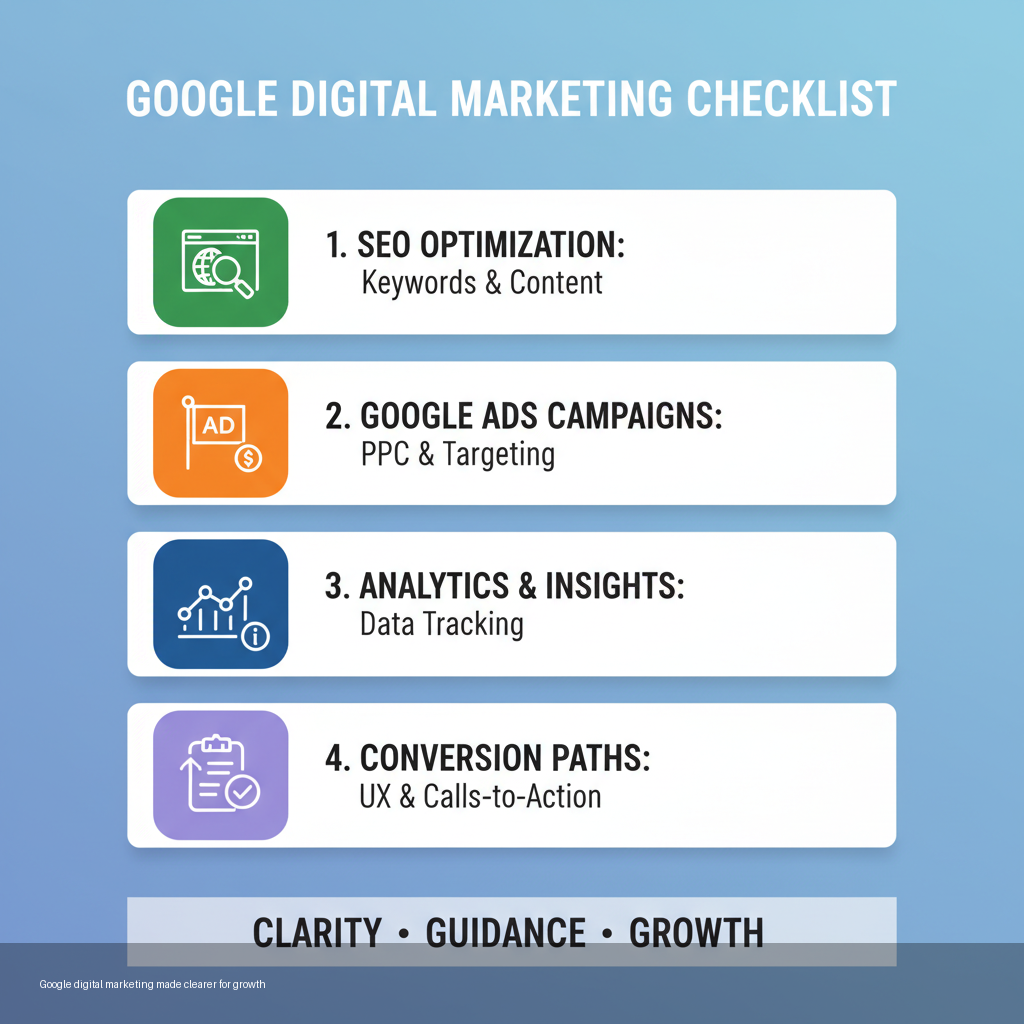
Google digital marketing made clearer for growth
Google digital marketing is the practice of using Google’s search, advertising, analytics, video, and measurement tools to attract qualified traffic and turn that traffic into enquiries, sales, or repeat engagement. The phrase can also refer to Google’s educational resources, but for businesses, the practical meaning is usually this: how visible, useful, and measurable your brand is across Google Search, Google Ads, YouTube, and related tracking platforms.
A strong Google strategy does not start with a campaign. It starts with a question: are people already searching for the product, service, or problem you solve? If the answer is yes, then search visibility, paid search, landing pages, and conversion tracking can work together as a connected system rather than separate tasks.
For businesses that want a broader view of search, paid media, content, and conversion planning, Zigma Internet Marketing’s Digital Marketing Services page outlines how these channels can be planned together instead of managed in isolation.
How Google digital marketing works in practice
Google digital marketing combines visibility, relevance, and measurement. Visibility means your business can be found when someone searches. Relevance means the page or ad matches the searcher’s intent. Measurement means you can see which visits, searches, ads, and pages create useful actions such as calls, forms, purchases, or booked appointments.
The main parts are search engine optimization, Google Ads, landing pages, content, YouTube, analytics, and conversion tracking. Search engine optimization helps unpaid pages appear for valuable searches. Google Ads gives faster visibility by paying for placement on selected queries. Analytics tools such as GA4 and Google Tag Manager help identify which actions are happening after a visitor arrives.
A common mistake is treating Google as one channel. Google Search, paid search, display placements, video, shopping feeds, and analytics each behave differently. A search ad may create immediate traffic, while SEO content may build visibility over months. A landing page may raise conversion rate without changing the traffic source at all.
If your team is deciding whether organic search should be a priority, Zigma’s SEO Services page explains the role of technical SEO, content planning, and search visibility in a larger marketing system.
Quick Facts: google digital marketing
The short version, in plain terms.
- What: Google digital marketing uses Google Search, Google Ads, YouTube, analytics, and landing pages to connect search demand with measurable business actions.
- Who: It fits businesses with search demand, defined offers, a sales process, and the ability to track enquiries or purchases accurately.
- Where: It applies across Google-owned and Google-connected surfaces, including search results, paid listings, YouTube placements, and analytics reports.
- How: Teams usually combine keyword research, content, paid search campaigns, technical fixes, landing page testing, and conversion tracking.
- Why: The goal is clearer attribution, stronger lead quality, lower wasted spend, and better decisions about what to improve next.
Google digital marketing channels compared clearly
Each Google channel has a different job. The right mix depends on whether you need faster traffic, stronger long-term visibility, better measurement, or more useful content for searchers.
SEO, Google Ads, and landing pages
A) SEO: SEO improves unpaid visibility by making pages easier for search engines and users to understand. It usually involves technical improvements, content planning, internal linking, and ongoing refinement.
- How it works: SEO aligns website pages with search intent, improves crawlability, and strengthens topical depth around important services or products.
- Best fit: SEO fits businesses that want compounding visibility and can invest in content, site health, and authority over time.
- Example: A service page may be rewritten to answer buyer questions, load faster, and connect to supporting blog posts.
B) Google Ads: Google Ads can place your business in front of searchers faster, but efficiency depends on query control, negatives, ad quality, and landing page relevance.
- How it works: Advertisers bid on searches and pay when users interact with ads, while campaign settings shape budget use and traffic quality.
- Best fit: Google Ads fits launches, urgent lead generation, competitive searches, and offers with clear conversion value.
- Example: A campaign can separate high-intent service queries from early research queries so budget is not spent on weak traffic.
C) Landing pages: Landing pages focus attention on one action and reduce distractions that can weaken conversion rate. They are useful for both paid and organic traffic.
- How it works: A landing page matches the promise of the search or ad, answers objections, and makes the next action easy to complete.
- Best fit: Landing pages fit campaigns where visitors need clear proof, service details, forms, calls, or product information.
- Example: A paid search campaign may send traffic to a dedicated page instead of a general homepage to improve enquiry quality.
Analytics, tracking, and reporting
A) GA4: GA4 records user activity and conversion events so marketers can understand which traffic sources and pages contribute to meaningful actions.
- How it works: GA4 collects event-based data from websites and apps, then organizes activity by traffic source, user behaviour, and conversion events.
- Best fit: GA4 fits businesses that need to compare search, paid traffic, referral traffic, and content performance in one reporting view.
- Example: A form submission can be marked as a conversion so reports show which campaigns influenced the enquiry.
B) Google Tag Manager: Google Tag Manager helps manage tracking tags without editing site code for every measurement change. It is especially useful when multiple platforms need accurate event data.
- How it works: Tags, triggers, and variables are configured to track actions such as clicks, form submissions, downloads, and purchase steps.
- Best fit: Google Tag Manager fits websites where marketing and development teams need cleaner tracking control.
- Example: A phone number click can be tracked as a lead action without rebuilding the full website.
C) Dashboards: Dashboards translate campaign and website data into a reporting view that decision-makers can use. The strongest dashboards separate activity metrics from business outcomes.
- How it works: Dashboard tools pull data from ads, analytics, search platforms, and forms to show trends across channels.
- Best fit: Dashboards fit businesses that need recurring visibility into leads, spend, traffic quality, and conversion patterns.
- Example: A dashboard may show that paid traffic volume rose while form quality dropped, prompting keyword and landing page changes.
Short-term and long-term channel roles
A) Fast visibility: Paid search can create traffic quickly, but speed alone does not equal efficiency. Campaign structure and landing page fit decide whether that traffic is useful.
- How it works: Ads are launched around selected queries, budgets, audiences, and conversion goals, then refined using search term and performance data.
- Best fit: Fast visibility fits new offers, seasonal campaigns, limited product launches, and competitive search categories.
- Example: A new service can use Google Ads while SEO pages are being built and indexed.
B) Durable search presence: SEO usually takes longer because search engines need to crawl, evaluate, and compare pages. The benefit is that strong pages can keep attracting qualified visits after publication.
- How it works: SEO builds page quality, topical relevance, internal connections, technical reliability, and user usefulness over repeated improvement cycles.
- Best fit: Durable visibility fits businesses with recurring search demand and service pages that can be improved over time.
- Example: A detailed service page supported by related educational content may bring steady traffic after search engines recognize its relevance.
C) Conversion improvement: Conversion rate optimization improves what happens after someone lands on the website. It can raise enquiry volume without increasing traffic.
- How it works: Teams review page layout, forms, calls to action, proof points, speed, and message match, then test changes against user behaviour.
- Best fit: Conversion improvement fits websites with traffic but weak form submissions, low call volume, or unclear user paths.
- Example: Shortening a form and clarifying service eligibility can improve lead completion from the same traffic source.
How to build a stronger Google marketing foundation
Step 1: Define the business action before choosing channels
Start by deciding which action counts as success: a call, form, purchase, consultation request, store visit, download, or booked demo. This step helps reduce reporting confusion so you can judge channels by contribution, not surface-level traffic.
Useful check: If a campaign increases visits but not qualified actions, the issue may be intent, landing page quality, tracking, or offer clarity.
Measurement detail: Set primary conversions separately from secondary engagement signals so reports do not treat every click as equal.
Example: A business may track completed forms as primary conversions and brochure downloads as supporting signals.
Step 2: Separate research searches from buying searches
People use Google at different stages. Some search to compare, some search to solve a problem, and some search because they are ready to act. This step helps align content and ads with intent so you can avoid sending every visitor to the same page.
Useful check: A phrase with “how,” “cost drivers,” or “comparison” may need educational content, while a service-specific phrase may need a direct landing page.
Measurement detail: Segment reports by query type so early-stage traffic is not judged by the same standard as high-intent paid search.
Example: An educational blog post can support awareness while a service page targets visitors closer to enquiry.
Step 3: Fix tracking before increasing spend
Marketing data is only useful when important actions are tracked correctly. This step helps prevent budget decisions based on incomplete or misleading reports so you can make changes with more confidence.
Useful check: Review whether phone clicks, form completions, purchases, and key buttons are recorded in analytics and advertising platforms.
Measurement detail: Test conversions after setup because form plugins, cookie settings, thank-you pages, and third-party tools can interrupt tracking.
Example: A campaign may appear weak until call tracking and form submission events are properly recorded.
Step 4: Match each page to one clear intent
A page that tries to educate, compare, sell, and recruit at the same time usually creates friction. This step helps visitors understand the next logical action so the page feels useful rather than crowded.
Useful check: Read the page from the visitor’s perspective and ask whether the main answer appears before competing messages.
Measurement detail: Compare scroll depth, form starts, call clicks, and exit points to see where visitors lose momentum.
Example: A service page can focus on qualification and enquiry, while a blog post can answer early-stage questions and link to deeper support.
Step 5: Review performance in cycles, not snapshots
Google campaigns and SEO work change as competitors, search behaviour, website content, and tracking accuracy change. This step helps keep decisions grounded in patterns rather than one unusual week of data.
Useful check: Compare performance across search terms, pages, devices, and conversion quality before changing budgets or rewriting content.
Measurement detail: A useful review cycle often includes search query cleanup, landing page changes, content updates, and tracking validation.
Example: If paid search leads fall in quality, reviewing search terms and negative keywords may be more useful than raising bids.
What professionals often wish businesses knew sooner
Traffic is not the same as demand. A page can receive visits from broad searches without attracting people who are ready for your offer. Search intent gives traffic its commercial value.
Tracking gaps can make good campaigns look weak. If phone clicks, form submissions, purchases, or qualified leads are not measured correctly, budget decisions become guesswork. Clean tracking is not a technical extra; it is part of campaign quality.
Landing pages often decide whether paid search succeeds. A well-structured campaign can still struggle if the page does not answer the searcher’s question, show trust signals, load quickly, or make the next action clear.
SEO vs PPC: when each Google strategy fits
SEO and PPC are often compared as if a business must pick one. A more useful comparison is time horizon. SEO tends to support long-term visibility through content, technical health, and authority. PPC can provide controlled exposure faster, but it needs disciplined query targeting, budget monitoring, and conversion tracking.
SEO may be the stronger first focus when your website has technical problems, thin service pages, or weak content depth. PPC may be the stronger first focus when you need to test demand, promote a defined offer, or generate traffic while organic assets are still being built.
The two channels can also improve each other. Paid search data can reveal which queries convert. SEO content can reduce dependence on paid traffic for educational searches. Landing page testing can raise performance across both channels. Zigma’s Google Ads Management service focuses on paid search structure, tracking, and ongoing campaign refinement.
Common weak spots in Google marketing campaigns
Many campaigns underperform because the strategy is split across disconnected tasks. The SEO plan sits in one report, Google Ads sits in another, landing pages receive occasional edits, and analytics is only reviewed when performance drops. That separation makes it harder to see the real constraint.
Several weak spots show up often in account and website reviews:
- Unclear conversion definitions: The business has not separated qualified leads from low-value interactions, so reports exaggerate performance.
- Poor query control: Paid search campaigns spend budget on searches that do not match the service, product, or buying stage.
- Thin content depth: Service pages mention the offer but do not answer objections, process questions, or comparison concerns.
- Slow technical fixes: Indexing, page speed, mobile layout, and crawl issues limit how well content and campaigns perform.
- Weak message match: The ad, search query, and landing page do not feel connected, which can reduce trust and conversion rate.
Improvement usually starts by finding the bottleneck. Is the business getting the wrong traffic, losing visitors on the page, or failing to measure the right action? Each answer leads to a different fix.
How to judge whether your Google setup is working
A useful Google marketing review should look beyond traffic volume. Traffic can rise while lead quality falls. Ad clicks can increase while sales conversations weaken. Organic rankings can improve for terms that do not support revenue. The better question is: which channel is producing actions your team can actually follow up on?
Review these signals together:
- Search intent: Are visitors arriving from queries that match the offer and buying stage?
- Conversion quality: Are calls, forms, purchases, or demos relevant enough for the sales process?
- Landing page behaviour: Are visitors scrolling, interacting, and completing key actions, or leaving quickly?
- Channel balance: Is the business relying too heavily on one source of traffic?
- Reporting clarity: Can leadership see which campaigns influence qualified enquiries, not just visits?
Zigma Internet Marketing uses a data-led planning process across SEO, PPC, web development, content, analytics, and conversion rate optimization. If your team wants a practical review of search visibility, paid media efficiency, and tracking quality, you can Book a Free Strategy Call.
FAQs About Google Digital Marketing
Paid search can produce traffic soon after launch, but useful performance signals depend on budget, search volume, tracking accuracy, and conversion volume. SEO usually takes longer because pages need to be crawled, indexed, compared, and refined before patterns become clear.
SEO and Google Ads serve different roles. Google Ads can create controlled paid visibility, while SEO builds unpaid visibility through useful pages, technical health, and search relevance. Using both can reduce blind spots, especially when paid search data informs organic content planning.
Most businesses should begin with GA4, Google Tag Manager, Google Search Console, and properly configured conversion tracking. These tools help show how people arrive, which pages they use, and which actions support business goals.
Low-quality paid traffic often shows up through irrelevant search terms, weak engagement, poor form quality, short calls, or conversions that sales teams cannot qualify. Reviewing search term reports, landing page behaviour, and lead outcomes usually gives a clearer answer than click volume alone.
A smaller website can compete when it targets specific search intent, has technically sound pages, answers real buyer questions, and tracks meaningful actions. Competing against larger sites is harder for broad terms, so focused content and clean conversion paths become more important.

