


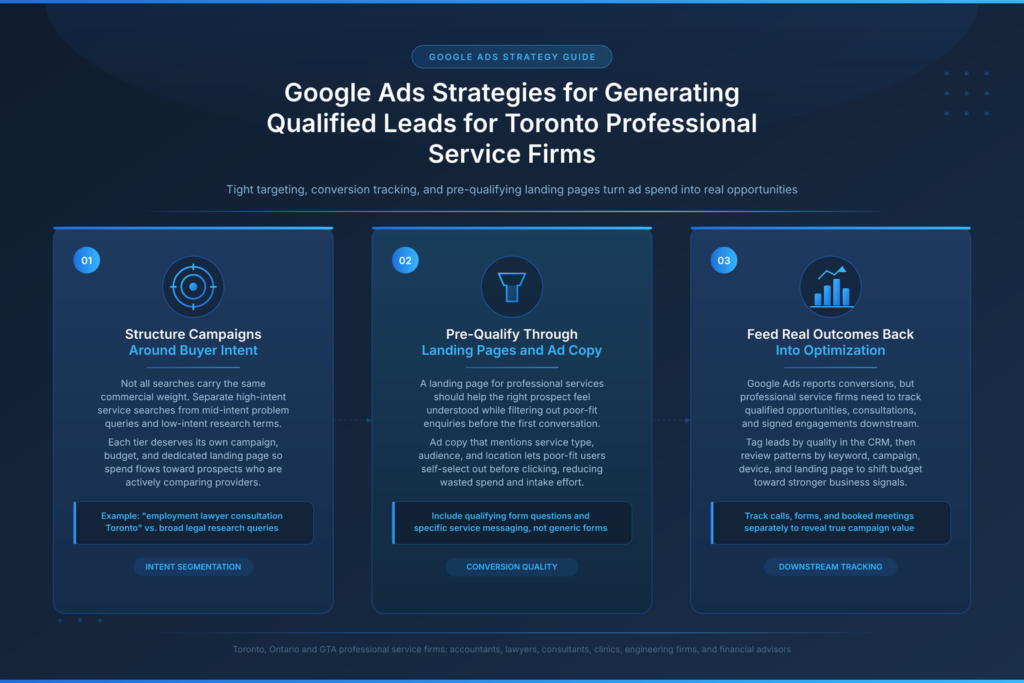
Google Ads strategies for generating qualified leads for Toronto professional service firms work best when campaigns are built around buyer intent, service-area economics, clean conversion tracking, and landing pages that pre-qualify the enquiry before a sales conversation begins.
For accountants, lawyers, consultants, clinics, engineering firms, financial advisors, and other professional service providers, a lead is only useful if the person has the right need, location, budget context, and urgency. A form fill from someone outside the Greater Toronto Area may inflate reporting, but it does not help a partner, principal, or intake team make better use of time.
That is why strong google ads management toronto is less about spending more and more about reducing waste. The campaign has to connect search terms, ad copy, landing page messaging, call tracking, CRM feedback, and follow-up quality into one system.


Why Google Ads lead quality is different for professional services
Professional service firms do not sell simple impulse purchases. A prospect may compare credentials, read reviews, check service areas, ask internal stakeholders, and request an initial conversation before making a decision. That buying path affects how Google Ads campaigns should be structured.
A campaign for emergency plumbing can treat a phone call as a near-final conversion. A campaign for a business lawyer, accounting firm, medical clinic, or consulting practice needs more filtering. The prospect’s query, the service page they land on, and the form questions they answer should all help separate serious enquiries from casual browsing.
This is where Google Ads Management becomes a commercial planning exercise, not only a media-buying task. The account structure should reflect the firm’s highest-value service lines, geographic priorities, intake capacity, and acceptable cost per qualified opportunity.
Google Ads strategies for generating qualified leads for Toronto professional service firms
The strongest campaigns start by defining what a qualified lead means. For a Toronto professional service firm, qualification may include service type, neighbourhood or office location, decision timeline, company size, case complexity, or whether the prospect is seeking an advisory relationship rather than a quick answer.
Once that definition is clear, campaign decisions become easier. Keywords can be grouped by intent. Negative keywords can remove research traffic. Landing pages can speak to specific services instead of sending every visitor to a general homepage. Conversion tracking can separate calls, forms, booked consultations, and spam enquiries.
A common mistake is treating all conversions equally. A 90-second phone call from a nearby business owner is not the same as a two-word form submission from outside the service area. Good campaign reporting should show lead quality indicators, not only the number of conversions shown in Google Ads.
How Toronto, Ontario search behaviour affects paid lead generation
Toronto, Ontario is a dense and competitive market, which means paid search campaigns often need tighter geographic and service segmentation than campaigns in smaller cities. Someone searching from downtown Toronto may have different expectations than a prospect in North York, Scarborough, Etobicoke, or Markham. Travel time, office proximity, virtual consultation availability, and local reputation can influence whether a click becomes a real enquiry.
Professional service firms also compete with directories, marketplaces, review platforms, national brands, and local specialists. A ppc agency toronto campaign should account for those SERP conditions by matching the ad promise to a highly specific landing page. For example, “corporate tax accountant Toronto” should not lead to a broad accounting page that gives no sign of corporate tax experience.
Zigma Internet Marketing supports firms across Toronto, Ontario and the GTA from its Markham office. That local context helps align paid media with surrounding digital signals such as SEO Services, local search visibility, analytics setup, and landing page conversion work.
How to structure campaigns around buyer intent
Search intent is the difference between someone researching a topic and someone ready to speak with a firm. Campaign structure should reflect that difference so the firm does not pay the same amount for weak intent and strong intent.
Search intent levels for professional service campaigns
A) High-intent service searches: These searches often include a service, location, and buying signal. They usually deserve focused budgets and dedicated landing pages.
- How it works: Campaigns target terms such as “employment lawyer consultation Toronto” or “business accountant near financial district.”
- Strong use case: Firms that have clear intake processes and want enquiries from people actively comparing providers.
- Example: A consulting firm may separate “operations consultant Toronto” from broader educational queries about operations planning.
B) Mid-intent problem searches: These searches show a business problem but may not name the service yet. They can work if the landing page explains the situation clearly and guides the next step.
- How it works: Ads connect a problem query to a page that explains the service and qualification criteria.
- Strong use case: Firms that can educate prospects without attracting too many low-value enquiries.
- Example: A financial advisor may target retirement planning concerns, then qualify by asset range, location, and advisory fit.
C) Low-intent research searches: These searches may be useful for SEO or remarketing, but they often waste paid search budget if used as primary lead-generation terms.
- How it works: Campaigns avoid broad research terms or isolate them with capped budgets and strict negative keywords.
- Strong use case: Firms building awareness through content, not firms trying to generate immediate qualified consultations.
- Example: “What does a management consultant do” may be better suited to content marketing toronto work than direct-response PPC.
Landing pages should qualify before the first conversation
A landing page is not just a place to collect a name and email. For professional services, a landing page should help the right prospect feel understood while gently filtering out poor-fit enquiries. That requires specific service messaging, trust cues, intake criteria, and clear next-step expectations.
A strong page often includes the exact service, who the firm serves, common situations, location coverage, credentials, and a form that asks useful qualifying questions. A weak page usually makes broad claims, sends users to a generic contact form, and leaves the intake team to sort through vague submissions.
This is where Website Design & Development connects directly to paid media performance. A campaign can bring the right traffic, but conversion rate optimization toronto work is often needed to improve form completion quality, call confidence, and consultation readiness.
Five practical Google Ads strategies that improve lead quality
Strategy 1: Segment campaigns by service value and urgency
Group campaigns around services that have distinct intent, revenue impact, and intake processes. A family law consultation, corporate tax advisory enquiry, and management consulting request should not be forced into one campaign because each searcher has different concerns and decision timelines.
Qualification signal: Track which service lines create consultations that your team would actually want to pursue.
Operational impact: Budget can shift toward services with stronger lead-to-client potential rather than services with the lowest cost per click.
Example: A professional firm may separate branded searches, high-value advisory searches, and niche service searches into different campaigns with different budgets and landing pages.
Strategy 2: Build negative keyword lists from real intake data
Negative keywords prevent ads from showing for irrelevant searches. For professional service firms, negative keywords often include job seekers, templates, free advice, student research, DIY terms, or locations outside the service area.
Qualification signal: Review search terms against call recordings, form notes, and CRM outcomes instead of judging queries only inside Google Ads.
Operational impact: Reduced irrelevant traffic can improve intake efficiency and make performance reports more honest.
Example: A law firm may exclude “free template,” “salary,” “course,” and “jobs” if those searches repeatedly produce poor-fit enquiries.
Strategy 3: Use call tracking and form tracking together
Some professional service leads prefer phone calls, while others want to submit a form after reviewing credentials. Tracking only one channel gives an incomplete view of campaign performance.
Qualification signal: Measure call duration, missed calls, form quality, booked consultations, and spam submissions separately.
Operational impact: Better tracking helps identify whether the issue is traffic quality, landing page clarity, or follow-up speed.
Example: A clinic may find that mobile search drives more calls during business hours, while desktop traffic produces longer form submissions in the evening.
Strategy 4: Align ad copy with the qualification criteria
Ad copy should not attract everyone. For professional services, strong ad copy can mention the service type, audience, consultation format, location, or case category so poor-fit users self-select before clicking.
Qualification signal: Compare click-through rate with lead quality, because the highest-click ad may attract the broadest and weakest traffic.
Operational impact: Better pre-click filtering can reduce wasted spend and improve the quality of conversations handled by staff.
Example: A B2B advisory firm may mention “for established service businesses” if that phrase reflects its real client profile.
Strategy 5: Feed qualified lead outcomes back into optimization
Google Ads can report conversions, but a professional service firm usually cares more about qualified opportunities, consultations, and signed engagements. The account should be optimized using downstream feedback, not surface-level conversion counts alone.
Qualification signal: Tag leads by quality level inside the CRM or intake sheet, then review patterns by keyword, campaign, device, and landing page.
Operational impact: Campaign decisions become more closely tied to business outcomes rather than vanity metrics.
Example: If two campaigns generate the same number of forms but one produces better consultation attendance, budget should favour the stronger business signal.
How to choose the right agency for paid lead generation
A digital marketing agency toronto search can return many firms with similar service claims. The better question is whether the agency understands professional service sales cycles, intake constraints, compliance-sensitive messaging, and the difference between a conversion and a qualified opportunity.
Ask how the agency handles campaign structure, negative keyword reviews, conversion tracking, landing page testing, and reporting. A capable lead generation agency toronto should be able to explain how paid search connects to sales follow-up without blaming every weak result on budget alone.
Zigma Internet Marketing brings together PPC, SEO, landing pages, web development, content, and analytics under one workflow. That is useful when paid search performance is affected by page speed, unclear messaging, weak technical setup, or missing CRM feedback.
Signals to check before choosing a provider
- Tracking depth: The agency should track calls, forms, booked meetings, and lead quality signals where the client’s tools allow it.
- Search term discipline: Search term reports should be reviewed for irrelevant traffic, not only used to expand keyword lists.
- Landing page capability: The agency should be able to improve page messaging, forms, and layout rather than relying only on bid changes.
- Reporting clarity: Reports should connect spend to qualified enquiries, not only impressions and clicks.
- Channel coordination: Paid search should work with SEO, local visibility, and content rather than competing against them internally.
What affects ROI in professional service campaigns
Return from paid search is shaped by more than ad spend. A campaign can generate clicks from the right audience and still underperform if the landing page is vague, the intake process is slow, or the firm cannot respond quickly during high-intent moments.
For Toronto firms, competition can also differ by practice area and neighbourhood. A downtown legal service, a North York clinic, and a Markham B2B advisory firm may face different search patterns, call behaviour, and conversion friction. Campaign planning should reflect those differences rather than treating Toronto, Ontario as a single uniform market.
ROI discussions should include lead value, close rate, intake capacity, lifetime client value, seasonality, and missed-call handling. A campaign with a higher cost per qualified lead may outperform a cheaper campaign if the enquiries are better aligned with the firm’s service model.
Campaign variables that influence commercial performance
- Lead definition: The firm should define which enquiries qualify by service, location, urgency, and fit.
- Landing page clarity: The page should state who the service is for, what problems it addresses, and what happens after submission.
- Follow-up speed: High-intent leads often cool down when calls are missed or form responses take too long.
- Search term control: Poor query filtering can make cost per lead look acceptable while lead quality declines.
- Analytics setup: GA4, Google Tag Manager, call tracking, and dashboard reporting should connect media spend to real business signals.
SEO vs PPC for Toronto professional service firms
SEO and PPC solve different timing problems. PPC can place a firm in front of high-intent searchers quickly, while SEO builds durable visibility across service pages, content, and local search assets. For professional service firms, the strongest digital marketing toronto programs often use both channels with different expectations.
PPC is useful when the firm wants controlled testing, faster feedback, seasonal demand capture, or visibility for a high-value service where organic rankings are not yet strong. SEO is useful for building trust before the click, reducing reliance on paid traffic over time, and covering research queries that would be expensive or inefficient in ads.
A seo company toronto can support paid search by improving site architecture, service pages, technical health, and content depth. Strong seo services toronto can also make landing pages more credible because prospects often check organic results, Google Business Profiles, reviews, and educational content before making contact.
How the channels can work together
- PPC tests demand: Paid search can reveal which services, phrases, and locations create qualified enquiries before a firm invests heavily in organic content.
- SEO supports trust: Organic pages, service-area content, and technical seo services help prospects validate the firm after seeing an ad.
- Local search supports conversion: local seo gta work and google business profile optimization can reinforce credibility when prospects search the firm’s name.
- Content reduces wasted clicks: Strong educational pages can handle research intent through content marketing toronto rather than forcing every query into paid search.
How local firms can compete online in Toronto
Toronto professional service firms do not need to outspend every competitor. They need sharper positioning, cleaner tracking, stronger landing pages, and a realistic understanding of which searches are worth buying.
A smaller firm can compete by narrowing its campaigns around specific service lines, neighbourhoods, business types, or client situations. For example, a boutique advisory firm near downtown Toronto may focus on a narrow B2B service rather than bidding broadly against national firms for generic terms.
The same principle applies across online marketing toronto and marketing agency gta work. Broad visibility has value, but qualified lead generation usually improves when the firm’s strongest service-market fit is reflected across paid search, local pages, organic content, and conversion paths.
Practical ways to compete without waste
- Narrow the campaign scope: Focus spend on service lines where the firm has capacity, expertise, and strong close potential.
- Use location intelligently: Build messaging for Toronto, Markham, North York, Scarborough, Etobicoke, and other GTA areas only where service delivery makes sense.
- Improve the website path: website design toronto work should make it easier for prospects to understand the firm, choose a service, and submit useful details.
- Review lead quality weekly at first: Early campaign periods should include regular search term, call, and form reviews so waste is reduced quickly.
FAQs About Google Ads strategies for generating qualified leads for Toronto professional service firms
Most firms need enough clicks, calls, and form submissions to see patterns by service line and search intent. Early reviews can happen weekly, but strategic decisions are stronger after the campaign has collected meaningful query, conversion, and intake feedback.
Search campaigns often provide the clearest starting point because they target people actively looking for a service in Toronto, Ontario. Display, Performance Max, or remarketing can support the funnel later, but search usually gives cleaner intent signals at launch.
Qualified leads should be assessed through intake notes, call duration, booked consultations, service fit, location fit, and eventual client outcomes. A low cost per lead can hide poor quality if the enquiries are outside the firm’s service area or not ready for professional help.
Homepage traffic can work for branded searches, but service-specific campaigns usually perform better with dedicated landing pages. A focused page can match the query, explain the service, address Toronto and GTA coverage, and ask intake questions that support qualification.
Yes. SEO can build long-term visibility and trust, while Google Ads captures high-intent demand and tests commercial messaging. The two channels work better when reporting separates paid leads, organic leads, branded searches, and assisted conversions.
Building a campaign that respects your intake team
A strong paid search campaign should make the business development process cleaner, not noisier. For Toronto professional service firms, that means fewer vague enquiries, clearer service fit, stronger tracking, and reporting that reflects qualified conversations rather than raw form volume.
Zigma Internet Marketing is a Google Partner-certified digital marketing agency based in the Toronto area, with execution across PPC, SEO, landing pages, analytics, and conversion improvement. If your firm wants a practical review of campaign structure, tracking, and lead quality, the team can assess where budget is being spent well and where the sales path is leaking.
Plan Google Ads around qualified opportunities
Speak with Zigma Internet Marketing about paid search, landing pages, tracking, and CRO for professional service lead generation in Toronto and the GTA.

