


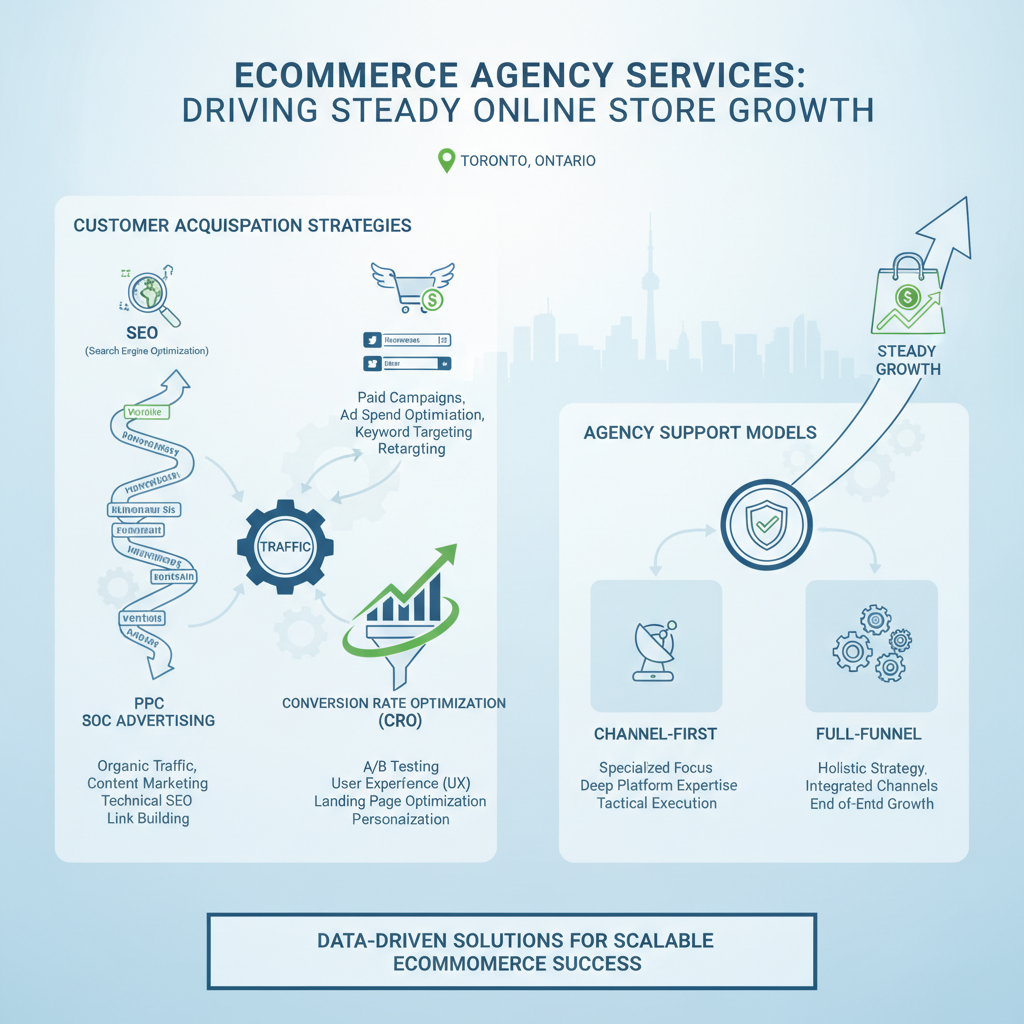
Why an ecommerce agency can change how a store grows
An ecommerce agency helps online brands improve traffic, conversion, and revenue by connecting strategy with execution across search, paid media, website performance, product merchandising, and analytics. For many store owners, the real value is not simply getting more visitors. It is getting the right visitors, reducing wasted spend, improving checkout performance, and building a system that can scale without constant guesswork.
That distinction is easy to miss early on. A store can attract clicks and still struggle with low conversion rates, weak product pages, poor tracking, or inconsistent campaign performance. In practice, that is where integrated support becomes useful. A team that understands Digital Marketing Services can connect SEO, media buying, landing page improvements, and reporting into one clearer growth process.
For business owners comparing support models, the bigger question is usually not “Do I need help?” but “Which kind of help will actually move the numbers I care about?” That is where the structure of an ecommerce agency matters.
What an ecommerce agency actually does day to day
An ecommerce agency works on the operating levers that influence online sales. That can include technical fixes that help search engines crawl product pages, campaign management that improves paid traffic quality, conversion-focused design changes, product feed optimization, email or remarketing support, and analytics setup that shows what is producing revenue instead of just activity.
Good agencies do not treat channels in isolation. A weak product page can hurt both organic rankings and paid performance. Poor tracking can make Google Ads Management look unprofitable even when branded search or remarketing is assisting sales. Thin category content can limit visibility for seo services toronto-style searches just as much as it can affect broader ecommerce discovery.
In practical terms, the work often falls into a few core areas:
- Acquisition: Bringing in qualified traffic through organic search, paid search, shopping campaigns, paid social, and content.
- Conversion: Improving the product page, cart, checkout path, mobile experience, and calls to action so more sessions turn into orders.
- Measurement: Setting up analytics, event tracking, attribution views, and dashboards that connect spend to sales.
- Retention support: Identifying repeat-purchase opportunities through audience segmentation, remarketing, and post-purchase journeys.
The strongest ecommerce agency relationships usually come from this kind of connected view rather than a single isolated tactic.
How the right ecommerce agency fits Toronto, Ontario businesses
For brands serving Toronto, Ontario, ecommerce growth often depends on balancing regional demand with broader digital reach. Some businesses need stronger local visibility for branded searches, pickup-related queries, or service-driven product lines. Others want national reach but still need their campaigns, product feeds, and landing pages to reflect how buyers in Toronto, Ontario actually shop: fast on mobile, comparison-heavy, and highly sensitive to friction.
That local layer matters more than it seems. Competition in the GTA is crowded, ad costs can rise quickly, and buyers often compare multiple retailers before converting. An agency that understands digital marketing toronto, online marketing toronto, and marketing agency gta positioning can help a brand decide whether the next gain is likely to come from technical SEO, creative testing, feed cleanup, or a better checkout path.
Where ecommerce strategy usually shows up in the Toronto market
In places like Downtown Toronto, North York, and Scarborough, search behaviour often reflects a mix of convenience, price comparison, and brand trust. Businesses near Markham and Richmond Hill may also see overlap between local search demand and broader ecommerce intent, especially when shoppers research online first and purchase later. That is one reason google business profile optimization can still support ecommerce brands that offer showroom visits, consultations, or local pickup.
What business owners should weigh before hiring support
Three factors usually shape the decision. First, channel fit: does the business need local seo gta, product-led SEO, shopping ads, or all three? Second, conversion readiness: can the current site turn more traffic into sales, or will added spend simply leak through weak pages? Third, reporting quality: can the team show how campaigns influence calls, forms, assisted conversions, and orders? Those questions tend to separate superficial activity from a real growth plan.
How to compare ecommerce agency support without getting distracted
Most brands are not choosing between “good” and “bad.” They are choosing between different operating styles. That is closer to choosing a growth model than hiring a vendor. Some teams focus heavily on traffic generation. Others are stronger in conversion rate optimization toronto, tracking, or platform development. The right fit depends on the store’s bottleneck.
Strategy focus: channel-first vs conversion-first vs full-funnel
A) Channel-first agencies: These teams concentrate on getting more traffic through SEO, PPC, or paid social.
- How it works: Campaigns and rankings are the first priority, with site improvements handled later or by another partner.
- Best fit: Stores that already convert well and mainly need more qualified sessions.
- Example: A mature Shopify brand with strong product pages may benefit from faster campaign expansion and feed management.
B) Conversion-first agencies: These teams start by fixing friction in the buying journey before scaling traffic.
- How it works: They review landing pages, navigation, mobile UX, offers, and checkout steps before increasing media spend.
- Best fit: Stores with traffic but weak revenue per session.
- Example: A retailer with strong ad click-through rates but a high cart drop-off rate may see better results from page and checkout testing first.
C) Full-funnel agencies: These teams connect acquisition, on-site performance, and measurement in one workflow.
- How it works: SEO, PPC, landing pages, analytics, and site updates are managed together.
- Best fit: Brands that want fewer handoffs and clearer accountability.
- Example: A business investing in content marketing toronto, shopping ads, and site improvements can benefit from one coordinated reporting view.
Platform support: campaign management vs platform-aware execution vs build-plus-growth
A) Campaign management only: The agency runs ads or SEO but does not change the website.
- How it works: Recommendations are passed back to the client or developer for implementation.
- Best fit: Businesses with a capable internal web team.
- Example: A brand with in-house developers may only need a ppc agency toronto to improve search and shopping campaigns.
B) Platform-aware execution: The agency understands Shopify or WordPress and can implement many growth changes directly.
- How it works: SEO fixes, page updates, template adjustments, and tracking changes happen faster because the same team can execute.
- Best fit: Growing stores that need speed and fewer bottlenecks.
- Example: A company evaluating website design toronto support may need both site improvements and campaign alignment.
C) Build-plus-growth support: The agency handles both site development and ongoing acquisition.
- How it works: Technical foundations such as speed, structure, and tracking are built with marketing execution in mind.
- Best fit: Businesses replatforming, redesigning, or rebuilding for scale.
- Example: A retailer migrating to Shopify may want technical seo services and media planning aligned from the start.
Reporting style: activity-based vs KPI-based vs business-outcome reporting
A) Activity-based reporting: Reports show tasks completed, impressions, and general campaign movement.
- How it works: Useful for visibility, but not always enough for decisions.
- Best fit: Early-stage brands that mainly want operational transparency.
- Example: A simple monthly summary may show ad changes without clarifying whether profitability improved.
B) KPI-based reporting: Reports track clearer performance indicators such as conversion rate, cost per acquisition, and assisted revenue.
- How it works: The agency ties channel activity to specific measurable outcomes.
- Best fit: Businesses trying to improve efficiency, not just traffic volume.
- Example: A lead generation agency toronto style reporting framework can help brands see which campaigns drive qualified actions.
C) Business-outcome reporting: The reporting connects marketing to margin, order quality, repeat purchase signals, or category growth.
- How it works: Data is framed around business decisions rather than channel summaries.
- Best fit: Brands with meaningful volume and multiple growth levers.
- Example: A retailer may shift budget away from high-click campaigns toward categories that produce stronger repeat-order behaviour.
How to choose the right ecommerce agency
The clearest selection process starts with one question: where is growth getting stuck right now? Some stores need better visibility in search. Some need more efficient paid campaigns. Some already have traffic and simply need a better buying experience. A useful agency should be able to diagnose that bottleneck instead of selling the same package to every business.
It also helps to look at how the team thinks about execution. Do they talk about rankings and clicks only, or do they move naturally into revenue quality, tracking integrity, category structure, and product page performance? A store can grow from 10,000 monthly sessions to 20,000 and still stay flat on revenue if the commercial fundamentals are weak.
Before deciding, ask a few practical questions. Who implements technical changes? How is attribution handled? What gets reviewed in the first 30 to 60 days? How does the team approach SEO alongside paid media rather than treating them as separate silos?
- Platform fluency: Shopify and WordPress are common, but the important detail is whether the agency can work inside the platform efficiently and safely.
- Tracking discipline: Clean GA4, tag setup, and event measurement are not side tasks. They shape every budget decision after launch.
- Conversion awareness: Strong agencies discuss navigation, merchandising, product content, and checkout friction early.
- Reporting clarity: A useful report helps you decide what to do next. It should not read like a list of activities with no consequence.
What impacts ROI in modern digital campaigns
Return on investment in ecommerce is usually shaped by a handful of connected variables rather than a single breakthrough. Traffic quality is one. Offer strength is another. Then there is page speed, mobile usability, product clarity, trust signals, and how accurately campaigns are measured. If one of those is weak, the rest often underperform with it.
A simple comparison helps here. Increasing traffic to a poor page is a bit like opening more taps into a bucket with a crack in the bottom. Volume rises, but retained value does not rise at the same pace. That is why an ecommerce agency that also understands search engine optimization, pay per click advertising, and analytics and tracking setup usually has a stronger chance of improving efficiency over time.
From working patterns across growth campaigns, a few factors show up repeatedly:
- Intent match: Search terms with weak buying intent often inflate traffic without adding enough sales value.
- Landing page alignment: The ad promise, search intent, and page content need to match closely.
- Measurement quality: Poor attribution can hide winning campaigns or make weak ones look stronger than they are.
- Speed of iteration: Brands that test offers, headlines, feeds, and layouts regularly tend to improve faster than brands that wait for full redesigns.
SEO vs PPC: when each strategy fits an ecommerce business
SEO and PPC do different jobs, even when they target similar products or categories. SEO compounds over time. It builds visibility through product pages, collections, informational content, internal linking, and technical improvements. PPC creates speed. It gives a brand controlled visibility for high-intent searches, promotions, and specific product pushes.
Most stores do not need to pick one forever. They need to understand sequence and role. A new product launch may rely on paid search or shopping campaigns first. A category with recurring demand may benefit from stronger organic rankings over six to twelve months. Businesses comparing an seo company toronto with a google ads management toronto provider often get better outcomes when the decision is framed around timing, intent, and site readiness instead of channel loyalty.
Step 1: Audit current demand sources
Check whether existing sales come from brand searches, non-brand searches, shopping feeds, repeat customers, or direct traffic. That baseline helps identify where SEO or PPC has the higher immediate leverage. This step helps reveal the clearest growth path so you can avoid channel bias.
Watch for: Paid traffic that converts only on branded terms.
Good sign: Non-brand category pages already show early organic traction.
Example: A store that ranks on page two for several profitable categories may be closer to an SEO lift than it realizes.
Step 2: Review the store’s conversion readiness
If the site has weak product content, a cluttered mobile experience, or checkout friction, scaling either channel becomes harder. Conversion quality should shape budget allocation. This step helps protect efficiency so you can grow without magnifying existing leaks.
Watch for: Strong click volume paired with low add-to-cart rates.
Good sign: Product pages answer buying questions clearly and reduce hesitation.
Example: A retailer may delay aggressive PPC expansion until the product page structure is cleaned up.
Step 3: Use PPC for speed and SEO for compounding gains
PPC is often useful for testing demand, validating product positioning, and filling visibility gaps quickly. SEO is better for building durable visibility around product and category intent. This step helps balance short-term revenue with longer-term customer acquisition stability.
Watch for: Overreliance on paid traffic for every sale.
Good sign: Paid search insights are feeding content and category optimization work.
Example: Search term data from PPC can help refine collection-page copy and FAQ content for organic rankings.
Step 4: Align reporting across both channels
SEO and PPC can support each other, but only if reporting shows their combined effect on assisted conversions, branded search growth, and category sales. This step helps reduce channel silos so you can make clearer budget decisions.
Watch for: Separate reports that hide overlap or duplication.
Good sign: One dashboard connects rankings, campaign costs, conversion trends, and revenue signals.
Example: A seasonal promotion may spike brand demand, which later lifts organic clicks for related products.
Step 5: Reassess every quarter
Channel roles shift as the store matures, product lines change, or competition tightens. Quarterly reviews often reveal whether the next gain should come from content expansion, feed work, bid refinement, or on-site CRO. This step helps keep growth grounded in current performance instead of habit.
Watch for: Budgets staying fixed while product economics or demand patterns change.
Good sign: The team adjusts channel weight based on contribution, not preference.
Example: A business may reduce spend on expensive search terms once organic category pages begin to rank well.
What experienced teams usually notice early
- Feed quality often gets underestimated. For ecommerce brands running shopping campaigns, missing attributes, weak titles, or inconsistent categorization can limit performance before bidding strategy even becomes relevant.
- Technical debt quietly taxes growth. Duplicate product paths, thin category copy, and broken tracking rarely create dramatic failures. They tend to create slow inefficiency that compounds over months.
- Creative and merchandising affect paid search more than many brands expect. Even strong targeting struggles when the product story, imagery, or offer structure does not reduce buyer hesitation.
How local businesses in Toronto can compete online
Not every ecommerce business in Toronto, Ontario is trying to become a national retailer overnight. Many are hybrid businesses with local service areas, pickup models, appointment-based buying journeys, or regionally concentrated demand. Those companies often need a blended strategy that supports both local discovery and broader ecommerce growth.
That may include local landing pages, location-aware content, stronger category targeting, and a site structure that supports both product sales and service intent. Businesses with physical presence can benefit from a connection between local search marketing and ecommerce pages, especially when people research online before visiting or calling. In those cases, SEO Services and on-site conversion work often need to move together.
A practical path usually looks like this:
- Own branded and local-intent searches: Make it easy for Toronto-area buyers to find the business, verify legitimacy, and reach the right page quickly.
- Build category depth gradually: Expand high-intent collection and product content based on demand patterns, not just catalogue size.
- Reduce friction on mobile: GTA buyers often compare quickly across devices. Simple navigation and fast-loading product pages can make a measurable difference.
- Use paid campaigns surgically: Support launches, promotions, and high-margin categories while organic visibility builds.
Quick signals that an ecommerce agency is thinking clearly
Some signs show up fast. The team asks about margins, attribution, and repeat purchase behaviour instead of focusing only on clicks. They want to review product feeds, category structure, and page speed before expanding spend. They can explain trade-offs in plain language. And they are comfortable saying that more traffic is not always the first fix.
That kind of discipline is often more useful than flashy reporting. It helps a business understand what should happen first, what can wait, and where performance is probably being lost. For brands that want steady improvement rather than random spikes, that mindset usually leads to better decisions.
FAQs About ecommerce agency
If the main challenge involves several connected areas at once, such as SEO, paid campaigns, landing pages, tracking, and platform updates, an ecommerce agency is often the better fit. A freelancer can work well for a narrow task, but multi-channel growth usually needs broader coordination and clearer reporting.
Yes. That situation often points to conversion issues rather than traffic volume. An ecommerce agency may review product pages, mobile usability, cart behaviour, trust signals, and analytics accuracy before recommending more spend. The goal is to improve revenue efficiency, not just session count.
Yes, especially for category searches, product discovery, and branded demand over time. For businesses in Toronto, Ontario, SEO can also support local visibility, pickup-related searches, and informational content that helps buyers compare products before they purchase.
That depends on timing and site readiness. PPC is often faster for testing demand or supporting promotions. SEO is usually stronger for building long-term visibility. In Toronto, Ontario, many businesses benefit from using PPC for immediate traction while improving site structure and content for organic growth.
The early phase usually includes auditing data, checking tracking, reviewing campaign structure, identifying technical issues, and prioritizing the biggest conversion gaps. Strong teams set a sequence of improvements instead of changing everything at once, which makes performance easier to measure and refine.
Steady growth usually comes from better decisions, not louder marketing
An ecommerce agency is most useful when it helps a business see the system more clearly: where traffic is coming from, where trust is being lost, where paid spend is leaking, and where on-site improvements could lift revenue without chasing vanity metrics. For store owners weighing the next step, the real test is simple. Can the team connect visibility, conversion, and measurement into one grounded plan? If that conversation would help, 📩 Ask an SEO/PPC question.
Related Topics:
- search engine optimization
- pay per click advertising
- local search marketing
- conversion optimization
- analytics and tracking setup