


A practical starting point for service companies
A digital marketing strategy for Toronto service businesses in 2026 should connect search visibility, paid traffic, website conversion, and lead tracking into one operating plan. For a service company, the goal is not simply more traffic; the goal is more qualified calls, form submissions, booked consultations, and repeatable acquisition data.
Toronto, Ontario is competitive across legal, home services, healthcare, consulting, trades, wellness, B2B, and professional service categories. A company can have a good reputation and still lose leads if its Google Business Profile is thin, its landing pages load slowly, or its ads send visitors to generic pages. The strategy has to match how people search, compare, and decide.
For many local businesses, the strongest plan combines organic search, paid search, content, website experience, and analytics. Zigma Internet Marketing supports that full mix through Digital Marketing Services built around measurable lead generation rather than vanity reporting.
Quick Facts: Digital Marketing Strategy in Toronto, Ontario
The short version for busy owners and managers.
- What: A coordinated plan for SEO, Google Ads, website conversion, content, local search, and tracking.
- Who: Service businesses that depend on calls, forms, appointments, consultations, or location-based inquiries.
- Where: Toronto, Ontario, including competitive areas such as Downtown, North York, Scarborough, Etobicoke, and nearby GTA markets.
- How: Search intent mapping, landing pages, conversion tracking, Google Business Profile work, reporting dashboards, and ongoing testing.
- Why: Better visibility, clearer attribution, stronger lead quality, and fewer wasted clicks from poorly matched traffic.
How digital marketing strategy for Toronto service businesses in 2026 should be built
A useful strategy starts with the buyer journey. A homeowner searching for emergency repair, a clinic patient comparing providers, and a business owner evaluating a consultant are not using the same search terms or decision signals. The campaign should separate urgent searches, research searches, brand searches, and comparison searches.
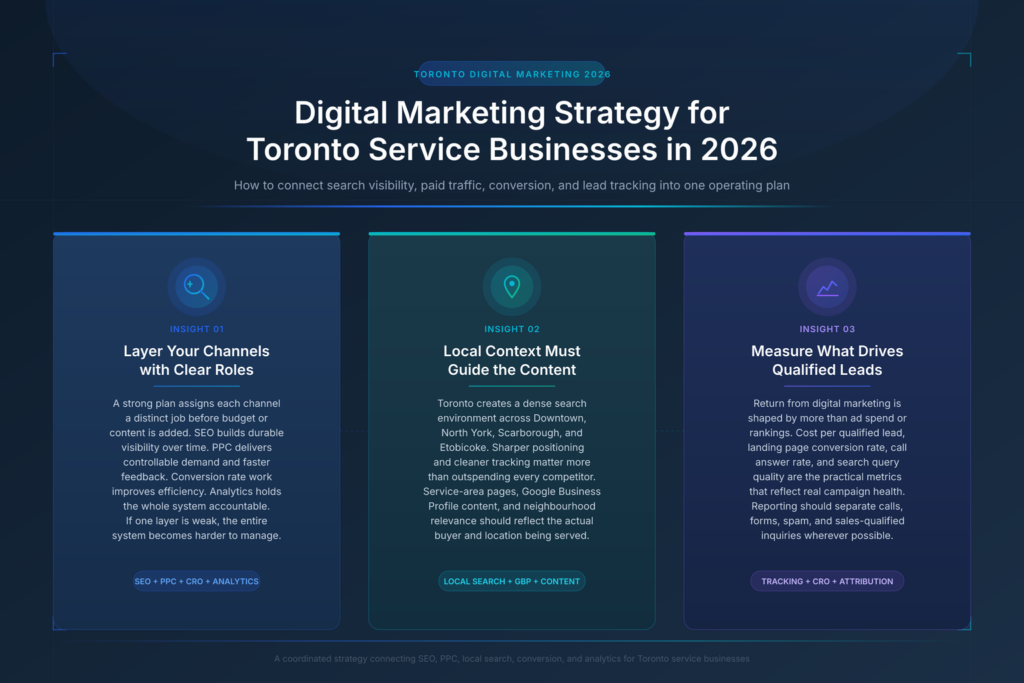
Search engine optimization is the long-term visibility layer. Paid search is the controllable demand layer. Conversion rate optimization is the efficiency layer. Analytics is the accountability layer. If one layer is weak, the whole system becomes harder to manage. For example, a strong Google Ads account can still underperform if the landing page has unclear service areas, slow load times, or no visible trust cues.
Service businesses also need a local search foundation. SEO Services can support organic rankings, service-area pages, technical fixes, and content planning, while Google Ads Management can help test high-intent queries faster.
How local businesses in Toronto, Ontario can compete online
Toronto, Ontario creates a dense search environment. A single service category may include independent firms, franchises, directories, marketplaces, sponsored listings, and map results on the same search page. A smaller business does not need to outspend every competitor, but it does need sharper positioning, cleaner tracking, and pages that answer the exact question behind the search.
For example, a company serving condos near Liberty Village may need different page content than a trades business serving detached homes in East York. A professional service firm near Bay Street may need proof of process, while a local home service company may need fast contact paths, neighbourhood relevance, and review visibility. Local context should guide the content, not decorate it.
Competitive visibility usually comes from a few practical choices:
- Service-area clarity: Pages should state which locations are served and which service situations the business handles.
- Search intent alignment: Pages for urgent leads should be different from pages for research-stage visitors.
- Review and profile consistency: Google Business Profile optimization should support trust before a user visits the website.
- Lead quality tracking: Reports should separate calls, forms, spam, repeat inquiries, and sales-qualified leads.
SEO, PPC, and local search are different jobs
Digital campaigns often fail because every channel is expected to do the same job. Organic search, paid search, and local listings influence different moments in the decision process. A strong plan assigns a clear role to each channel before budget or content is added.
Organic search versus paid search
A) SEO: SEO builds visibility for service pages, location pages, educational content, and comparison searches over time.
- How it works: Technical improvements, content structure, internal links, and local relevance help search engines understand the website.
- Strong use case: SEO fits businesses that want durable visibility for recurring search demand.
- Example: A clinic may use seo services toronto to rank for treatment pages and neighbourhood-specific searches.
B) PPC: PPC places ads in front of people searching for high-intent terms and can be adjusted quickly.
- How it works: Campaigns target search queries, control bids, exclude poor-fit searches, and send users to focused landing pages.
- Strong use case: PPC fits businesses that need demand testing, seasonal lead volume, or tighter control over priority services.
- Example: A contractor may use google ads management toronto for emergency-service campaigns with call tracking.
C) Combined search: SEO and PPC can share query data, landing page insights, and conversion signals.
- How it works: Paid search can reveal converting terms while SEO builds stronger pages around those topics.
- Strong use case: A combined route fits businesses that need near-term leads and long-term search equity.
- Example: A firm may use a ppc agency toronto while strengthening technical seo services on its main website.
A seo company toronto should be able to explain which keywords are worth pursuing organically and which terms are better tested through ads first. That separation reduces waste and keeps expectations realistic.
How to choose the right digital marketing agency
The right agency should make decisions easier, not more confusing. A business owner should understand what is being worked on, why it was prioritized, and how the work connects to leads or revenue. If reporting focuses only on impressions and clicks, the strategy is missing the business layer.
A digital marketing agency toronto should be able to discuss SEO, PPC, web development, content, analytics, and conversion paths without treating each service as a separate silo. A lead generation agency toronto should also be direct about what can be controlled and what needs testing, especially in competitive service categories.
Use these questions during evaluation:
- How will lead quality be measured? Calls, forms, booked appointments, and qualified inquiries should be separated wherever possible.
- What happens before ad spend increases? Landing pages, tracking, negatives, service-area settings, and offer clarity should be reviewed first.
- How are SEO priorities chosen? Technical fixes, local pages, content gaps, and authority signals should be ranked by business impact.
- Who reviews performance? Reporting should include interpretation, not only exported charts.
- Can the agency support implementation? Strategy has less value if website changes, tracking updates, or content production stall.
What impacts ROI in modern digital campaigns
Return from digital marketing is shaped by more than ad spend or rankings. Lead quality, close rate, website speed, pricing fit, seasonality, response time, reviews, and follow-up process all affect campaign performance. Marketing can create demand signals, but the business process has to capture them.
For service businesses, the most useful metrics are often practical and operational:
- Cost per qualified lead: This is more useful than cost per click because it reflects whether inquiries match the service.
- Landing page conversion rate: A small improvement can reduce acquisition cost without increasing spend.
- Call answer rate: Missed calls can make a strong campaign appear weak.
- Search query quality: Poor-fit queries can quietly drain PPC budgets if negatives are not maintained.
- Organic lead mix: Tracking should show whether leads come from service pages, location pages, blog content, or Google Business Profile activity.
Conversion rate optimization toronto work may include clearer forms, stronger service-page hierarchy, better mobile layouts, trust cues above the fold, and focused landing pages. The same principle applies to website design toronto projects: design should support speed, clarity, accessibility, and action.
SEO vs PPC: When to use each strategy
SEO is usually stronger for building visibility across service topics, educational searches, and location pages. PPC is stronger for testing demand, controlling priority services, and reaching searchers who are ready to call or submit a form. The better choice depends on timing, margin, competition, and the quality of the website experience.
Use SEO when the business has recurring demand, defined services, and a website that can support deeper content. Use PPC when the company needs faster feedback, seasonal push, or campaign-level control. Use both when paid data can guide content planning and organic performance can reduce reliance on ads over time.
For example, a business investing in online marketing toronto may use ads to test which services convert, then build content marketing toronto assets around the strongest themes. A marketing agency gta with SEO and PPC knowledge should be able to turn campaign data into content briefs, landing page updates, and reporting improvements.
A 2026 planning checklist for service businesses
Planning should be specific enough to guide execution and flexible enough to respond to real performance data. A useful checklist keeps the team focused on actions that improve visibility, conversion, and accountability.
Step 1: Define the lead types that count
Separate service inquiries, job applications, spam, vendor messages, and repeat customer requests. This step helps clarify campaign value so the business can judge performance using qualified demand, not raw form volume.
Measurement focus: Track calls, forms, booked appointments, and closed opportunities where the sales process allows it.
Common weak point: Treating every form fill as equal can distort budget decisions.
Example: A home service company may count emergency repair calls differently from maintenance-plan inquiries.
Step 2: Map services to search intent
Group search terms by urgency, location, service type, and buyer stage. This step helps align pages and campaigns so visitors land on content that matches their search.
Measurement focus: Compare keyword groups by conversion rate, lead quality, and follow-up outcome.
Common weak point: Sending every searcher to a homepage often reduces clarity.
Example: “Emergency repair” traffic should not land on the same page as a broad educational topic.
Step 3: Strengthen local proof
Reviews, service areas, Google Business Profile content, photos, and local landing pages help visitors confirm relevance. This step helps Toronto, Ontario searchers understand whether the business serves their area and handles their situation.
Measurement focus: Watch calls, direction requests, website clicks, and location-page leads.
Common weak point: Thin profiles can reduce trust before the website is even visited.
Example: A company serving Scarborough, North York, and Etobicoke should make coverage clear across its profile and website.
Step 4: Build landing pages for decisions
Landing pages should answer service fit, location, process, credibility, and next steps quickly. This step helps reduce friction so qualified visitors can act without searching through unrelated pages.
Measurement focus: Review form starts, phone taps, scroll depth, and assisted conversions.
Common weak point: A visually polished page can still fail if the service promise is vague.
Example: A WordPress or Shopify build should include SEO structure, speed, and conversion planning from the start.
Step 5: Review data on a fixed rhythm
Campaign data should be reviewed regularly with clear decisions attached. This step helps the team adjust bids, content, pages, and tracking based on evidence rather than preference.
Measurement focus: Use GA4, Google Tag Manager, call tracking, and dashboards to connect marketing activity to outcomes.
Common weak point: Reports without interpretation create activity but not better decisions.
Example: If paid clicks rise but qualified calls do not, the next review should check queries, landing pages, and phone handling.
FAQs About digital marketing strategy for Toronto service businesses in 2026
A Toronto, Ontario service business should begin planning before major seasonal demand periods or budget changes. Early planning gives the team time to fix tracking, improve landing pages, update local profiles, and test campaigns before lead volume becomes urgent.
Start with the weakest part of the current lead system. If visibility is low, SEO and local search may need attention. If leads are needed sooner, PPC can test demand. If traffic exists but inquiries are weak, conversion work should come first.
Google Business Profile supports local visibility, trust, and contact actions. For Toronto, Ontario service businesses, profile categories, services, photos, reviews, posts, and accurate contact details can influence whether a searcher calls before visiting the website.
Sometimes they can, but paid campaigns often perform better with tighter landing pages built around one service, one location, and one action. SEO pages usually need broader context, internal links, and content depth to support organic search.
A useful report should show qualified leads, source breakdown, search query quality, conversion rate, ad spend efficiency, organic visibility, and recommended next actions. The report should explain what changed and what the team will adjust next.
Planning with cleaner data and fewer assumptions
A strong 2026 plan does not need to be complicated. It needs clear goals, accurate tracking, search intent alignment, useful pages, and regular performance reviews. The service businesses that improve steadily are usually the ones that connect marketing decisions to real conversations with customers.
Zigma Internet Marketing is a Google Partner-certified digital marketing team serving Toronto, the GTA, and businesses across Ontario from Markham. The agency supports SEO, PPC, web design and development, content, social media, analytics, dashboards, and CRO with a focus on measurable lead generation.
If you want a practical second opinion on your search, ads, or tracking setup, you can reach Zigma Internet Marketing at (647) 556-6071 or info@zigma.ca.
Related Topics:
- Search engine optimization
- Pay per click advertising
- Local search marketing
- Conversion optimization
- Analytics and tracking setup

