


A clear answer for a confusing marketing role
A digital marketing specialist plans, runs, measures, and improves online campaigns across channels such as search engines, paid ads, websites, content, email, analytics, and social platforms. The role is practical: connect marketing activity to business outcomes such as qualified leads, sales, booked appointments, lower acquisition waste, and clearer reporting.
The title can be confusing because different companies use it in different ways. In a small business, one specialist may handle SEO, Google Ads, landing pages, tracking, and content coordination. In a larger company, the specialist may focus on one area, such as paid search or conversion rate optimization, while working with designers, developers, and sales teams.
The useful question is not just “Can this person run campaigns?” A better question is: “Can this person diagnose what is blocking growth, choose the right channel, track the right numbers, and improve performance without wasting budget?” That is where the role becomes valuable.
What a digital marketing specialist actually does
A digital marketing specialist turns business goals into measurable marketing activity. The work usually starts with understanding the offer, target audience, sales process, current website, traffic sources, and the numbers already available in analytics or advertising accounts.
From there, the specialist builds a plan around the channels most likely to support the goal. For example, a service business may need search visibility and conversion tracking before spending heavily on ads. An e-commerce brand may need product feed cleanup, shopping campaign structure, technical SEO, and stronger product pages before traffic quality improves.
Typical responsibilities include:
- Researching demand: The specialist identifies how people search, compare, and decide before buying or submitting a form.
- Planning campaigns: The specialist selects channels, budgets, landing pages, content priorities, and measurement points.
- Improving visibility: SEO work may include technical fixes, content planning, internal linking, site structure, and on-page improvements.
- Managing paid media: PPC work may include keyword targeting, ad copy, negative keywords, bidding, audience signals, and landing page alignment.
- Strengthening conversion paths: CRO work focuses on forms, calls to action, page speed, trust signals, message clarity, and lead quality.
- Reporting on useful KPIs: Reporting should connect activity to metrics such as leads, conversion rate, cost per lead, revenue, ROAS, and assisted conversions.
For business owners comparing service support, Zigma’s Digital Marketing Services page shows how SEO, PPC, web, content, and analytics can work together instead of being treated as disconnected tasks.
The skills that separate execution from guesswork
Strong digital marketing work is not just publishing posts or launching ads. A capable specialist can explain why a campaign is structured a certain way, what signal will be measured, and how decisions will be made after enough data is collected.
The most useful skills usually sit across four areas: strategy, technical ability, creative judgment, and measurement. A specialist does not need to be a senior expert in every channel, but the person should know how each channel affects the others.
Search and content judgment
Search engine optimization requires more than adding keywords to pages. A specialist should understand search intent, page structure, crawlability, content depth, internal links, and how technical issues can hold back otherwise useful content. For businesses reviewing organic visibility, SEO Services can support technical audits, content planning, and long-term search growth.
Paid media discipline
Paid search can create fast feedback, but weak structure can waste money quickly. A specialist should understand match types, search terms, negative keywords, conversion tracking, landing page relevance, and budget pacing. If paid search is part of the plan, Google Ads Management can help connect campaign structure with measurable lead quality.
Website and conversion awareness
Traffic alone rarely fixes a weak conversion path. A specialist should be able to spot unclear page messaging, slow load times, weak forms, missing trust cues, poor mobile layouts, and calls to action that do not match the visitor’s decision stage. Website support from Website Design & Development can make campaigns easier to measure and improve.
Analytics and reporting accuracy
Good reporting answers business questions, not just platform questions. A specialist should be comfortable with GA4, Google Tag Manager, conversion tracking, dashboards, attribution limits, and source quality. If the numbers are wrong, the campaign decisions will usually be wrong too.
Specialist, freelancer, in-house hire, or agency support?
Different support models fit different levels of complexity. The right structure depends on budget control, speed, channel depth, internal capacity, and how much implementation help the business needs.
In-house digital marketing specialist
- How the role works: An in-house hire works closely with sales, operations, leadership, and customer service, which can improve message accuracy and turnaround time.
- Best fit: This works well when marketing tasks are constant, the business has enough work for a full role, and leadership can guide priorities clearly.
- Trade-off: One person may not have deep capability across SEO, PPC, design, development, analytics, and content production.
Freelance specialist
- How the role works: A freelancer usually supports a defined channel or project, such as Google Ads setup, content planning, technical SEO, or analytics cleanup.
- Best fit: This works well for a business with a specific gap and someone internally who can manage priorities, approvals, and follow-through.
- Trade-off: A freelancer may not cover strategy, implementation, creative production, tracking, and reporting as one connected system.
Agency team
- How the role works: An agency brings specialists across channels, which can be useful when SEO, PPC, web development, content, CRO, and analytics all affect performance.
- Best fit: This works well when the business needs ongoing execution, reporting discipline, and multiple skill sets without building a full internal team.
- Trade-off: The business still needs a clear internal owner who can approve work, share sales feedback, and keep goals current.
The practical comparison is simple: an in-house hire brings closeness to the business, a freelancer brings focused support, and an agency brings broader execution capacity. The right choice depends on where the bottleneck sits.
How a strong campaign plan is built
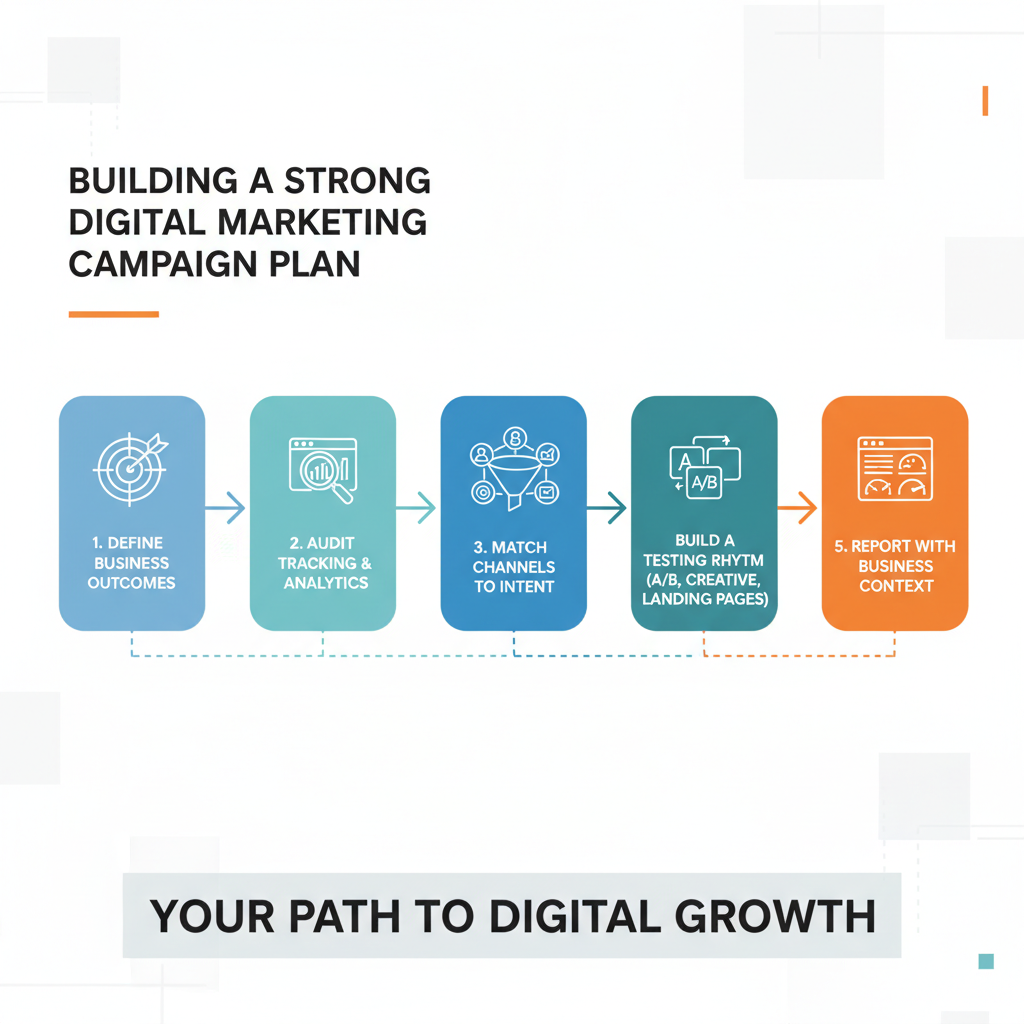
A campaign plan should connect the business goal to the channel, message, landing page, tracking setup, and reporting rhythm. Without that connection, marketing teams can end up measuring activity instead of outcomes.
A useful planning process often includes these steps:
Step 1: Define the business outcome
The campaign should start with a specific outcome such as qualified form submissions, booked calls, product sales, repeat purchases, or lower wasted spend. This keeps channel decisions grounded in business impact.
Useful metric: Lead volume, lead quality, conversion rate, revenue, or cost per acquisition.
Common issue: Teams sometimes report impressions and clicks while the sales team has no clear view of lead quality.
Example: A campaign may bring more traffic, but if the contact form receives low-intent submissions, the landing page and targeting need review.
Step 2: Audit current tracking
Before changing campaigns, the specialist should confirm that forms, calls, purchases, and key events are tracked properly. Broken tracking creates false confidence and poor decisions.
Useful metric: Conversion event accuracy across GA4, ad platforms, and dashboards.
Common issue: A form thank-you page may be counted as a conversion even when spam or duplicate submissions are included.
Example: If phone calls are a major lead source, call tracking and source reporting should be reviewed before judging PPC performance.
Step 3: Match channel to intent
Search campaigns often work well for active demand because users are already seeking a service or product. Content and SEO can support research-stage demand, while social campaigns may help with awareness, remarketing, or offer testing.
Useful metric: Conversion rate by source and funnel stage.
Common issue: A business may use the same landing page for cold social traffic and high-intent search traffic, even though those users need different proof and messaging.
Example: A high-intent Google Ads campaign may need a concise landing page, while an SEO article may need fuller educational context before a reader is ready to act.
Step 4: Build a testing rhythm
Marketing improvement usually comes from controlled changes. A specialist should test ad copy, landing page sections, keyword groups, content formats, form design, and audience segments without changing too many variables at once.
Useful metric: Change in conversion rate, qualified lead rate, or cost per qualified lead after a defined testing period.
Common issue: Frequent changes without documentation make it hard to know which change helped or hurt performance.
Example: Testing a shorter form may increase submissions, but sales feedback should confirm whether those extra leads are worth pursuing.
Step 5: Report with business context
Reports should explain what changed, why it changed, what was tested, what signal was found, and what action comes next. A useful dashboard supports decisions; it does not replace human analysis.
Useful metric: Lead source quality, conversion path, spend efficiency, and month-over-month trend direction.
Common issue: Reporting can look positive while sales conversations reveal weak-fit leads.
Example: If cost per lead drops but close rate drops too, the specialist should review targeting, ad promises, landing page wording, and qualification signals.
How to judge whether a specialist is competent
A skilled specialist should be able to explain trade-offs clearly. For example, SEO may take longer to compound, but it can support durable visibility when the website and content are strong. PPC can create faster data, but it needs tight tracking and landing pages to avoid paying for low-intent traffic.
During evaluation, listen for how the specialist talks about measurement. If the conversation focuses only on rankings, clicks, followers, or impressions, the plan may not be close enough to revenue. Better conversations include lead quality, attribution limits, sales feedback, testing priorities, and the difference between platform-reported conversions and verified business outcomes.
Useful questions include:
- How will success be measured? A good answer should mention the primary business outcome and the supporting KPIs that explain progress.
- Which channel should be addressed first? A good answer should connect the recommendation to current constraints, demand level, website quality, and tracking readiness.
- How will sales feedback shape campaign changes? A good answer should include lead quality review, call notes, CRM data, or another feedback source.
- What will be tested first? A good answer should name a specific campaign element, the reason for testing it, and the metric that will guide the decision.
- What could limit performance? A good answer should acknowledge constraints such as weak landing pages, unclear offers, slow site speed, poor tracking, thin content, or limited search demand.
Common mistakes businesses make with marketing hires
Hiring marketing help without clear priorities can create confusion quickly. The specialist may be capable, but if the business has no defined offer, no sales feedback loop, and no reliable tracking, even solid execution can look inconsistent.
Several mistakes appear often:
- Hiring for channel activity before strategy: Posting more content or running more ads will not fix unclear positioning, weak landing pages, or poor lead handling.
- Expecting one person to do every task deeply: SEO, PPC, design, development, analytics, copywriting, and CRO each require different skill sets.
- Ignoring implementation capacity: A strategy is only useful if someone can publish pages, fix tracking, update the website, build campaigns, and review outcomes.
- Using vanity metrics as the main scorecard: Traffic and clicks can be useful indicators, but they need to be connected to qualified actions.
- Changing direction too quickly: Some campaigns need enough data before a pattern is meaningful, especially when lead volume is low.
The strongest marketing relationships usually have clear ownership on both sides. The specialist brings channel knowledge and execution discipline; the business brings offer clarity, sales feedback, and operational reality.
When business owners should bring in outside support
Outside support may make sense when campaigns touch several areas at once. For example, paid ads may underperform because the landing page is weak, the tracking is incomplete, the keyword targeting is too broad, and the offer is unclear. Fixing only the ads would leave the real problem in place.
Agency support can also help when a business needs both planning and implementation. Zigma Internet Marketing works across SEO, PPC, website design and development, content, social media, analytics, dashboards, and conversion improvement. That combination is useful when growth depends on connecting multiple pieces rather than assigning isolated tasks.
Trust should come from practical signals. Look for clear reporting, documented testing, Google Partner-certified expertise where paid media is involved, and a willingness to discuss what the data does not show. Strong specialists do not hide behind dashboards; they explain the business meaning behind the numbers.
If you want a second set of eyes on SEO, PPC, tracking, or campaign priorities, you can ask an SEO/PPC question and share where the marketing plan feels unclear.
FAQs About digital marketing specialist
A specialist should understand enough technical detail to diagnose website, tracking, SEO, and campaign issues accurately. The person does not always need to code, but should know how page speed, tags, crawlability, forms, redirects, and analytics setup affect marketing performance.
One specialist can manage both when the campaigns are not overly complex and the person has hands-on experience in each channel. For larger accounts, SEO and PPC often need separate specialists because technical depth, testing cycles, and platform work can become demanding.
The first KPIs should connect to the business goal. Common examples include qualified leads, conversion rate, cost per lead, revenue, ROAS, form submissions, call quality, and landing page performance. Traffic and clicks are useful only when tied to meaningful actions.
Tracking may be broken if reported conversions do not match real enquiries, phone calls are missing from source reports, purchases are duplicated, or form submissions include spam. A specialist should audit tags, events, forms, call tracking, and dashboard logic before major campaign decisions.
Agency support can make more sense when the business needs several skills at once, such as SEO, PPC, landing pages, CRO, analytics, and development. A single hire may still work well when the scope is narrower and internal implementation support already exists.
Related Topics:
- Search engine optimization
- Pay per click advertising
- Conversion optimization
- Analytics and tracking setup
- Content strategy