


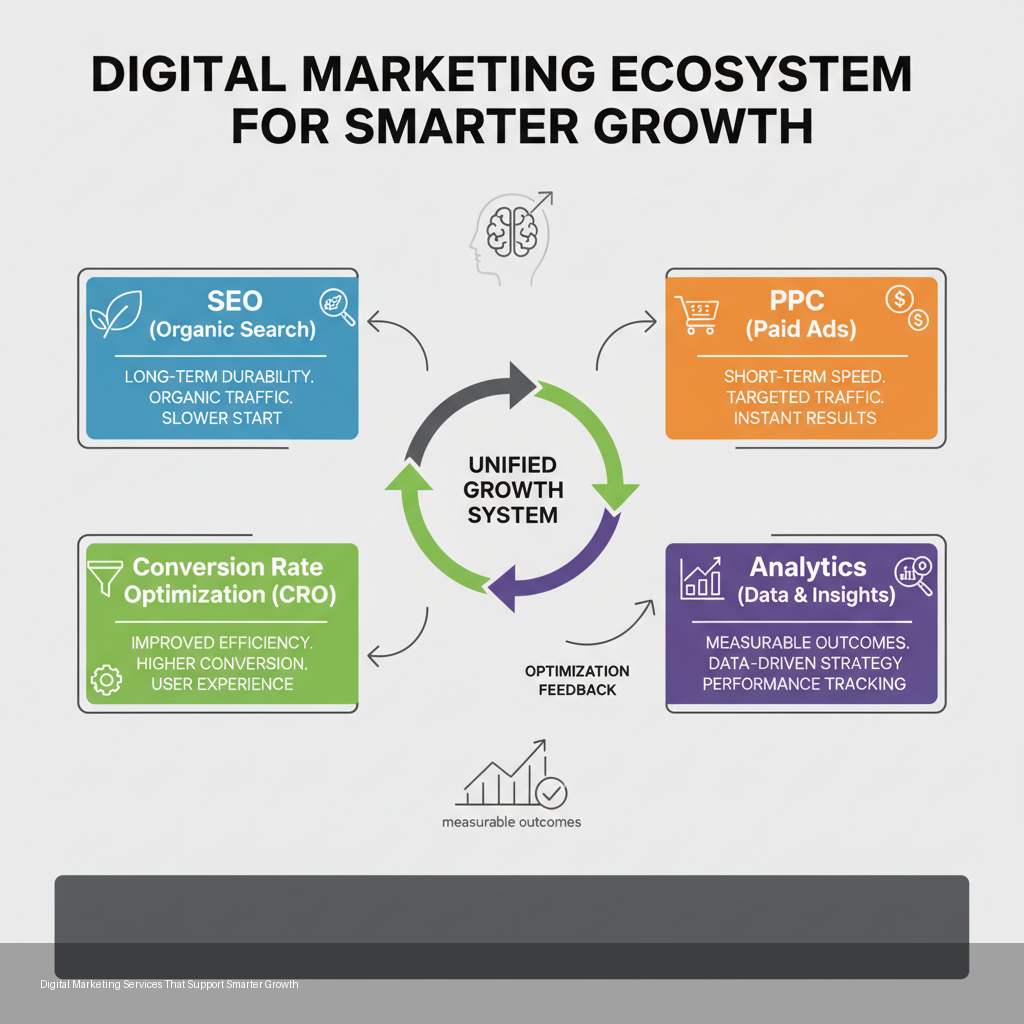
Digital Marketing Services That Support Smarter Growth
Digital marketing services are coordinated activities that help a business attract qualified visitors, turn those visitors into leads or sales, and measure which channels are actually contributing to growth. The core pieces usually include search engine optimization, paid search, website improvements, content, social media, conversion tracking, and reporting. A strong program connects those pieces so the business can see which campaigns create calls, form submissions, purchases, or other meaningful actions.
For many business owners, the confusing part is not whether digital marketing has value. The harder question is how each channel should work together. SEO may build visibility over time, Google Ads may create demand faster, and conversion rate optimization may help the same traffic produce more enquiries. The right mix depends on your sales cycle, margins, website quality, competition, and how quickly you need feedback from the market.
Zigma Internet Marketing supports businesses with strategy and execution across Digital Marketing Services, SEO, PPC, web design, content, social media, analytics, and conversion improvement. The goal is not activity for its own sake. The goal is a clear system that connects marketing work to business outcomes.
Quick Facts: Digital Marketing Services
The short version, in plain business terms.
- What: Digital marketing services combine SEO, paid ads, content, website improvements, tracking, and reporting into a coordinated growth system.
- Who: These services fit businesses that need more qualified enquiries, clearer attribution, stronger website performance, or better campaign accountability.
- Where: Campaigns can support search engines, social platforms, websites, landing pages, email journeys, shopping feeds, and analytics dashboards.
- How: A practical plan usually includes keyword research, audience targeting, conversion tracking, landing page testing, content planning, and monthly performance review.
- Why: The main purpose is to reduce wasted spend, increase qualified traffic, and make marketing decisions using evidence instead of assumptions.
How digital marketing services actually fit together
Digital marketing works best as a connected system. SEO helps a website earn visibility for searches that reflect intent. PPC places ads in front of people who are actively searching or fit a defined audience profile. Content gives search engines and users clear information. Web design and development make the site easier to navigate, faster to use, and better aligned with conversion goals.
Tracking is the piece that holds the system accountable. Without analytics, call tracking, form tracking, and platform reporting, a business may see clicks without knowing whether those clicks produced qualified enquiries. A campaign can look healthy on the surface while leaking value because forms are too long, landing pages load slowly, or the wrong keywords are attracting low-fit visitors.
A complete service plan may include SEO Services, technical SEO, Google Ads management, landing pages, content strategy, social campaigns, and dashboards. The sequence usually starts with business goals, then moves into channel selection, tracking setup, campaign launch, and ongoing refinement.
Which digital marketing services fit different growth needs?
Different services solve different business problems. The useful question is not “Which channel is strongest?” A better question is: which channel addresses the constraint holding growth back right now?
Search visibility versus paid visibility
A) SEO: Search engine optimization improves a website’s ability to appear for relevant unpaid search queries. It usually needs patience, but it can create durable visibility when the technical foundation, content, and authority signals are handled well.
- How it works: SEO improves crawlability, content relevance, internal linking, page experience, and authority signals so search engines can understand and rank the site more confidently.
- Best fit: SEO fits businesses that want long-term visibility, stronger organic lead flow, and reduced dependence on paid traffic over time.
- Example: A service business may build dedicated pages for its core services, improve page speed, and publish useful content that answers buyer questions.
B) PPC: Pay-per-click advertising places paid listings on search engines or social platforms. It can generate faster traffic than SEO, but it needs careful query control, audience refinement, budget monitoring, and conversion tracking.
- How it works: PPC uses bids, keywords, audiences, ad copy, landing pages, and tracking data to show ads to defined searchers or audience groups.
- Best fit: PPC fits launches, seasonal pushes, high-intent service categories, remarketing, and campaigns that need faster feedback.
- Example: A company may run search ads for high-intent queries while testing landing page headlines, form length, and call tracking quality.
C) SEO and PPC together: Combining SEO and PPC can give a business both immediate data and longer-term visibility. Paid campaigns can reveal which terms convert, while SEO can build durable assets around the strongest themes.
- How it works: PPC data can inform SEO content priorities, while SEO insights can improve landing page relevance and reduce waste in paid campaigns.
- Best fit: A combined plan fits businesses that need both short-term lead flow and a stronger search presence over the next several months.
- Example: Search term reports may show profitable queries that deserve dedicated organic pages and stronger internal links.
Traffic generation versus conversion improvement
A) Traffic campaigns: Traffic-focused campaigns aim to bring more qualified visitors to a website or landing page. SEO, Google Ads, social ads, and content distribution often sit in this category.
- How it works: Campaigns target search queries, audiences, placements, or content themes that match user intent and business goals.
- Best fit: Traffic campaigns fit businesses with a sound website that already turns visitors into enquiries at an acceptable rate.
- Example: A business with strong landing pages may increase paid search coverage to capture more high-intent demand.
B) Conversion rate optimization: Conversion rate optimization focuses on getting more value from existing traffic. CRO may address page structure, forms, calls to action, trust signals, page speed, and message clarity.
- How it works: CRO uses analytics, behaviour patterns, testing, and page improvements to reduce friction between visitor intent and enquiry action.
- Best fit: CRO fits websites that receive traffic but produce fewer calls, forms, purchases, or booked consultations than expected.
- Example: A landing page may improve by moving proof points higher, simplifying the form, and clarifying the offer above the fold.
C) Website development and technical SEO: Website development supports both acquisition and conversion when the build is fast, crawlable, secure, and easy to update. WordPress and Shopify sites often need both design thinking and technical SEO care.
- How it works: Development work may improve site structure, templates, schema, product feeds, Core Web Vitals, internal linking, and conversion paths.
- Best fit: Technical work fits businesses with slow pages, thin service pages, indexing issues, messy product data, or outdated site architecture.
- Example: An e-commerce store may improve collection pages, fix product feed issues, and create cleaner tracking for purchases and revenue.
Campaign execution versus measurement discipline
A) Channel execution: Channel execution includes the practical work of building ads, writing content, improving pages, publishing campaigns, and managing platform settings.
- How it works: Specialists manage the visible campaign assets and keep them aligned with search intent, audience fit, and conversion goals.
- Best fit: Execution support fits businesses that have a plan but need consistent implementation and optimization cycles.
- Example: A team may refresh ad copy, add negative keywords, build new service pages, and publish SEO content each month.
B) Analytics setup: Analytics setup defines which actions count as conversions and how those actions are reported. This work can include GA4, Google Tag Manager, call tracking, dashboards, and attribution review.
- How it works: Tracking tools connect user actions to marketing channels so teams can evaluate lead quality, campaign efficiency, and revenue contribution.
- Best fit: Analytics support fits businesses that see traffic and leads but cannot confidently connect marketing activity to outcomes.
- Example: A dashboard may separate phone calls, quote forms, purchases, newsletter signups, and low-value actions instead of treating every event equally.
C) Performance reporting: Reporting turns raw numbers into decisions. Useful reports explain what changed, why it likely changed, and which action should happen next.
- How it works: Reporting reviews KPIs such as qualified leads, conversion rate, cost per lead, search visibility, revenue, and landing page performance.
- Best fit: Reporting support fits businesses that need clearer conversations about spend, lead quality, and campaign priorities.
- Example: A report may show that total leads rose, but qualified leads came from only a small group of keywords and landing pages.
How to choose the right digital marketing partner
A good agency conversation should start with business goals, not channel preferences. Before recommending SEO, PPC, content, or website changes, the agency should understand your sales process, lead quality standards, average closing cycle, capacity limits, and current tracking setup. A campaign that increases low-fit leads can create operational strain rather than useful growth.
Ask how the agency defines success. Traffic and impressions can be useful diagnostic signals, but they do not tell the whole story. For lead generation, stronger indicators include qualified calls, form submissions, booked consultations, cost per qualified lead, and close-rate feedback from the sales team. For e-commerce, product feed quality, purchase tracking, average order value, and repeat purchase patterns may shape the plan.
Also check whether the agency can implement the work it recommends. Strategy loses value when technical fixes, landing pages, tracking updates, or content revisions sit untouched for months. A practical digital marketing partner should be able to connect diagnosis with execution.
Questions worth asking before you commit
- How will conversions be tracked? The answer should include specific actions such as calls, forms, purchases, booked meetings, or high-intent clicks.
- Which channels should come first? The recommendation should connect to your sales cycle, competition, existing website condition, and need for speed.
- How will lead quality be reviewed? Strong reporting should include feedback loops, not only platform metrics.
- Who implements technical changes? Clarify whether the agency handles development, analytics, landing pages, and content updates directly.
- What happens after launch? Campaigns need review cycles for search terms, negative keywords, content gaps, page performance, and conversion data.
What affects ROI in modern digital campaigns?
Return from digital marketing is shaped by more than clicks and rankings. A campaign can bring the right visitors to the wrong page, or the right enquiries to a sales process that does not respond quickly enough. ROI becomes easier to improve when the full path is reviewed: search intent, ad message, landing page, form experience, tracking quality, and sales follow-up.
Useful measurement often starts with 3 to 5 primary conversion actions. For a service business, those actions may include phone calls, quote forms, consultation requests, and high-intent contact page visits. For an online store, primary actions may include add-to-cart events, purchases, product feed performance, and revenue by campaign. Secondary actions can still be tracked, but they should not be treated as equal to revenue-linked events.
Campaigns also need enough time and data to separate signal from noise. PPC can produce directional data within days or weeks, while SEO usually needs longer because crawling, indexing, content quality, and authority signals develop over time. The practical rhythm is to review early data frequently, make controlled changes, and avoid rewriting the strategy every time a short-term fluctuation appears.
ROI pressure points to review first
- Search intent fit: Keywords and audiences should match the buyer stage your campaign is meant to influence.
- Landing page clarity: A page should quickly explain the service, proof points, next step, and reason to trust the business.
- Tracking accuracy: Broken tags, duplicated conversions, or untracked phone calls can distort decisions.
- Lead quality feedback: Marketing teams need to know which enquiries become real opportunities, not just which forms were submitted.
- Budget allocation: Spend should move toward campaigns, queries, products, and pages that show stronger business contribution.
SEO versus PPC: when each channel makes sense
SEO and PPC are often compared as if one must replace the other. A more useful comparison is speed versus durability. PPC can create faster visibility and clearer testing data, but the traffic stops when budget stops. SEO usually takes longer, but strong pages can continue attracting qualified visitors after the initial work is completed and maintained.
Google Ads Management may be the better early move when a business needs immediate campaign data, has a high-intent service, or wants to test messaging before investing heavily in content. SEO may be the better foundation when search demand is stable, the website has content gaps, and the business wants to build a stronger asset over time.
The strongest plan may use PPC to test which queries, offers, and landing pages convert, then use those insights to guide SEO content and website structure. That creates a feedback loop: paid search reveals demand patterns, organic content captures recurring intent, and conversion data shows which pages deserve more attention.
Simple channel fit comparison
- Use SEO when: You need durable visibility, have time to build authority, and want stronger content assets across core services.
- Use PPC when: You need faster traffic, have clear conversion tracking, and can actively manage search terms, budgets, and landing pages.
- Use both when: You want short-term data and long-term visibility working from the same keyword and conversion insights.
How smaller businesses can compete online
Smaller businesses do not need to outspend larger competitors in every channel. They need sharper focus. That usually means choosing the services, audiences, and conversion actions that can realistically create revenue, then building campaigns around those priorities instead of spreading effort too thin.
Website quality plays a major role here. A smaller business with clear service pages, strong calls to action, fast load times, useful content, and accurate tracking can often make better decisions than a larger competitor that spends heavily without diagnosing friction. Execution discipline can narrow the gap.
Website Design & Development also affects search performance, paid media efficiency, and conversion quality. If a campaign sends visitors to a slow page with unclear messaging, even strong traffic can underperform. Better pages give every channel a fairer chance.
Practical moves that improve competitiveness
- Build pages around specific services: Dedicated pages usually perform better than vague pages that try to cover every offer at once.
- Use paid search data carefully: Search term reports can reveal profitable language, poor-fit queries, and new content priorities.
- Improve the first screen of key pages: Visitors should understand the service, proof, and next step without searching through the page.
- Track real conversions: Calls, forms, purchases, and booked meetings should be separated from low-intent engagement signals.
- Review campaigns on a consistent cycle: Weekly and monthly checks help catch wasted spend, technical issues, and content gaps early.
What experienced marketers check before scaling spend
Scaling a campaign before the foundation is ready can amplify waste. Before adding budget, experienced marketers usually check whether tracking is accurate, landing pages are converting, search terms are relevant, and lead quality feedback is being used. More spend does not fix a weak conversion path.
For PPC, early checks may include negative keyword coverage, match type performance, ad-to-landing-page alignment, call tracking, and conversion duplication. For SEO, early checks may include indexation, title and heading clarity, internal linking, technical errors, content depth, and whether service pages match real search intent.
For content and social campaigns, the review is slightly different. The question is whether the content supports a clear business path. Helpful posts, videos, and social campaigns should connect to service pages, lead magnets, product pages, or remarketing audiences instead of sitting apart from the main conversion system.
Trustworthy digital marketing services use clear measurement
Trust in digital marketing comes from transparent reporting, practical implementation, and honest discussion about what the data does and does not show. Zigma Internet Marketing brings Google Partner-certified expertise and full-service delivery across SEO, PPC, web, content, analytics, and social media marketing. That combination is useful because campaign recommendations can be tied to implementation details such as tracking, landing pages, technical SEO, and CRO.
A reliable reporting process should answer three questions: what changed, why it likely changed, and what should happen next. If a report only lists clicks and rankings, it may not be enough for business decisions. If a report connects spend, conversions, lead quality, landing page behaviour, and next actions, it becomes a management tool.
If you want a clearer view of which channels fit your business, you can ask Zigma Internet Marketing for a strategy review. You can also reach the team by phone at (647) 556-6071 or by email at info@zigma.ca.
FAQs About digital marketing services
PPC can often produce early directional data within days or weeks, especially when tracking is set up properly. SEO usually needs a longer evaluation window because technical improvements, content changes, crawling, indexing, and authority signals take time to influence visibility.
The starting point should come from the biggest constraint. If the website has traffic but few enquiries, conversion rate optimization may come first. If the site lacks visibility, SEO may be the priority. If faster market feedback is needed, PPC may be more practical.
SEO and PPC can support each other when the data is shared. PPC search terms can reveal high-converting language for SEO content, while SEO landing page insights can improve paid campaign relevance, quality, and conversion paths.
Campaign performance should be judged by business outcomes, not only traffic. Useful signals include qualified calls, form submissions, purchases, booked consultations, cost per qualified lead, conversion rate, revenue contribution, and lead quality feedback from the sales process.
Digital marketing can reveal where a website is weak, but traffic alone will not fix poor page speed, unclear messaging, broken tracking, or confusing forms. Website improvements and conversion work often need to happen alongside SEO or paid campaigns.
Clearer marketing decisions start with better inputs
Digital marketing becomes easier to manage when every channel has a role, every conversion is tracked properly, and every report leads to a decision. SEO, PPC, content, web design, CRO, and analytics should not compete for attention inside a business. They should work as connected parts of one growth system.
The most useful next step is often a simple audit of the current foundation: which services are being promoted, which pages receive traffic, which actions are tracked, and which leads become real opportunities. Once those inputs are clear, the marketing plan becomes much easier to prioritize.

