


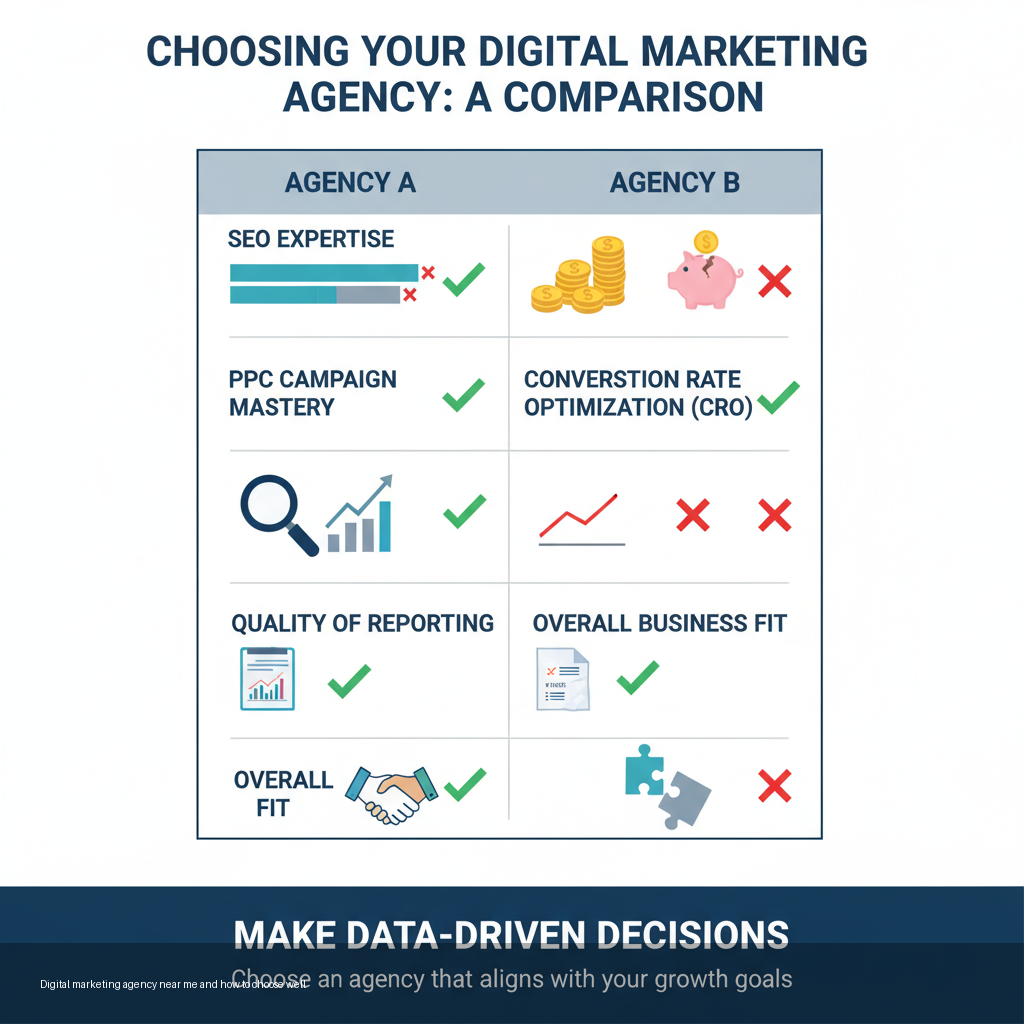
A digital marketing agency near me search is useful when you want a marketing partner that can understand your business, clarify your goals, and manage execution across search, ads, websites, content, and reporting. The search result alone does not tell you whether an agency can improve lead quality, lower wasted ad spend, or connect campaign activity to sales outcomes. A better decision comes from knowing what to ask, what to review, and which warning signs to take seriously.
For business owners, the hard part is rarely finding agencies. The harder part is separating strong operators from teams that only show dashboards, impressions, and vague traffic growth. A capable digital marketing agency should explain how each channel supports a business goal, how tracking will be set up, and how campaign decisions will be made after data starts coming in.
How to assess a digital marketing agency near me without guessing
The phrase “near me” can make digital marketing feel like a location-first decision, but agency fit should be judged by capability, communication, and accountability. A close agency with weak tracking can still waste budget. A capable agency should be able to show how search visibility, paid media, landing pages, and analytics work together to generate measurable demand.
Start by asking whether the agency can explain your current marketing situation in plain language. If your website has low conversion rates, stronger ads alone may not fix the issue. If your ad account has broad match waste, new landing pages may help, but search terms and negative keywords also need attention. If your SEO traffic is growing but leads are poor, content intent and page structure may be misaligned.
A practical review should include:
- Channel fit: The agency should explain whether SEO, PPC, content, social campaigns, or website improvements should carry the first phase of work.
- Tracking quality: Calls, forms, purchases, booked consultations, and qualified lead events should be measured before major campaign changes are judged.
- Decision cadence: The agency should describe how often campaigns are reviewed and which signals lead to changes.
- Business context: Reporting should connect marketing activity to revenue-related outcomes, not only clicks and rankings.
What a qualified digital marketing agency actually handles
A full-service digital marketing agency manages strategy and execution across the parts of the funnel that influence demand. That usually includes search engine optimization, paid search, website performance, landing pages, content planning, social advertising, analytics, and conversion rate optimization. Each discipline affects the others. Poor technical SEO can limit content performance, weak landing pages can raise paid acquisition costs, and incomplete tracking can make a strong campaign look weak.
For example, SEO Services should go beyond publishing pages. Strong SEO work includes technical cleanup, internal linking, content intent mapping, structured data, page speed review, and ongoing performance analysis. The goal is to earn qualified visibility for searches that indicate real buyer interest.
Paid media needs the same discipline. Google Ads Management should include query review, negative keyword work, conversion tracking, ad testing, audience segmentation, landing page feedback, and budget allocation based on performance. Without those controls, paid search can produce traffic that looks active but does not create enough sales conversations.
Website work also belongs in the discussion. A clean Website Design & Development plan should support crawlability, page speed, mobile usability, accessibility, and conversion paths. A campaign can bring qualified visitors to a site, but the site still has to answer questions, reduce hesitation, and make the next step clear.
Quick Facts: Digital marketing agency near me
A fast read before comparing agencies.
- What: A digital marketing agency plans and manages SEO, paid ads, content, websites, analytics, and conversion improvements.
- Who: The right fit usually serves business owners, marketing managers, e-commerce teams, and service companies that need measurable lead or sales growth.
- How: Strong work starts with tracking setup, account audits, keyword and audience research, page improvements, campaign testing, and clear reporting.
- Watch: Be cautious if an agency promises rankings, avoids explaining data, or reports only traffic without lead quality.
- Outcome: Better agency selection can improve visibility, reduce wasted spend, and make marketing decisions easier to defend.
How to Choose the Right Digital Marketing Agency
Choosing an agency should feel like hiring an operating partner, not buying a package. The right team will ask about margins, sales capacity, lead handling, website constraints, seasonality, and past campaign performance before recommending a channel mix. Those questions reveal whether the agency is thinking about your business model or simply selling services.
A strong agency should also be comfortable explaining trade-offs. SEO can build durable visibility, but it needs content depth, technical quality, and time. PPC can generate faster data, but poor targeting or weak landing pages can burn budget. Social media can support awareness and retargeting, but it may not replace high-intent search for every business.
Questions worth asking before you decide
- How will success be measured? Look for answers tied to qualified leads, sales, booked calls, cost per acquisition, or e-commerce revenue rather than only impressions.
- Who performs the work? Ask whether SEO audits, ad management, copywriting, development, and reporting are handled by specialists or passed between disconnected vendors.
- What happens in the first month? A serious team usually prioritizes analytics, account access, technical review, conversion tracking, and fast fixes before scaling spend.
- How are recommendations explained? The agency should connect each action to a business reason, such as improving lead quality, reducing wasted clicks, or fixing pages that lose visitors.
- What will reports show? Useful reports connect channel activity to outcomes and include commentary on what changed, why it changed, and what comes next.
What Impacts ROI in Modern Digital Campaigns
Marketing ROI is shaped by more than ad spend or keyword rankings. The largest differences often come from tracking accuracy, offer clarity, landing page quality, sales follow-up, and campaign discipline. If a form submission is counted as a lead but half of those submissions are spam, the campaign report will overstate performance. If phone calls are not tracked, the same campaign may be undervalued.
Campaign ROI also depends on the gap between traffic intent and page experience. A visitor searching for a specific service expects a page that answers pricing factors, process, proof, timing, and next steps. Sending that visitor to a generic homepage creates friction. The visitor has to search again inside the site, and many will leave before taking action.
Signals that usually affect returns
- Conversion tracking: GA4, Google Tag Manager, call tracking, form tracking, and e-commerce events should be configured before decisions are made from campaign data.
- Search intent match: Pages should align with the reason behind a query, whether the visitor is researching, comparing, or ready to speak with a provider.
- Landing page structure: Strong pages answer objections, show service fit, reduce distractions, and make forms or calls easy to complete.
- Budget control: PPC campaigns need regular query review, negative keywords, audience refinement, and bid adjustments based on actual outcomes.
- Sales feedback: Marketing teams need to know which leads became real conversations, which were poor fit, and which channel produced the strongest opportunities.
SEO vs PPC: When to Use Each Strategy
SEO and PPC solve different timing problems. SEO is usually stronger for compounding visibility, brand trust, and lower reliance on paid traffic over time. PPC is useful when a business needs faster testing, immediate search exposure, or data about which keywords and offers produce qualified leads.
The two channels often work better together than apart. PPC can reveal which search terms convert before a company invests heavily in long-form content. SEO pages can improve Quality Score alignment and support paid landing page planning. Analytics can show whether visitors who first arrived through ads later convert through organic search or direct visits.
A practical comparison
- Use SEO when: Your business has a long-term service line, repeat search demand, and the ability to publish or improve pages consistently.
- Use PPC when: You need faster feedback, want to test offers, or need visibility for high-intent searches while organic pages gain traction.
- Use both when: Search demand is competitive, the sales value supports investment, and your website can convert visitors from multiple channels.
The deciding question is simple: do you need speed, durability, or both? The answer shapes how budget, content, technical SEO, landing pages, and reporting should be prioritized.
How Businesses Can Compete Online Without Overspending
Smaller teams can compete online by narrowing focus. A broad campaign that targets every service, audience, and keyword usually spreads effort too thin. A focused campaign starts with the pages, offers, and search terms most likely to produce qualified conversations.
Content quality also matters more than volume. Publishing many thin pages can create crawl waste and weak user experience. A smaller set of useful pages, supported by technical SEO services, internal links, clear calls to action, and specific proof points, usually gives search engines and visitors a stronger reason to trust the site.
Practical ways to focus effort
- Prioritize high-intent pages: Build service pages around searches that indicate a real need, then support those pages with helpful articles and FAQs.
- Fix tracking before scaling: Better data prevents poor budget decisions and helps identify which campaigns produce real sales conversations.
- Improve conversion paths: Shorter forms, clearer page sections, faster load times, and stronger proof can raise lead volume without increasing traffic.
- Use content strategically: Content marketing should answer buyer questions, support SEO, and give sales teams stronger material to share with prospects.
- Review reporting with context: A ranking gain or lower cost per click only has value when it moves the business closer to qualified demand.
Trust signals to check before hiring a digital marketing agency
Trust should be visible in how an agency works. Look for clear reporting, defined KPIs, practical implementation support, and the ability to explain both wins and problems. Zigma Internet Marketing brings Google Partner-certified expertise, full-service execution across SEO, PPC, web, content, and social media, and reporting that connects campaign activity to business outcomes.
If you want a second set of eyes on your current SEO, PPC, website, or analytics setup, you can ask a focused question and get direction on what to review first.
FAQs About digital marketing agency near me
Compare agencies by reviewing their tracking process, reporting quality, service depth, and ability to explain channel trade-offs. A strong agency should connect SEO, PPC, website performance, content, and analytics to qualified leads or sales outcomes.
At minimum, the agency should understand SEO, paid search, landing pages, conversion tracking, analytics, and reporting. Even if you start with one channel, the team should know how website quality and tracking affect campaign performance.
Use PPC for faster testing and immediate search visibility. Use SEO for durable visibility and long-term search demand. Use both when you need faster data now while building organic pages that can support future lead flow.
Useful data can appear once tracking is accurate and campaigns have enough activity to reveal patterns. Early signals often include search terms, conversion paths, landing page engagement, and lead quality feedback from the sales team.
Honest reporting explains what changed, why it changed, and what the team recommends next. Be cautious with reports that only show impressions, clicks, or rankings without connecting those numbers to qualified leads, sales, or conversion quality.
Related Topics:

