


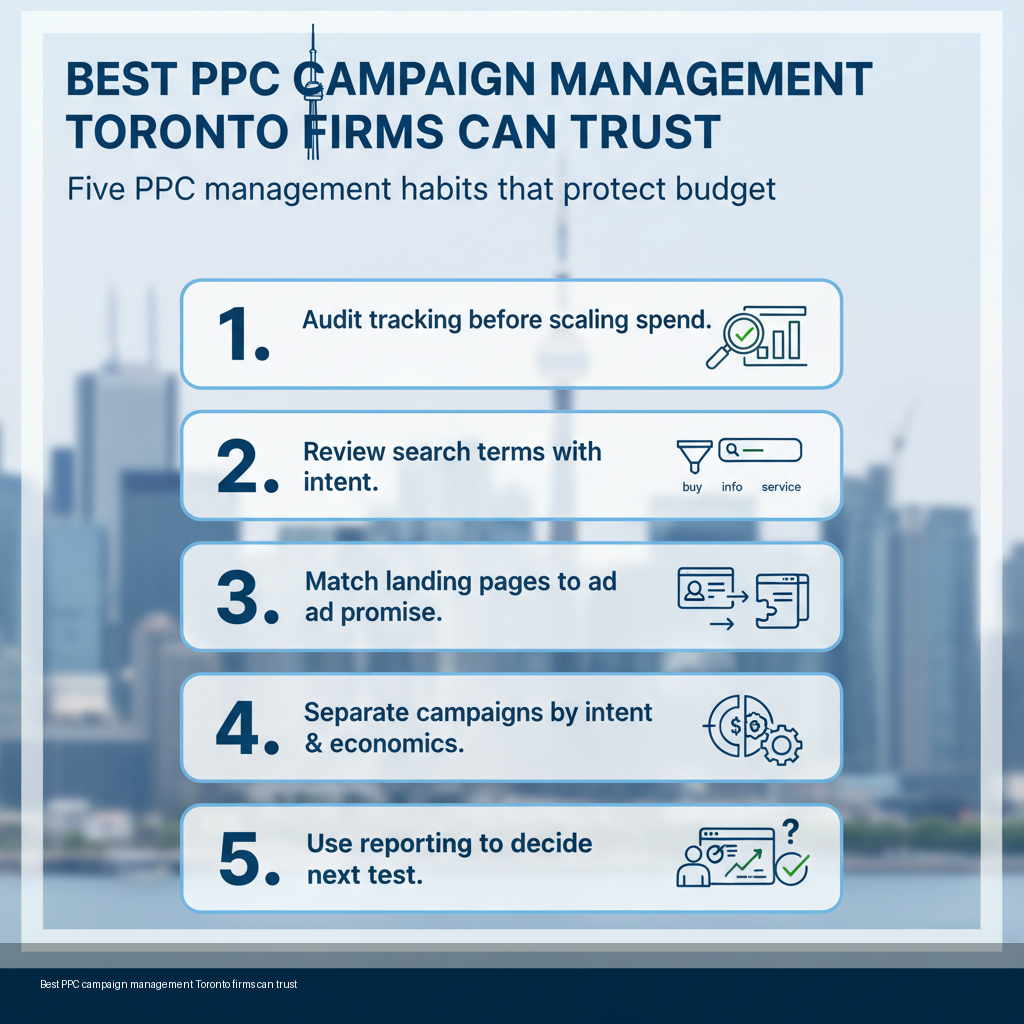
Best PPC campaign management Toronto firms can trust
Choosing paid search without wasting the first few months
Best PPC campaign management Toronto searches usually come from business owners who are spending on Google Ads, planning to spend, or comparing agencies before budget goes live. The right paid search partner should be able to explain where your money is going, which searches are producing leads, and which campaign changes are improving cost per acquisition. For Toronto, Ontario businesses, PPC management is not only about building ads; it is about aligning search intent, tracking, landing pages, and sales follow-up.
A strong PPC program connects keyword targeting, negative keywords, ad copy, bid strategy, conversion tracking, and landing page performance. Without those pieces working together, a campaign can look active while quietly paying for weak clicks. Zigma Internet Marketing approaches PPC with that full path in mind, supported by Google Ads Management, analytics setup, SEO, web design, and conversion rate optimization.
Quick Facts: Best PPC Campaign Management Toronto
The short version for business owners comparing paid search support.
- What: PPC campaign management covers account structure, search terms, ad copy, bidding, landing pages, conversion tracking, and reporting.
- Who: Toronto businesses that rely on calls, forms, bookings, or e-commerce sales often need stronger oversight than a basic campaign setup.
- Where: Campaigns may target downtown Toronto, North York, Scarborough, Etobicoke, the GTA, or specific service areas based on actual sales coverage.
- How: Effective management uses query review, negative keywords, audience signals, conversion data, A/B testing, and landing page improvements.
- Why: Good PPC management helps reduce wasted spend, improve lead quality, and connect ad budget to business outcomes.
What the best PPC campaign management Toronto teams actually manage
PPC, or pay-per-click advertising, means a business pays when someone clicks an ad on a platform such as Google Ads. Search campaigns appear when people type queries into Google, while display, shopping, remarketing, YouTube, and Performance Max campaigns use different placements and signals. A capable ppc agency toronto businesses can rely on should explain which campaign type fits the buying stage, not simply activate every available format.
Good management starts before ads run. Conversion actions must be defined, call tracking should be checked, forms should be tested, and landing pages should match the promise made in the ad. If a law firm tracks every page visit as a conversion, or a contractor sends all paid traffic to a slow generic homepage, the campaign data will mislead decision-making.
Zigma Internet Marketing connects PPC with SEO Services, landing page strategy, and analytics because paid search rarely performs well in isolation. Search engine marketing sem can bring traffic quickly, but weak tracking and poor page experience can make the numbers look better than the business reality.
Why Toronto, Ontario campaigns need tighter local control
Toronto, Ontario is a dense and expensive paid search market across legal, home services, healthcare, professional services, education, real estate, and e-commerce. A campaign targeting “Toronto” too broadly may attract clicks from users outside a practical service area, job seekers, researchers, or people comparing services with no buying intent. Local control means campaign settings and search terms must reflect how the business actually sells.
For a company serving Liberty Village, North York, Scarborough, Etobicoke, and nearby GTA areas, the correct location setup may differ from a brand that only serves downtown appointments or only ships products across Canada. A digital marketing agency toronto businesses hire should ask about territory, sales capacity, margins, and lead handling before building campaigns. Those details shape keywords, bids, schedules, and landing pages.
How paid search choices affect lead quality
Different PPC campaign structures create different trade-offs. A focused search campaign may produce fewer clicks but stronger buying intent. A broad automated campaign may create more volume, but it needs clean conversion data and regular review to prevent budget drift. The best ppc campaign management toronto companies choose usually balances control with enough data for the platform to optimize responsibly.
Search campaigns versus automated campaigns
A) Search campaigns: Search campaigns target people typing specific phrases into Google. They give advertisers more visibility into queries and intent.
- How it works: Ads trigger from selected keywords, match types, bidding settings, and search intent signals.
- Best fit: This fits service businesses that need high-intent calls, quote forms, consultations, or appointment requests.
- Example: A clinic may target procedure-specific searches in Toronto while excluding research terms and unrelated job queries.
B) Performance Max: Performance Max can reach users across Search, Display, YouTube, Gmail, Maps, and other Google placements. It needs accurate conversion data to avoid chasing weak signals.
- How it works: Google uses assets, audience signals, product feeds, and conversion data to distribute budget across placements.
- Best fit: This fits e-commerce brands or lead generation accounts with strong tracking and enough conversion volume.
- Example: A Shopify brand may use Performance Max with product feed optimization and separate campaigns for margin-sensitive categories.
C) Remarketing campaigns: Remarketing targets people who previously visited a website or interacted with a brand. It supports longer sales cycles when users need more than one touchpoint.
- How it works: Audiences are built from website visits, customer lists, video views, or specific behaviour tracked through tags.
- Best fit: This fits businesses with considered purchases, repeat visits, or longer decision windows.
- Example: A B2B firm may retarget visitors who viewed a service page but did not submit a consultation form.
Lead generation versus e-commerce PPC
A) Lead generation ads: Lead generation ads aim to create calls, form submissions, bookings, or consultation requests. The quality of the lead is often more important than the total count.
- How it works: Campaigns are judged through conversion tracking, call duration, form quality, close rate feedback, and cost per qualified lead.
- Best fit: This fits contractors, clinics, lawyers, accountants, B2B firms, and local service businesses.
- Example: A home service company may reduce spend on general “near me” searches if calls are mostly price shoppers outside its service area.
B) E-commerce ads: E-commerce campaigns need product feeds, shopping ads, merchant centre accuracy, and revenue-based tracking. Product-level profitability often shapes campaign decisions.
- How it works: Google Merchant Center, shopping feeds, campaign segmentation, and revenue tracking connect ad spend to product performance.
- Best fit: This fits Shopify and other online stores with clear product categories, inventory, margins, and shipping coverage.
- Example: A Toronto retailer may separate high-margin products from clearance items so bidding does not treat all revenue equally.
C) Hybrid campaigns: Some businesses need both lead and sales tracking. Mixed models require careful measurement so the campaign does not overvalue easy but low-value conversions.
- How it works: Multiple conversion actions are tracked, but only the most valuable actions should guide bidding decisions.
- Best fit: This fits brands selling online while also driving calls, demos, showroom visits, or distributor inquiries.
- Example: A manufacturer may track catalogue downloads separately from sales inquiries because both actions do not carry the same value.
Account setup versus ongoing management
A) Basic setup: A basic setup creates campaigns, ads, keywords, and core settings. It may be enough for a short test, but it rarely fixes poor tracking or landing page friction.
- How it works: The account is built once, then performance depends on the quality of the initial structure and tracking.
- Best fit: This fits small tests where the business already has strong tracking and a clear landing page path.
- Example: A seasonal campaign may need a focused launch structure but still require search term checks after traffic begins.
B) Active management: Active management reviews data, filters poor queries, tests ads, adjusts bids, and improves landing pages. The work happens after the first clicks arrive.
- How it works: The manager reviews search terms, conversion patterns, budget pacing, campaign segmentation, and lead quality.
- Best fit: This fits businesses that need PPC to become a repeatable acquisition channel, not a one-time experiment.
- Example: A professional services firm may refine campaigns weekly after seeing which search terms produce booked consultations.
C) Integrated growth management: Integrated management connects PPC with landing pages, CRO, technical tracking, SEO, and reporting. This is usually where deeper gains are found.
- How it works: Campaign data informs page changes, content strategy, analytics dashboards, and sales feedback loops.
- Best fit: This fits companies that need clearer attribution and steady improvement across multiple marketing channels.
- Example: A lead generation agency toronto campaign may reveal that a dedicated landing page converts better than a general services page.
How to choose a PPC partner without relying on pitch decks
A good Google Ads partner should be comfortable showing how decisions are made. Ask how the agency handles negative keywords, match types, conversion tracking, landing page testing, and reporting. A vague answer usually means the account will be managed through surface-level adjustments rather than meaningful analysis.
Business owners should also ask who will review the account and how often campaign insights will be translated into business language. Impressions and clicks are useful, but they do not answer the bigger question: did the campaign produce inquiries that the sales team could realistically convert?
Questions worth asking before signing
- Tracking: Ask whether the agency will audit GA4 setup, Google Tag Manager, call tracking, form tracking, and conversion attribution before judging campaign performance.
- Search terms: Ask how often search queries are reviewed and how negative keywords are added to reduce irrelevant spend.
- Landing pages: Ask whether the agency can improve page speed, form layout, trust signals, and conversion rate optimization toronto campaigns often require.
- Reporting: Ask whether reports connect spend to calls, forms, sales, cost per lead, and other practical KPIs.
- Channel fit: Ask how PPC will work alongside seo company toronto support, content marketing toronto plans, and broader online marketing toronto activity.
What affects returns in modern PPC campaigns
PPC return is shaped by more than bid settings. A campaign with accurate tracking, strong landing pages, and fast lead response can outperform a larger campaign with weak follow-up. In competitive Toronto searches, small gaps in the conversion path can become expensive because every wasted click has a real cost.
Several variables deserve attention before campaign performance is judged. Search intent controls whether users are ready to act. Landing page relevance affects whether visitors stay. Sales team response time can influence whether a paid lead becomes revenue. Analytics accuracy determines whether the campaign manager is improving the right signals.
Core performance drivers
- Query quality: Search terms should match buyer intent, not just traffic volume.
- Conversion tracking: Calls, forms, purchases, and booked appointments need clean measurement through ga4 setup and google tag manager.
- Landing page clarity: The page should match the ad, answer the user’s concern, and make the next step obvious without clutter.
- Budget allocation: Spend should move toward campaigns and services that produce qualified outcomes, not just cheaper clicks.
- Feedback loops: Sales notes, CRM data, and call quality reviews can reveal which campaigns produce real prospects.
SEO and PPC work differently, and timing counts
SEO and PPC solve different growth problems. PPC can create traffic quickly once campaigns and tracking are live, which is useful for urgent lead flow, new service launches, seasonal campaigns, and market testing. SEO usually builds visibility over a longer period through technical improvements, content, authority, and local relevance.
A business should not treat SEO and PPC as rivals. Paid search can reveal which keywords produce valuable inquiries, while SEO can reduce long-term dependence on paid clicks for recurring searches. Zigma often connects google ads management toronto work with seo services toronto planning so paid and organic insights strengthen each other.
Practical channel fit
- Use PPC for speed: Paid campaigns are useful when a business needs traffic for a new service, seasonal push, or tested offer.
- Use SEO for compounding visibility: Search engine optimization supports long-term rankings, technical health, content depth, and local seo gta growth.
- Use both for better data: PPC query data can shape SEO content, while organic landing page insights can improve paid conversion paths.
- Measure separately: PPC and SEO should have distinct KPIs, even when both channels support the same sales goal.
How local businesses in Toronto can compete online
Local competition in Toronto, Ontario is often uneven. A smaller business may compete against national brands, marketplaces, directories, franchises, and well-funded local firms on the same results page. Strong PPC management helps a smaller advertiser compete by narrowing the target, improving relevance, and avoiding searches that do not fit the business model.
Local businesses should align ads with service area reality. A company serving Scarborough and Markham may not benefit from spending heavily in west-end searches. A professional services firm near the Financial District may need business-hour bid adjustments, call tracking, and landing pages that speak to specific industries rather than generic visitors.
Toronto-specific controls to review
- Location settings: Campaigns should distinguish between people physically in the target area and people merely interested in that area.
- Service-area language: Ads and landing pages should match the neighbourhoods, nearby cities, and appointment formats the business truly supports.
- Google Business Profile alignment: PPC, local SEO, and google business profile optimization should reinforce the same service categories and contact paths.
- Website quality: Website design toronto work may be needed if paid traffic reaches slow, unclear, or mobile-frustrating pages.
- Technical foundation: Technical seo services, page speed, form reliability, and mobile usability can affect both paid and organic performance.
Behind the scenes of PPC accounts that improve over time
Paid search accounts rarely improve because of one large change. Progress usually comes from steady refinements: removing poor queries, rewriting ads, separating intent groups, testing landing pages, checking conversion accuracy, and shifting budget toward stronger outcomes. The account becomes clearer as real search behaviour appears.
In our work, we have seen accounts struggle because every form submission was treated equally. A short unqualified message, a real appointment request, and a vendor pitch can all appear as conversions unless the tracking setup or CRM process separates them. That is why marketing dashboards should connect campaign data to lead quality, not only lead quantity.
Basic reporting versus decision reporting
Basic reporting shows impressions, clicks, spend, and conversions.
Decision reporting connects campaigns to calls, forms, sales feedback, landing page tests, and cost per qualified lead.
Better PPC decisions usually come from the second kind of reporting because it reflects business value more clearly.
Five PPC management habits that protect budget
Step 1: Audit tracking before scaling spend
Conversion data should be checked before campaign changes are judged. If calls, forms, purchases, or booked appointments are tracked incorrectly, bidding algorithms may optimize toward weak actions. This step helps protect decision quality so you can invest based on real business signals.
Watch for: Duplicate conversion tags, untested forms, imported goals that count low-value actions, and phone calls that are too short to qualify.
Business impact: Cleaner tracking gives managers a better view of which campaigns create viable leads or sales.
Example: A campaign may appear profitable until the team sees that half the conversions came from accidental button clicks or short calls.
Step 2: Review search terms with intent in mind
Search term reports show the actual queries that triggered ads. Reviewing those terms helps identify irrelevant research phrases, competitor employment searches, low-intent informational queries, and service mismatches. This step helps reduce wasted clicks so you can spend more on users with buying intent.
Watch for: Broad match expansion that brings in distant or unrelated queries.
Business impact: Negative keyword work can improve lead quality without requiring a larger budget.
Example: A B2B software company may exclude “free template” searches if those clicks do not turn into demos or sales conversations.
Step 3: Match landing pages to the ad promise
A visitor who clicks an ad should land on a page that reflects the same service, location, and action. Sending every click to a homepage often creates extra friction because the user must search again. This step helps improve conversion rate so you can get more value from the same traffic.
Watch for: Slow mobile pages, vague headlines, hidden phone numbers, long forms, and missing proof points near the form.
Business impact: Strong landing pages can improve both conversion quality and campaign efficiency.
Example: A dedicated Toronto service page may perform better than a generic national page because the user sees relevant coverage and contact details immediately.
Step 4: Separate campaigns by intent and economics
Not every service, product, or lead type has the same value. Campaigns should be structured so high-value services are not forced to compete with lower-value traffic inside the same budget pool. This step helps improve budget control so you can prioritize the searches that support profitable growth.
Watch for: Mixed campaigns where branded, non-branded, low-margin, and high-margin activity share one budget.
Business impact: Clear segmentation makes performance easier to diagnose and improve.
Example: An e-commerce brand may separate product categories by margin, inventory, and seasonality rather than treating all shopping traffic the same.
Step 5: Use reporting to decide the next test
Reporting should not end with a dashboard screenshot. Useful reports identify what changed, why it changed, and what action comes next. This step helps turn campaign data into practical improvements so you can keep refining ads, pages, budgets, and targeting.
Watch for: Reports that highlight clicks and impressions but avoid lead quality, sales feedback, and conversion source details.
Business impact: Better reporting helps business owners understand whether PPC is supporting pipeline, revenue, or only traffic.
Example: If mobile calls convert better than desktop forms, the next test may involve mobile-first landing page changes and call-focused ad extensions.
Trust signals to expect from a serious PPC team
A serious PPC partner should be willing to work inside the account, explain decisions clearly, and connect paid media performance to business outcomes. Zigma Internet Marketing brings Google Partner-certified expertise, practical implementation support, and full-service delivery across PPC, SEO, web development, content, social media, analytics, and conversion improvement.
Toronto businesses should expect transparent reporting, clear ownership of tracking work, and campaign reviews that focus on calls, forms, sales, and acquisition efficiency. If you want a grounded review of your current account or a plan for new campaigns, reach Zigma Internet Marketing at (647) 556-6071 or info@zigma.ca.
Request a PPC strategy review
Get a practical look at campaign structure, tracking, landing pages, and reporting before more budget is committed.
FAQs About Best PPC Campaign Management Toronto
A Toronto business should retain access to its Google Ads account, analytics properties, conversion tracking, and landing page data. The agency can manage the work, but the business should be able to review performance, understand changes, and keep ownership of campaign history if the relationship changes.
A PPC campaign can begin collecting data as soon as ads run, but useful patterns depend on traffic volume, tracking accuracy, and conversion activity. Early data may show which searches are irrelevant, while stronger decisions usually require enough clicks and conversions to compare behaviour reliably.
PPC often performs better with a dedicated landing page because the page can match the ad, service, location, and user intent more closely. For Toronto, Ontario campaigns, a focused page can also clarify service areas, contact paths, trust signals, and the action the visitor should take next.
A useful PPC report should include spend, conversions, cost per conversion, search term insights, call or form quality, landing page performance, and next actions. For lead generation, sales feedback is especially useful because not every conversion has the same value to the business.
Yes. PPC can create faster traffic and test keyword intent, while SEO builds organic visibility through content, technical improvements, and local relevance. A Toronto business can use PPC data to identify high-value searches, then support those terms through SEO and landing page improvements.
Related Topics:

