


A quick answer before you start comparing agencies
The best marketing agencies are the ones that match your business goals, work within clear performance measures, and can explain exactly how they plan to generate leads, sales, or stronger visibility. A strong agency does more than offer broad services. It should connect strategy to outcomes through search engine optimization, pay per click advertising, conversion optimization, analytics and tracking setup, and reporting that makes sense to a business owner.
That is where many companies get stuck. One agency promises brand growth, another focuses on lead generation, and another sells isolated tactics like content or ads without showing how the pieces fit together. If you are comparing teams, it helps to start with the fundamentals: what the agency actually does, how it measures results, where it has practical experience, and whether its process fits your market, budget, and timeline.
Businesses that want a clearer view of service scope often start by reviewing a provider’s Digital Marketing Services before narrowing in on channel-specific support. That makes the rest of the comparison far more useful.
What separates the best marketing agencies from average ones
The gap usually comes down to execution discipline. Many firms can talk about visibility, engagement, or growth. Fewer can explain how search intent, landing page quality, campaign structure, technical site health, and reporting all influence results. The best marketing agencies tend to treat marketing as a connected system rather than a collection of disconnected tasks.
For example, a business may hire a digital marketing agency toronto company for online marketing toronto support, yet the real issue may be weak conversion paths, incomplete tracking, or a site that loads slowly on mobile. In that case, more traffic alone will not fix the problem. Good agencies look at the full funnel: targeting, messaging, page experience, tracking, and follow-up performance.
Another useful test is whether the agency can explain trade-offs in plain language. A team offering SEO Services should be able to distinguish between long-term organic visibility and short-term paid acquisition, and show where each fits. That kind of clarity usually signals stronger strategic thinking.
How the best marketing agencies fit businesses in Toronto, Ontario
In Toronto, Ontario, agency fit often depends on how well a team handles competition, geography, and intent across multiple neighbourhoods and service areas. A downtown clinic, a Markham home service company, and a GTA e-commerce brand may all need traffic growth, but they do not need the same campaign structure. Search behaviour, cost-per-click pressure, and local conversion triggers can vary widely.
That is why many businesses searching for digital marketing toronto support also compare a marketing agency gta partner against a specialist seo company toronto firm or a lead generation agency toronto provider. The right choice depends on the business model. A local service company may need local seo gta, google business profile optimization, and call tracking. An online retailer may need product feed work, technical seo services, and sharper landing page performance.
Toronto also has a dense mix of professional services, contractors, clinics, and multi-location businesses. Agencies that understand how to tailor strategy by market segment tend to build more reliable campaigns than teams using one generic template across every client.
For companies weighing both paid and organic growth, it helps to compare channel depth as well. A provider that handles Google Ads Management and SEO together can often make better budget decisions than two disconnected vendors working in parallel.
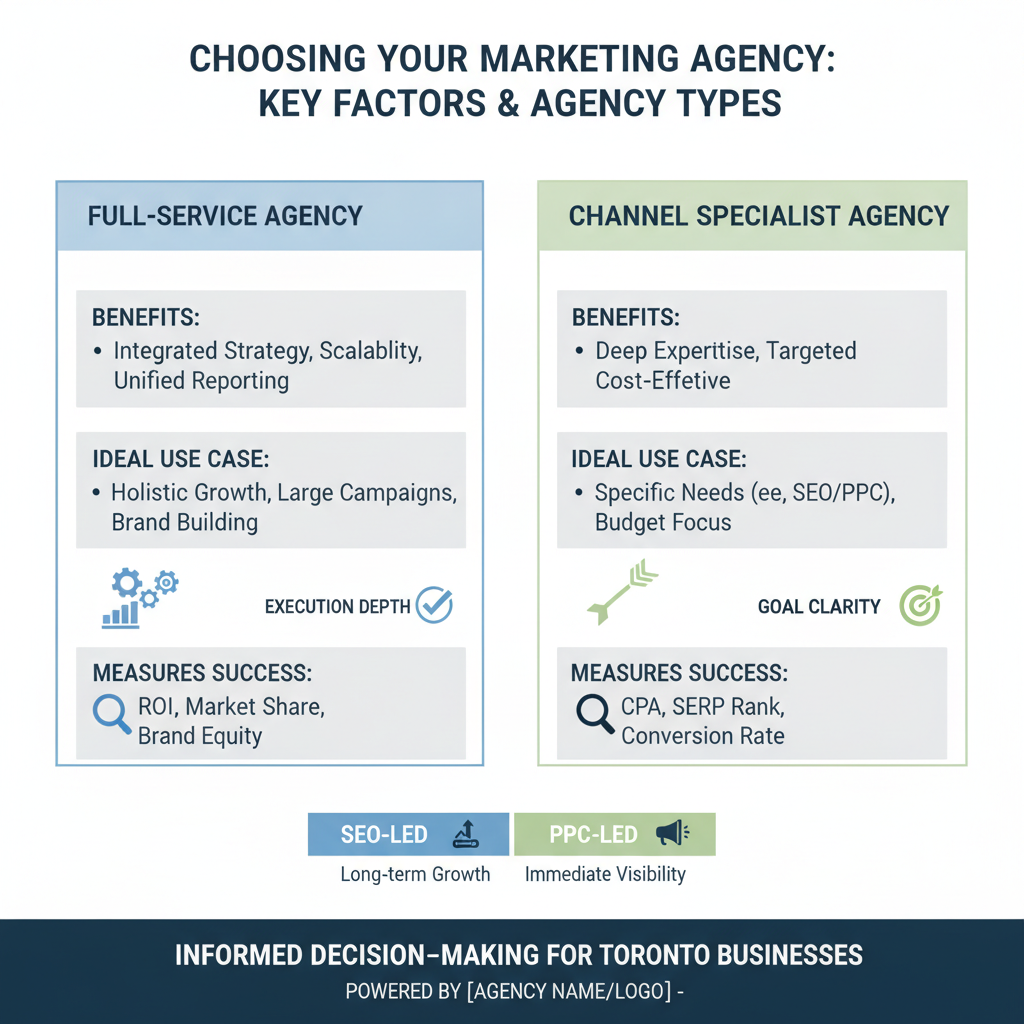
Comparing agency types helps narrow the field
Not every agency is built for the same kind of client. The best marketing agencies are often the best for a specific scenario, not for every scenario.
Service scope
Full-service agency: A full-service team covers multiple channels under one plan.
- How it works: SEO, PPC, website design toronto support, content, and reporting are coordinated through one strategy.
- Best fit: Businesses that want one partner to manage several moving parts and connect traffic growth to lead flow.
- Example: A B2B firm needing content marketing toronto support, conversion rate optimization toronto work, and analytics cleanup.
Channel specialist: A specialist focuses deeply on one discipline.
- How it works: The agency concentrates on one area such as seo services toronto or google ads management toronto.
- Best fit: Businesses with a clear bottleneck in one channel and internal support elsewhere.
- Example: A company with an in-house site team but weak organic rankings hiring a technical seo services partner.
Creative-first shop: A creative-led firm prioritizes branding, visuals, and messaging.
- How it works: Design, campaign concepts, and creative assets lead the project, sometimes ahead of direct-response structure.
- Best fit: Brands preparing a repositioning effort or a visual refresh before scaling media spend.
- Example: A consumer brand rebuilding its message before launching broader online marketing toronto campaigns.
Lead generation approach
SEO-led agency: An SEO-led partner focuses on organic demand capture.
- How it works: The team improves technical structure, local search marketing, content, and authority signals over time.
- Best fit: Businesses that want durable lead flow and can wait for compounding returns.
- Example: A contractor building visibility across Toronto, Ontario and surrounding service areas.
PPC-led agency: A PPC agency focuses on faster testing and faster traffic.
- How it works: Campaigns target high-intent searches, supported by landing pages, negatives, and conversion tracking.
- Best fit: Businesses entering a new market, validating offer demand, or needing immediate inquiry volume.
- Example: A clinic using a ppc agency toronto partner to test service demand by treatment line.
Hybrid performance agency: A hybrid team blends both for balance.
- How it works: Paid search drives near-term traffic while organic work builds lower-cost acquisition over time.
- Best fit: Companies that need short-term results without giving up long-term search visibility.
- Example: A local service business pairing search engine marketing sem with local SEO and landing page testing.
Build and measurement capability
Media-only agency: Some firms run ads or SEO but do not touch the website.
- How it works: The agency drives traffic while another vendor manages development and CRO changes.
- Best fit: Companies with a strong in-house web team.
- Example: A software company whose internal product marketing team handles pages and forms.
Performance and web agency: These agencies combine acquisition and site improvements.
- How it works: Traffic strategy, landing pages, technical fixes, and conversion testing happen under one workflow.
- Best fit: Businesses whose lead volume is limited by both visibility and page performance.
- Example: A service business that needs faster pages, better calls to action, and stronger paid search structure.
Reporting-first consultancy: Some teams are strongest in measurement and oversight.
- How it works: They audit channels, set dashboards, validate attribution, and guide vendor decisions.
- Best fit: Firms already spending on media but unsure which efforts are actually producing revenue.
- Example: A multi-location brand fixing analytics and tracking setup before increasing budget.
How to choose the right digital marketing agency
Start with the business problem, not the channel. If the problem is weak lead quality, more traffic may not help. If the problem is low search visibility, a brand campaign may not help. If the problem is poor conversion on a high-traffic page, the priority may be CRO rather than acquisition. A good agency conversation should begin with those distinctions.
It also helps to ask a few direct questions. How will success be measured in the first ninety days? What work is handled in-house versus outsourced? What assumptions are you making about our market? Those questions reveal whether the agency is thinking clearly or pitching from a template.
For businesses comparing proposals, these checkpoints usually make the decision easier:
- Goal clarity: The agency should define whether the campaign is built for calls, forms, booked consultations, e-commerce sales, or a mix of outcomes.
- Channel fit: The recommendation should explain why SEO, paid search, local search marketing, or content is the right starting point.
- Tracking quality: Conversion tracking, GA4 setup, and dashboard visibility should be discussed before performance claims are made.
- Execution depth: Strong plans usually include landing page work, technical fixes, and testing, not just media buying.
- Communication style: Straight answers and plain-language reporting are often a better sign than polished jargon.
What impacts ROI in modern digital campaigns
Return on investment is usually shaped by a handful of connected factors rather than one big lever. Traffic quality is one. Offer clarity is another. Conversion rate, page speed, sales follow-up time, tracking accuracy, and geographic targeting all influence whether a campaign becomes efficient or expensive.
A simple comparison helps here: two companies can spend the same amount on paid search, yet one turns traffic into qualified calls because its landing page is specific, loads quickly, and routes leads well. The other sends traffic to a generic page and records only partial conversions. Same spend. Different operational setup. Very different outcome.
Agencies that improve ROI tend to work on the system around the ads and rankings, not just the ads and rankings themselves. That often includes conversion optimization, better call tracking, cleaner keyword intent mapping, and page content aligned to what buyers are actually searching.
- Search intent alignment: Queries tied to buying or booking behaviour usually perform differently from broad research terms.
- Landing page relevance: A focused page often outperforms a general service page because it reduces friction.
- Tracking accuracy: If form fills, calls, or offline closes are not measured properly, budget decisions become guesswork.
- Follow-up speed: Leads that sit too long often lose value, especially in competitive local markets.
SEO vs PPC: when to use each strategy
SEO and PPC solve different timing problems. SEO is usually better for long-term visibility, lower incremental traffic costs, and broader search coverage across service and informational intent. PPC is usually better for immediate testing, quick visibility, and precise control over commercial search terms.
If a business has little search presence and needs leads quickly, paid search can create useful short-term demand data. If the same business also wants to reduce dependency on ongoing ad spend, search engine optimization should be built in alongside paid campaigns. That is often the more stable path.
The better question is not which one is superior. It is which one solves the next business problem. A new service launch may call for PPC first. A mature business with rising ad costs may need stronger organic acquisition. In many cases, the strongest agencies recommend sequencing rather than choosing one side permanently.
- Use SEO first: When the site has strong service depth, the business can wait for momentum, and organic visibility is currently underdeveloped.
- Use PPC first: When speed matters, search demand needs validation, or the business is entering a new category.
- Use both together: When short-term lead generation and long-term acquisition efficiency both matter to the business.
How local businesses in Toronto can compete online
For local businesses in Toronto, Ontario, the competitive edge often comes from sharper relevance rather than bigger budgets. A smaller company can still win visibility by building focused service pages, improving Google Business Profile signals, tightening conversion paths, and publishing content that reflects real search intent in the markets it serves.
Neighbourhood and service-area differences also matter. Search behaviour can shift between downtown Toronto, North York, Scarborough, Markham, and Vaughan depending on service type and urgency. A business that serves the GTA should not rely on a single generic page if customers search in more specific ways.
Local competition also rewards operational discipline. Consistent reviews, accurate service information, fast mobile pages, and strong location relevance can outperform flashy campaigns that do not address buyer intent. That is one reason local seo gta and google business profile optimization often play such a large role in lead generation for service-based companies.
- Build service-area relevance: Content should reflect how customers actually search across Toronto and surrounding communities.
- Improve local conversion signals: Clear calls, trust markers, and mobile usability support more enquiries.
- Track lead sources properly: Businesses need to know whether SEO, PPC, maps, or referral traffic is driving qualified demand.
- Support rankings with site quality: Technical SEO, structured content, and page speed still influence local performance.
Behind the scenes, agency quality shows up in the process
Most business owners do not need a deep technical education. They do, however, need enough clarity to spot weak process. If an agency cannot explain how it audits current performance, prioritizes work, and validates results, the relationship may turn into vague monthly activity rather than useful progress.
In practical terms, the best marketing agencies usually show a few consistent habits. They define conversion goals early. They separate traffic growth from lead quality. They talk about implementation, not just strategy. And they are comfortable pointing out limits, such as a weak offer, a slow website, or a tracking gap that needs attention before scaling media.
That tends to produce better working relationships. Expectations are clearer. Reports mean something. Adjustments happen faster. For a business owner, that is often more valuable than a polished pitch deck.
FAQs About best marketing agencies
A strong agency ties work to specific outcomes such as qualified calls, form submissions, booked meetings, or online sales. Reporting should connect campaign actions to those outcomes, not just impressions, clicks, or ranking screenshots.
That depends on the bottleneck. In Toronto, Ontario, a specialist can be useful if one channel is clearly underperforming. A full-service team is often a better fit when SEO, PPC, web changes, and tracking all need to work together.
Ask how success will be measured, what work is done in-house, what assumptions the agency is making about your market, and how often strategy changes are reviewed. Clear answers usually indicate a more disciplined process.
Yes, often for different reasons. Paid ads can produce immediate demand, while SEO can improve long-term visibility and reduce reliance on media spend. Many businesses in Toronto, Ontario use both together to balance speed and durability.
Local fit usually comes from strong search intent mapping, service-area content, Google Business Profile work, landing page quality, and accurate conversion tracking. Agencies that understand those details are typically better equipped to support local growth.
A practical final takeaway
The best marketing agencies are not defined by broad claims or oversized service lists. They are defined by fit, clarity, and execution. If an agency can explain your growth problem clearly, connect the right channels to that problem, and show how performance will be measured, you are already in a better position to make a sound decision.
For businesses that want tailored advice on SEO, PPC, CRO, web improvements, or lead generation strategy, Zigma Internet Marketing brings Google Partner-certified expertise, full-service delivery, and KPI-focused reporting across campaigns and websites. Reach out if you’d like tailored advice through a Book a Free Strategy Call.